
Pulp Fiction, 1877 · page 22 of 40
Beadle's New York Dime Library, Vol. II, No. 15 — page 22: what you’re looking at
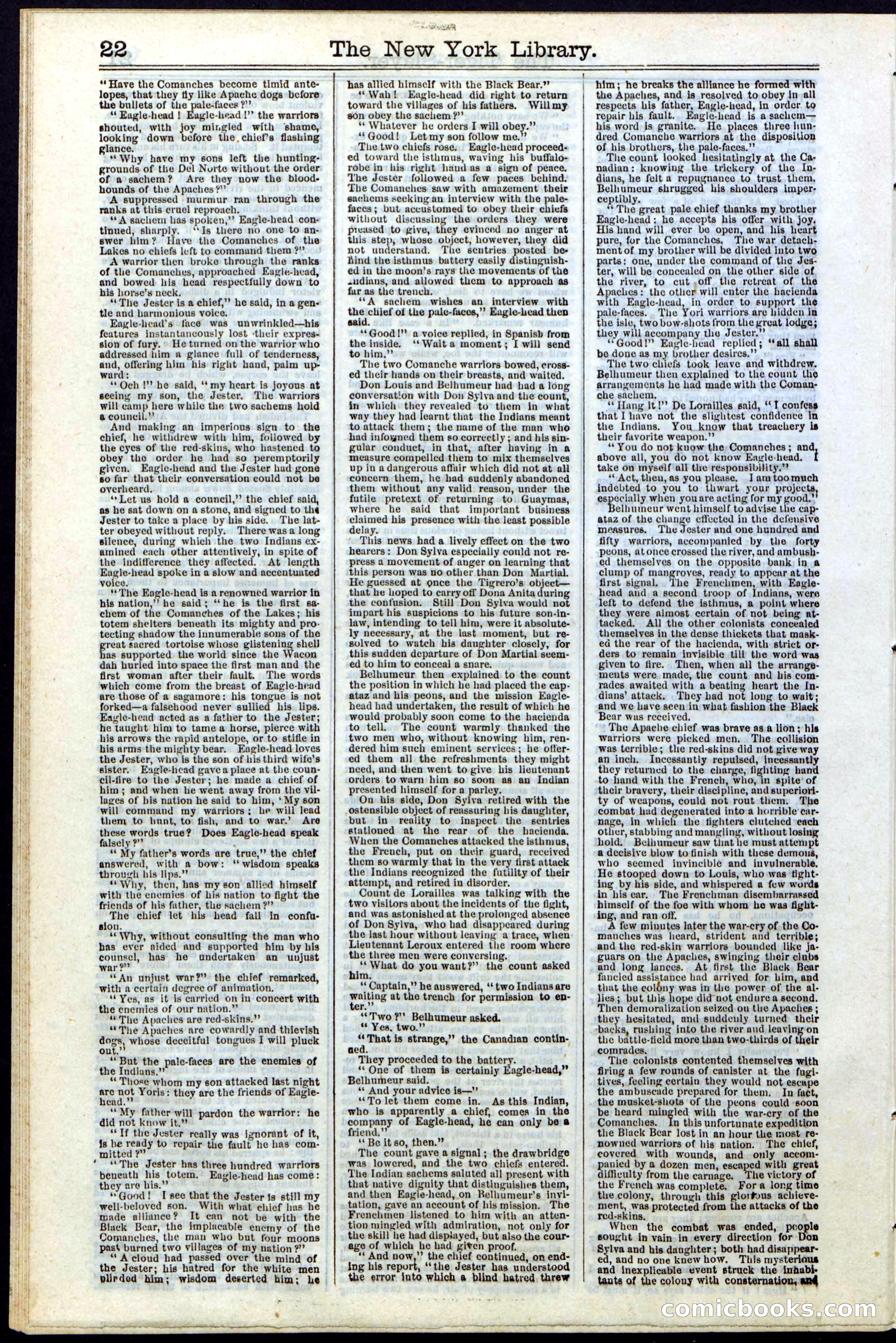
A restored page from Pulp Fiction, 1877. Page through the whole issue in the reader above.
📄 Transcribed text from this page (OCR, searchable)
Machine-transcribed from the original scan — historical spelling and the odd misread are preserved.
— s~ — ~ ee ee ene ee ee Oe s—.smr % . 3 a..5 -s — . ~~ . ae. ee a2 The New . York Library. ‘Have the Comanches become timid ante- lopes, that they tly like Apache dogs before the bullets of the pale-faces ?”’ “ Eagle-head | Eagle-head !’’ the warriors shouted, with joy mingled with shame, looking down before the, chief's flashing glance. *“*Why have my sons left the hunting- grounds of the Del Nurte without the order of a sachem? Are they now the blood- hounds of the Apaches ?”’ . A suppressed murmur ran through the ranks at this cruel reproach. ** A sachem has spoken,’’ Eagle-head con- tinued, sharply. ‘‘Is there no one to an- swer him? Have the Comanches of the Lakes no chiefs left to command them ?” A warrior then broke through the ranks of the Comanches, approached Eagle-head, and bowed his head respectfully down to his horse’s neck. “The Jester is a chief,” he said, in a gen- tle and harmonious voice. Eagle-head’s face was unwrinkled—his features instantancously lost their expres- sion of fury.’ He turned on the warrior who addressed him a glance full of tenderness, and, offering him his right hand, palm up- ward: **Och !’’ he said, ‘‘my heart is joyous at seeing my son, the Jester. The warriors will camp here while the two sachems hold @ council.” And making an imperious sign to the chief, he withdrew with him, followed by the cyes of the red-skins, who hastened to obey the order he had so peremptorily given. Eagic-head and the Jester had gone so far that their conversation could not be overheard. ‘*Let us hold a council,’’ the chief said, as he sat down on a stone, and signed to the Jester to take a place by his side. The lat- ter obeyed without reply. There wasa long silence, during which the two Indians ex- amined each other attentively, in spite of the indifference they affected. At length Eagle-head spoke in a slow and accentuated voice. **The Eagle-head is a renowned warrior in his nation,’’ he said; “‘he is the first sa- chem of the Comanches of the Lakes; his totem shelters beneath its mighty and pro. tecting shadow the innumerable sons of the reat sacred tortoise whose glistening shel as rt ep the world since the Wacon dah hurled into space the first man and the first woman after their fault. The words which come from the breast of Eagle-head are those of a sagamore: his tongue is not forked—a falsehood never sullied his lips. Eayle-head acted as a father to the Jester; he taught him to tame a horse, pierce with his arrows the rapid antelope, or to stifle in his arms the mighty bear. Eagle-head loves the Jester, who is the son of his third wife’s sister. Eagle-head gavea place at the coun- cil-fire to the Jester; he made a chief of him; and when he went away from the vil- lages of bis nation he said to him, ‘My son will command my warriors; be will lead them to hunt, to fish, and to war.’ Are these words true? Does Eagle-head speak falsely ?”’ ‘* My father’s words are true,’’ the chief answered, with a bow: “ wisdom speaks through his lips.” “Why, then, has my son allied himself with the enemies of his nation to fight the friends of his father, the sachem ?” The chief let his head fall in confua- sion. ‘““Why, without consulting the man who bas ever aided and supported him by his counsel, has he undertaken an unjust war?” ‘An unjust war?” the chief remarked, with a certain degree of animation. ‘Yes, as it is carried on in concert with the enemies of our nation.” “The Apaches are red-skins,”’ “The Apaches are cowardly and thievish anes, whose deceitful tongues I will pluck out. ‘“‘But the pale-faces are the enemies of the Indians.” “Those whom my son attacked last night are not Yoris: they are the friends of Eagle- head.” ‘My father will pardon the warrior: he did not know it.” ‘If the Jester really was ignorant of it, fs he ready to repair the fault he has com- mitted ?” “The Jester has three hundred warriors beneath his totem. Eayvle-head has come: they are his.” ‘Good! I see that the Jester is still my well-beloved son. With what ehief has he made alliance? It can not be with the Black Bear, the implacable enemy of the Comanches, the mau who but four moons past burned two villages of my nation ?”’ “A cloud had passed over the mind of the Jester; his hatred for the white men vlirded him; wisdom deserted him; he has allied himself with the Black Bear.” “Wah! Eagle-head did right to return toward the villages of his fathers. Willmy gon obey the sachem ?”’ ** Whatever he orders I will obey.” “Good! Letmy son follow me.” The two chiefs rose. Eagle-head proceed- ed toward the isthmus, waving his buffalo- robe in his right haud as a sign of peace. The Jester followed a few paces behind. The Comanches saw with amazement their sachems secking an interview with the pale- faces; but accustomed to obcy their chiefs without eta the orders they were pivased to give, they evinced no anger at this step, whose object, however, they did not understand. The sentries posted be- hind the isthmus battery easily distinguish- ed in the moon’s rays the movements of the -udians, and allowed them to approach as fur as the trench. “A sachem wishes an interview with ae chief of the pale-faces,’’? Eagle-head then **Good!” a voice replied, in Spanish from the inside. ‘*Waita moment; I will send to him,”’ The two Comanche warriors bowed, cross- ed their hands on their breasts, and waited. Don Louis and Belhumeur had had a long conversation with Don Sylvaand the count, in which ee revealed to them in what way they had learnt that the Indians meant to attack them; the name of the man who had infoxgned them so correctly ; and his sin- gular conduct, in that, after having in a measure compelled them to mix themselves up in a dangerous affair which did not at all concern them, he had suddenly abandoned them without any valid reason, under the futile pretext of returning to Guaymas, where he said that important business re ein his presence with the least possible elay. This news had a lively effect on the two hearers: Don Sylva especially could not re- press a movement of anger on learning that this person was no other than Don Martial. He guessed at once the Tigrero’s object— that he hoped to carry off Dona Anita durin the confusion. Still Don Sylva would no impart his suspicions to his future son-in- law, intending to tell him, were it absolute- ly necessury, at the last moment, but re- solved to watch his daughter closely, for this sudden departure of Don Martial seem- ed to him to conceal a snare. Belhumeur then explained to the count the position in which he had placed the cap- ataz and his peons, and the mission Eagle- head had undertaken, the result of which he would probably soon come to the hacienda to tell. The count warmly thanked the two men who, without knowing him, ren- dered him such eminent services; he offer- ed them all the refreshments they might need, and then went to give his lieutenant orders to warn him so soon as an Indian presented himself for a parley. On his side, Don Sylva retired with the ostensible object of reassuring his daughter, but in reality to inspect the sentries stationed at the rear of the hacienda. When the Comanches attacked the isthmus the French, put on their guard, received them so warmly that in the very first attack the Indians recognized the futility of their attempt, and retired in disorder. Count de Lorailles was talking with the two visitors about the incidents of the fight, and was astonished at the prolonged absence of Don Sylva, who bad disappeared during the last hour without leaving a trace, when Lieutenant Leroux entered the room where the three men were conversing. ** What do you want?” the count asked m, ** Captain,” he answered, ‘‘ two Indians are ae at the trench for permission to en- r ’ ‘“Two ?’ Belhumeur asked, * Yes, two.” — is strange,”’ the Canadian contin- aed. They proceeded to the battery. ** One of them is certainly Bagle-head,” Belhumeur said. *“* And your advice is—"’ “To let them come in. As this Indian, who is apparently a chief, comes in the company of Eagle-head, he can only be @ friend,’’ ** Be it so, then.” The count gave a signal; the drawbridge was lowered, and the two chiefs entered. The Indian sachems saluted all present with that native dignity that distinguishes them, and then Eagle-head, on Belhumeur’s invi- tation, gave an account of his mission. The Frenchmen listened to him with an atten- tion mingled with admiration, not only for the skill he had displayed, but also the cour- age of which he had given proof, ‘** And now,”’ the chief continued, on end- ing his report, “the Jester has understood the error into which a blind hatred threw him; he breaks the alliance he formed with the Apaches, and is resolved to obey in all respects his father, Eagle-head, in order to repair his fault. Eagle-head is a saclhem— his word is granite. He places three hun- dred Comanche warriors at the disposition of his brothers, the pale-faces,”’ The count looked hesitatingly at the Ca- nadian: knowing the trickery of the In- dians, he felt a repugnance to trust them, Belhumeur shrugged his shoulders imper- ceptibly. ‘** The great pale chief thanks my brother Eagle-head; he accepts his offer with joy. His hand will ever be open, and his heart pure, for the Comanches, The war detach- mentof my brother will be divided into two parts; one, under the command of the Jes- ter, will be concealed on the other side of the river, to cutoff the retreat of the Apaches: the otlier will enter the hacienda with Eagle-head, in order to support the pale-faces. The Yori warriors are hidden in the isle, two bow-shots from the great lodge; they will accompany the Jester.” **Good!” Eagle-head replied; “all shall be done as my brother desires,” The two chiefs took leave and withdrew. Belhumeur then explained to the count the arrangements he had made with the Coman- che sachem, ‘‘ Hang itl’? De Lorailles said, ‘I confess that I have not the slightest confidence in the Indians. You know that treachery is their favorite weapon.”’ ** You do not know the: Comanches; and above all, you do not know Eagle-head. I take on myself all the responsibility.” ‘* Act, then, as you please, I amtoomuch indebted to you to thwart your projects, especially when youare acting for my good.’ elhuimeur went himself to advise the cap- ataz of the change effected in the defensive measures. The Jester and one hundred and fifty warriors, accompanied by the forty peons, atonce crossed the river, and ambusbh- ed themselves on the opposite bank in a clump of mangroves, ready to appear at the first signal. The Frenclimen, with Eagle- head and a second troop of Indians, were left to defend the isthmus, a point where they were almost certain of not being at- tacked. All the other colonists concealed themselves in the dense thickets that mask- ed the rear of the hacienda, with strict or- ders to remain invisible till the word was given to fire. Then, when all the urrange- ments were made, the count and his com- rades awaited with a beating heart the [n- dians’ attack. They had not long to wait; and we have seen in what fashion the Black Bear wus received, The Apache chief was brave as a lion; his warriors were picked men. The collision was terrible; the red-skins did not give way an inch. Incessantly repulsed, incessantly they returned to the charge, my, tigre hand to hand with the French, who, in spite’ of their bravery, their discipline, and superiori- ty of weapons, could not rout them. The combat had degenerated into a horrible ear- nage, in which the fighters clutched each other, stabbing and mangling, without losin hold. Beilhumeur saw that be must attemp a decisive blow to finish with these demous, who scemed invincible and invulnerable, He stooped down to Louis, who was fight- ing by his side, and whispered a few words in his ear. The Frenchman disembarrassed himself of the foe with whom be was fight- ing, and ran off, few minutes later the war-cry of the Co- manches was heard, strident and terrible; and the red-skin warriors bounded like ja- guars on the Apaches, swinging their clubs and long lances. At first the Black Bear fancied assistance had arrived for him, and that the eollny was in the power of the al- lies; but this hope did not endure a second. Then demoralization seized ou the Apaches ; they hesitated, and suddeuly turned their ‘backs, rushing into the river and leaving-on the battle-tield more than two-thirds of their comrades, The colonists contented themselves with firing a few rounds of canister at the fugi- tives, feeling certain they would not escape the ambuscade prepared for them, In faet, the musket-shots of the peons could soon be heard mingled with the war-ery of the Comanches. In this unfortunate expedition the Black Bear lost in an hour the most re- nowned warriors of his nation. The chief, covered with wounds, and only accom- ee by a dozen men, escaped with great ifficulty from the carnage. _The victory of the French was complete. Fora long time the colony, through this glorfous achieve- ment, was protected from the attacks of the red-skins., A When the combat was ended, = sought in vain in every direction for Don Sylva and his daughter; both had disappear- ed, and no one knew how. This mysterious and inexplicable event struck the imhabi- tants of the colouy with consternation, and _—-—-~ 2. 2st 2x * “: fare te eS GOmiGcbookscom:, * . ~ Se tt i Rg RR AF LY LALO A RO” esse ss oo ‘ : bs oy ee = - — = =