
Pulp Fiction, 1877 · page 7 of 28
Beadle's Dime Library, Vol. II, No. 14 — page 7: what you’re looking at
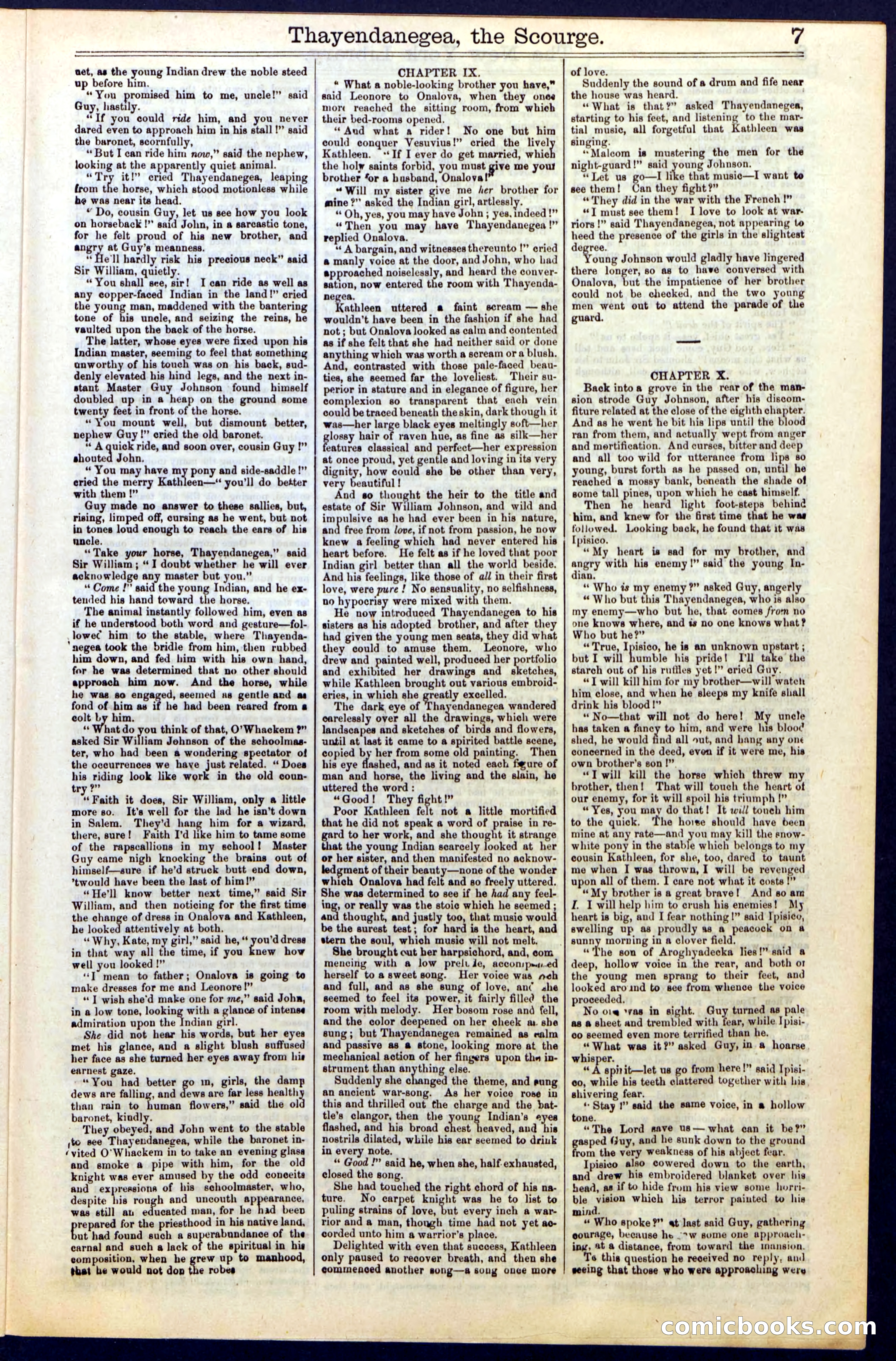
A restored page from Pulp Fiction, 1877. Page through the whole issue in the reader above.
📄 Transcribed text from this page (OCR, searchable)
Machine-transcribed from the original scan — historical spelling and the odd misread are preserved.
ie es net, as the young Indian drew the noble steed up before him. “You promised him to me, uncle!” said Guy, hastily. “Tf you could ride him, and you never dared even to approach him in his stall !’”” said the baronet, scornfully, “But I can ride him now,” said the nephew, looking at the apparently quiet animal. “Try it!” cried Thayendanegea, leaping from the horse, which stood motionless while be was near its head. “ Do, cousin Guy, let us see how you look on horseback !’" said John, in a sarcastic tone, for he felt proud of his new brother, and angry at Guy’s meanness. ‘He'll hardly risk his precious neck” said Sir William, quietly. “You shall see, sir! I can ride as well as any copper-faced Indian in the land!” cried the young man, maddened with the bantering tone of his uncle, and seizing the reins, he vaulted upon the back of the horse. The latter, whose eyes were fixed upon his Indian master, seeming to feel that something unworthy of his touch was on his back, sud- denly elevated his hind legs, and the next in- stant Master Guy Johnson found himeelf doubled up in a heap on the ground some twenty feet in front of the horse. “You mount well, but dismount better, nephew Guy!” cried the old baronet. “ A quick ride, and soon over, cousin Guy !” shouted John, “You may have my pony and side-saddle!” cried the merry Kathleen—*“ you'll do better with them !” Guy made no answer to these sallies, but, rising, limped off, cursing as he went, but not in tones loud enough to reach the ears of his uncle. “Take your horse, Thayendanegea,” said Sir William; “I doubt whether he will ever acknowledge any master but you.” “Come !" said the young Indian, and he ex- tended his hand toward the horse, The animal instantly followed him, even as if he understood both word and gesture—fol- lowec him to the stable, where Thayenda- ‘negea took the bridle from him, then rubbed him down, and fed him with his own hand, for he was determined that no other should approach him now. And the horse, while he was so engaged, seemed us gentle and as fond of him as if he had been reared from a pee him. ‘* What do you think of that, O'Whackem ?” asked Sir William Johnson of the schoolmas- ter, who had been a wondering spectator of the occurrences we haye just related. “ Does his riding look like work in the old coun- try ?” “Faith it does, Sir William, only a little more so. It's well for the lad he isn’t down in Salem. They’d hang him for a wizard, there, sure! Faith I'd like him to tame some of the rapscallions in my school! Master Guy came nigh knocking the brains out of himself—sure if he’d struck butt end down, ’twould have been the last of him!” “He'll know better next time,” said Sir William, and then noticing for the first time the change of dress in Onalova and Kathleen, he looked attentively at both. “Why, Kate, my girl,” said he, “ ou’d drese in that way all the time, if you knew how well you looked !” “T mean to father; Onalova is going to make dresses for me and Leonore !” “I wish she'd make one for me,” said John, in a low tone, looking with a glance of intense admiration upon the Indian girl. She did not hear his words, but her eyes met his glance, and a slight blush suffused her face as she turned her eyes away from his earnest gaze. “You had better go m, girls, the damp dews are falling, and dews are far less health than rain to human flowers,” said the ol baronet, kindly. They obeyed, and John went to the stable jto see Thayendanegea, while the baronet in- ‘vited O'Whackem in to take an evening glasa and smoke a pipe with him, for the old knight was ever amused by the odd coneeits and expreasiona of his schoolmaster, who, despite his rough and uncouth appearance, was still aun educated man, for he had beep repared for the priesthood in his native land, bot had found such a superabundance of the earnal and such a lack of the spiritual in his composition, when he grew up to manhood, that he would not don the robes CHAPTER IX. “ What a noble-looking brother you have,” said Leonore to Onualova, when they onee mor reached the sitting room, from which their bed-rooms opened. “Aud what a rider! No one but him could conquer Vesuvius!” cried the livel Kathleen. “If I ever do get married, whieh the holy saints forbid, you must give me your brother ‘or a husband, Onalova! “Will my sister give me fer brother for mine ?” asked the Aohe girl, artlessly. “ Oh, yes, you may have John; yes, indeed !” “Then you may have Thayendanegea !” replied Onalova. “ A bargain, and witnesses thereunto !” cried a manly voice at the door, and John, who had approached noiselessly, and heard the conver- sation, now entered the room with Thayenda- negea. Kathleen uttered a faint ecream — she wouldn't have been in the fashion if she had not ; but Onalova looked as calm and contented as if she felt that she had neither said or done anything which was worth a scream ora blush, And, contrasted with those pale-faced beau- ties, she seemed far the loveliest. Their su- perior in stature and in elegance of figure, her complexion so transparent that each vein could be traced beneath the skin, dark though it was—her large black eyes meltingly soft—her plosey hair of raven hue, as fine as silk—her eatures classical and perfect—her expression at once proud, yet gentle and loving in its very dignity, how could she be other than very, very beautiful ! And so thought the heir to the title and estate of Sir William Johnson, and wild and inputs as he had ever been in his nature, and free from Jove, if not from passion, he now knew a feeling which had never entered his heart before. He felt as if he loved that poor Indian girl better than all the world beside. And his feelings, like those of all in their first love, were pure ! No sensuality, no selfishness, no hypocrisy were mixed with them. He now introduced Thayendanegea to his sisters as his adopted brother, and after they had given the young men seats, they did what they could to amuse them. Leonore, who drew and painted well, produced her portfolio and exhibited her drawings and sketches, while Kathleen brought out various embroid- eries, in which she greatly excelled. The dark eye of Thayendanegea wandered carelessly over all the drawings, which were landscapes and sketches of birds and flowers, until at last it came to a spirited battle scene, copied by her from some old wom’ Then his eye flashed, and as it noted each fure of man and horse, the living and the slain, he uttered the word : “Good! They fight!” Poor Kathleen felt not a little mortified that he did not speak a word of praise in re- gard to her work, and she thought it strange that the young Indian scarcely looked at her or her sister, and then manifested no acknow- ledgment of their beaut y—none of the wonder which Onalova had felt and so freely uttered. She was determined to see if he had any feel- ing, or really was the stoic which he seemed ; and thought, and justly too, that music would be the surest test; for hard is the heart, and stern the soul, which music will not melt. She brought out her harpsichord, and, com mencing with a low prelude, acconipes.ed herself to a sweet song. Her voice was neh and full, and as she sung of love, an¢ «she seemed to feel its power, it fairly filled the room with melody. Her bosom rose and fell, and the color deepened on her cheek a. she sung; but Thayendanegea remained as calm and passive as @ stone, looking more at the mechanical action of her fingers upon the in- strument than anything else. Suddenly she changed the theme, and eung an ancient war-song. As her yoice rose in this and thrilled out the charge and the bat- tle’s clangor, then the young Indian’s e flashed, and his broad BS eaved, and his nostrils dilated, while his ear seemed to drink in every note, “‘ Good !” said he, when she, half. exhausted, closed the song. She had touched the right chord of his na- ture. No carpet knight was he to list to puling strains of love, but every inch a war- rior and @ man, though time had not yet ac- corded unto him a warrior’s place. Delighted with even that success, Kathleen only paused to recover breath, and then she commenced another song—a song once more Thayendanegea, the Scourge. | 7 of love. Suddenly the sound of a drum and fife near the house was heard. “What is that?” asked Thayendanegea, starting to his feet, and listening to the mar- tial music, all forgetful that Kathleen was singing. “Malcom is mustering the men for the night-guard!” said young Johnson. “Let us go—l like that music—I want to see them! Can they fight?” “They did in the war with the French !” “JT must see them! I love to look at war- riors !” said Thayendanegea, not appearing to heed the presence of the girls in the slightest degree. oung Johnson would gladly have lingered there longer, so as to have conversed with Onalova, but the impatience of her brother could not be checked, and the two young men went out to attend the parade of the guard, CHAPTER X. Back into grove in the rear of the man- sion strode Guy Johnson, after his discom- fiture related at the close of the eighth chapter. And as he went he bit his lips until the blood ran from them, and actually wept from anger and mortification. And curses, bitter and deep and all too wild for utterance from lips 80 young, burst forth as he passed on, until he reached a mossy bank, beneath the shade of some tall pines, upon which he cast himself. Then he heard light foot-steps behind him, and knew for the first time that he was followed. Looking back, he found that it was [pisico. “My heart is sad for my brother, and angry with his enemy!” said the young In- ian, “Who is my enemy ?” asked Guy, angerly “Who but this Thayendanegea, who is also my enemy—who but he, that comes from no one knows where, and is no one knows what? Who but he?” “True, Ipisico, he is an unknown upstart ; but I will fiambis his pride! T'll take the starch out of his ruffles yet!” eried Guy. «J will kill him for my brother—will wateh him close, and when he sleeps my knife shall drink his blood!” “ No—that will not do here! My uncle has taken a fancy to him, and were his blood shed, he would find all out, and hang any one concerned in the deed, even if it were me, his own brother's gon !”, “T will kill the horse which threw my brother, then! That will touch the heart of our enemy, for it will spoil his triumph !” “Yes, you may do that! It will touch him to the quick. The hoise should have been mine at any rate—and you may kill the enow- white pony in the stable which belongs to my cousin Kathleen, for she, too, dared to taunt me when I was thrown, I will be revenged upon all of them. I care not what it costs !” “My brother is a great brave! And 80 am I. I will help him to crush his enemies! My heart is big, and I fear nothing!” said Ipisico, swelling up as proudly as a peacock on a | pe morning in a clover field, “ he son of Aroghyadecka lies!” said a deep, hollow voice in the rear, and both or the young men sprang to their feet, and looked around to see from whence the voice proceeded, atl | No ove ‘vas in sight. Guy turned as pale as @ sheet and trembled with fear, while I pisi- co seemed even more terrified than he, “What was it?” asked Guy, in a hoarse. whisper. “A spirit—let us go from here!” said Ipisi- co, while his teeth clattered together with his, shivering fear. ‘Stay 1” said the same voice, in a hollow tone. “The Lord save us— what can it be?” asped (Juy, and he sunk down to the ground rom the very weakness of his abject fear. — Ipisico also cowered down to the earth, and drew his embroidered blanket over his head, as if to hide from his view some horri- ble vision which his terror painted to his mind. “ Who spoke?” at last said Guy, gathering courage, because he “*w some one approach- ing, 2t a distance, from toward the inansion. 6 this question he received no reply, and seeing that those who were approaching were ‘S (E icomichboo