
Pulp Fiction, 1877 · page 8 of 28
Beadle's Dime Library, Vol. II, No. 14 — page 8: what you’re looking at
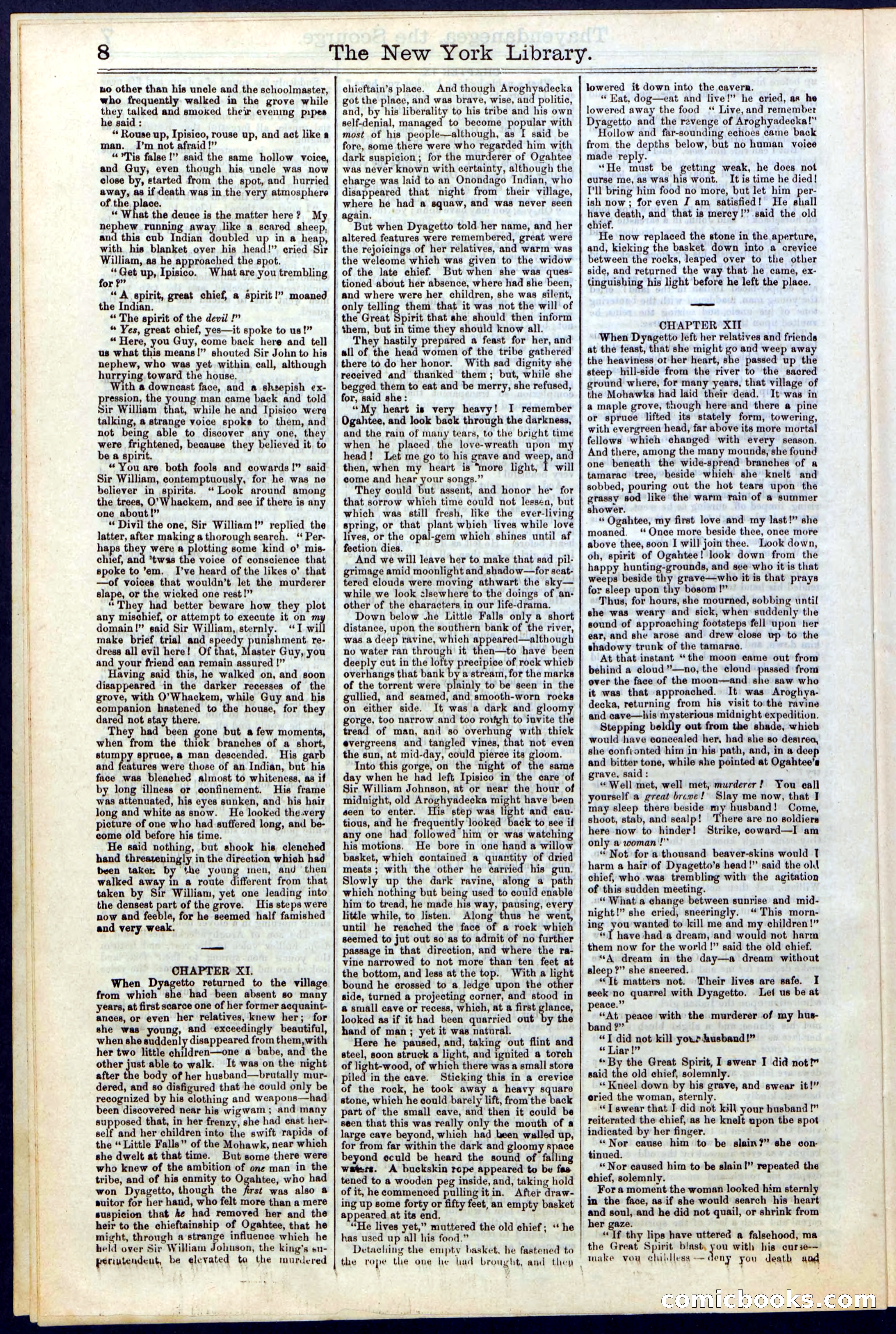
A restored page from Pulp Fiction, 1877. Page through the whole issue in the reader above.
📄 Transcribed text from this page (OCR, searchable)
Machine-transcribed from the original scan — historical spelling and the odd misread are preserved.
att ° een el eee ~~ a" ee en a eee ee PS a li eT _— ——— - —— =a - ——E- a a ——-- — ew we a _ 8 The New York Library. no other than his uncle and the schoolmaster, who frequently walked in the grove while they talked and smoked their evening pipes he said : “ Rouse up, Ipisico, rouse up, and act like a man. I’m not afraid!” “Tis false!’ said the same hollow voice, and Guy, even though his uncle was now close by, etarted from the spot, and hurried away, as if death was in the very atmosphere of the place. “ What the deuce is the matter here? My pepe running away like a scared sheep, and this cub Indian doubled up in a heap, with his blanket over his head!” cried Sir William, as he approached the spot. j ‘ae up, Ipisico. What are you trembling or? “A spirit, great chief, a Spirit!” moaned the Indian. “ The spirit of the devil !” “ Yes, great chief, yes—it spoke to us!” “ Here, you Guy, come back here and tell us what this means!” shouted Sir John to his nephew, who was yet within call, although hurrying toward the house. ith a downcast face, and a shsepish ex- Preneie the young man came back and told sir William that, while he and Ipisico were talking, a strange voice spoke to them, and not being able to discover any one, they were frightened, because they believed it to be a spirit. “You are both fools and cowards!” said Sir William, contemptuously, for he was ne believer in spirits. “ Look around among the trees, O'Whaekem, and see if there is any one about!” “ Divil the one, Sir William!” replied the latter, after making a thorough search. “ Per- haps ey were a plotting some kind o’ mis- chief, and *twas the voice of conscience that spoke to ’em. I’ve heard of the likes o’ that —of voices that wouldn’t let the murderer slape, or the wicked one rest!” “They had better beware how they plot any mischief, or attempt to execute it on m domain!” said Sir William, sternly. “I will make brief trial and speedy punishment. re- dress all evil here! Of that, Master Guy, you and your friend can remain assured !” Having said this, he walked on, and soon disappeared in the darker recesses of the grove, with O'Whackem, while Guy and his conprene hastened to the house, for they dared not stay there. They had been gone but a few moments, when from the thick branches of a short, stumpy spruce, a man descended. His garb and features were those of an Indian, but his face was bleached almost to whiteness, as if by long illness or confinement. His frame was attenuated, his eyes sunken, and his hair long and white as snow. He looked thesvery picture of one who had suffered long, and be- come old before his time. He said nothing, but shook his clenched hand threaveningly in the direction which had been taker by ‘the young men, and then walked away in a route different from that taken by Sir William, yet one leading into the densest part of the grove. His steps were now and feeble, for he seemed half famished and very weak. CHAPTER XI. When Dyagetto returned to the village from which she had been absent so many years, at first scarce one of her former aequaint- ances, or even her relatives, knew her; for she was young, and exceedingly beautiful, when she sudden! y disappeared from them,with her two little children—one a babe, and the other just able to walk. It was on the night after the body of her husband—brutally mur- dered, and so disfigured that he could only be recognized by his clothing and weapons—had been discovered near his wigwam ; and many supposed that, in her frenzy, she had east her- self and her children into the swift rapids of the “Little Falls” of the Mohawk, near which she dwelt at that time. But some there were who knew of the ambition of one man in the tribe, and of his enmity to Ogahtee, who had won Dyagetto, though the ye was also & suitor for her hand, who felt more than a mere suspicion that he had removed her and the heir to the chieftainship of Ogahtee, that he might, through a pee influenee which he held over Sir William Johnson, the king's su- periutendent, be elevated ta the murdered —_-s chieftain’s place. And though eH 1 hae got the place, and was brave, wise, and politic, and, by his liberality to his tribe and his own self-denial, managed to become popular with most of his people—although, as [ said be fore, some there were who regarded him with dark suspicion; for the murderer of Ogahtee was never known with certainty, although the charge was laid to an Onondago Indian, who disappeared that night from their village, where he had a equaw, and was never seen ain. But when Dyagetto told her name, and her altered features were remembered, great were the rejoicings of her relatives, and warm was the welcome which was given to the widow of the late chief. But when she was ques- tioned about her absence, where had she been, and where were her children, she was silent, only telling them that it was not the will of the Great Spirit that she should then inform them, but in time they should know all. They hastily prepared a feast for her, and all of the head women of the tribe gathered there to do her honor. With sad dignity she received and thanked them; but, while she begged them to eat and be merry, she refused, for, said she: “My heart is very heavy! I remember Ogahtee, and look back through the darkness, and the rain of many tears, to the bright time when he placed the love-wreath upon my head! Let me go to his grave and weep, and then, when my heart is “more light, I will come and hear your songs.” They could but assent, and honor he~ for that sorrow which time could not lessen, but which was still fresh, like the ever-living spring, or that per which lives while love lives, or the opal-gem which shines until af fection dies. And we will leave her to make that sad pil- grimage amid moonlight and shadow—for scat- tered clouds were moving athwart the sky— while we look slsewhere to the doings of an- other of the characters in our life-drama. Down below che Little Falls only a short distance, upon the southern bank of the river, was a deep ravine, which appeared—although no water ran through it then—to have been deeply cut in the lo v precipice of rock whicb overhangs that bank by a stream, for the marke of the torrent were plainly to be seen in the gullied, and seamed, and smooth-worn rocks on either side. It was a dark and gloomy gorge, too narrow and too rovfyh to invite the tread of man, and so overhung with thick evergreens and tangled vines, that not even the sun, at mid-day, could pierce its ea Into this gorge, on the night of the same day when he had left Ipisico in the care of Sir William Johnson, at or near the hour of midnight, old Aroghyadecka might have been seen to enter. His step was light and cau- tious, and he frequently looked back to see il any one had followed him or was watching his motions. He bore in one hand a willow basket, which contained a arcs of dried meats ; with the other he carried his gun. Slowly up the dark ravine, along a path which nothing but being used to could enable him to tread, he made his way, pausing, every little while, to listen. Along thus he went, until he reached the face of a rock which seemed to jut out so as to admit of no further passage in that direction, and where the ra- vine narrowed to not more than ten feet at the bottom, and less at the top. With a light bound he crossed to a ledge upon the other side, turned a projecting corner, and stood in a small cave or recess, which, at a first glance, looked as if it had been quarried out by the hand of man; yet it was natural. Here he paused, and, taking out flint and steel, soon struck a light, and ignited a torch of light-wood, of which there was a small store piled in the cave. Sticking this in a crevice of the rock, he took away a heavy square stone, which he could barely lift, from the back part of the small cave, and then it could be seen that this was really only the mouth of a large cave beyond, which had been walled up, for from far within the dark and gloomy space beyond eculd be heard the sound of falling waters. A buckskin rope appeared to be fas tened to a wouden peg inside, and, taking hold of it, he commenced pulling itin. After draw- ing up some forty or fifty feet, an empty basket appeared at its end. “He lives yet,” muttered the old chief; ‘‘ he has used up all his food.” Detaching the empty basket, he fastened to the rope the one he lad brought, and then, Sl see ti aeteetl lowered it down into the cavern. “ Eat, dog—eat and live!” he eried, as he lowered away the food ‘ Live, and remember Dyagetto and the revenge of Aroghyadecka!" Hollow and far-sounding echoes came back from the depths below, but no human voice made reply. “He must be getting weak, he does not curse me, as was his wont. It is time he died! I'll bring him food no more, but let him per- ish now; for even J am satisfied! He shall have death, and that is mercy!” said the old chief. He now replaced the stone in the aperture, and, kicking the basket down into a crevice between the rocks, leaped over to the other side, and returned the way that he came, ex- tinguishing his light before he left the place. CHAPTER XII When Dyagetto left her relatives and friends at the teast, that she might g° and weep away the heaviness or her heart, she passed up the steep hill-side from the river to the sacred ground where, for many years, that village of the Mohawks had laid their dead. It was in a maple grove, though here and there a pine or spruce lifted its stately form, towering, with evergreen head, far above its more mortal fellows which changed with every season. And there, among the many mounds, she found one beneath the wide-spread branches of a tamarac tree, beside which she knelt and sobbed, pouring out the hot tears upon the grassy sod like the warm rain of a summer shower. “ Ogahtee, my first love and my last!” she moaned. ‘“ Once more beside thee, once more above thee, soon I will join thee. Look down, oh, spirit of Ogahtee! look down from the happy hunting-grounds, and see who it is that weeps beside oa grave—who it is that prays for sleep upon thy bosom !” Thus, for hours, she mourned, sobbing until she was weary and sick, when suddenly the sound of approaching footsteps fell upon her ear, and she arose and drew close up to the shadowy trunk of the tamarac. At that instant “the moon eame out from behind a cloud ”—no, the cloud sed from over the face of the moon—and she saw who it was that approached. It was Aroghya- decka, returning from his visit tothe ravine and cave—his mysterious midnight expedition. Stepping beldly out from the shade, which would have concealed her, had she so desirea, she confronted him in his path, and, in a dee and bitter tone, while she pointed at Ogahtee’s grave, said: «“ Well met, well met, murderer! You eall yourself a great browe! Slay me now, that I may sleep there beside my husband! Come, shoot, stab, and sealp! here are no soldiers here now to hinder! Strike, coward—I am only a woman!" “ Not for a thousand beaver-skins would 1 harm a hair of Dyagetto’s head!” said the okt chief, who was trembling with the agitation of this sudden meeting. “ What a change between sunrise and mid- night!” she cried, sneeringly. “This morn- ing you wanted to kill me and my children!” “T have had a dream, and would not harm them now for the world !” said the old chief. “A dream in the day—a dream without sleep ?” she sneered. “Tt matters not. Their lives are safe. I seek no quarrel with Dyagetto. Let us be at peace.” “At peace with the murderer of my hus- band ?” “T did not kill your husband!” “ Liar!” fo By the Great Spirit, I swear I did not! said the old chief, solemnly. “‘Kneel down by his grave, and swear it!” cried the woman, sternly. “T swear that I did not kill your husband !” reiterated the chief, as he knelt upon tbe spot indicated by her finger. “Nor cause him to be slain?” she con- tinued. “Nor caused him to be slain!” repeated the chief, solemnly. For a moment the woman looked him sternly in the face, as if she would search his heart and soul, and he did not quail, or shrink from her ne “If thy lips have uttered a falsehood, ma the Great Spirit blast, you with his curse-— make vou childless deny you death aod Eomicbooks (E(o