
Pulp Fiction, 1877 · page 6 of 28
Beadle's Dime Library, Vol. II, No. 14 — page 6: what you’re looking at
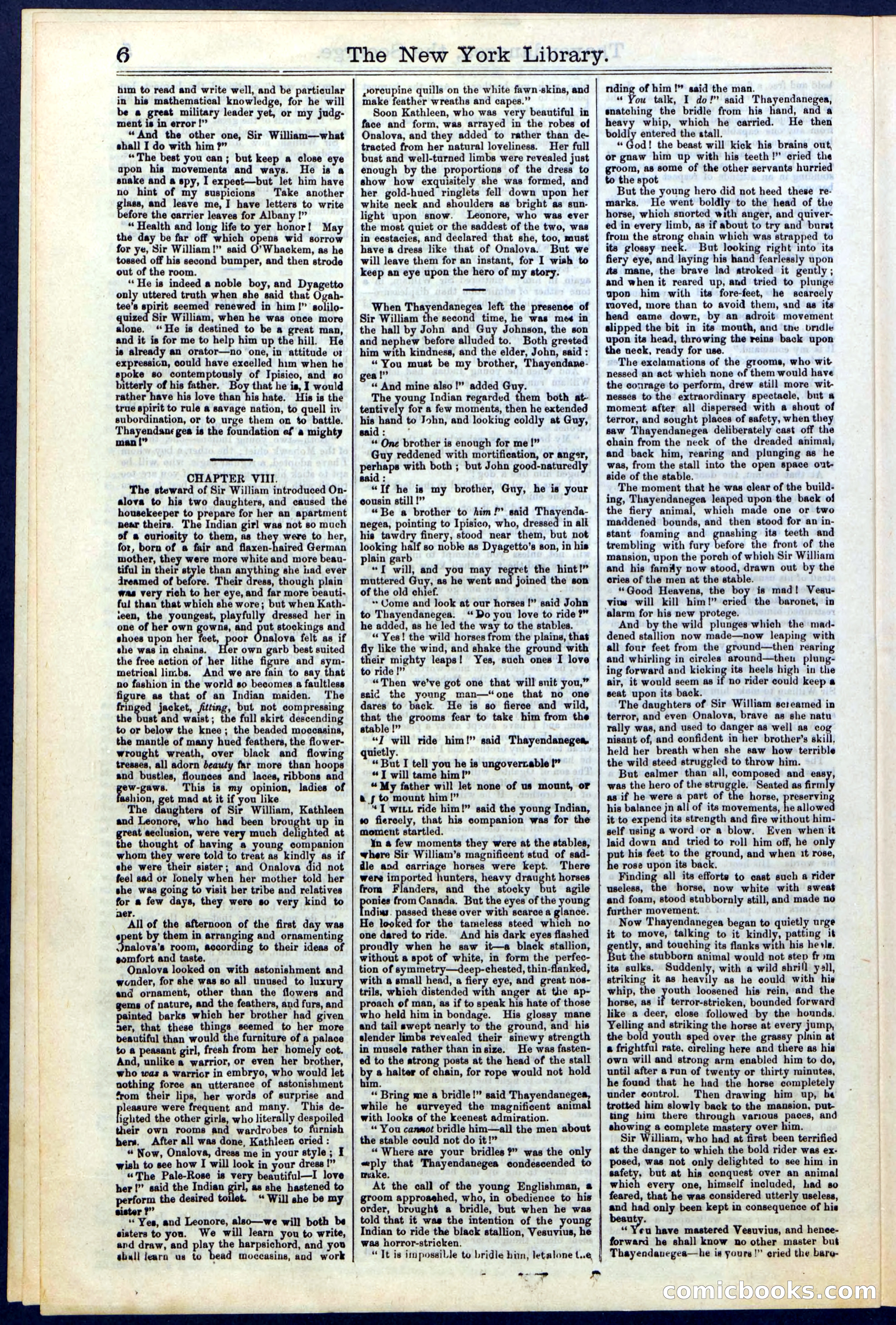
A restored page from Pulp Fiction, 1877. Page through the whole issue in the reader above.
📄 Transcribed text from this page (OCR, searchable)
Machine-transcribed from the original scan — historical spelling and the odd misread are preserved.
. 6 —_ The New York Library. him to read and write well, and be particular in his mathematical knowledge, for he will be a great military leader yet, or my judg- ment is in error!” “And the other one, Sir William—what shall I do with him ?” “The best you can; but keep a close eye apon his movements and ways. He is a snake and a spy, I expect—but let him have no hint of my suspicions Take another lass, and leave me, I have letters to write fore the carrier leaves for Albany !” “ Health and long life to yer honor! May the day be far off which opens wid sorrow for ye, Sir William!” said O'Whackem, as he tossed off his second bumper, and then strode out of the room. “He is indeed a noble boy, and Dyagetto only uttered truth when she said that Ogah- tee’s spirit seemed renewed in him!” solilo- q Sir William, when he was once more alone. “He is destined to be a great man, and it is for me to help him up the hill. He is already an orator—no one, in attitude ot expression, could have excelled him when he spoke so contemptously of Ipisico, and so bitterly of his father. Boy that he is, I would rather have his love than his hate. His is the true spirit to rule a savage nation, to quell in subordination, or to urge them on to battle. ens gea is the foundation ef a mighty man CHAPTER VIII. The steward of Sir William introduced On- alova to his two daughters, and caused the housekeeper to prepare for her an apartment near theirs. The Indian girl was not so much of a curiosity to them, as they were to her, for, born of a fair and flaxen-haired German mother, they were more white and more beau- tiful in their style than anything she Lad ever dreamed of before. Their dress, though plain was very rich to her eye, and far more beauti- ful than that which she wore; but when Kath- een, the youngest, playfully dressed her in one of her own gowns, and put stockings and shoes upon her feet, poor Onalova felt as if she was in chains. Her own garb best suited the free action of her lithe figure and sym- metrical limbs. And we are fain to say that no fashion in the world so becomes a faultless figure as that of an Indian maiden. The fringed jacket, fitting, but not compressing the bust and waist; the full skirt descending to or below the knee; the beaded moccasins, the mantle of many hued feathers, the flower- wrought wreath, over black and flowing treases, all adorn beauty far more than hoops and bustles, flounces and laces, ribbons and shed This is my opinion, ladies of ashion, ft mad at it if you like The daughters of Sir William, Kathleen and Leonore, who had been brought up in seclusion, were very much deligh t e thought of having a young companion whom they were told to treat as kindly as if she were their sister; and Onalova did not feel sad or Jonely when her mother told her she was going to visit her tribe and relatives for a few days, they were so very kind to ner. All of the afternoon of the first day was spent by them in arranging and ornamenting Jnalova’s room, according to their ideas of somfort and taste. Onalova looked on with astonishment and wonder, for she was so all unused to luxu and ornament, other than the flowers an of nature, and the feathers, and furs, and painted barks which her brother had given ner, that these things seemed to her more beautiful than would the furniture of a palace to a peasant girl, fresh from her oily’ act And, unlike a warrior, or even her brother, who was a warrior in embryo, who would let nothing force an utterance of astonishment from their lips, her words of surprise and leasure were frequent and a This de- fichted the other girls, who literally despoiled their own rooms and wardrobes to furnish hers. After all was done, Kathleen cried : “ Now, Onalova, dress me in your style; I wish to see how I will look in your dress !” “The Pale-Rose is very beautiful—I love her!’ said the Indian girl, as she hastened to perform the desired to “ Will she be my > r?’ “Yes, and Leonore, also—we will both be sisters to you. We will learn you to write, and draw, and play the harpsichord, and you shall learn us to bead moccasins, and work porcupine quills on the white fawn-skins, and make feather wreaths and capes.” Soon Kathleen, who was very beautiful in face and form, was arrayed in the robes of Onalova, and they added to rather than de- tracted from her natural loveliness. Her full bust and well-turned limbs were revealed just enough by the proportions of the dress to show how exquisitely she was formed, and her gold-hued ringlets fell down upon her white neck and shoulders as bright as sun- light upon snow. Leonore, who was ever the most quiet or the saddest of the two, was in eestacies, and declared that she, too, must have a dress like that of Onalova. But we will leave them for an instant, for I wish to keep an eye upon the hero of my story. When Thayendanegea left the presence of Sir William the second time, he was mee in the hall by John and Guy Johnson, the son and nephew before alluded to. Both greeted him with kindness, and the elder, John, said : “You must be my brother, Thayendane- ea |” ar And mine also!” added Guy. The young Indian regarded them both at- tentivel for a few moments, then he extended ors omy to John, and looking coldly at Guy, “* One brother is enough for me !” Guy reddened with mortification, or anger, ae ai with both ; but John good-naturedly said : “If he is my brother, Guy, he is your cousin still!” “Be a brother to him!’ said Thayenda- negea, pointing to Ipisico, who, dressed in alk his tawdry finery, stood near them, but not looking half so noble as Dyagetto’s son, in his plain garb “I will, and you may regret the hint!” muttered Guy, as he went and joined the son of the old chief. * Come and look at our horses !” said John to Thayendanegea. “Do you love to ride?” he added, as he led the way to the stables. “Yes! the wild horses from the plains, that fly like the wind, and shake the ground with their mighty leaps! Yes, such ones I love to ride !”” “Then we’ve got one that will snit you,” ssid the young man—“one that no one dares to back. He is so fierce and wild, that the grooms fear to take him from the stable !” “J will ride him!” said Thayendanegea, uietly. “But I tell you he is ungoverrable !” “T will tame him!” “My father will let none of us mount, or a s to mount him!” “I witt ride him!” said the young Indian, to fiercely, that his companion was for the moment startled. ¥n a few moments they were at the stables, where Sir William’s magnificent stud of sad- dle and carriage horses were kept. There were imported hunters, heavy draught horses from Flanders, and the stocky but agile ee from Canada. But the eyes of the young ndias. passed these over with scarce a glance. He looked for the tameless steed which no one dared to ride. And his dark eyes flashed proudly when he saw it—a black stallion, without a spot of white, in form the perfec- tion of symmetry—deep-chested, thin-flanked, with a small head, a fiery eye, and great nos- trils, which distended with anger at the ap- proach of man, as if to speak his hate of those who held him in bondage. His glossy mane and tail swept nearly to the ground, and his slender limbs revealed their sinewy strength in muscle rather than insize. He was fasten- ed to the atrong posts at the head of the stall by 8 halter of chain, for rope would not hold “ Bring me a bridle!” said Thayendanegea, while he surveyed the magnificent ani with looks of the keenest admiration. “ You cannot bridle him—all the men about the stable could not do it!” “ Where are your bridles ?” was the only ~ply that Thayendanegea condescended to make. At the call of the young Englishman, @ groom approaehed, who, in obedience to his order, brought a bridle, but when he was told that it was the intention of the young Indian to ride the black stallion, Vesuvius, he was horror-stricken. “Tt is imposaiLle to bridle hinn, letalone t..e ae Sy nding of him !” said the man. “You talk, I do!” said Thayendanegea, snatching the bridle from his hand, and a heavy whip, which he carried. He then boldly entered the stall. “God! the beast will kick his brains out, or gnaw him up with his teeth!” cried the groom, as some of the other servants hurried to the spot But the young hero did not heed these re- marks. He went boldly to the head of the horse, which snorted with anger, and quiver- ed in every limb, as if about to try and burst from the rect te chain which was strapped to its glossy neck. But looking right into its fiery eye, and laying his hand fearlessly upon its mane, the brave lad stroked it gently ; and when it reared up, and tried to plunge upon him with its fore-feet, he scarcely moved, more than to avoid them, and as its head came dowr, by an adroit movement slipped the bit in its mouth, and the vridle upon its head, throwing the reins back upon the neck, ready for use. The exclamations of the grooms, who wit nessed an act which none of them would have the courage to perform, drew still more wit nesses to the extraordinary spectacle, but a moment after all dispersed with a shout of terror, and sought places of safety, when they saw Thayendanegea deliberately cast off the chain from the neck of the dreaded animal, and back him, rearing and plunging as he was, from the stall into the open space out- side of the stable. The moment that he was clear of the build- ing, Thayendanegea leaped upon the back of the fiery animal, which made one or two maddened bounds, and then stood for an in- stant foaming and gnashing its teeth and trembling with fury before the front of the mansion, upon the poreh of which Sir William and his fam#y now stood, drawn out by the cries of the men at the stable. ‘Good Heavens, the boy is mad! Vesu- vius will kill him!” cried the baronet, in alarm for his new protege. And by the wild plunges which the mad- dened stallion now made—now leaping with all four feet from the ground—then rearing and whirling in circles around—then plung- ing forward and kicking its heels high in the air, it would seem as if no rider could keep a seat upon its back. The daughters of Sir William screamed in terror, and even Onalova, brave as she natu rally was, and used to danger as well as co nisant of, and confident in her brother’s skill, held her breath when she saw how terrible the wild steed struggled to throw him. But calmer than all, composed and easy, was the hero of the struggle. Seated as firmly as if he were a part of the horse, preservin his balance jn all of its movements, he allowe it to expend its strength and fire without him- self using a word or a blow. Even when it laid down and tried to roll him off, he only ut his feet to the ground, and when it rose, fs rose upon its back. Finding all its efforts to cast such a rider useless, the horse, now white with sweat and foam, stood stubbornly still, and made no further movement. Now Thayendanegea began to quietly urge it to move, talking to it kindly, patting it ently, and touching its flanks with his hele. But the stubborn animal would not step fr»m its sulks. Suddenly, with a wild shrill yell, striking it as heavily as he could with hie whip, the youth loosened his rein, and the horse, as if terror-stricken, bounded forward like a deer, close followed by the honnds. Yelling and striking the horse at every jump, the bold youth sped over the grassy plain at a frightful rate, circling here and there as his own will and strong arm enabled him to do, until after a run of twenty or thirty minutes, he found that he had the horse completely under control. Then drawing him up, he trotted him slowly back to the mansion, put- ting him there through various paces, and showing s complete mastery over him. Sir William, who had at first been terrified at the danger to which the bold rider was ex- posed, was not only delighted to see him in safety, but at his conquest over an animal which every one, himself included, had so feared, that he was considered utterly useless, and had only been kept in consequence of his Wee ‘“‘ Yeu have mastered Vesuvius, and hence- forward he shall know no other master but Thayendanegea—he is yours!” cried the bare- comicbooks:co LB) =»)