
Pulp Fiction, 1877 · page 5 of 28
Beadle's Dime Library, Vol. II, No. 14 — page 5: what you’re looking at
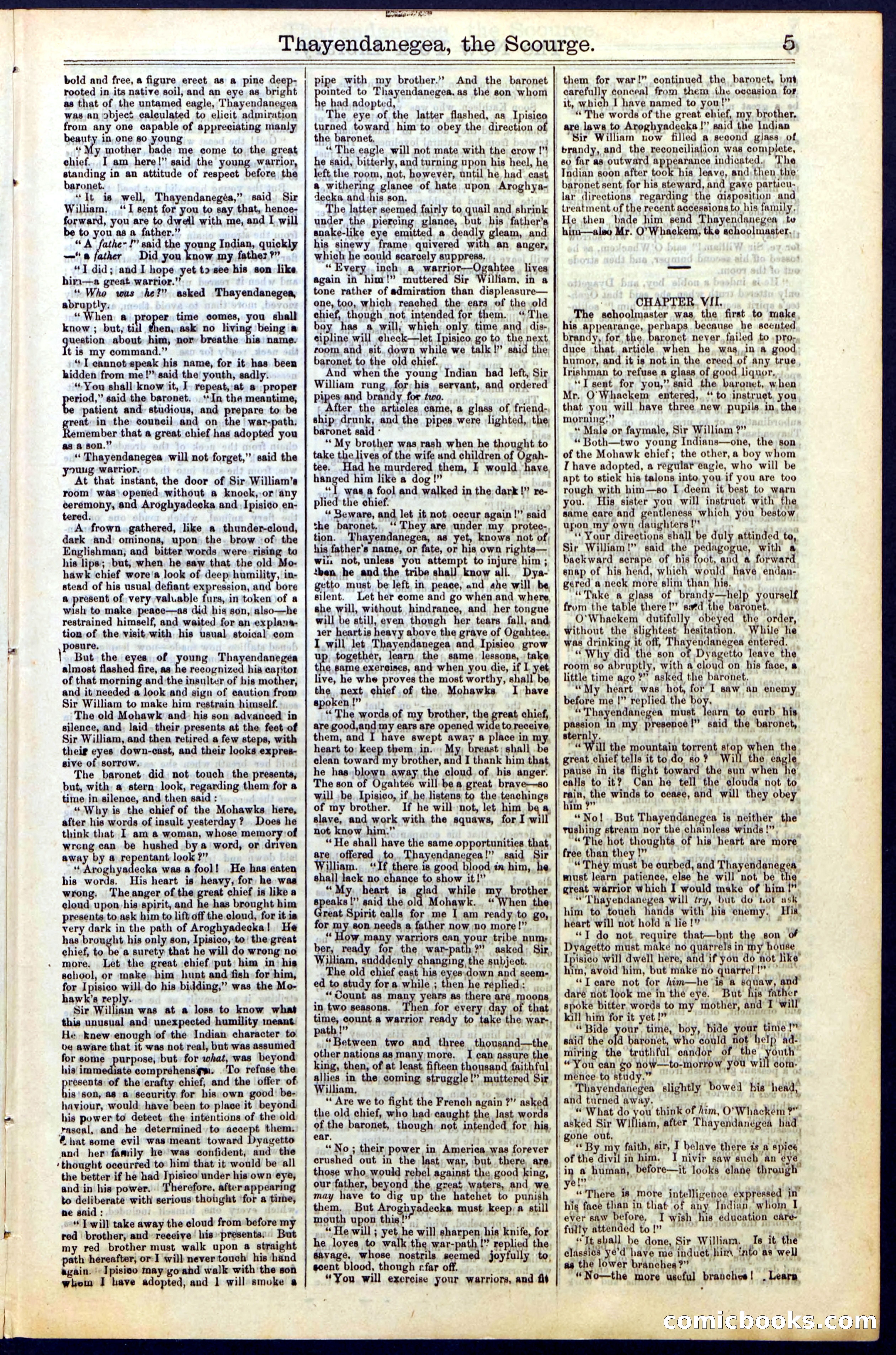
A restored page from Pulp Fiction, 1877. Page through the whole issue in the reader above.
📄 Transcribed text from this page (OCR, searchable)
Machine-transcribed from the original scan — historical spelling and the odd misread are preserved.
-_- = Thayendanegea, the Scourge. 5 bold and free, a figure erect as a pine don, | t rooted in its native soil, and an eye as brig as that of the untamed eagle, Thayendanegea was an object calculated to elicit admiration from any one capable of appreciating manly beauty in one so young “My mother bade me come to the great chief. I am here!” said the young warrior, standing in an attitude of respect before the baronet. “It is well, Thayendanegéa,” said Sir William, ‘I sent for you to say that, hence- forward, you are to dwell with me, and I will be to you as a father.” “A fathe- !” said the young Indian, quickly —‘a father Did you know my fathe:?” “I did; and I hope yet to see his son like him—a great warrior.” ‘Who was he?” asked Thayendanegea, otranthn “When a proper time comes, you shall know ; but, til then, ask no living being a uestion about him, nor breathe his name. tis my command.” ‘I cannot speak his name, for it has been hidden from me!’ said the’ youth, sadly. “You shall know it, J. repeat, at a proper riod,” said the baronet. In the meantime, patient and studious, and prepare to be reat. in the couneil and on the war-path: Rentemaber that a great chief has adopted you as 8 son.” “ Thayendanegea will not forget,” said the young warrior. At that instant, the door of Sir William’s room was opened without a knock, or any i and Aroghyadecka and Ipisi¢o en- tered. A frown gathered, like a thunder-cloud, dark and ominons, upon the brow of the Englishman, and bitter words were rising te his lips; but, when he saw that the old Mo- hawk chief wore'a look of deep humility, in- stead of his usual defiant expression, and bore a present of very valuable furs, in'token of a wish to make peace—as did his son, also—he restrained himself, and weited for an explana tion of the visit with his usual stoical com posure. But the eyes of young Thayendanegea almost flashed fire, as he ceominad, hia cayitor of that morning and the insulter of his mother, and it needed a look and sign of caution from Sir William to make him restrain himself. The old Mohawk and his son advanced in silence, and. laid their presents at the feet of Sir William, and then retired a few steps, with their eyes down-cast, and their looks expres- sive of sorrow. The baronet did not touch the presents, but, with a stern look, regarding them for a time in silence, and then said : “Why is the chief of the Mohawks here, after his words of insult yesterday ? Does he think that I am a woman, whose memory of wreng can be hushed bya word, or driven away by a repentant look ?” “ Aroghyadecka was a fool! He has eaten his Sante His heart is heavy, for he was wrong. The.anger of the great chief is like a cloud upon his spirit, and he has brought bim presents to ask him to lift off the cloud, for it is very dark in the path of Aroghyadecka! He has brought his only son, Ipisico, to’ the great chief, to be a surety that he will do wrong no more. Let the great chief put him in his school, or make him hunt and fish for him, for Ipisico will do his bidding,” was the Mo- hawk’s reply. Sir William was at a loss to know what this unusual and unexpected humility meant. He knew enough of the Indian character to be aware that it was not real, but was assumed for some purpose, but for what, was beyond his’ immediate comprehens¢m. ‘To refuse the pease of the crafty chief, and the offer of is son, a8 a security for his own good’ be- haviour, would have been to place it beyond his power to detect the intentions of the old raseal, and he determined to accept them. @ hat some evil was‘meant toward Dyagetto and her family he was confident, and the ‘thought occurred to him that it would be all the better if he had Ipisico under his own eye, and in his power. erefore, after appearing to deliberate with serious thought ‘for a time, ne said : | Twill take away the cloud from before my red brother, and reeeive his presents. But my red brother must walk upon 4 straight path hereafter, or I will never'touch his hand again. Ipisioo may yoahd walk with the son whom I have adopted, and 1 will smoke a ede pipe with my brother.” And the baronet pee to Thayendanegea, as the son whom 1¢ had adopted, The eye of the latter flashed, as Ipisico turned toward him to obey the direction of the baronet, “The eagle will not mate with the crow !" he said, bitterly, and turning upon his heel, he left, the room, not, however, until he had cast a withering glance of hate upon Aroghya- decka and fis son, | The latter seemed fairly to quail and shrink under the piercing glance, but his father’s snake-like eye emitted a deadly gleam, and, his sinewy frame quivered with an anger, which he could scarcely suppress, “Every inch a MSTA OTS URS PS lives again in him!” muttered Sir William, in a tone rather of admiration than displeasure— one, too, which reached the ears of the old chief, though not intended for them. “The boy has a will; which only time and dis- eipline will eheck—let Ipisico go to the next room and sit. down while we talk!” said the baronet to the old chief. And when the young Indian had left, Sir William rung, for: his servant, and ordered Pies and brandy for two. fter the articles came, a glass of friend-, ship drunk, and the pipes were lighted, the, baronet said ° ‘*My brother was rash when he thought to take the lives of the wife und children of o ah- tee. Had he murdered them, I would have, hanged him like a dog!” 7 “I was a fool and walked in the dark!” re- plied the chief. : “ Seware, and let it not occur again !’’ said the baronet, ‘‘ They are under my protec-, tion. Thayendanegea, as yet, knows not of, his father’s name, or fate, or his own rights— wii not, unless you attempt to injure him ; then he and the tribe shal) know all. Dya- getto must be left in peace, and ahe will be silent. Let her come and go when and where, she will, without hindrance, and her tongue will be still, even though her tears fall, and ier heartis heavy above the grave of Ogahtee. I will let Thayendanegea and Ipisico grow up together, learn the same. lessons, take the same exercises, and when you die, if L yet live, he whe proves the most worthy, shall. be the next chief of the Mohawks I have spoken !” “The words of my brother, the grees chief, are good,and my ears are opened wide to receive, them, and I have swept away a place in my, | 8 heart to keep them, in. My, breast: shall be clean toward my brother, and I thank him that, he has blown away the cloud of his anger. The son of Ogahtee will bea great brave—so will be Ipisico, if he listens to the teachings of my brother. If he will not, let him be a, slave, and work with the squaws, for I will not know him.” : “ si oe have The —_ and eh ae are offe to.. Thayendanegea!’’ said Sir William. “If there 2 good blood in him, he. shall lack no chance to show it!” = ‘olh “My. heart is glad while mY. brows, speaks |” gaid the old Mohawk... “ When the, reat Spirit calls for me I am ready to go,. for my son needs a father now no more!” “ How many warriors can your tribe num: ber, ready for the war-path ?” asked; Sir, William, sudddenly changing the subject. The old chief cast his evpedonn and seem- ed to study fora while ; then he replied: “Count a8 many years as there are_ moons, in two seasons. Then for every oe a4 that Gia Gen a warrior ready to take the war-, path !” | | ii Between two and Re eats ite other nations a8 many more, can assure the king, then, of at least fifteen Phonsand Aah {ah allies in the coming struggle!” muttered Sir William, fog : ‘Are we to fight the French again ?” asked the old chief, who had caught the last words of the baronet, though not intended for his, ear. . “No ; their power in America.was forever | crushed out in the last) war, but there, are, those who, would rebel against the good king, our father, beyond the great waters, and we may have to dig up the hatchet to punish them. But Arogiyadecks must keep, a still mouth upon thig!" eogTo a Moe’ “He will ; yet he will sharpen his knife, for he loyes to walk the war-path 1" replied the, gavage, whose nostrils seemed joyfully to, scent blood, though efar off. ye “You will exercise your warriors, and fit / them for war!” continued the baronet, bnt carefully conceal from them the occasion for it, which I have named to you!” “The words of the great ehief, my. brother, are lawa to Aroghyadecka !” said the lndian ‘Sir William now filled a second glass of brandy, and the reconciliation was complete, ev far as outward appearance indicated. The Indian soon after took his leave, and then the baronet sent for his steward, and gave particu- lar directions regarding the disposition and treatment of the recent accessions to his family, He then bade him send Thayendanegea te him—aleo Mr. O’Whackem, the schoolmaster, CHAPTER. VII. The schoolmaster was, the first to make, his appearance, perhaps because be scented brandy, for the, baronet never failed to .pro-, duce that article when he was,in a good humor, and it is notin the creed of any true, Irishman to refuse a glass of good liquor, ‘IT sent for you,” said the baronet, when Mr. O'Whackem entered, “ to instruet. you that you will have three new pupils. in, the morning,” Male or faymale, Sir William ?” “Both—two young Indians—one, the son of the Mohawk chief; the other, a boy whom I have adopted, a regular eagle, who will be apt to stick his talons into, you if you are too rough with him—so I deem it best to warn you. Hig sister you will instruct with the same care and gentleness which you bestow upon my own daughters!” . ‘Your directions shall be duly attinded to, Sir William!” said the pedagogue, with backward scrape of his foot, and a forward enap of his head, which would have endan- gered a neck more slim than his, | “Take a glass of brandy—help yourself from the table there!’ s#d the baronet, O'’Whackem Sura obeyed the order, Without the slightest hesitation. While he was drinking it off, Thayendanegea entered. _ “ Why did the son of Dyagetto leave the room so abruptly, with a cloud on his face, a little time ago?” asked the baronet. “My heart was hot, for I saw an enemy before me |” replied the poy , _“Thayendanegea must learn to curb his, passion in my presencé!” said the baronet,. tery. | | ' “Will the mountain torrent stop when the. great chief tells it todo so? Will the eagle pause in its flight toward the sun when he. ‘ealls to it? Can he tell the elouds not to. rain, the winds to cease, and will they obey him ?” “No! But Thayendanegea is neither the rushing stream nor the chainless winds !”, “The hot thoughts of his heart are more ‘free than they !” 3 . “They must be curbed, and Thayendensess, must learn patience, else he will not be the warrior which I would make of him!” ‘Thayendanegea will try, but do Lot ask him to touch hands with his enemy. Hia. heart will not hold a lie!” — os “T do not require that—bnt the son of Dyagetto must make no quarrels in my house Ipisico will dwell here, and if you do not like’ him; avoid him, but make no quarrel 1") “T care not for him—he ‘is a squaw, ond daré not look me in the eye. But his ‘father spoke bitter words to my mother, and Twill kill nit for it yet!” +2 | yer a ti wi “Bide your, time, boy, bide your time I" said the old baronet, whe sould ni herp ad- miring the truthful candor of e. outh | You ean go noW—to-morrow you will cota. -mence-to study.” ay “Thayendanegea ‘slightly bowed bis ‘head, and tuened away. ee Sed “ What do you think of him, O'Whackem er asked Sir William, after Thayendanegea Bed gone out, ile ' nit tad ' “By my faith, sir, I belave there ts a fot of the divilin him. I nivir saw such an ¢yé. in a human, before—it looks clane through eters 5 Ren “There is more intelligence enpteted hig face than in that of any Indian, whom I, | eYes ae before, | wish his education care. ‘fully attended to! ~~ | spel “shed \. hf ‘ie “ be done, Sir William, Ts it the -elassies ye'd have me induct him, into as well: e lower branches?” ee a as “No—the more useful branches! .Leara, (E(@) micboo IST oe