
Pulp Fiction, 1877 · page 19 of 28
Beadle's Dime Library, Vol. II, No. 14 — page 19: what you’re looking at
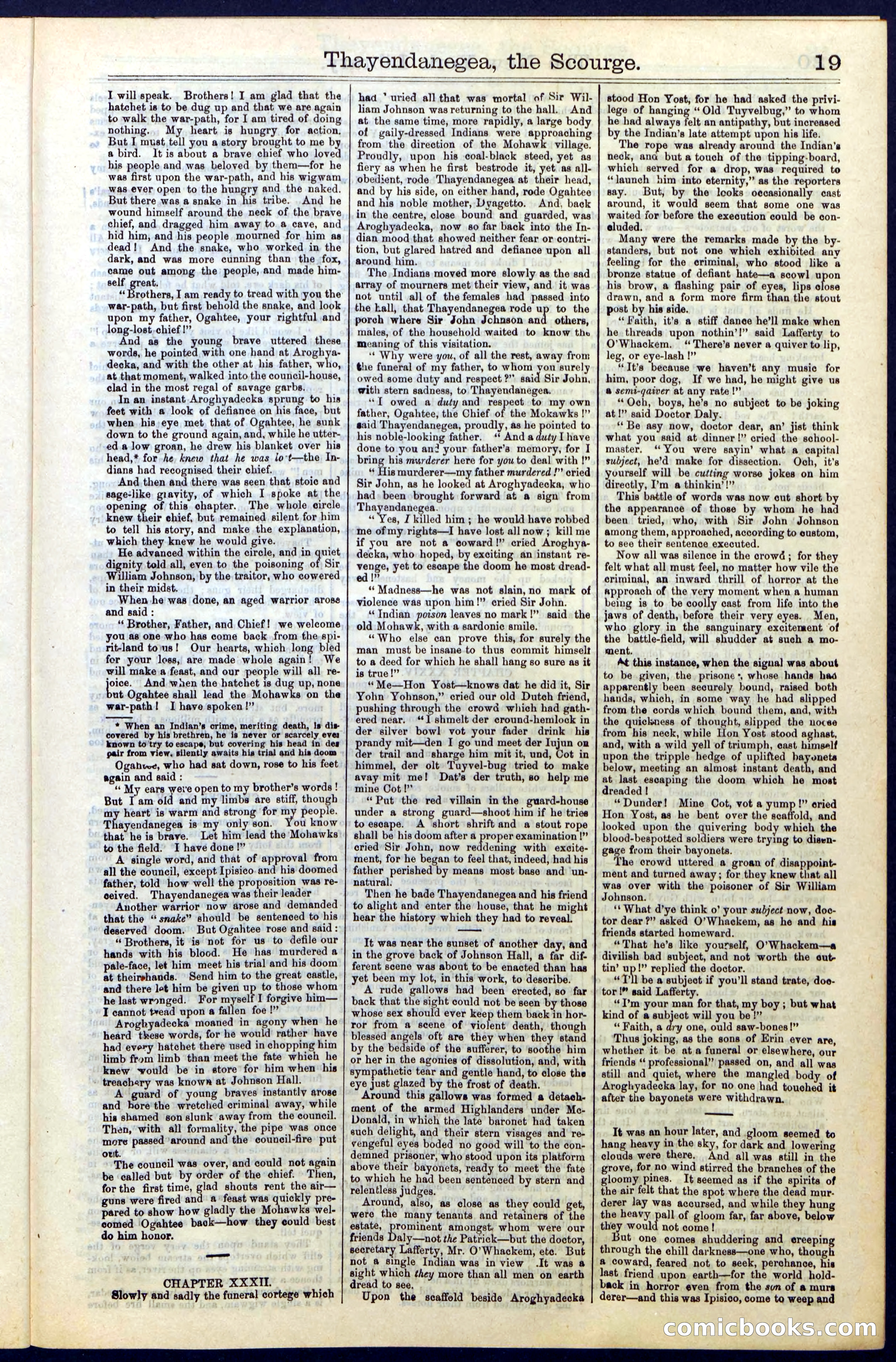
A restored page from Pulp Fiction, 1877. Page through the whole issue in the reader above.
📄 Transcribed text from this page (OCR, searchable)
Machine-transcribed from the original scan — historical spelling and the odd misread are preserved.
a I will speak. Brothers! I am glad that the hatchet is to be dug up and that we are again to walk the war-path, for I am tired of doing nothing. My heart is hungry for action, But I must tell you a story brought to me by a bird. It is about a brave chief who loved his people and was beloved by them—for he was first upon the war-path, and his wigwam was ever open to the hungry and the naked. But there was a snake in his tribe. And he wound himself around the neck of the brave chief, and dragged him away to a cave, and hid him, and his people mourned for him as dead! And the snake, who worked in the dark, and was more cunning than the fox, came out among the people, and made him- self great. “Brothers, I am ready to tread with you the war-path, but first behold the snake, and look upon my father, Ogahtee, your rightful and long-lost. chief !’’ And as the young brave uttered these words, he pointed with one hand at Aroghya- decka, and with the other at his father, who, at that moment, walked into the council-house, clad in the most regal of savage garbs. In an instant Aroghyadecka sprung to his feet with a look of defiance on his face, but when his eye met that of Ogahtee, he sunk down to the ground again, and, while he utter- ed a low groan, he drew his blanket over his head,* for he knew that he was lo*t—the In- dians had recognised their chief. And then and there was seen that stoic and sage-like giavity, of which I spoke at the opening of this chapter. The whole circle knew their chief, but remained silent for him to tell his story, and make the explanation, which they knew he would give. He advanced within the circle, and in quiet dignity told all, even to the poisoning of Sir William Johnson, by the traitor, who cowered in their midst. When he was done, an aged warrior arose and said : ‘‘ Brother, Father, and Chief! we welcome you as one who has come back from the opi rit-land toms! Our hearts, which long bled for your less, are made whole again! We will make a feast, and our people will all re- joice: And when the hatchet 1s dug up, none ut Ogahtee shall lead the Mohawks on the war-path! I have spoken!” * When an Indian’s crime, meriting death, Is dis covered by his brethren, he is never or scarcely ever known to try to escape, but covering his head in des pair from view. silently awaits his trial and his doom Ogahwe, who had sat down, rose to his feet again and said : “ My ears were open to my brother’s words! But I am old and my limbs are stiff, though my heart is warm and strong for my people. Thkventtankeen is my only son. You know that he is brave. Let him lead the Mohawks to the field. I have done!” A single word, and that of approval from all the council, except Ipisico. and his doomed father, told how well the proposition was re- ceived. Thayendanegéa was their leader Another warrior now arose and demanded that the “snake” should be sentenced to his deserved doom. But Ogahtee rose and said: “ Brothers, it is not for us to defile our hands with his blood. He has murdered a pale-face, let him meet his trial and his doom at theirehands. Send him to the great castle, and there let him be given up to those whom he last wronged. For myself I forgive him— I cannot tread upon a fallen foe !” Aroghyadecka moaned in agony when he heard tkese words, for he would rather have had every hatchet there used in chopping him limb from limb than meet the fate which he knew would be in store for him when his - treachery was known at Johnson Hall. A guard of young braves instantly arose and hore'the wretched criminal away, while his shamed son slunk away from the council. Then, with all formality, the pipe was once more passed around and the couneil-fire put out. The council was over, and could not again be called but by order of the chief. Then, for the first time, glad shouts rent the air— guns were fired and a feast was cabot pre- pared to show how gladly the Mohawks wel- comed Ogahtee back—how they could best do him honor. —_— CHAPTER XXXII. — Slowly and sadly the funeral cortege which Thayendanegea, the Scourge. 19 ee had *uried all that was mortal of Sir Wil- liam Johnson was returning to the hall. And at, the same time, more rapidly, a large body of yaily-dressed Indians were approaching from the direction of the Mohawk village. Proudly, upon his coal-black steed, yet as fiery as when he first bestrode it, yet as all- obedient, rode Thayendanegea at their head, and by his side, on either hand, rode Ogahtee and his noble mother, Dyagetto. And, back in the centre, close bound and guarded, was Aroghyadecka, now so far back into the In- dian mood that showed neither fear or contri- tion, but glared hatred and defiance upon all around him. The Indians moved more slowly as the sad array of mourners met their view, and it was not until all of the females had passed into the hall, that Thayendanegea rode up to the porch where Sir John Jchnson rtd others, males, of the household waited to know the meaning of this visitation, ‘‘ Why were you, of all the rest, away from the funeral of my father, to whom you surely owed some duty and respect ?” said Sir John, with stern sadness, to Thayendanegea. “IT owed a duty and respect to my own father, Ogahtee, the Chief of the Mokawks !”’ said Thayendanegea, proudly, as he pointed to his noble-looking father. ‘ Anda deuty [have done to you an? your father’s memory, for I bring his murderer here for you to deal with !” ‘“ His murderer—my father murdered !” cried Sir John, as he looked at Aroghyadecka, who had been brought forward at a sign from Thayendanegea. ‘““ Yes, J killed him; he would have robbed me of my rights—I have lost all now; kill me if you are not a coward!” cried Aroghya- decka, who hoped, by exciting an instant re- venge, yet to escape the doom he most dread- ed }? ‘‘ Madness—he was not slain,no mark of violence was upon him!” eried Sir John. “Indian poison leaves no mark!” said the old Mohawk, with a sardonic smile. “Who else can prove this, for surely the man must be insane to thus commit himselt to a deed for which he shall hang so sure as it is true!” “ Me—Hon Yost—knows dat he did it, Sir Yohn Yohnson,” cried our old Dutch friend, pushing through the crowd which had gath- ered near. “1 shmelt der cround-hemlock in der silver bowl vot your fader drink his randy mit—den I go und meet der Iujun on er trail and sharge him mit it, und, Cot in himmel, der olt Tuyvel-bug tried to make avay mit me! Dat’s der truth, so help me mine Cot!” “Put the red villain in the guard-house under a strong guard—shoot him if he tries to escape. A short shrift and a stout rope shall be his doom after a proper examination |” cried Sir John, now eedicniad with excite- ment, for he began to feel that, indeed, had his father perished by means most base and ‘un- natural. Then he bade Thayendanegea and his friend to alight and enter the house, that he might hear the history which they had to reveal. It was near the sunset of another day, and in the grove back of Johnson Hall, a far dif- ferent scene was about to be enacted than has yet been my lot, in this work, to describe. A rude gallows had been erected, so far back that the pee could not be seen by those whose sex should ever keep them back in hor- ror from a scene of violent death, though blessed angels oft are they when they stand by the bedside of the sufferer, to soothe him or her in the agonies of dissolution, and, with sympathetic tear and gentle hand, to close the eye just glazed by the frost of death. Around this gallows was formed a detach- ment of the armed Highlanders under Me- Donald, in which the late baronet had taken such delight, and their stern visages and re- vengeful eyes boded no good will to the con- demned prisoner, who stood upon its platform above their bayonets, ready to meet the fate to which he had been sentenced by stern and relentless judges. Around, also, as close as they could get, were the many tenants and retainers of the estate, prominent amongst, whom were our friends Daly—not the Patrick—but the doctor, secretary Lafferty, Mr. O’Whackem, ete. But not a single Indian was in view .It was a sight which ¢hey more than all men on earth dread to see, . | / Upon the scaffold beside Aroghyadecka . ee stood Hon Yost, for he had asked the privi- lege of hanging “ Old Tuyvelbug,” to whom he had always felt an antipathy, but increased by the Indian’s late attempt upon his life. The rope was already around the Indian's neck, ana but a touch of the tipping-board, which served for a drop, was required to “launch him into eternity,” as the reporters say. But, by the looks occasionally cast around, it would seem that some one was waited for before the execution could be con- cluded. Many were the remarks made by the by- standers, but not one which exhibited any feeling for the criminal, who stood like a bronze statue of defiant hate—a scowl upon his brow, a flashing pair of eyes, lips close drawn, and a form more firm than the stout post by his side. “ Maith, it’s a stiff dance he’ll make when he threads upon nothin’!” said Lafferty to O’Whackem. ‘“ There’s never a quiver to lip, leg, or eye-lash !” “It’s because we haven’t any music for him, poor dog, If we had, he might give us & semi-qaiver at any rate !” ‘“Och, boys, he’s no subject to be joking at!” said Doctor Daly. “Be asy now, doctor dear, an’ jist think what you said at dinner!” cried the school- master. “You were sayin’ what a capital subject, he’d make for dissection. Och, it’s tea will be cutting worse jokes on him irectly, I’m a thinkin’!” This battle of words was now cut short by the appearance of those by whom he had been tried, who, with Sir John ‘Johnson among them, approached, according to custom, to see their sentence executed. Now all was silence in the crowd; for they felt what all must feel, no matter how vile the criminal, an inward thrill of horror at the approach of the very moment when a human being is to be coolly cast from life into the jaws of death, before their very eyes. Men, who glory in the sanguinary excitement of the battle-field, will shudder at such a mo- ment. At this instance, when the signal was about to be given, the prisone*, whose hands haa apparently been securely bound, raised both hands, which, in some way he had slipped from the cords which bound them, and, with the quickness of thought, slipped the nocee from his neck, while Hon Yost stood aghast, and, with a wild yell of triumph, cast bimeelf upon the tripple hedge of uplifted bayonets below, meeting an almost instant death, and at last escaping the doom which he most dreaded | “Dunder! Mine Cot, vot a yump!” eried Hon Yost, as he bent over the scaffold, and looked upon the quivering body which the blood-bespotted soldiers were trying to disen- gage from their bayonets. ‘he crowd uttered a groan of disappoint- ment and turned away; for they knew that all was over with the poisoner of Sir William Johnson. ‘* What d’ye think o’ your subject now, doc- tor dear ?” asked O’Whackem, as he and his friends started homeward. “That he’s like yourself, O’Whackem—a divilish bad subject, and not worth the out- tin’ up!” replied the doctor. “Tl be a subject if you'll stand trate, doo- tor” said Lafferty. “I’m your man for that, my boy ; but what kind of a subject will you be !” “ Faith, a dry one, ould saw-bones!” Thus joking, as the sons of Erin ever are, whether it be at a funeral or elsewhere, our friends “ professional” passed on, and all was still and quiet, where the mangled body of Aroghyadecka lay, for no one had touched it after the bayonets were withdrawn. —— It was an hour later, and gloom seemed to hang heavy in the sky, for dark and lowering clouds were there. And all was still in the grove, for no wind stirred the branches of the gloomy pines. It seemed as if the spirits of the air felt that the spot where the dead mur. derer lay was accursed, and while they hung the heavy pall of gloom far, far above, below they would not come! | ut one comes shuddering and ereepin through the chill darkness—one who, thoug ‘& coward, feared not to seek, perchance, his Jast. friend upon earth—for the world hold- back in horror ¢ven from the sun of a murs derer—and this was Ipisico, come to weep and comicbooks-com * . : ' a i Res: ee