
Pulp Fiction, 1877 · page 18 of 28
Beadle's Dime Library, Vol. II, No. 14 — page 18: what you’re looking at
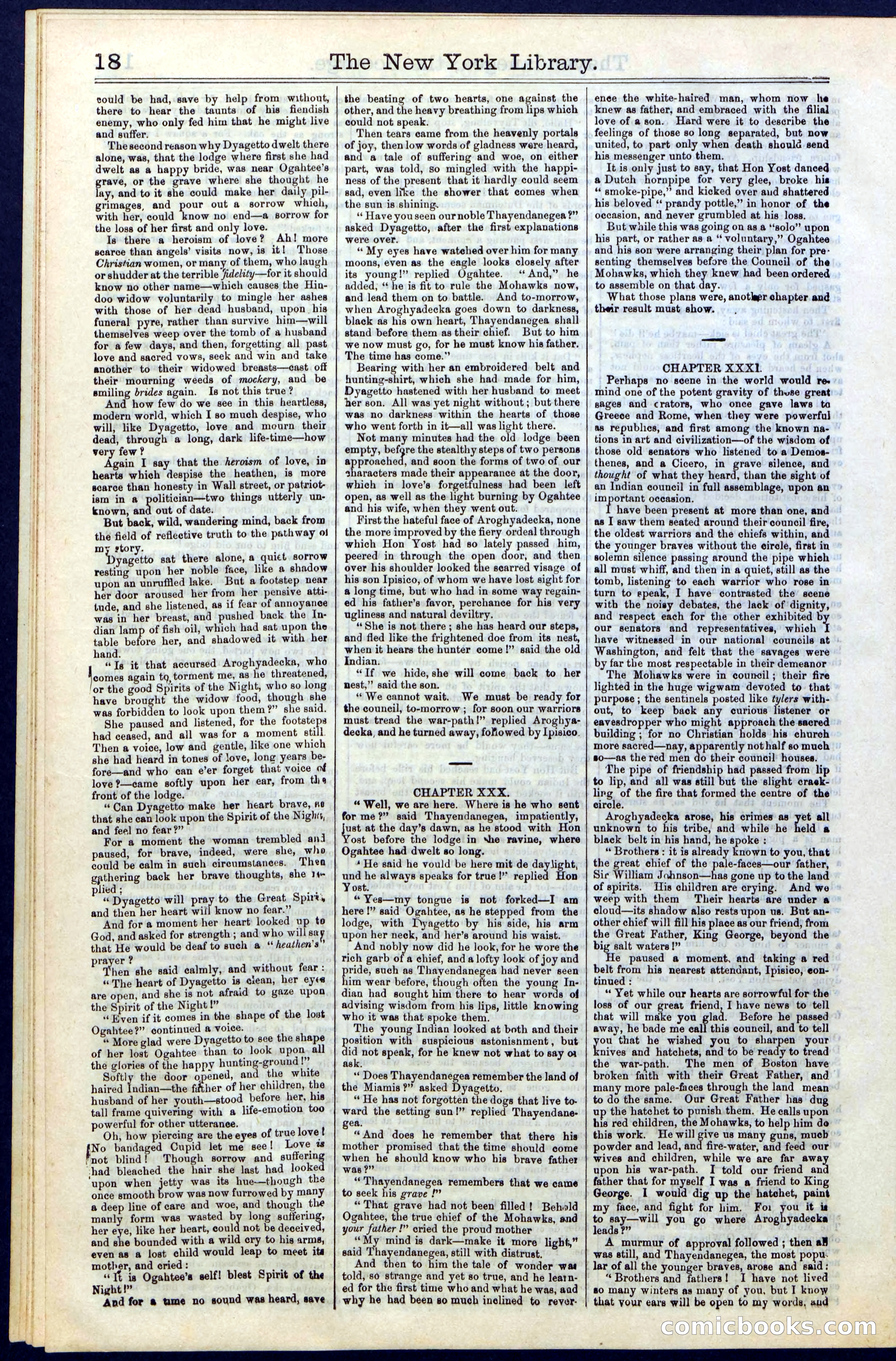
A restored page from Pulp Fiction, 1877. Page through the whole issue in the reader above.
📄 Transcribed text from this page (OCR, searchable)
Machine-transcribed from the original scan — historical spelling and the odd misread are preserved.
SO CS Dee A Se ES RS SS I Ss > oF , id °- - J wie + nS oF. aw ™ - ke ia LE IT I ANG I PE A ELE EELS CI NE I EE A EE A A I EY i = - = . — 3 - ™ - a mee AG Re et 5 PE eee 18 could be had, save by help from without, there to hear the taunts of his fiendish enemy, who only fed him that he might live and suffer. The second reason why Dyagetto dwelt there alone, was, that the lodge where first she had dwelt as a happy bride, was near Ogahtee’s rave, or the grave where she thought he fans and to it she could make her daily pil- grimages, and pour out a sorrow which, with her, could know no end—a sorrow for the loss of her first and only love. Is there a heroism of love? Ah! more scarce than angels’ visits now, is it! Those Christian women, or many of them, who laugh or shudder at the terrible fidelity—for it should know no other name—which causes the Hin- doo widow voluntarily to mingle her ashes with those of her dead husband, upon_ his funeral pyre, rather than survive him—will themselves weep over the tomb of a husband for a few days, and then, forgetting all past love and sacred vows, seek and win and take another to their widowed breasts—cast off their mourning weeds of mockery, and be smiling brides again. Is not this true? And how few do we see in this heartless, modern world, which I so much despise, who will, like Dyagetto, love and mourn their dead, through a long, dark life-time—how very few ? gain I say that the heroism of love, in hearts which despise the heathen, is more scarce than honesty in Wall street, or patriot- ism in a politician—two things utterly un- known, and out of date. But back, wild, wandering mind, back from the field of reflective truth to the pathway oI my story. yagetto sat there alone, a quiet sorrow resting upon her noble face, like a shadow upon an unrufiled lake. But a footstep near her door aroused her from her pensive atti- tude, and she listened, as if fear of annoyance was in her breast, and pushed back the In- dian lamp of fish oil, which had sat upon the table before her, and shadowed it with her hand. “Tg it that accursed Aroghyadecka, who feomes again to, torment me, as he threatened, or the good Spirits of the Night, who so long have brought the widow food, though she was forbidden to look upon them?” she said. She paused and listened, for the footsteps had ceased, and all was for a moment sti L. Then a voice, low and gentle, like one which she had heard in tones of love, long years be- fore—and who can e’er forget that voice of love ?—came softly upon her ear, from the front of the lodge. “Can Dyagetto make her heart brave, ho that she can look upon the Spirit of the Nights, and feel no fear?” For a moment the woman trembled and paused, for brave, indeed, were she, who could be calm in such circumstances. Thea gathering back her brave thoughts, she 14 lied ; any 3 “ Dyagetto will pray to the Great, Spirei, and then her heart will know no fear.” And for @ moment her heart looked "Pp to God, and asked for strength ; and who willsa that He would be deaf to such a “ heathen's” rayer ? . Then she said calmly, and without fear : “The heart of Dyagetto is ciean, her ey«s are open, and she is on afraid to gaze upon th irit of the Night!” M tren if it pe in the shape of the lost Ogahtee?” continued a voice. “ More glad were Dyagetto to see the shape of her lost Ogahtee than to look upon. all the glories of the happy hunting Fae ! Softly the door opened, an the white haired Indian—the fither of her children, the husband of her youth—stood before her, his tall frame quivering with a life-emotion too powerful for other utterance. Oh, how piereing are the eyes of true love! fNo bandaged Cupid let me see! Love 18 Pnot blind L Though sorrow and suffaring “had bleached the hair she last had looke ‘upon when jetty was its hue-—though the once smooth brow was now furrowed by many a deep line of care and woe, and though the manly form was wasted by long mallering, her eye, like her heart, could not be deceived, and she bounded with a wild cry to his arms, even as a lost child would leap to meet ita mother, and cried: He “Tt is Ogahtee’s self! blest Spirit of the Night!” And for @ tame no sound was heard, save The New York Library. the beating of two hearts, one against the other, and the heavy breathing from lips which could not speak. Then tears came from the heavenly portals of joy, then low words of gladness were heard, and a tale of suffering and woe, on either part, was told, so mingled with the happi- ness of the present that i¢ hardly could seem sad, even like the shower that comes when the sun is shining. ‘Have youseen ournoble Thayendanegea ?” asked Dyagetto, after the first explanations were over. “My eyes have watched over him for many moons, even as the eagle looks closely after its young!” replied Ogahtee. ‘ And,” he added, “ he is fit to rule the Mohawks now, and lead them on to battle. And to-morrow, when Aroghyadecka goes down to darkness, black as his own heart, Thayendanegea shall stand before them as their chief. But to him we now must go, for he must know his father. The time has come.” Bearing with her an embroidered belt and hunting-shirt, which she had made for him, Dyagetto hastened with her husband to meet her son. All was yet night without; but there was no darkness within the hearts of those who went forth in it—all was light there. Not many minutes had the old lodge been empty, befgre the stealthy steps of two persons 5 hp eh , and soon the forms of two of our sharacters made their appearance at the door, which in love’s forgetfulness had been left open, as well as the light burning by Ogahtee and his wife, when they went out. First the hateful face of Aroghyadecka, none the more improved by the fiery ordeal through which Hon Yost had so lately passed him, peered in through the open door, and then over his shoulder looked the searred visage of his son Ipisico, of whom we have lost sight for a long time, but who had in some way regain- ed his father’s favor, perchance for his very ugliness and natural deviltry. “She is not there ; she has heard our steps, and fled like the frightened doe from its nest, when it hears the hunter come!” said the old Indian. “If we hide, she will come back to her nest,’’ said the son. ‘We cannot wait. We must be ready for the council, to-morrow ; for soon our warriors must tread the war-path!” replied Aroghya- decka, and he turned away, fofiowed by Ipisico. CHAPTER XXX. “ Well, we are here. Where is he who sent for me?” said Thayendanegea, impatiently, {ast at the day’s dawn, as he stood with Hon ost before the lodge in “he ravine, where Ogahtee had dwelt so long. 4 He said he vould be here mit de day\ight, und he always speaks for true!” replied Hon ¥ ost. “Yes—my tongue is not forked—I am here!” said Ogahtee, as he stepped from the lodge, with Dvyagetto by his side, his arm upon her neck, and her’s around his waist. And nobly now did he look, for he wore the rich garb of a chief, and a lofty look of joy and se. such as Thayendanegea had never seen 1im wear before, though often the young In- dian had sought him there to hear words of advising wisdom from his lips, little knowing who it was that spoke them. The young Indian looked at both and their poets with suspicious astonisnment, but Pe not speak, for he knew not what to say o1 aslk, ‘Does Thayendanegea remember the land of the Miamis ?” asked Dyagetto. “ He has not forgotten the dogs that live to- ward the setting sun!” replied Thayendane- gea. “And does he remember that there his mother promised that the time should come uses he should know who his brave father was?” ‘““Thayendanegea remembers that we came to seek his grave !” “That grave had not been filled! Behold Ogahtee, the true chief of the Mohawks, and your father !” cried the proud mother “My mind is dark—make it more light,” said Thayendanegea, still with distrust. And then to him the tale of wonder was told, so strange and yet so true, and he learn- ed for the first time who and what he was, aad why he had been so much inelined to rever- ie I ence the white-haired man, whom now he knew as father, and embraced with the filial love of ason. Hard were it to describe the feelings of those so long separated, but now united, to part only when death should send his messenger unto them. It is only just to say, that Hon Yost danced a Dutch hornpipe for very glee, broke his “ smoke-pipe,” and kicked over aud shattered his beloved “‘ prandy pottle,” in honor of the occasion, and never grumbled at his loss. But while this was going on as a “solo” upon his part, or rather as a “ voluntary,” Ogahtee and his son were arranging their plan for pre- senting themselves before the Council of the Mohawks, which they knew had been ordered to assemble on that day. What those plans were, anotlaer chapter and their result must show. CHAPTER XXX1L Perhaps no scene in the world would re mind one of the potent gravity of thuse great sages and crators, who once gave laws ta Greece and Rome, when they were powerful as republics, and first among the known na- tions in art and civilization—of the wisdom of those old senators who listened to a Demos- thenes, and a Cicero, in grave silence, and thought of what they heard, than the sight of an Indian council in full assemblage, upon an im ached occasion. have been present at more than one, and as I saw them seated around their council fire, the oldest warriors and the chiefs within, and the younger braves without the circle, first in solemn silence passing around the pipe which all must whiff, and then in a quiet, still as the tomb, listening to each warrior who rose in turn to epeak, I have contrasted the scene with the noisy debates, the lack of dignity, and respect each for the other exhibited b our senators and representatives, which have witnessed in our national councils at Washington, and felt that the savages were by far the most respectable in their demeanor The Mohawks were in council; their fire lighted in the huge wigwam devofed to that purpose ; the sentinels posted like tylers with- out, to keep back any curious listener or eavesdropper who might approach the sacred building ; for no Christian holds his church more sacred—nay, apparently not half so much so—as the red men do their council houses. The pipe of friendship had passed from lip to lip, and all was still but the slight craek- lirg of the fire that formed the centre of the circle. Aroghyadecka arose, his crimes as yet all unknown to his tribe, and while he held a black belt in his hand, he spoke : “ Brothers : it is alread arate to you, that the great chief of the pale-faces—our father, Sir William Johnson—has gone up to the land of spirits. fis children are crying. And we weep with them Their hearts are under a cloud—its shadow also rests upon us. But an- other chief will fill his place as our friend, from the Great Father, King George, beyond the big salt waters !” e paused a moment, and taking a red belt from his nearest attendant, Ipisico, eon- tinued : “Yet while our hearts are sorrowful for the loss of our great friend, I have news to tell that will make you lad. Before he passed away, he bade me eall thie council, and to tell you that he wished you to sharpen your nives and hatchets, and to be ready to tread the war-path. The men of Boston have broken faith with their Great Father, and many more pale-faces through the land mean to do the same. Our Great Father has dug up the hatchet to punish them. He calls upon his red children, the Mohawks, to help him do this work. He will ee us many guns, much powder and lead, and fire-water, and feed our wives and children, while we are far awa upon his war-path. I told our friend a father that for myself I was a friend to King George. I would dig up the hatchet, paint my face, and fight for him. Foi you it is to say—will you go where Aroghyadecka leads ?” A murmur of approval followed ; then al was still, and Thayendanegea, the most popu: lar of all the younger braves, arose and said: “ Brothers and fathers! I have not lived 60 many winters as many of you, but I know that your ears will be open to my words, and Gomichoo Sjp(€ (0)