
Pulp Fiction, 1877 · page 20 of 28
Beadle's Dime Library, Vol. II, No. 14 — page 20: what you’re looking at
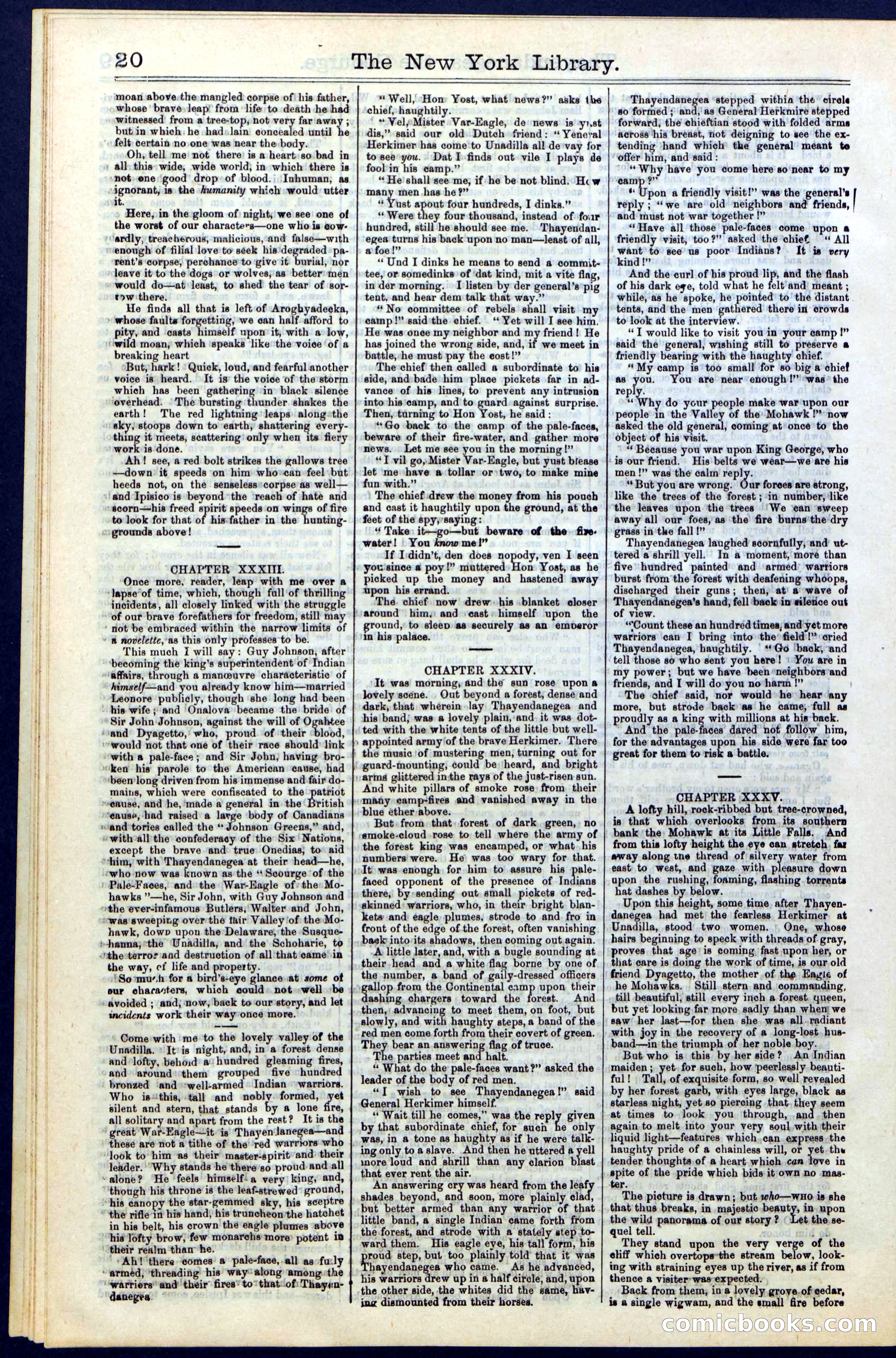
A restored page from Pulp Fiction, 1877. Page through the whole issue in the reader above.
📄 Transcribed text from this page (OCR, searchable)
Machine-transcribed from the original scan — historical spelling and the odd misread are preserved.
_— Hoon a ind -e O° PE ee eee ee ys See gorge —_ —— —- — — and Dyagetto, who, proud of their “would not that one of their race should link with a pale-face; and Sir John, having bro- ken his ~eause, and he, made a general in the armed, ‘threading his way*along among ‘warriors and’ their’ fires’ to that of: Thay«n- 20 moan above the mangled corpse of| his father, whose brave leap! from life to death he had witnessed from a tree-top; not very far away ; but in which: he had: lain concealed until 4 felt certain no one was near the body. Oh, tell me not there is a heart so bad in : all. this wide, wide world; in which there is ‘notene good drop of blood. Inhuman, as ignorant, 1s the kumanity which would utter it. Here, in the gloom of night, we see one of the worst of our characters—one who is sow- ‘ardly, treacherous, malicious, and false—with enough of filial love to seek his degraded pa- rent’s corpse, perchance to give it burial, nor leave it to the dogs or wolves, as better men would do—at least, to shed the tear of sor- row there. He finds all that is left of Aroghyadecka, » whose faults i MCI D we can half afford to pity and casts himself upon it, with a low, wild moan, which speaks like the voice of a breaking heart But, hark! Quick, loud, and fearful another voice is heard. It is’ the voice of the storm which has been gathering in black silence overhead. The bursting Elaasdbe shakes the earth! The red lightning leaps along *the sky, stoops down to earth, shattering every- ve it meets, scattering only when its fiery work is done. Ah! see, a red bolt strikes the gallows tree —down it speeds on him whovcan feel but heeds not, on the senseless: corpse as well— and Ipisico is beyond the ‘reach of hate and ‘scorn—his freed spirit speeds on wings of fire to look for that of his:father in the hunting » grounds above! CHAPTER XXXIII. Once more, reader, leap with me over a ‘lapse’of time, which, though full of thrilling incidents, all closely linked with the etruggle of our brave forefathers for freedom, still may ‘ not be embraced within the narrow limits of ‘ 8 novelette, as this only professes to be. This much I will say: Guy Johnson, after ‘becoming the king's superintendent of Indian affairs, through a manwuvre characteristic of himself—and you already know him—married Leonore publicly, though she long had been his wife; and Onalova became the bride of Sir John Johnson, against the will of one ood, parole to the American cause, had ‘been long driven from his immense and fair do- mains, which were confiscated to the patriot ritish ‘eause, had raised a rt body of Canadians and tories called the “Johnson Greens,” and, “with all the confederacy of the Six Nations, except the brave and true Onedias, to aid him, with Thayendanegea at their head—he, ‘who now was known as the “Scourge of the | Pale-Faces, and the War-Eagle of: the Mo- hawks ’—he, Sir John, with Guy Johnson and the ever-infamous Butlers, Walter and John, “was sweeping over thé tair Valley ‘of the Mo- hawk, dowp upon the Delaware, the Susque- hanna;*the Unadilla, and the Schoharie, to the terror and destruction of all that came in the way, cf life and property. ‘So muh for a bird’s-eye glance at some of our characters, which could not well ‘be “avoided ; and; now, back to our’story, and let incidents work their way once more. Come with me to the lovely valley of the ‘Unadilla. » It: is night, and, in a forest dense and lofty, behoid a hundred gleaming fires, ‘and around: them grouped five hundred bronzed and -»well-armed Indian warriors. Who isthis, tall and nobly formed, yet silent and stern, that stands by a lone re, all solitary and apart from the rest? It is the ‘great War-Eagle—it is Thayen Jan a—and these are not a tithe of the red warriors who |. look to him as their master-spirit and: their lender. “Why stands he there’so proud and all “alone? He feels himsélf-a very king, and, though his throne is the leafistrewed ground, “his canopy the star-gemmed sky, his sceptre / “the rifle in his hand, his truncheon'the hatchet in hie belt, his crown the eagle plames above his Tofty brow; few monarchs more? potent is ' their realm tham he. Ah! there comes a pale-face,.all as re the danegea. The New York Lib It was enongh for him to assure his gallop frora the Continental gauip upon their “Well, Hon Yost, what news?” asks the chief, haughtily. “Vel Mister Var-Eagle, de news is y.st dis,” said our old Dutch friend: “ Yeneyal Herkimer has come to Unadilla all de‘vay for to see you. Dat I finds out vile I plays de fool in his camp.” “ He shall see me, if he be not blind. Hcw many men has he ?”’ “ Yust apout four hundreds, I dinks.” “Were they four thousand, instead of four hundred, still he should see me. Thayendan- egea turns his back upon no man—least of all, a foe!” ‘Und I dinks he means to send a commit- tee, or somedinks of ‘dat kind, mit a vite flag, in der morning. I listen by der general’s pig tent, and hear dem talk that way.” “*No committee of rebels shall visit my camp!” said'the ehief. ‘ Yet will I see him. He was onee my neighbor and my friend! He has joined the wrong side, and, if we meet in battle, he must pay the cost!” The chief then called a subordinate to his side, and bade him place pickets far in ad- vance of his lines, to prevent any intrusion into his camp, and to guard against surprise. Then, turning to Hon Yost, he said : “Go back to the camp of the pale-faces, beware of their fire-water, and gather more news. Let me see you in the morning!” “TI vil go, Mister Var-Eagle, but yust biease let me have a tollar or two, to make mine fun with.” The chief drew the money from his pouch and cast it haughtily upon the ground, at the feet of the spy;saying: “ Take: it~go—but beware of the five- water! You know me!” If Ididn’t, den does nopody, ven I seen you since a poy!” muttered Hon Yost, as he picked up the money and hastened away upon his errand. The chief now drew his blanket closer around him,) and cast» himself upon the ground, to sleep as securely as an emoveror in his palace. CHAPTER XXXIV. It was morning, and the sun rose upon a lovely scene. Out beyond a forest, dense and dark, that wherein lay Thayendanegea and his band; was a lovely plain, and. it was dot- ted with the white tents of the little but well- appointed army/of the brave Herkimer. There ' the music of mustering men, turning out for guard-mounting, could be ‘heard, and bright varms glittered inthe rays of the just-risen sun. And white pillars of smoke rose from their “many eamp-fires and vanished away in the blue éther above. But. from that forest of dark green, no emoke-cloud rose to tell where the army of the forest king was encamped, or what. his numbers were. He was too wary for nai ale- faced opponent of the presence of Indians there, by»sending out small pickets of red- skinned warriors, who, in their bright blan- kets and eagle plumes, strode to and fro in front of the edge of the forest, often vanishing bask into its shadows, then coming out again. A little later, and, with a bugle sounding at their head and a white flag borne by one of the number, a band of gaily-dressed officers ashing chargers toward the forest. And then, advancing to meet them, on foot, but slowly, and with haughty steps, a band of the red men come forth from their covert of green. They bear an answering flag of truce. The parties meet and halt. “ What do the pale-faces want?” asked the leader of the body of red men. “I wish to see Thayendanegea!” said General Herkimer himself. “Wait till he comes,” was the reply given by that subordinate chief, for such he only was, in a tone as haughty as if he were talk- ing only to aslave. And then he uttered a Sn wore loud and shrill than any clarion blast that ever rent the air. An answering cry was heard from the Ieely shades beyond, and soon, more plainly clad, but better armed than any warrior of that little band, a single Indian came forth from the forest, and strode with a stately step to- ward them. His eagle eye, his tall form, his roud step, but too plainly told’ that it was hayendanegea who came. As he advanced, his warriors drew up in a half circle, and, upon the other side, the whites did the same, hav- ing dismounted from their horses. rary. iy age stepped withia the circle so formed; and,' as General Herkmire stepped forward, the chiéftian stood with folded arms across his breast, not deigning to see the ex- tending hand which the general meant to offer him, and said : “Why have you come here so near to my camp ?”" * Upon a friendly visit!” was the general’s reply ; ““we are old neighbors and friends, and must not war together !” “Have all those pale-faces come upon a friendly visit, too?” asked the chief “ All want to see us poor Indians? It is very kind !” And the curl of his proud lip, and the flash of his dark ege, told what he felt and meant ; while, as he spoke, he pointed to the distant tents, and the men gathered there in crowds to look at the interview. “T would like to visit you in your camp !” said the general, wishing still to preserve a friendly bearing with the haughty chief. ‘My camp is too small for so big a chief as you. You are near enough!’ ‘was’ the rep y ‘Why do your people make war upon our people in the Valley of the: Mohawk |” now asked the old general, coming at once to the object of his visit. “Because you war upon King George, who is our friend. His belts we wear—we are his men !” was the calm reply. “ But you are wrong. Our forees are strong, like the trees of the forest ; in number, like the leaves upon the trees We can sweep away all our foes, as the fire burns'the dry grass in the fall !” Thayendanegea laughed scornfully, and’ ut- tered a shrill yell. In a moment, more than five hundred painted and ‘armed’ warriors burst from the forest with deafening whoops, discharged their guns; then, at’ a wave of Thayendanegea's hand, fell back in «iletice out of view. “Count these an hundred times, and'yet more warriors can I bring into the’ field!” cried Thayendanegea, baughtily. **Go ‘back, ‘and tell those so who sent you here! | You are in my power; but we have been ‘neighbors’and friends, and I will do you no harm !” The chief said, nor would he hear any more, but strode back as he came, full as proudly as a king with millions at his back. And the pale-faces’ dared not follow him, for the advantages upon his side were far too great for them to risk a battle. CHAPTER XXXV. A lofty hill, rock-ribbed but. tree-crowned, is that which overlooks from its southern bank ‘the: Mohawk at its Little Falls. And from this lofty height the eye can stretch, far away along tne thread of silvery water from east to west, and gaze with pleasure down upon the rushing, foaming, flashing. torrents hat dashes by below. Upon this height, some time after Thayen- danegea had met the fearless Herkimer at Unadilla, stood two women. ' One, whose hairs beginning to speck with threads of gray, proves that age is coming fast upon her, or that care is doing the work of time, is our old friend Dyagetto, the mother of the Eayle of he Mohawks. Still stern and commanding, till beautiful, still every inch a forest, yueen, but yet looking far more sadly than whem we saw her last—for then she was all.radiant with joy in the recovery of a long-lost. hus- band—in the triumph of her noble boy. But who is this by her side? An Indian maiden ; yet for such, how peerlessly beauti- ful! Tall, of exquisite form, so well revealed by her forest garb, with eyes large, black as starless night, yet. so piercing that. they seem at times to look you through, and. then again to melt into your very soul with their liquid light—features which can express, the haughty pride of a chainless will, or yet. the tender thoughts of a heart which can love in ame of the pride which bids it own no mas- The picture is drawn; but who—wuo is she that thus breaks, in majestic beauty, in upon the wild panorama of our story? Let the se- quel tell. i of They stand upon the very verge of the cliff which ove e stream below, look- ing with straining eyes up the river, as if from thence a visiter-was expected. Back from them, ina lovely groye.of cedar, is a single wigwam, and the et fire before | | Gomichboo ‘S (E(0)