
Pulp Fiction, 1881 · page 4 of 24
Beadle's New York Dime Library, No. 138 — page 4: what you’re looking at
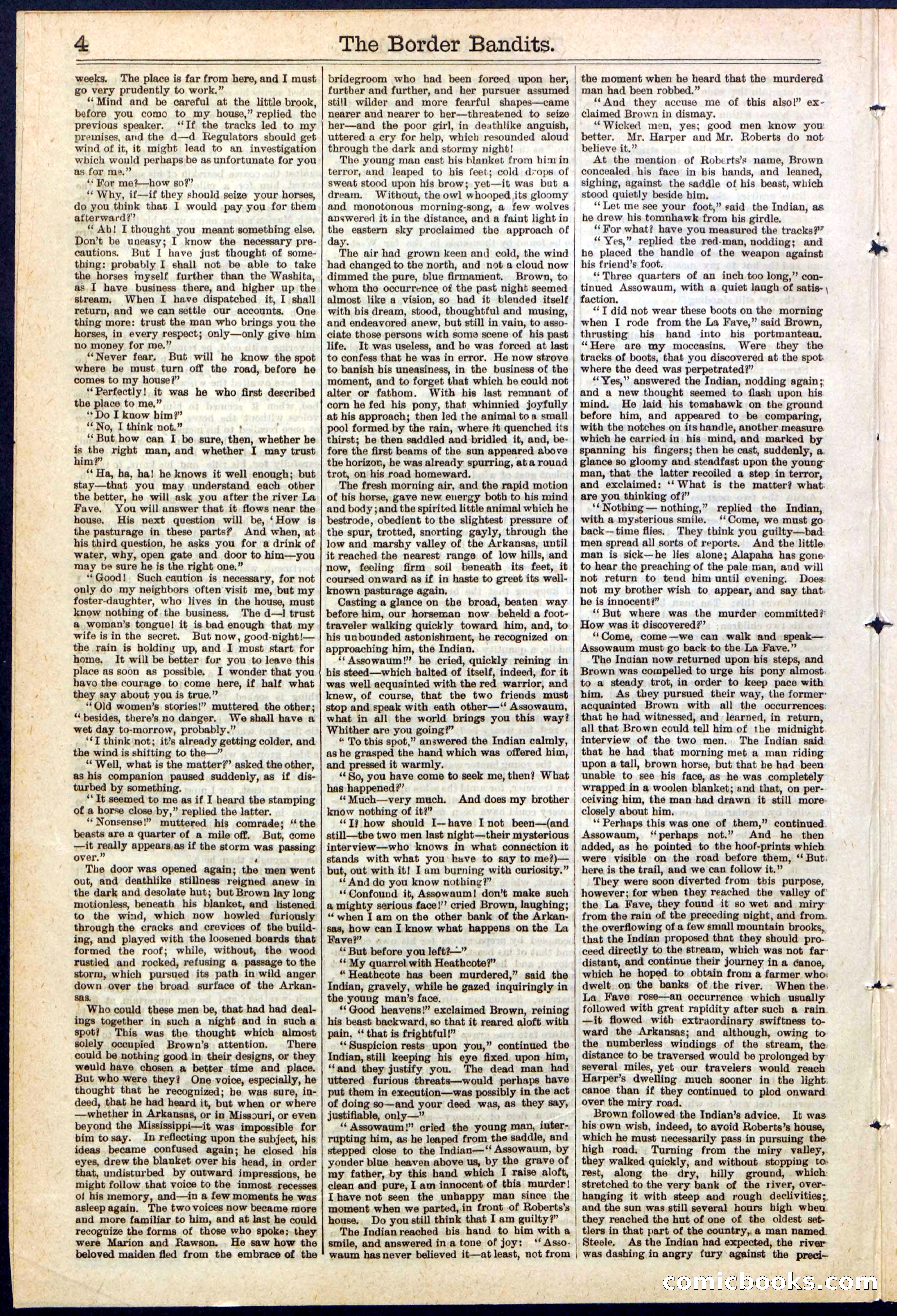
A restored page from Pulp Fiction, 1881. Page through the whole issue in the reader above.
📄 Transcribed text from this page (OCR, searchable)
Machine-transcribed from the original scan — historical spelling and the odd misread are preserved.
i eg | | | | _———~ — — — i ES a ago ——— eee weeks. The place is far from here, and I must go very prudently to work.” ‘Mind and be careful at the little brook, before you como to my house,” replied tho previous speaker. ‘‘If the tracks led to my premises, and the d—d Regulators should get wind of it, it might lead to an investigation which would perhaps be as unfortunate for you as for me.” ‘‘ For me¢+—how so?” ** Why, if—if they should seize your horses, do you think that I would pay you for them afterward?” . “ Ab! I thought you meant something else, Don’t be uneasy; I know the necessary pre- cautions. But I have just thought of some- thing: probably I shall not be able to take the horses myself further than the Washita, as. I have business there, and higher up the stream, When I have dispatched it, I shall return, and we can settle our accounts, One thing more: trust the man who brings you the horses, in every respect; only—only give him no money for me.” “Never fear. But will he know the spot where he must turn off the road, before he comes to my house?” “*Parfectly! it was he who first described the place to me,” ‘** Do I know him?” “No, I think not.” ’ | “But how can I bo sure, then, whether he is the right man, and whether I may trust him?’ ‘* Ha, ha, ha! he knows it well enough; but stay—that you may understand each other the better, he will ask you after the river La Fave, You will answer that it flows near the house. His next question will be, ‘How is the pasturage in these parts? And when, at his third question, he asks you for a drink of water, why, open gate and door to him—you may be sure he is the right one,” ‘“Good! Such caution is necessary, for not only do my neighbors often visit me, but my foster-daughter, who lives in the house, must know nothing of the business, The d—l trust a woman’s tongue! it is bad enough that my wife isin the secret. But now, good-night!— the rain is holding up, and I must start for home. It will be better for you to leave this place as soon as possible, I wonder that you havo the courage to come here, if half what they say about you is true.” ‘“‘Old women’s stories!” muttered the other; ** besides, there’s no danger. We shall have a wet day to-morrow, probably.” ‘*T think not; it’s already getting colder, and the wind is shifting to the—” “Well, what is the matter?’ asked the other, as his companion paused suddenly, as if dis- turbed by something. ‘It seemed to me as if I heard the stamping of a horse close by,” replied the latter. ‘‘ Nonsense!” muttered his comrade; “the beasts are a quarter of a mile off. But, come —it really appears,as if the storm was passing over.” a The door was opened again; the men went out, and deathlike stillness reigned anew in the dark and desolate hut; but Brown lay long motionless, beneath his blanket, and listened to the wind, which now howled furiously through the cracks and crevices of the build- ing, and played with the loosened boards that formed the roof; while, without, the wood rustled and rocked, refusing a passage to the storm, which pursued its path in wild anger down over the broad surface of the Arkan- Sas. _ Who could these men be, that had had deal- ings together in such a night and in sucha spot? This was the thought which almost solely occupied Brown’s attention. There could be nothing good in their designs, or they would have chosen a better time and place. But who were they? One voice, especially, he thought that he recognized; be was sure, in- deed, that he had heard it, but when or where —whether in Arkansas, or in Missouri, or even beyond the Mississippi—it was impossible for bim tosay. In reflecting upon the subject, his ideas became confused again; he closed his eyes, drew the blanket over his head, in order that, undisturbed by outward impressions, he might follow that voice to the inmost recesses of his memory, and—in a few moments he was asleep again. The two voices now became more and more familiar to him, and at last he could r ize the forms of those who spoke; they w Marion and Rawson. He saw how the beloved maiden fled from the embrace of the The Border Bandits. bridegroom who had been forced upon her, further and further, and her pursuer assumed still wilder and more fearful shapes—came nearer and nearer to ber—threatened to seize her—and the poor girl, in deathlike anguish, uttered a ery for help, which resounded aloud through the dark and stormy night! The young man cast his blanket from him in terror, and leaped to his feet; cold drops of sweat stood upon his brow; yet—it was but a dream, Without, the owl whooped its gloomy and monotonous morning-song, a few wolves answered it in the distance, and a faint light in the eastern sky proclaimed the approach of day. The air had grown keen and cold, the wind had changed to the north, and not a cloud now dimmed the pure, blue firmament. Brown, to whom the occurrence of the past night seemed almost like a vision, so had it blended itself with his dream, stood, thoughtful and musing, and endeavored anew, but still in vain, to asso- ciate those persons with some scene of his past life. It was useless, and he was forced at last to confess that he was in error. He now strove to banish his uneasiness, in the business of the moment, and to forget that which he could not alter or fathom. Witb his last remnant of corn he fed his pony, that whinnied joyfully at his approach; then led the animal toa small pool formed by the rain, where it quenched its thirst; be then saddled and bridled it, and, be- fore the first beams of the sun appeared above the horizon, he was already spurring, at a round trot, on his road homeward. The fresh morning air, and the rapid motion of his horse, gave new energy both to his mind and body ;and the spirited little animal which he bestrode, obedient to the slightest pressure of the spur, trotted, snorting gayly, through the low and marshy valley of the Arkansas, until it reached the nearest range of low hills, and now, feeling firm soil beneath its feet, it coursed onward as if in haste to greet its well- known pasturage again, Casting a glance on the broad, beaten way before him, our horseman now beheld a foot- traveler walking quickly toward him, and, to his unbounded astonishment, he recognized on approaching him, the Indian. ‘* Assowaum!”’ he cried, quickly reining in his steed—which halted of itself, indeed, for it was well acquainted with the red warrior, and knew, of course, that the two friends must stop and speak with eath other—‘ Assowaum, what in all the world brings you this way? Whither are you going?” “ To this spot,” answered the Indian calmly, as he grasped the hand which was offered him, and pressed it warmly. ‘¢ So, you have come to seek me, then? What has happened?” “ Much—very much. And does my brother know nothing of it?” ‘““T? how should [~have I not been—(and still—the two men last night—their mysterious interview—who knows in what connection it stands with what you have to say to me?)— but, out with it! Iam burning with curiosity.” ** And do you know nothing?” ‘‘Confound it, Assowaum! don’t make such a mighty serious face!’’ cried Brown, laughing; ‘‘ when I am on the other bank of the Arkan- sas, how can I know what happens on the La Fave?” - “* But before you left?—” ‘* My quarrel with Heathcote?” “ Heathcote has been murdered,” said the Indian, gravely, while he gazed inquiringly in the young man’s face. **Good heavens!” exclaimed Brown, reining his beast backward, so that it reared aloft with pain, ‘‘ that is frightful!” ‘Suspicion rests upon you,” continued the Indian, still keeping his eye fixed upon him, ‘‘and they justify you. The dead man had uttered furious threats—would perhaps have put them in execution—was possibly in the act of doing so—and your deed was, as they say, justifiable, only—” ‘“« Assowaum!” cried the young man, inter- rupting him, as he leaped from the saddle, and stepped close to the Indian—‘ Assowaum, by yonder blue heaven above us, by the grave of my father, by this hand which I raise aloft, clean and pure, I am innocent of this murder! I have not seen the unhappy man since the moment when we parted, in front of Roberts’s house, Do youstill think that I am guilty?” _ The Indianreached bis hand to him with a smile, and answered ina tone of joy: ‘‘ Asso. waum has never believed it—at least, not from the moment when he heard that the murdered man had been robbed.” ‘‘And they accuse me of this also!” ex- claimed Brown in dismay. “Wicked men, yes; good men know you better. Mr. Harper and Mr. Roberts do not believe it,” At the mention of Roberts’: name, Brown concealed his face in bis hands, and leaned, sighing, against the saddle of his beast, which stood quietly beside bim. ‘Let me see your foot,” said the Indian, as he drew his tomnhawk from his girdle. ** For what? have you measured the tracks?’ ** Yes,” replied the red-man, nodding; and he placed the handle of the weapon against: his friend’s foot. ‘‘Tbree quarters of an inch too long,” con- tinued Assowaum, with a quiet laugh of satis-, faction. ‘‘T did not wear these boots on the morning when I rode from the La Fave,” said Brown, thrusting his band into his portmanteau. “Here are my moccasins, Were they the tracks of boots, that you discovered at the spot. where the deed was perpetrated?” ‘Yes,’ answered the Indian, nodding again; and a new thought seemed to flash upon his mind. He laid his tomahawk on the ground before him, and appeared to be comparing, with the notches on its handle, another measure which he carried in his mind, and marked by spanning his fingers; then he cast, suddenly, a. glance so gloomy and steadfast upon the young man, that the latter recoiled a step in terror, and exclaimed: ‘‘ What is the matter? what: are you thinking of?” ‘* Nothing — nothing,” replied the Indian, with a mysterious smile. ‘‘Come, we must go back-time flies. They think you guilty—bad. men spread all sorts of reports. And the little man is sick—he lies alone; Alapaha has gone to hear the preaching of the pale man, and will not return to tend him until evening. Does: not my brother wish to appear, and say that. he is innocent?” ‘But where was the murder committed? How was it discovered?’ ‘‘Come, come—we can walk and speak— Assowaum must go back to the La Fave.” The Indian now returned upon his steps, and Brown was compelled to urge his pony almost. to a steady trot, in order to keep pace with him. As they pursued their way, the former acquainted Brown with all the occurrences: that he had witnessed, and learned, in return, all that Brown could tell him of the midnight interview of the two men. The Indian said that he had that morning met a man riding upon a tall, brown horse, but that he had been unable to see his face, as he was completely wrapped in a woolen blanket; and that, on per- ceiving him, the man had drawn it still more: closely about him. ‘* Perhaps this was one of them,” continued. Assowaum, ‘perhaps not.” And he then added, as he pointed to the hoof-prints which were visible on the road before them, “ But: here is the trail, and we can follow it,” They were soon diverted from this purpose, however; for when they reached the valley of the La Fave, they found it so wet and miry from the rain of the preceding night, and from. the overflowing of a few small mountain brooks, that the Indian proposed that they should pro. ceed directly to the stream, which was not far’ distant, and continue their journey in a canoe, which he hoped to obtain from a farmer who: dwelt on the banks of the river. When the. La Fave rose—an occurrence which usually followed with great rapidity after such a rain. —it flowed with extraordinary swiftness to- ward the Arkansas; and although, owing to the numberless windings of the stream, the. distance to be traversed would be prolonged by several miles, yet our travelers would reach Harper’s dwelling much sooner in the light. canoe than if they continued to plod onward over the miry road. _Brown followed the Indian’s advice. It was his own wish, indeed, to avoid Roberts’s house, which he must necessarily pass in pursuing the high road, Turning from the valley, they walked quickly, and without stopping to: rest, along the dry, hilly ground, . which: stretched to the very bank of the river, over- hanging it with steep and rough declivities;. and the sun was still several hours high when. they reached the hut of one of the oldest set- tlers in that part of the country, a man named. Steele. As the Indian had expected, the river was dashing in angry fury against the preci- ~comicbooks:co ek, =