
Pulp Fiction, 1881 · page 5 of 24
Beadle's New York Dime Library, No. 138 — page 5: what you’re looking at
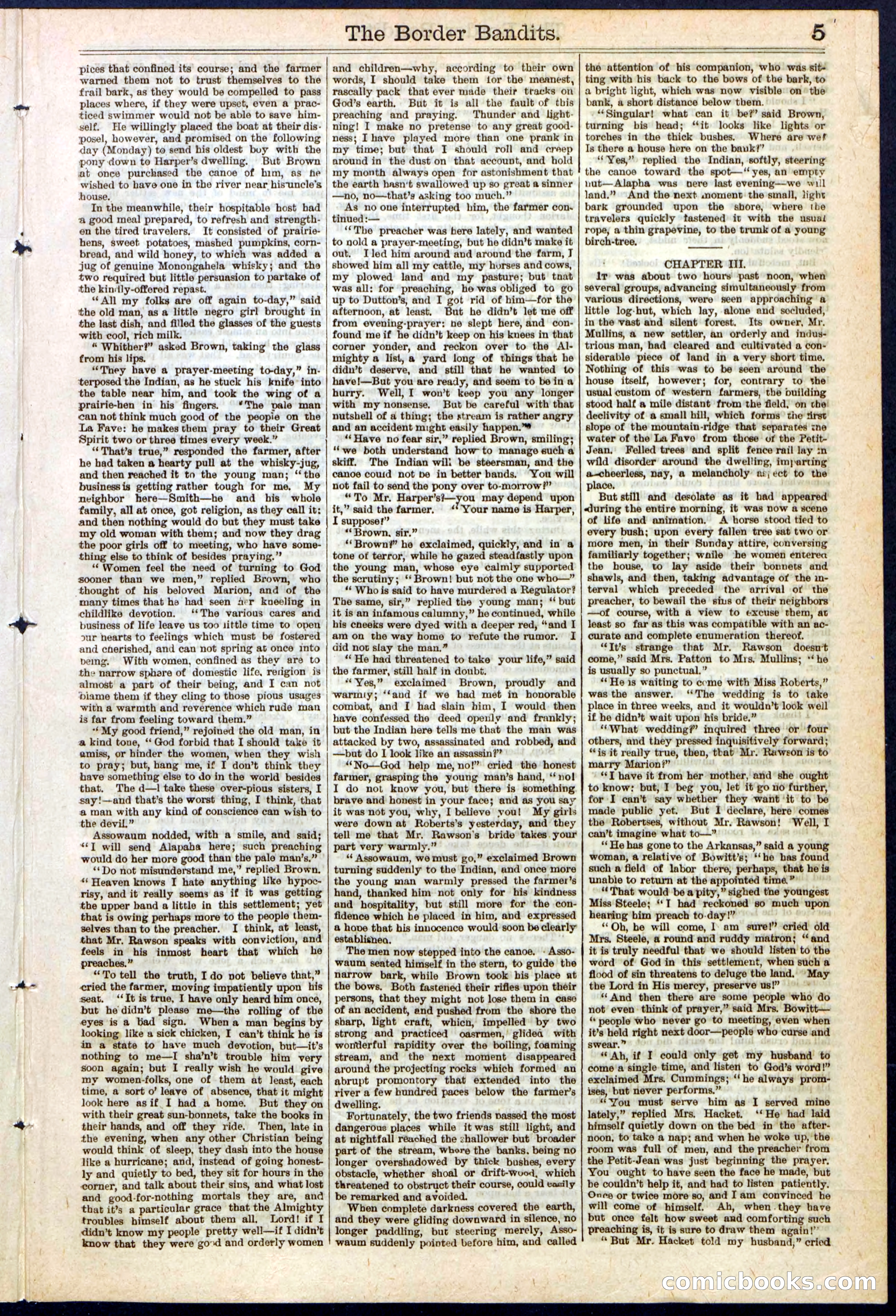
A restored page from Pulp Fiction, 1881. Page through the whole issue in the reader above.
📄 Transcribed text from this page (OCR, searchable)
Machine-transcribed from the original scan — historical spelling and the odd misread are preserved.
pices that confined its course; and the farmer warned them not to trust themselves to the frail bark, as they would be compelled to pass places where, if they were upset, even a prac- ticed swimmer would not be able to save him- self. He willingly placed the boat at their dis- posel, however, and promised on the following day (Monday) to send his oldest boy with the pony down to Harper’s dwelling. But Brown at once purchased the canoe of him, as he wished to have one in the river near hisuncle’s house. In the meanwhile, their hospitable host had a good meal prepared, to refresh and strength- en the tired travelers, It consisted of prairie- hens, sweet potatoes, mashed pumpkins, corn- bread, and wild honey, to which was added a jug of genuine Monongahela whisky; and the two required but little persuasion to partake of ithe kinelly-offered repast. *“ All my folks are off again to-day,” said the old man, as a little negro girl brought in the last dish, and filled the glasses of the guests with cool, rich milk. “ Whither?” asked Brown, taking the glass from his lips. “They have a prayer-meeting to-day,” in- terposed the Indian, as he stuck his knife into the table near him, and took the wing of a prairie-hen in his fingers. “The vale man can not think much good of the peopie on the La Fave: he makes them pray to their Great Spirit two or three times every week.” “‘That’s true,” responded the farmer, after he had taken a hearty pull at the whisky-jug, and then reached it to the young man; “the businessis getting rather tough for me, My neighbor here—Smith—he and bis whole family, all at once, got religion, as they call it: and then nothing would do but they must take my old woman with them; and now they drag the poor girls off to meeting, who have some- thing else to think of besides praying.” ‘Women feel the need of turning to God sooner than we men,” replied Brown, who thought of his beloved Marion, and of the many times that he had seen Arr kneeling in childlike devotion. ‘‘The various cares and business of life leave us too iittle time to open our hearts to feelings which must be fostered and cherished, and can not spring at once into peng. With women, confined as they are to the narrow sphere of domestic life, rerigion is almost a part of their being, and I can not diame them if they cling to those pious usages with a warmth and reverence which rude man is far from feeling toward them.” **My good friend,” rejoined the old man, in a kind tone, ‘‘ God forbid that I should take it amiss, or hinder the women, when they wish to pray; but, hang me, if I don’t think they have something else to do in the world besides that. The d—! take these over-pious sisters, I say!—and that’s the worst thing, I think, that a man with any kind of conscience can wish to the devil.” Assowaum nodded, with a smile, and said; *“‘T will send Alapaha here; such preaching would do her more good than the pale man’s,” ‘‘Do not misunderstand me,” replied Brown. ‘‘ Heaven knows I hate anything like hypoc- risy, and it really seems as if it was getting the upper band a little in this settlement; yet that is owing perhaps more to the people them- selves than to the preacher. I think, at least, that Mr. Rawson speaks with conviction, and feels in his inmost heart that which he preaches.” “To tell the truth, Ido vot believe that,” cried the farmer, moving impatiently upon his seat. ‘‘It is true, I have only heard bim once, but he didn’t please me—the rolling of the eyes is a bad sign. Whena man begins by looking like a sick chicken, I can’t think he is in a state to have much devotion, but—it’s nothing to me—I sha’n’t trouble him very soon again; but I really wish he would give my women-folks, one of them at least, each time, a sort o’ leave of absence, that it might look here asif I had a home. But they on with their great sun-bonnets, take the books in their hands, and off they ride. Then, late in the evening, when any other Christian being would think of sleep, they dash into the house like a hurricane; and, instead of going honest- ly and quietly to bed, they sit for hours in the corner, and talk about their sins, and what lost and good-for-nothing mortals they are, and that it?s a particular grace that the Almighty troubles himself about them all, Lord! if I didn’t know my people pretty well—if I didn’t know that they were good and orderly women The Border Bandits. a a i ee 5 8 eee eee eee eee and children—why, according to their own words, I should take them tor the meanest, rascally pack that ever made their tracks on God’s earth. But it is all the fault of this preaching and praying. Thunder and light- ning! I make no pretense to any great good- ness; Ihave played more than one prank in my time; but that I should roll and creep around in the dust on that account, and hold my month always open for astonishment that the earth hasn’‘t swallowed up so great a sinner —no, no—that’s asking too much.” As no one interrupted him, the farmer con. tinued :— ‘The preacher was bere lately, and wanted to nold a prayer-meeting, but he didn’t make it out. Iled him around and around the farm, J showed him all my cattle, my horses and cows, my plowed land and my pasture; but that was all: for preaching, he was obliged to go up to Dutton’s, and I got rid of him—for the afternoon, at least, But he didn’t let me off from evening-prayer: be slept here, and con- found me if he didn’t keep on his knees in that corner yonder, and reckon over to the Al- mighty a list, a yard long of things that he didn’t deserve, and still that he wanted to have!—But you are ready, and seem to bein a hurry. Well, I won’t keep you any longer with my nonsense. But be careful with that nutshell of a thing; the stream is rather angry and an accident might easily happen.™ ‘‘Have no fear sir,” replied Brown, smiling; ‘“we both understand how-to manage such a skiff. The Indian wili be steersman, and the canoe couid not be in better bands. ‘You will not fail to send the pony over to-morrow?” “To Mr. Harper’s}—you may depend upon it,” said the farmer. ‘* Your name is Harper, I suppose?” **Brown, sir.” ‘*Brown?” he exclaimed, quickly, and in a tone of terror, while he gazed steadfastly upon the young man, whose eye calmly supported the scrutiny; ‘‘ Brown! but not the one who—” ‘* Who is said to have murdered a Regulator? The same, sir,” replied the young man; “ but it is an infamous calumny,” he continued, while his cheeks were dyed with a deeper red, “and I am on the way home to refute the rumor. I did not slay the man,” ‘‘ He had threatened to take your life,” said the farmer, still half in doubt. “Yes,” exclaimed Brown, proudly and warmiy; ‘‘and if we had met in honorable combat, and [ had slain him, I would then have confessed the deed openly and frankly; but the Indian here tells me that the man was attacked by two, assassinated and robbed, and —but do I look like an assassin?” “‘No—God help me, no!” cried the honest farmer, grasping the young man’s hand, “nol I do not know you, but there is something brave and honest in your face; and as you say it was not you, why, I believe vou! My girls were down at Roberts’s yesterday, and they tell me that Mr. Rawson's bride takes. your part very warmly.” “ Assowaum, we must go,” exclaimed Brown turning suddenly to the Indian, and once more the young man warmly pressed the farmer’s hand, thanked him not only for his kindness and hospitality, but still more for the con- fidence which he placed in him, and expressed a hove that his innocence would soon be clearly establisnea. The men now stepped into the canoe. - Asso- waum seated himself in the stern, to guide the narrow bark, while Brown took his place at the bows. Both fastened their rifles upon their persons, that they might not lose them in case of an accident, and pushed from the shore the sharp, light craft, whicn, impelled by two strong and practiced oasrmen, glidea with womderful rapidity over the boiling, foaming stream, and the next moment disappeared around the projecting rocks which formed an abrupt promontory that extended into the river a few bundred paces below the farmer’s dwelling. Fortunately, the two friends passed the most dangerous places while it was still light, and at nightfall reached the zhallower but broader part of the stream, Where the banks. being no longer overshadowed by thick bushes, every obstacle, whether shoal or drift-wvod, which threatened to obstruct their course, could easily be remarked and avoided. When complete darkness covered the earth, and they were gliding downward in silence, no longer paddling, but steering merely, Asso- waum suddenly pointed before him, and called \ ; the attention of his companion, who was sit- ting with his back to the bows of the bark, to a bright light, which was now visible on’ the bank, a short distance below them. “Singular! what can it be?’ said Brown, turning bis head; “it looks like lights or torches in the thick bushes. Where are wef Is there a house here on the bank?” “Yes,” replied the Indian, softly, steering the canoe toward the spot—“ yes, an empty nut—Alapha was nere last evening—we will land.” And the next moment the small, light bark grounded upon the sbore, where the travelers quickly tastened it with the usual rope, a thin grapevine, to the trunk of a young birch-tree. : CHAPTER III. it lr was about two hours past noon, when several groups, advancing simultaneously from various directions, were seen approaching a little log-hut, which lay, alone and secluded, in the vast and silent forest. Its owner, Mr. Mullins, a new settler, an orderly and indus- trious man, had cleared and cultivated a con- siderable piece of land in a very short time. Nothing of this was to be seen around the house itself, however; for, contrary to the usual custom of western farmers, the building stood half a mile distant from the fleld, on the declivity of a small bill, which forms the tirst slope of the mountain-ridge that separates ine water of the La Fave from those of the Petit- Jean, Felled trees and split fence rail lay :n wild disorder around the dwelling, imparting a-—cheerless, nay, a melancholy as; ect to the place. : an But still and desolate as it had appeared «luring the entire morning, it was now a scene of life and anirnation. <A horse stood tied to every bush; upon every fallen tree sat two or more men, in their Sunday attire, conversing familiarly together; waoile be women enterea the house, to lay aside their bonnets and shawls, and then, taking advantage of the in- terval which preceded the arrival orf the preacher, to bewail the sius of their neighbors —of course, with a view to excuse them, at least so far as this was compatible with an ac- curate and complete enumeration thereof. “Tt’s strange that Mr. Rawson doesnt come,” said Mrs. Patton to Mrs. Mullins; *‘ he is usually so punctual.” ‘He is waiting to come with Miss Roberts,” was the answer. ‘‘The wedding is to take place in three weeks, and it wouldn’t look well if he didn’t wait upon his bride.” , ‘“‘What wedding?’ inquired three or four others, and they pressed inquisitively forward; “is it really true, then, that Mr. Rawson is to marry Marion?” “TI have it from her mother, and she ought to know: but, I beg you, let it go no further, for I can’t say whether they want ‘it to be made public yet. But I declare, here comes the Robertses, without Mr. Rawson! Well, I can’t imagine what to—” | 8 eee ** He has gone to the Arkansas,” said a young woman, a relative of Bowitt’s; ‘‘he bas found such a field of labor there, perhaps, that he is unable to return at the appointed time ”’ ' “That would be a pity,” sighed the youngest Miss Steele; “I had reckoned so much upon hearing bim preach to-day!” | ‘“Oh, be will come, |. am sure!” cried old Mrs. Steele, a round and ruddy matron; “and it is truly needful that we should listen to the word of Godin this settlement, when such a flood of sin threatens to deluge the land. May the Lord in His mercy, preserve us!” ‘And then there are some people who do not even think of prayer,” said Mrs. Bowitt— “ people who never go to meeting, even when it’s held right next door—people who curse and swear.” — de “Ah, if I could only get my husband to come a single time, and listen to God’s word!” exclaimed Mrs. Cummings; “he always prom- ises, but never performs.” : “You must serve him as I served mine lately,” replied Mrs. Hacket. ‘‘ He had laid himself quietly down on the bed in the after- noon, to take a nap; and when he woke up, the room was full of men, and the preacher from the Petit-Jean was just beginning the prayer, You ought to have seen the face he made, but be couldn’t help it, and had to listen patiently. Once or twice more so, and Iam convinced he will come of himself. Ah, when they have but once felt how sweet and comfor such preaching is, it is sure to draw them again!” “But Mr. Hacket told my husband,” cried s) (El) Jcomichdoo