
Pulp Fiction, 1881 · page 3 of 24
Beadle's New York Dime Library, No. 138 — page 3: what you’re looking at
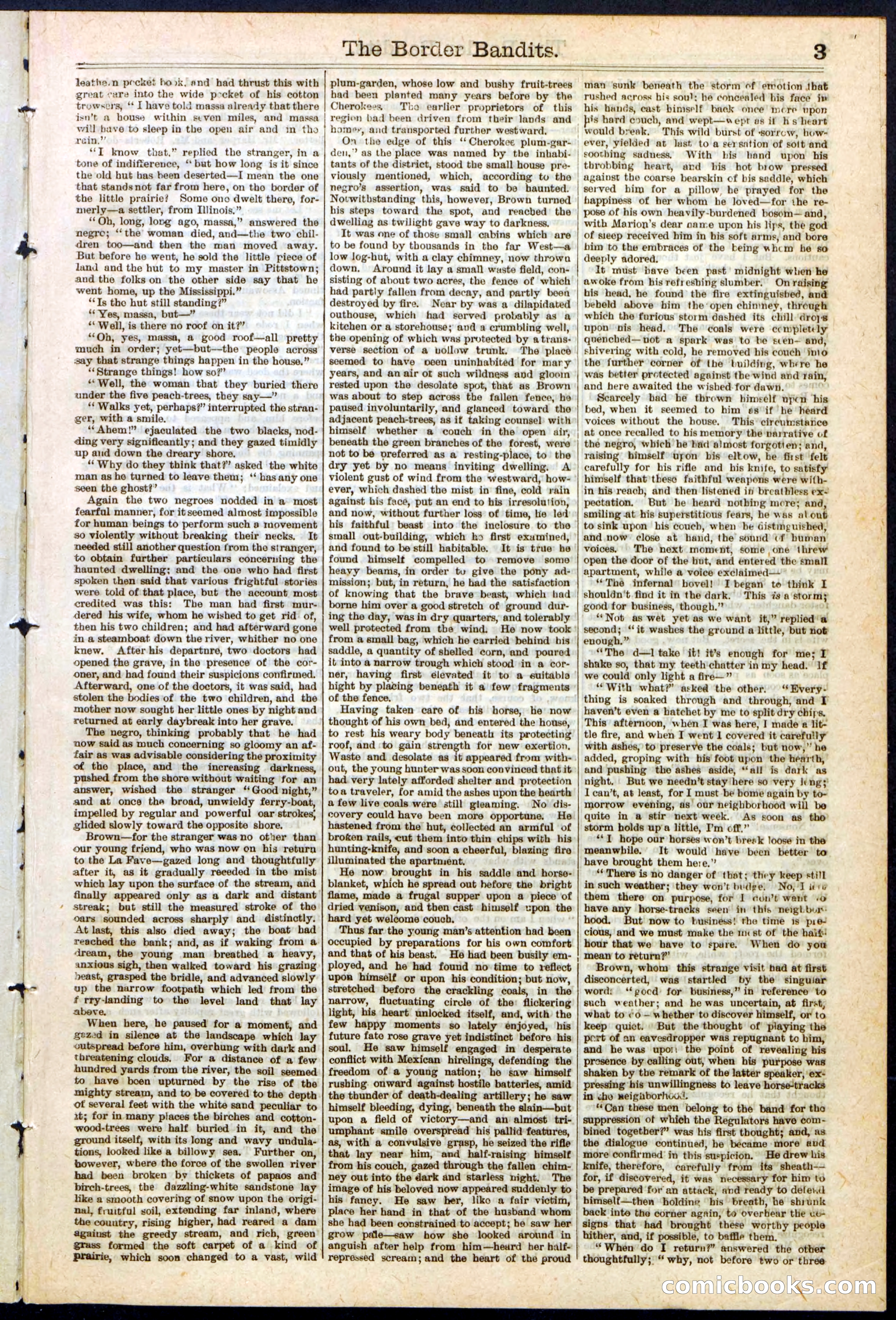
A restored page from Pulp Fiction, 1881. Page through the whole issue in the reader above.
📄 Transcribed text from this page (OCR, searchable)
Machine-transcribed from the original scan — historical spelling and the odd misread are preserved.
Ome -- - LL — —— — — The Border Bandits. | leathe.n pecket book, and had thrust this with | plum-garden, whose low and bushy fruit-trees great care into the wide pocket of his cotton trowsers, ‘ I have told massa already that there ixn’t a bouse within seven miles, and massa will bave to sleep in the open air and in tho rein.”’ ‘“‘T know that,” replied the stranger, in a tone of indifference, “‘ but how long is it since the old hut bas been deserted—I mean the one that standsnot far from here, on tho border of the little prairie? Some ono dwelt there, for- merly—a settler, from Illinois.” ‘Oh, long, lorpg ago, massa,” answered the negro; ‘‘the woman died, and—the two chil- dren too—and then the man moved away. But before he went, he sold the little piece of land and the hut to my master in Pittstown; and the folks on the other side say that he went home, up the Mississippi.” **Ts the hut still standing?” “Yes, massa, but—” ** Well, is there no roof on it?” “Oh, yes, massa, a good roof—all pretty much in order; yet—but—-the people across say that strange things happen in the house.” “Strange things! how so?’ *‘ Well, the woman that they buried there under the five peach-trees, they say—” ** Walks yet, perhaps?” interrupted the stran- ger, with a smile. ‘‘Ahem!” ejaculated the two blacks, nod- ding very significantly; and they gazed timidly up aud down the dreary shore. ““ Why do they think that?’ asked the white man as he turned to leave them; ‘ bas any one seen the ghost?’ Again the two negroes nodded in a most fearful manner, for itseemed almost impossible for human beings to perform such s movement so violently without breaking their necks, It needed still another question from the stranger, to obtain further particulars concerning the haunted dwelling; and the one who had first spoken then said that various frightful stories were told of that place, but the account most credited was this: Tbe man had first mur- dered his wife, whom he wished to get rid of, then his two children; and had afterward gone in a steamboat down the river, whither no one knew. After his departure, two doctors had opened the grave, in the presence of the cor- oner, and had found their suspicions confirmed. Afterward, one of the doctors, it was said, had stolen the bodies of the two children, and the mother now sought her little ones by night and returned at early daybreak into her grave. The negro, thinking probably that he had now said as much concerning so gloomy an af- fair as was advisable considering the proximity of the place, and the increasing darkness, pushed from the shore without waiting for an answer, wished the stranger ‘Good night,” and at once the broad, unwieldy ferry-boat, impelled by regular and powerful oar strokes, glided slowly toward the opposite shore. Brown—for the stranger was no other than our young friend, who was now on his return to the La Fave—gazed long and thoughtfully after it, as it gradually reeeded in the mist which lay upon the surface of the stream, and finally appeared only as a dark and distant streak; but still the measured stroke of the oars sounded across sharply and distinctly. At last, this also died away; the boat had reached the bank; and, as if waking from a dream, the young man breathed a heavy, anxious sigh, then walked toward his grazing beast, grasped the bridle, and advanced slowly up the narrow footpath which led from the f rry-landing to the level land that lay abeve. When here, he paused for a moment, and gezed in silence at the landscape which lay vutspread before him, overhung with dark and threatening clouds. For a distance of a few hundred yards from the river, the soil seemed fo have boen upturned by the rise of the mighty stream, and to be covered to the depth ot several feet with the white sand peculiar to at; for in many places the birches and cotton- wood-trees were half buried in it, and the itself, with its long and wavy undula- tions, looked like a billowy sea, Further on, bowever, where the force of the swollen river had been broken by thickets of papaos and birch-trees, the dazzling-white sandstone lay like a smooth covering of snow upon the origi- nal, fruitful soil, extending far inland, where the country, rising higher, had reared a dam against the greedy stream, and rich, green grass formed the soft carpet of a kind of. Prairie, which soon changed to a vast, wild 7 had been planted many years before by the Cherokees, Tho earlier proprietors of this region bad been driven from their lands and — homer, and transported further westward. On the edge of this ‘‘ Cherokee plum-gar- den,’ as the place was named by the inhabi- tants of the district, stood the small house pre- viously mentioned, which, according to the negro’s assertion, was said to be haunted. Notwithstanding this, however, Brown turned his steps toward the spot, and reacbed the dwelling as twilight gave way to darkness. It was one of those small cabins which are to be found by thousands in the far West—a low log-hut, with a clay chimney, now thrown down. Around it lay a small waste field, con- sisting of about two acres, the fence of which had partly fallen from decay, and partly been destroyed by fire. Near by was a dilapidated outhouse, which had served probably as a kitchen or a storehouse; avd a crumbling well, the opening of which was protected by a trans- verse section of a vollow trunk. The place seemed to have ween uninhabited for mary years, and anair of such wildness and gloom rested upon the desolate spot, that as Brown was about to step across the fallen fence, he paused involuntarily, and glanced toward tho adjacent peach-trees, as it taking counsel with himself whether a couch in the open air, beneath the green branches of the forest, were not to be vreferred as a resting-place, to the dry yet by no means inviting dwelling. <A violent gust of wind from the westward, how- ever, which dashed the mist in fine, cold rain against bis face, put an end to his irresolution, and now, without further loss of time, tie led his faithful beast into the inclosure to the small out-building, which ko first exumined, and found to be still habitable. It is true be found himself compelled to remove some heavy beams, in order tu give the pony ad- mission; but, in return, he bad the satisfaction of knowing that the brave beast, which had borne him over a good stretch of ground dur- ing the day, was in dry quarters, and tolerably well protected from tbe wind: He now took from a small bag, which he carried behind his saddle, a quantity of shelled corn, and poured it into a narrow trough which stood in a cor- ner, having first élevated it to a suitabls hight by plating beneath it a few fragments of the fence. Having taken care of his horse, he now thought of his own bed, and entered the house, to rest his weary body beneath its protecting roof, and to gain strength for new exertion. Waste and desolate as it appeared from with- out, the young hunter was soon convinced that it had very lately afforded shelter and protection toa traveler, for amid the ashes upon the hearth a few live coals were still gleaming. No dis- covery could have been more opportune. He hastened from the hut, collected an armful of broken rails, cut them into thin chips with his hunting-knife, and soon a cheerful, blazing fire illuminated the apartment, He now brought in his saddle and horse- blanket, which he spread out hefore the bright flame, made a frugal supper upon a piece of dried venison, and then cast himself upon the hard yet welcome couch, Thus far the young man’s attention had been occupied by preparations for his own comfort and that of his beast. He had been busily em- ployed, and he had found no time to reflect upon himself or upon his condition; but now, stretched before the in the narrow, fluctuating circle of the: flickering light, his heart unlocked itself, and, with the few happy moments so lately énjoyed, his future fate rose grave yet indistinct before his soul. He saw himself engaged in desperate conflict with Mexican hirelings, defending the freedom of a young nation; he saw himself rusbing onward against hostile batteries, amid the thunder of death-dealing artillery; he saw himself bleeding, dying, beneath the slain—but upon a field of victory—and an almost tri- umphant smile overspread his pallid features, as, with a convulsive grasp, he seized the rifle that lay near him, and half-raising himself from his couch, gazed through the fallen chim- ney out into the dark and starless night. The image of his beloved now appeared suddenly to his fancy. He saw her, liko a fair victim, place her hand in that of the husband whom she had been constrained to accept; be saw her grow padle—saw how she looked around in anguish after help from him—heurd her half- repressed scream; and the heart of the proud 3 man sunk beneath the storm of emotion that rushed across his soul: he concealed his face fp his hands, east bimsrlf back once mere upon is hard couch, and wept—oepr as if hs heart _ would break. This wild burst of sorrow, how- ever, yielded at last to a sersation of soit and soothing sadness, With his hand upon his throbbing heart, and his hot brow pressed against the coarse bearskin of bis seddle, which served him for a pillow, he prayed for the happiness of her whom he loved—for the re- pose of his own heavily-burdened bosom— and, with Marion's dear oame upon his lips, the god of sieep received him in his soft arms, and bore bim to the embraces of the being whcm he so deeply adored. It must have been past midnight when he awoke from his refreshing slumber. On raising bis head, he found the fire extinguished, and beheld above him theopen chimney, through which the furious storm dashed its chill droy# upon nis head. The coals were ccmpletely quencbed— not a spark was to be scven— and, shivering with cold, he removed his couch inio the further corner of the building, where he was better protected against the wind and Ta and here awaited the wished for dawni. tone Scarcely bad he thrown himeelf uyicn his bed, when it seemed to him és if he heard voices without the house. This circumstatce at once recalled to his memory the narrative of the negro, which he had almost forgotten; and, raising himself upon bis eltow, he first felt carefully for his rifle and his knife, to satisfy himself that these faithful weapons were with- in his reach, and then listened if breathless ex- pectation. But be heard nothing more; and smiling at his superstitious fears, he was alout to sink upon bis couch, when he distmguirhed, and now close at hand, the sound «f buman voices, The next moment, some one threw open the door of the but, and entered the small apartment, while a voice exclaimed— “The infernal bovel! I began to think I shouldn't find it in the dark. This 7s a stormy good for business, though.” | rt “Not as wet yet as we want it,” replied'a second; ‘‘it washes the ground a little, but not enough,” “The d—1 take it! it’s enough for me; IT shake so, that my teeth chatter in my head. If we could only light a fire—” “With what?” asked the other. “Every- thing is soaked through and through, and FP haven’t even a hatchet by me to split dry chips, This afternoon, when I was here, I made e lit- tle fire, and when I went 1 covered it carefully’ with ashes, to preserve the coals; but now,” he added, groping with his foot upon the hearth, and pushing the ashes aside, “all is dark as night. But we needn’t stay here so very jing; I can’t, at least, for I must be bome again by to- morrow evening, as our heighborhood will be quite in a stir next week. As soon as tho’ storm holds up‘a little, I’m off.” **IT hope our horses won’t bresk loose in the meanwhile. It would have been better to have brought them here.” , “There is no danger of that; they keep still in such weather; they won't budge, No, I ire them there on purpose, for 1 dun’t want .o have any horse-tracks seen in this neigh bur: hood. But now to business! the time is pie cious, and we must make the tn st of the halt! hour that we bave to spure. When do you mean to return?” 4 Brown, whom this strange visit bad at first disconcerted, was startled by the singuiar word: ‘‘pocd for business,” in reference to such weather; and he was uncertain, at first, what to ¢o— whether to discover himself, or to keep quict. But the thought of 0 spam Po pert of an eavesdropper was repugnant to him, and he was upor the point of revealing his presence by calling out, when his purpose was shaken by the remark of the latter speaker, ex pressing his unwillingness to leave horse-tracks in che neighborhood. | **Can these men belong to the band for the suppression of which the Regulators have com- bined together?” was his first thought; and, as the dialogue continued, he became more aud more confirmed in this suspicion. He drew his knife, therefore, carefully from its sheath-~ for, if discovered, if was necessary for him to be prepared for an attack, and ready to delenih bimself—then holding his breath, he shrunk back inte the corner again, to overhear the ue- signs that had brought these worthy people hither, and, if possible, to baffle them.” “When do I return?” answered the other thoughtfully; “ why, not before two or three ; ‘ “ ‘a (e(0) GOMIGDOOKS