
Pulp Fiction, 1881 · page 2 of 24
Beadle's New York Dime Library, No. 138 — page 2: what you’re looking at
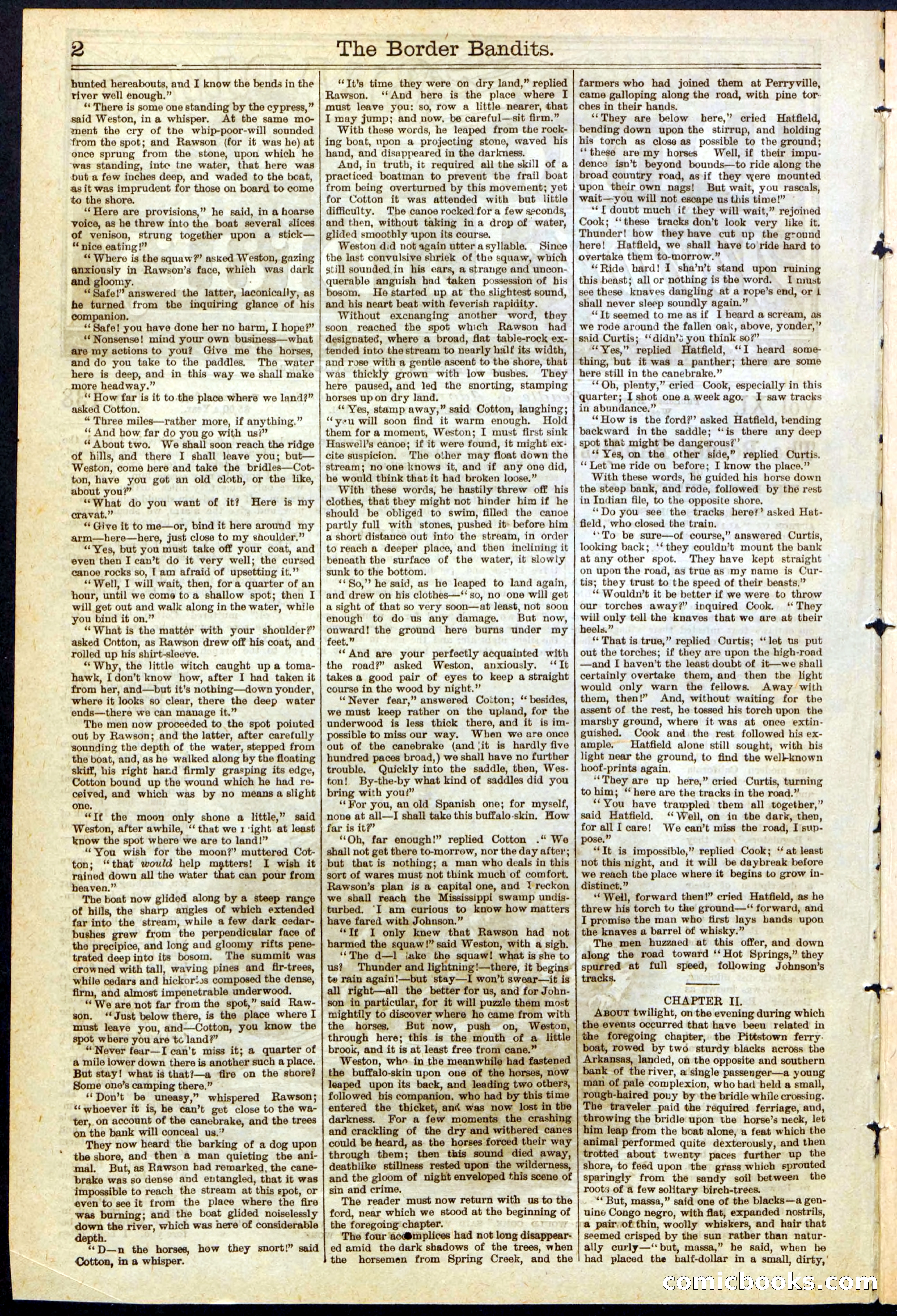
A restored page from Pulp Fiction, 1881. Page through the whole issue in the reader above.
📄 Transcribed text from this page (OCR, searchable)
Machine-transcribed from the original scan — historical spelling and the odd misread are preserved.
2 The Border Bandits. hunted hereabouts, and I know the bends in the river well enough.” ‘* There is some one standing by the cypress,” said Weston, in a whisper. At the same mo- ment the cry of the whip-poor-will sounded from the spot; and Rawson (for it was he) at once sprung from the stone, upon which he ‘was standing, intc tne water, that here was but a few inches deep, and waded to the boat, as it was imprudent for those on board to come to the shore. ‘Here are provisions,” he said, in a hoarse voice, as he threw into the boat several slices of venison, strung together upon a stick— “nice eating!” ** Where is the squaw?”’ asked Weston, gazing anxiously in Rawson’s face, which was dark and gloomy. “Safe!” answered the latter, laconically, as he turned from the inquiring glance of his companion. _** Safe! you have done her no harm, I hope?” “Nonsense! mind your own business—what are my actions to you? Give me the horses, and do you take to the paddles. The water here is deep, and in this way we shall make more headway.” ‘* How far is it to the place where we land?” asked Cotton. “Three miles—rather more, if anything.” ** And how far do you go with us?” * About two. We shall soon reach the ridge of hills, and there I shall leave you; but— Weston, come here and take the bridles—Cot- ton, have you got an old cloth, or the like, about you?’ “What do you want of it? Here is my cravat.” “ Give it to me—or, bind it here around my arm—here—here, just close to my shoulder.” “Yes, but you must take off your coat, and even then I can’t do it very well; the cursed canoe rocks so, [ am afraid of upsetting it.” ‘Well, I will wait, then, fora quarter of an hour, until we come to a shallow spot; then I will get out and walk along in the water, while you bind it on.” “What is the mattér with your shoulder?” asked Cotton, as Rawson drew off his coat, and rolled up his shirt-sleeve. “Why, the little witch caught up a toma- hawk, I don’t know how, after I had taken it from her, and—but it’s nothing—down yonder, where it looks so clear, there the deep water ends—there we can manage it.” The men now proceeded to the spot pointed out by Rawson; and the latter, after carefully sounding the depth of the water, stepped from the boat, and, as he walked along by the floating skiff, his right hand firmly grasping its edge, Cotton bound up the wound which he had re- ceived, and which was by no means a slight one. “Tf the moon only shone a little,” said Weston, after awhile, “‘ that we 1 ‘ight at least know the spot where we are to land!” “You wish for the moon?” muttered Cot- ton; “that would help mgtters! I wish it rained down all the water that can pour from heaven.” The boat now glided along by a steep range of hills, the sharp angles of which extended Seidler” the stream, while a few dark cedar- es grew from the perpendicular face of the precipice, and long and gloomy rifts pene- trated deep into its bosom. The summit was crowned with tall, waving pines and fir-trees, while cedars and hickor‘.s composed the dense, firm, and almost impenetrable underwood. “We are not far from the spot,” said Raw- son. ‘Just below there, is the place where I must leaye you, and—Cotton, you know the spot where you are tc land?” “Never fear—I can’t miss it; a quarter of a mile lower down there is another such a place. But stay! what is that?—a fire on the shore? me one’s camping there.” ‘“Don’t be uneasy,” whispered Rawson; ‘‘ whoever it is, he can’t get close to the wa- ter, on account of the canebrake, and the trees on the bank will conceal us.” They now heard the barking of a dog upon the shore, and then a man quieting the ani- ‘mal, But, as Rawson bad remarked, the cane- brake was so dense and entangled, that it was impossible to reach the stream at this epot, or even to see it from the place where the fire was burning; and the boat glided noiselessly ‘down the river, which was here of considerable ‘““D—n the horses, how they snort!” said Cotton, in a whisper. the buffalo-skin upon one of the “‘Tt’s time they were on dry land,” replied Rawson. ‘‘And here is the place where I must leave you: so, row a little nearer, that I may jump; and now, be careful—-sit firm.” With these words, he leaped from the rock- ing boat, npon a projecting stone, waved his hand, and disappeared in the darkness. And, in truth, it required all the skill of a practiced boatman to prevent the frail boat from being overturned by this movement; yet for Cotton it was attended with but little difficulty. The canoe rocked for a few seconds, and then, without taking ina drop of water, glided smoothly upon its course. Weston did not again utter asyllable. Since the last convulsive shriek of the squaw, which still sounded in his ears, a strange and uncon- querable anguish bad taken possession of bis bosom, He started up at the slightest sound, and his neart beat with feverish rapidity. Without exchanging another word, they soon reached the spot which Rawson had designated, where a broad, flat table-rock ex- tended into the stream to nearly half its width, and rose with a gentle ascent to the shore, that was thickly grown with low busbes. They here paused, and led the snorting, stamping horses upon dry land. ‘Yes, stamp away,” said Cotton, laughing; “veu will soon find it warm enough. Hold them for a moment, Weston; I must first sink Haswell’s canoe; if it were found, it might ex- cite suspicion. The other may float down the stream; no one knows it, and if any one did, he would think that it had broken loose.” With these words, he hastily threw off his clothes, that they might not hinder him if he should be obliged to swim, filled the canoe partly full with stones, pushed it» before him a short distance out into the stream, in order to reach a deeper place, and then inclining it beneath the surface of the water, it slowly sunk to the bottom. ‘«So,”? he said, as he leaped to land again, and drew on his clothes—*‘ so, no one will get a sight of that so very soon—at least, not soon enough to do us any damage. But now, onward! the ground here burns under my feet.” ‘*And are your perfectly acquainted with the road?” asked Weston, anxiously. ‘It takes a good pair of eyes to keep a straight course in the wood by night.” “ Never fear,” answered Cotton; “ besides, we must keep rather on the upland, for the underwood is less thick there, and it is im- possible to miss our way. When we are once out of the canebrake (and /it is hardly five hundred paces broad,) we shall have no further trouble. Quickly into the saddle, then, Wes- ton! By-the-by what kind of saddles did you bring with you?” ‘‘Hor you, an old Spanish one; for myself, none at all—I shall take this buffalo-skin, How far is it?” “Oh, far enough!” replied Cotton .“ We shall not get there to-morrow, nor the day after; | but that is nothing; a man who deals in this sort of wares must not think much of comfort. Rawson’s plan is a capital one, and 1 reckon we sball reach the Mississippi swamp undis- turbed. ‘I am curious to know how matters have fared with Johnson.” “Tf I only knew that Rawson had not barmed wa w!” said Weston, with a sigh. ‘The d—1 lake ar Baer * what is she to us? Thunder and lightning!—there, it begins t rain again!—but stay—I won’t swear—it is all right—all the better for us, and for John- son in particular, for it will puzzle most mightily to discover where he came from with the horses, But now, push on, Mae through here; this is the mouth of a brook, and it is at least free trom can a Weston, who in the meanwhil leaped upon its back, and | followed his companion, deathlike stillness rested upon the wilderness, and the gloom of night enveloped this scene of sin and crime. The reader must now return with us to the ford, near which we stood at the beginning of the foregoing chapter. Gy The four ac@mplices had not long disappear- ed amid the dark shadows of the trees, when the horsemen from Spring Creek, and the farmers who had joined them at Perryville, came galloping along the road, with pine tor- ches in their hands. ‘“‘They are below here,’ cried Hatfield, bending down upon the stirrup, and holding his torch as close as possible to the ground; “these are my horses Well, if their impu- dence isn’t beyond bounds—to ride along the broad country road, as if they were mounted upon their own nags! But wait, you rascals, wait—you will not escape us this time!” ‘““{ doubt much if they will wait,” rejoined Cook; ‘‘these tracks don’t look very like it. Thunder! how they have cut up the ground here! Hatfield, we shall have to ride hard to overtake them to-morrow.” “Ride hard! I sha’n’t stand upon ruining this beast; all or nothing is the word. I must see these knaves dangling at a rope’s end, or i shall never sleep soundly again.” *‘Tt seemed to me as if I heard a scream, as we rode around the fallen oak, above, yonder,” said Curtis; ‘‘didn’s you think so?” ! “Yes,” replied Hatfield, ‘‘1 heard som thing, but it was a panther; there are some here still in the canebrake.” **Oh, plenty,” cried Cook, especially in this quarter; I shot one a week ago, I saw tracks in abundance.” “‘How is the ford?’ asked Hatfield, bending backward inthe saddle; “is there any deep spot that might be dangerous?” ‘* Yes, on the other side,” replied Curtis. ** Let me ride ou before; I know the place.” With these words, he guided his horse down the steep bank, and rode, followed by the rest in Indian file, to the opposite shore. “Do you see the tracks here?’ asked Hat- field, who closed the train. ‘““To be sure—of course,” answered Curtis, looking back; ‘‘ they couldn’t mount the bank at any other spot. They have kept straight on upon the road, as true as my name is Cur- tis; they trust to the speed of their beasts.” ‘“Wouldn’t it be better if we were to throw our torches away?’ inquired Cook. ‘ They will only tell the knaves that we are at their heels.” * That is true,” replied Curtis; ‘‘let us put out the torches; if they are upon the high-road —and I haven't the least doubt of it—we shall certainly overtake them, and then the light would only warn the fellows. Away with them, then!” And, without waiting for the assent of the rest, he tossed his torch upon the marsby ground, where it was at once extin- guished. Cook and the rest followed his ex- ample, Hatfield alone still sought, with his light near the ground, to find the welkknown hoof-prints again, ‘They are up here,” cried Curtis, turning to him; “‘ here are the tracks in the road.” *“You have trampled them all together,” said Hatfield. ‘‘ Well, on in the dark, then, for all [ care! We can’t miss the road, I sup- pose,” “It is impossible,” replied Cook; “ at least ‘not this night, and it will be daybreak before we reach the place where it begins to grow in- distinct.” ‘Well, forward then!” cried Hatfield, as he threw his torch tu the ground—*“ forward, and I promise the man who first lays bands upon the knaves a barrel of whisky.” The men huzzaed at this offer, and down along the road toward ‘‘ Hot Springs,” they spurred at full speed, following Johnson’s track % pana ohn CHAPTER II. Axsout twilight, on the evening during which | the events occurred that have beeu related in the foregoing chapter, the Pittstown ferry. »oat, rowed by two sturdy blacks across the Arka landed, on the opposite and southern sank of the river, a single passenger—a young mm of pale complexion, who had held a small, Tough-haired pony by the bridle while crossing. The traveler paid the required ferriage, and, throwing the bridje upon tbe horse’s neck, let him leap from the boat alone, a feat which the animal performed quite dexterously, and then trotted about twenty paces further up the shore, to feed upon ‘the grass which sprouted sparingly from the sandy soil between the roots of 4 few solitary birch-trees. ‘** But, massa,” said one of the blacks—a gen- uine Congo negro, with flat, expanded nostrils, a pairofthin, woolly whiskers, and hair that seemed crisped by the sun rather than natur- ally curly—‘ but, massa,” he said, when he \had placed the balf-dollar in a small, dirty,’ EOMmIGDOOKS.- Gol ‘ )