
Pulp Fiction, 1881 · page 22 of 24
Beadle's New York Dime Library, No. 138 — page 22: what you’re looking at
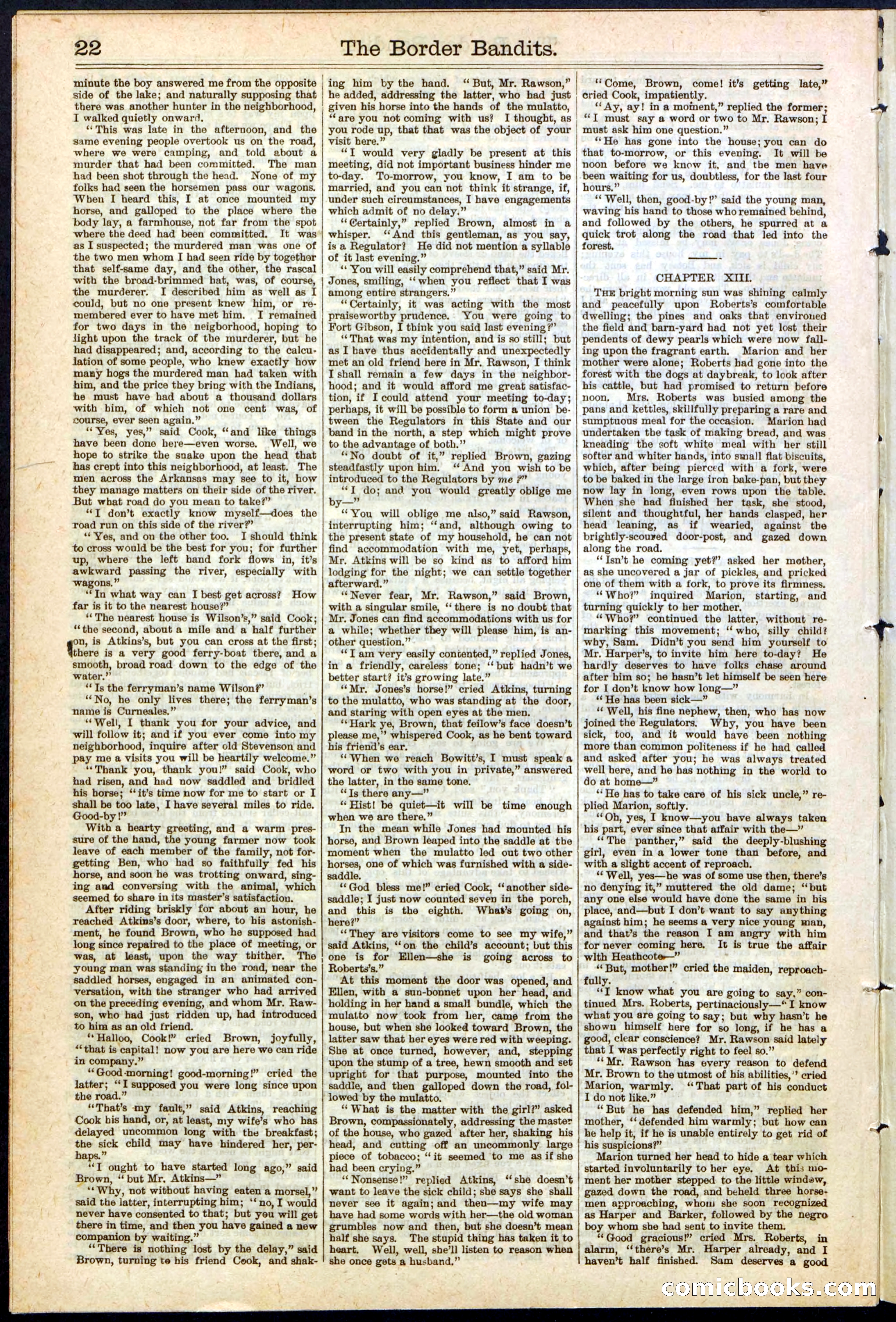
A restored page from Pulp Fiction, 1881. Page through the whole issue in the reader above.
📄 Transcribed text from this page (OCR, searchable)
Machine-transcribed from the original scan — historical spelling and the odd misread are preserved.
AE SS i a 22 minute the boy answered me from the opposite side of the lake; and naturally supposing that there was another hunter in the neighborhood, I walked quietly onward. “This was late in the afternoon, and the Same evening people overtook us on the road, where we were camping, and told about a murder that had been committed. The man had been shot through the head. None of my folks had seen the horsemen pass our wagons. When I heard this, I at once mounted my horse, and galloped to the place where the body lay, a farmhouse, not far from the spot where the deed had been committed. It was as I suspected; the murdered man was one of the two men whom I had seen ride by togethor that self-same day, and the other, the rascal with the broad-brimmed hat, was, of course, the murderer. I described him as well as I could, but no one present knew him, or re- membered ever to have met him. I remained for two days in the neigborhood, hoping to light upon the track of the murderer, but he had disappeared; and, according to the calcu- lation of some people, who knew exactly how many hogs the murdered man had taken with him, and the price they bring with the Indians, be must have had about a thousand dollars with him, of which not one cent was, of course, ever seen again.” “Yes, yes,” said Cook, “and like things have been done here—even worse. Well, we hope to strike the snake upon the head that has crept into this neighborhood, at least. The men across the Arkansas may see to it, how they manage matters on their side of the river. But what road do you mean to take?” *““T don’t exactly know myself—does the road run on this side of the river?” ‘‘ Yes, and on the other too. I should think to cross would be the best for you; for further up, where the left hand fork flows in, it’s awkward passing the river, especially with wagons.” ‘“*In what way can I best get across? How far is it to the nearest house?” ‘The nearest house is Wilson’s,” said Cook; “the second, about a mile and a half further on, is Atkins’s, but you can cross at the first; Finere is a very good ferry-boat there, and a smooth, broad road down to the edge of the water.”’ “Ts the ferryman’s name Wilson?” | “No, he only lives there; the ferryman’s name is Curneales.” | “Well, I thank you for your advice, and will follow it; and if you ever come into my i neighborhood, inquire after old Stevenson and | pay me a visits you will be heartily welcome.” “Thank you, thank you!” said Cook, who ia had risen, and had now saddled and bridled . his borse; ‘it’s time now for me to start or I shall be too late, I have several miles to ride. ‘ as Good-by !” : With a hearty greeting, and a warm pres- sure of the hand, the young farmer now took leave of each member of the family, not for- getting Ben, who had so faithfully fed his ' horse, and soon he was trotting onward, sing- ing and conversing with the animal, which seemed to share in its master’s satisfaction. After riding briskly for about an hour, he reached Atkins’s door, where, to his astonish- ment, he found Brown, who he supposed had long since repaired to the place of meeting, or was, at least, upon the way thither. The young man was standing iu the road, near the saddled horses, engaged in an animated con- versation, with the stranger who had arrived on the preceding evening, and whom Mr. Raw- son, who had just ridden up, had introduced to him as an old friend. *Halloo, Cook!” cried Brown, joyfully, “that is capital! now you are here we can ride in company.” “‘Good-morning! good-morning!” cried the latter; “‘I supposed you were long since upon the road.” “That’s my fault,” said Atkins, reaching Cook his hand, or, at least, my wife’s who has delayed uncommon long with the breakfast; the sick child may have hindered her, per- “T ought to have started long ago,” said if wn, “but Mr, Atkins—” **Why, not without having eaten a morsel,” said the latter, interrupting him; ‘‘ no, I would never have consented to that; but you will get there in time, and then you have gained a new companion by waiting.” “There is nothing lost by the delay,” said Brown, turning te his friend Cook, and shak- — . ' Ne 0 re ee ee -— ; d +. - Sw oo ec The Border Bandits. ing him by the hand. ‘“ But, Mr. Rawson,” he added, addressing the latter, who had just given his horse into the hands of the mulatto, “are you not coming with us? I thought, as “Come, Brown, come! it’s getting late,” cried Cook, impatiently. ‘Ay, ay! in a moment,” replied the former; “JT must say a word or two to Mr. Rawson; I you rode up, that that was the object of your | must ask him one question.” visit here.” “TY would very gladly be present at this meeting, did not important business hinder me to-day. To-morrow, you know, I am to be married, and you can not think it strange, if, under such circumstances, I have engagements which admit of no delay.” “Certainly,” replied Brown, almost in a whisper. ‘‘And this gentleman, as you say, is a Regulator? He did not mention a syllable of it last evening.” ‘* You will easily comprehend that,” said Mr. Jones, smiling, ‘‘when you reflect that I was among entire strangers.” “Certainly, it was acting with the most praiseworthy prudence. You were going to Fort Gibson, I think you said last evening?” “That was my intention, and is so still; but as I have thus accidentally and unexpectedly met an old friend here in Mr. Rawson, I think I shall remain a few days in the neighbor- hood; and it would afford me great satisfac- tion, if I could attend your meeting to-day; perhaps, it will be possible to form a union be- tween the Regulators in this State and our band in the north, a step which might prove to the advantage of both.” **No doubt of it,” replied Brown, gazing steadfastly upon him. ‘‘ And you wish to be introduced to the Regulators by me ?” “I do; and you would greatly oblige me by—” “You will oblige me also,” said Rawson, interrupting him; ‘and, although owing to the present state of my household, he can not find accommodation with me, yet, perhaps, Mr, Atkins will be so kind as to afford him lodging for the night; we can settle together afterward.” “Never fear, Mr. Rawson,” said Brown, with a singular smile, ‘‘ there is no doubt that Mr. Jones can find accommodations with us for a while; whether they will please him, is an- other question.” **T am very easily contented,” replied Jones, in a friendly, careless tone; ‘‘but hadn’t we better start? it’s growing late.” “Mr. Jones’s horse!” cried Atkins, turning to the mulatto, who was standing at the door, and staring with open eyes at the men. **Hark ye, Brown, that feilow’s face doesn’t please me,” whispered Cook, as he bent toward his friend's ear. *‘'When we reach Bowitt’s, I must speak a word or two with you in private,” answered the latter, in the same tone. “Ts there any—” “Hist! be quiet—it will be time enough when we are there.” In the mean while Jones had mounted his horse, and Brown leaped into the saddle at the moment when the mulatto led out two other horses, one of which was furnished with a side- saddle. : ‘God bless me!” cried Cook, “‘ another side- saddle; I just now counted seven in the porch, and this is the eighth. What’s going on, here?” “They are visitors come to see my wife,” said Atkins, ‘‘on the child’s account; but this one is for Ellen—she is going across to Roberts’s.” At this moment the door was opened, and Ellen, with a sun-bonnet upon her head, and holding in her hand a smali bundle, which the mulatto now took from her, came from the house, but when she looked toward Brown, the latter saw that her eyes were red with weeping. She at once turned, however, and, stepping upon the stump of a tree, hewn smooth and set upright for that purpose, mounted into the saddle, and then galloped down the road, fol- lowed by the mulatto. “What is the matter with the girl?” asked Brown, compassionately, addressing the master of the house, who gazed after her, shaking his head, and cutting off an uncommonly large piece of tobacco; “it seemed to me as if she had been crying.” “Nonsense!” replied Atkins, “she doesn’t want to leave the sick child; she says she shall never see it again; and then—my wife may have had some words with her—the old woman grumbles now and then, but she doesn’t mean half she says. The stupid thing has taken it to ‘He has gone into the house; you can do that to-morrow, or this evening. It will be noon before we know it, and the men have been waiting for us, doubtless, for the last four hours,” ** Well, then, good-by!” said the young man, waving his hand to those who remained behind, and followed by the others, he spurred at a quick trot along the road that led into the forest. CHAPTER XIII. THE bright morning sun was shining calmly and peacefully upon Roberts’s comfortable dwelling; the pines and oaks that environed the field and barn-yard had not yet lost their pendents of dewy pearls which were now fall- ing upon the fragrant earth. Marion and her mother were alone; Roberts had gone into the forest with the dogs at daybreak, to look after his cattle, but had promised to return before noon, Mrs. Roberts was busied among the pans and kettles, skillfully preparing a rare and sumptuous meal for the occasion. Marion had undertaken the task of making bread, and was kneading the soft white meal with her still softer and whiter hands, into small flat biscuits, which, after being pierced with a fork, were to be baked in the large iron bake-pan, but they now lay in long, even rows upon the table. When she had finished her task, she stood, silent and thoughtful, her hands clasped, her head leaning, as if wearied, against the brightly-scoured door-post, and gazed down along the road. “‘Isn’t he coming yet?’ asked her mother, as she uncovered a jar of pickles, and pricked one of them witb a fork, to prove its firmness. “Who?” inquired Marion, starting, and turning quickly to her mother. “Who?” continued the latter, without re- marking this movement; ‘‘ who, silly child? why, Sam. Didn’t you send him yourself to Mr. Harper’s, to invite him here to-day? He hardly deserves to have folks chase around after him so; he hasn’t let himself be seen here for I don’t know how long—” ‘* He has been sick—” ‘* Well, his fine nephew, then, who has now joined the Regulators. Why, you have been sick, too, and it would have been nothing more than common politeness if he had called and asked after you; he was always treated well here, and he bas nothing in the world to do at home—” ‘“‘He has to take care of his sick uncle,” re- plied Marion, softly. **Oh, yes, I know—you have always taken his part, ever since that atfair with the—” “The panther,” said the deeply-blushing girl, even in a lower tone than before, and with a slight accent of reproach. ** Well, yes—he was of some use then, there’s no denying it,” muttered the old dame; ‘but any one else would have done the same in his place, and—but I don’t want to say anything against him; he seems a very nice young man, and that’s the reason I am angry with him for never coming here. It is true the affair wlth Heathcote—” ‘But, mother!” cried the maiden, reproach- fully. “T know what you are going to say,” con- tinued Mrs. Roberts, pertinaciously—* I know what you are going to say; but why hasn’t he shown himself here for so long, if he has a good, clear conscience? Mr. Rawson said lately that I was perfectly right to feel so.” ‘Mr. Rawson has every reason to defend Mr. Brown to the utmost of his abilities,’’ cried Marion, warmly. “That part of his conduct I do not like.” “But he has defended him,” replied her mother, ‘‘ defended him warmly; but how can he help it, if he is unable entirely to get rid of his suspicions?” Marion turned her head to hide a tear which started involuntarily to her eye. At this mo- ment her mother stepped to the little windew, gazed down the road, and beheld three horse- men approaching, whom she soon recognized as Harper and Barker, followed by the negro boy whom she had sent to invite them. ““Good gracious!” cried Mrs. Roberts, in heart. Well, well, she’ll listen to reason when | alarm, ‘‘there’s Mr. Harper already, and I she once gets a husband,” haven’t half finished. Sam deserves a good Se = = _———$ rrr comilcbooks:co — r —