
Pulp Fiction, 1881 · page 23 of 24
Beadle's New York Dime Library, No. 138 — page 23: what you’re looking at
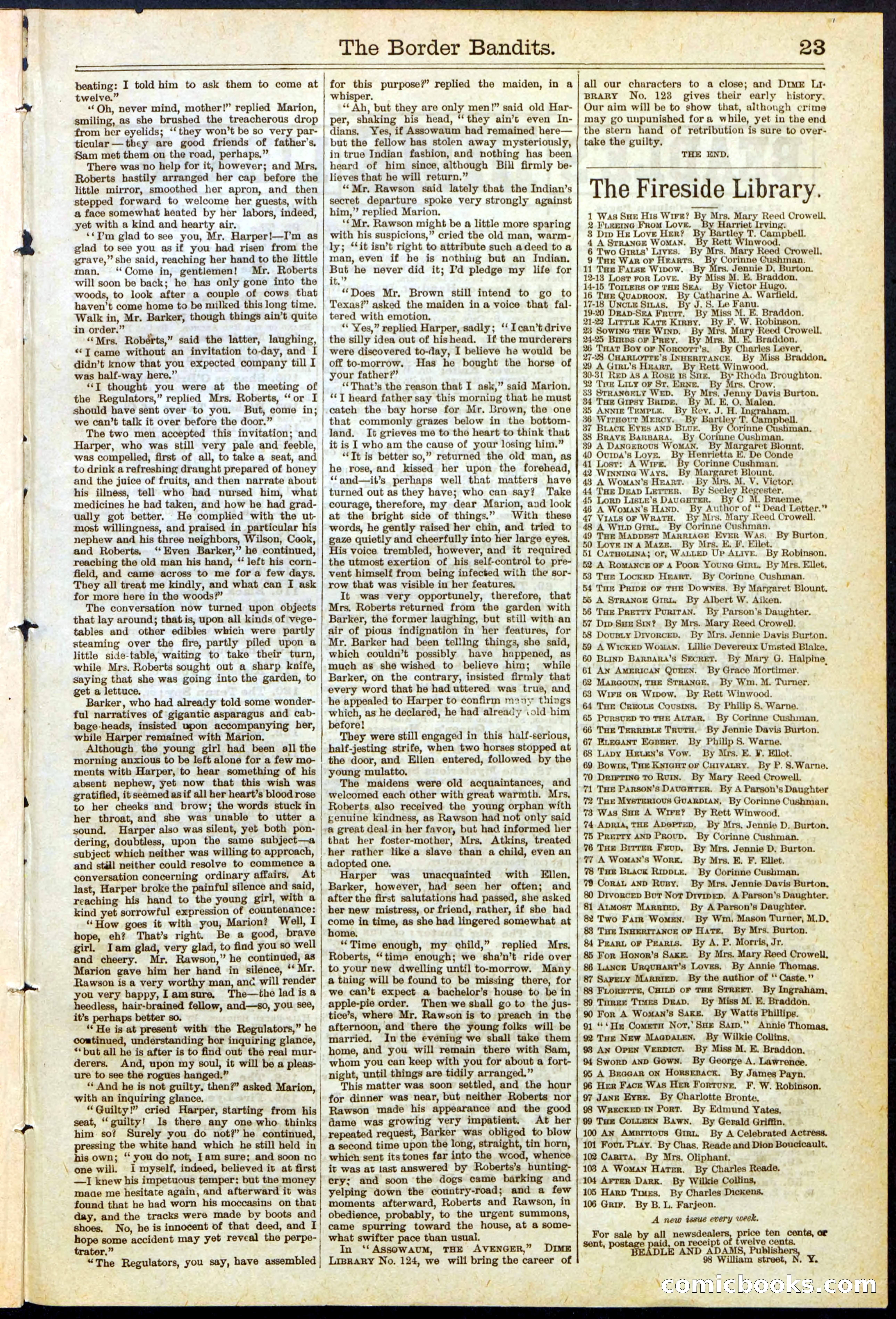
A restored page from Pulp Fiction, 1881. Page through the whole issue in the reader above.
📄 Transcribed text from this page (OCR, searchable)
Machine-transcribed from the original scan — historical spelling and the odd misread are preserved.
-“ a The Border Bandits. ld 23 beating: I told him to ask them to come at twelve.” ‘Oh, never mind, mother!” replied Marion, smiling, as she brushed the treacherous drop from her eyelids; ‘‘they won’t be so very par- ticular —they are good friends of father’s. Sam met them on the road, perhaps,” There was no help for it, however; and Mrs, Roberts hastily arranged her cap before the little mirror, smoothed her apron, and then stepped forward to welcome her guests, with a face somewhat heated by her labors, indeed, yet with a kind and hearty air. ‘*Pm glad to see you, Mr. Harper!—I’m as glad to see you asif you had risen from the grave,” she said, reaching her hand to the little man. “Come in, gentlemen! Mr. Roberts will soon be back; he has only gone into the woods, to look after a couple of cows that haven’t come home to be milked this long time. Walk in, Mr. Barker, though things ain’t quite in order.” ; ‘““Mrs. Robérts,” said the latter, laughing, ‘J came without an invitation to-day, and I didn’t know that you expected company till I was half-way here.” “‘T thought you were at the meeting of the Regulators,” replied Mrs. Roberts, “or I should have sent over to you. But, come in; we can’t talk it over before the door.” The two men accepted this invitation; and Harper, who was still very pale and feeble, was compelled, first of all, to take a seat, and to drink a refreshing draught prepared of honey and the juice of fruits, and then narrate about his illness, tell who had nursed him, what medicines he had taken, and how he had grad- ually got better. He complied with the ut- most willingness, and praised in particular his nephew and his three neighbors, Wilson, Cook, and Roberts. ‘“ Even Barker,” he continued, reaching the old man his hand, “ left his corn- field, and came across to me fora few days. They all treat me kindly, and what can I ask for more here in the woods?” The conversation now turned upon objects that lay around; that is, upon all kinds of vege- tables and other edibles which were partly steaming over the fire, partly piled upon a little side-table, waiting to take their turn, while Mrs. Roberts sought out a sharp knife, saying that she was going into the garden, to get a lettuce. Barker, who had already told some wonder- ful narratives of gigantic asparagus and cab- bage-heads, insisted upon accompanying ber, while Harper remained with Marion. Although the young girl had been all the morning anxious to be left alone for a few mo- ments with Harper, to hear something of his absent nephew, yet now that this wish was gratified, it seemed asif all her heart’s blood rose to her cheeks and brow; the words stuck in her throat, and she was unable to utter a sound, Harper also was silent, yet both pon- dering, doubtless, upon the same subject—a subject which neither was willing to approach, and stall neither could resolve to commence a conversation concerning ordinary affairs, At last, Harper broke the painful silence and said, reaching his hand to the young girl, with a kind yet sorrowful expression of countenance: “How goes it with you, Marion? Well, I hope, eh? That’s right. Be a good, brave girl. Iam glad, very glad, to find you so well and cheery. Mr. Rawson,” he continued, as Marion gave him her hand in silence, ‘* Mr. Rawson is a very worthy man, anc will render you very bappy, [amsure, The—the lad is a heedless, hair-brained fellow, and—so, you see, — | tice’s, where Mr. Rawson is to preach in the it’s perhaps better so. ‘‘ He is at present with the Regulators,” he | coatinued, understanding hor inquiring glance, **but all he is after is to find out the real mur- derers. And, upon my soul, it will be a pleas- ure to see the ed.” ai And he is not guilty, then?” asked Marion, with an inquiring glance. “Guilty!” cried Harper, starting from his seat, “guilty! Is there any one who. thinks him so? Surely you do not?’ he continu pressing the white band which he still held in his own; “ you do not, [am sure; and soon no one will. I myself, indeed, believed it at first —J] knew his impetuous temper: but the money made me hesitate again, and afterward it was found that he had worn his moccasins on that day, and the tracks were made by boots and shoes. No, he is innocent of that deed, and I hope some accident may yet reveal the perpe- trater.” “The Regulators, you say, have assembled for this purpose?” replied the maiden, in a whisper. “* Ah, but they are only men!” said old Har- per, shaking his head, ‘they ain’t even In- dians, Yes, if Assowaum had remained here— but the fellow has stolen away mysteriously, in true Indian fashion, and nothing has been heard of him since, although Bill firmly be- lieves that he will return.” ‘“‘Mr. Rawson said lately that the Indian’s secret departure spoke very strongly against him,” replied Marion. ‘*Mr. Rawson might be a little more sparing with his suspicions,” cried the old man, warm- ly; “‘it isn’t right to attribute such adeed toa man, even if he is nothing but an Indian. But he never did it; ’'d pledge my life for it,” ‘Does Mr. Brown still intend to go to Texas?” asked the maiden in a voice that fal- tered with emotion. ‘** Yes,” replied Harper, sadly; ‘‘ Ican’t drive the silly idea out of hishead. If the murderers were discovered to-day, I believe he would be off to-morrow. Has he bought the horse of your father?’ ‘‘That’s the reason that I ask,” said Marion. ‘*T heard father say this morning that he must catch the bay horse for Mr. Brown, the one that commonly grazes below in the bottom- land. It grieves me to the heart to think that it is I who am the cause of your losing him.” ‘Tt is better so,” returned the old man, as he rose, and kissed her upon the forehead, ‘‘ and—it’s perhaps well that matters have turned out as they have; who can say? Take courage, therefore, my dear Marion, and look at the bright side of things.” With these words, he gently raised her chin, and tried to gaze quietly and cheerfully into her large eyes. His voice trembled, however, and it required the utmost exertion of his self-control to pre- vent himself from being infected with the sor- row that was visible in her features. It was very opportunely, therefore, that Mrs. Roberts returned from the garden with Barker, the former laughing, but still with an air of pious indignation in her features, for Mr. Barker had been telllng things, she said, which couldn’t possibly have happened, as much as she wished to believe him; while Barker, on the contrary, insisted firmly that every word that he had uttered was trus, and he appealed to Harper to confirm many things which, as he declared, he had already \old him before! They were still engaged in this half-serious, half-jesting strife, when two horses stopped at the door, and Ellen entered, followed by the young mulatto. The maidens were old acquaintances, and welcomed each other with great warmth. Mrs. Roberts also received the young orphan with genuine kindness, as Rawson had not only said ‘a great deal in her favor, but had informed her that her foster-mother, Mrs, Atkins, treated her rather like a slave than a child, even an adopted one. . Harper was unacquainted with Ellen. Barker, however, had seen her often; and after the first salutations had passed, she asked her new mistress, or friend, rather, if she had come in time, as she had lingered somewhat at home, “Time enough, my child,” replied Mrs, Roberts, “time enough; we sha’n’t ride over to your new dwelling until to-morrow. Many a thing will be found to be missing there, for we can’t expect a bachelor’s house to be in apple-pie order. Then we sball go to the jus- afternoon, and there the young folks will be married. In the evening we shall take them home, and you will remain there with Sam, whom you can keep with you for about a fort- night, until things are tidily arranged.” This matter was soon settled, and the hour for dinner was near, but neither Roberts nor Rawson made his appearance and the good dame was growing very impatient. At her repeated request, Barker was obliged to blow a second time upon the long, straight, tin horn, which sent its tones far into the wood, whence it was at last answered by Roberts’s hunting- ery: and soon the dogs came barking and yelping down the country-road; and a few moments afterward, Roberts and Rawson, in obedience, probably, to the urgent summons, came spurring toward the house, at a some- what swifter pace than usual. In ‘‘ASSOWAUM, THE AVENGER,” DIME LrBrary No. 124, we will bring the career of / all our characters to a close; and Dowe Li BRARY No. 123 gives their early history. Our aim will be to show that, although crime may go unpunished fora while, yet in the end the stern hand of retribution is sure to over- take the guilty, THE END. 1 Was Sue His Wire? By Mrs. Mary Reed Crowell, 2 Pieeme From Love. Harriet Irving. 8 Dip He Love Her? By tley T. Campbell. 4 A Srrance Woman. By Rett Winwood. 6 Two Grats’ Lives. By Mrs. Mary Reed Crowell. 9 THe War or Hearts. By Corinne Cushman. 11 Tae Fatse Wipow. By Mrs. Jennie D. Burton. 12-13 Lost ror Love. By Miss M. KE. Braddon. 14-15 Torters or THe Sea. By Victor Hugo, 16 THe Quaproon. By Catharine A. Wartield. 17-18 Uncie Stuas. By J. 8, Le Fanu. 19-20 Deap-Sea Freurr, By Miss M. E. Braddon. 21-22 LirrLe Kare Kirsy. By F. W. Robinson. 23 Sowine THe Winp. By Mrs. Mary Reed Crowell. 24-25 Braps or Prey. By Mrs. M. EF. Braddon, 26 THat Boy or Norcorr’s. By Charles Lever. 27-28 CaHarLorre's Inwerrrance. By Miss Braddon, 29 A Grrau's Hearr, By Rett Winwood. 30-31 Rep AS A Rose 18 Sue, By Rhoda Broughton. 32 Tr Lity or St. Erne. By Mrs. Crow. 383 STRANGELY WeD. By Mrs. Jenny Davis Burton. 34 Tue Gresy Bare. y M. E, O. en. 35 Annie Tempie. By Rev. J. H. Ingraham. 36 Wrrnovt Mercy. By Bartley T. Campbell. 387 Buack Eyres and Bior. By Corinne Cushman. 38 Brave Barsara. By Corinne Oushman. 39 A Danagrovus WomAN. By Margaret Blount. 40 Ovrpa’s Love. By Henrietta E. De Conde | 41 Lost: A Wire. By Corinne Cushman. 42 Wrynina Ways, By Margaret Blount. 43 A Woman's Heart. 44 Tue Deap Lerrer. By Seeley Regester. , 45 Lorp Liste’s Davasrer. By C M. Braeme, , 46 A Woman's Hanp. By Author of “ Dead Letter.” 47 Viaus or Wratu. By Mrs. Mary Reed Crowell. 48 A Witp Grau. By Corinne Cushman. 49 Tar Mapprst MARRIAGE Ever Was. By Burton, 50 Love iva Maze. By Mrs. E. I. Ellet. 51 CaTHoLina; or, WALLED Up Auive. By Robinson. 52 A Romance or 4 Poor Youne Giri. By Mrs. Ellet. 53 Tae Lockep Heart. By Corinne Cushman. 54 Toe Prive or tre Downes. By Margaret Blount. / 7z 55 A Srrancrt Grrat. By Albert W. Aiken. 56 Tae Pretry Poriran. By Parson’s Daughter. 57 Dip Sue Sry? By Mrs. Mary Reed Crowell. 58 Dousty Drvorcep, By Mrs. Jennie Davis Burton. 59 A Wickep Woman. Lillie Devereux Umsted Blake. : 60 Bunp Barnara’s Secret. By Mary G. Halpine q 61 An American Quren. By Grace Mortimer. 62 MarGoun, THE STRANGE. By Wm. M. Turner. i 63 Wire or Wipow. By Rett Winwood. : 64 Tur Creote Cousins. By Philip 5. Warne. 65 PursvgeD To THe Attar, By Corinne Cushman. wl 66 Tux Terrie Trora. By Jennie Davis Burton. Ni 67 Buregant Eopert. By Philip S. Warne. 68 Lapy Heugen’s Vow. By Mrs. E. ¥. Elliot. 69 Bowrm, Tae Kyicur or Curvatry. By P. 8.Warne. 70 Dreurtine To Rui. By Mary Reed Crowell. 71 Tue Parson's Daventer. By A Parson's Daughter 72 Tax Mysrrerious Guarpian, By Corinne Cushman. 73 Was Sar A Wire’? By Rett Winwood. 74 ApRiA, THE ApepTEeD, By Mrs. Jennie D. Burton. 7 Prerry AND Provp. By Corinne Cushman. By Mrs. M. V. Victor. 76 Tux Brrrer Fevp. By Mrs. Jennie D, Burton. me 77 A Woman's Work. By Mrs. E. F. Ellet. Z 78 Tue Buack Rrippie. By Corinne Cushman. “ 79 Coral AND Rosy. By Mrs. Jennie Davis Burton. ‘} 80 Drvorcep But Not Drvipep. A Parson's Daughter. A 81 Aumost Marermp. By A Parson’s Daughter. ‘ 82 Two Far Women. By Wm. Mason Turner, M.D, | 83 Tue Innerrrance or Hate, By Mrs. Burton. a 84 Peart or Pearus. By A. P. Morris, Jr. , ies 85 For Honor’s Saxe. By Mrs. Mary Reed Crowell, : 86 Lance Urquaart’s Loves. By Annie Thomas. io. 87 y Marrrep. By the author of * Caste," 4 88 FLorerre, Carty or THe Street. By Ingraham ae 89 Tourer Trres Deav. By Miss M. E. Braddon. ie 90 For A Woman’s Sake. By Watts Phillips. — Wy 91 ‘He Comern Not,’Sae Sam."" Annie Thomas. - wp 92 Tue New Maapauen, By Wilkie Collins. 93 An Open Verpvicr. By Miss M. E. Braddon. €i 94 Sworp anp Gown. By George A. Lawrence. ° eal 9 A Bracar ON Horsrrack. By James Payn. os 96 Her Face Was Her Fortune. F. W. Robinson. 97 Jane Eyre. By Charlotte Bronte, 98 WreckeD IN Port. By Edmund Yates. aa 99 Taz CoLtLerN Bawn. By Gerald Griffin. ‘ 100 AN Amarrious Girt. By A Celebrated Actress. h: 101 Foun Pay. By Chas. Reade and Dion Boucicault. 102 Carita, By Mrs, Oliphant. us — a 103 A Woman Harter. By Charles Reade. : -. 104 Arrer Dark. By Wilkie Collins, | 105 Harp Times. By Charles Dickens. a 106 Grur. By B. L. Farjeon. * A new issue every week. For sale by all newsdeal _— ten cents, or sent, on receipt of twelve cents. AND ADAMS, Pu 98 William street, N. ¥. MIEOOOKS XE(o) (E(0) | opt LT ad a