
Pulp Fiction, 1881 · page 21 of 24
Beadle's New York Dime Library, No. 138 — page 21: what you’re looking at
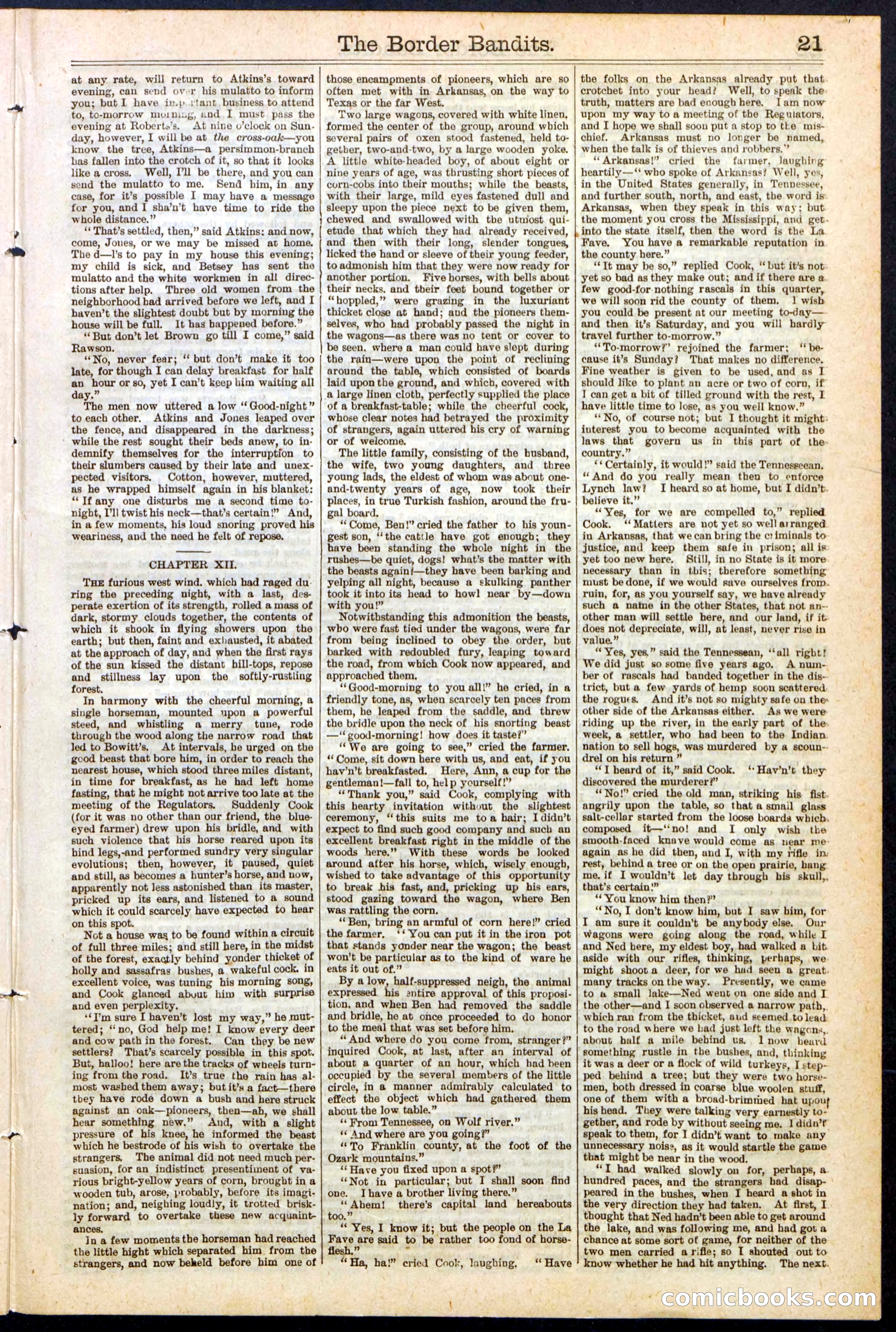
A restored page from Pulp Fiction, 1881. Page through the whole issue in the reader above.
📄 Transcribed text from this page (OCR, searchable)
Machine-transcribed from the original scan — historical spelling and the odd misread are preserved.
SS at any rate, will return to Atkins’s toward evening, can send over his mulatto to inform you; but I have iv.) :tant. business to attend to, to-morrow mvuining, and I must pass the evening at Roberts’s. At nine o’clock on Sun. day, however, I will be at the cross-oak—you know the tree, Atkins—a persimmon-branch bas fallen into the crotch of it, so that it looks like a cross. Well, I'll be there, and you can send the mulatto to me. Send him, in any case, for it’s possible 1 may have a message for you, and I sha’n’t have time to ride the whole distance.” ‘* That’s settled, then,” said Atkins: and now, come, Jones, or we may be missed at home. The d—l’s to pay in my house this evening; my child is sick, and Betsey has sent the mulatto and the white workmen in all direc- tions after help. Three old women from the neighborhood had arrived before we left, and I haven’t the slightest doubt but by morning the house will be full. It has bappened before.” ‘But don’t let Brown go till I come,” said Rawson. ‘‘No, never fear; “‘ but don’t make it too late, for though I can delay breakfast for half an hour or so, yet I can’t keep him waiting all day.” The men now uttered a low “‘ Good-night ” to each other. Atkins and Jones leaped over the fence, and disappeared in the darkness; while the rest sought their beds anew, to in- demnify themselves for the interruption to their slumbers caused by their late and unex- pected visitors. Cotton, however, muttered, as he wrapped himself again in his blanket: “Tfany one disturbs me a second time to- night, 1’ll twist his neck—that’s certain!” And, in a few moments, his loud snoring proved his weariness, and the need he felt of repose, CHAPTER XII. THE furious west wind. which had raged du. ring the preceding night, with a last, des- perate exertion of its strength, rolled a mass of dark, stormy clouds together, the contents of which it shook in flying showers upon the earth; but then, faint and exhausted, it abated at the approach of day, and when the first rays of the sun kissed the distant hill-tops, repose and stillness lay upon the softly-rustling forest. In harmony with the cheerful morning, a single horseman, mounted upon a powerful steed, and whistling a merry tune, rode through the wood along the narrow road that led to Bowitt’s, At intervals, he urged on the good beast that bore him, in order to reach the nearest house, which stood three miles distant, in time for breakfast, as he had left home fasting, that he might not arrive too late at the meeting of the Regulators. Suddenly Cook (for it was no other than our friend, the blue- eyed farmer) drew upon his bridle, and with such violence that his horse reared upon its bind legs,-and performed sundry very singular evolutions; then, however, it paused, quiet and still, as becomes a hunter’s horse, and now, apparently not Jess astonished than its master, pricked up its ears, and listened to a sound which it could scarcely have expected to hear on this spot. Not a house was to be found within a circuit of full three miles; and still here, in the midst of the forest, exactly behind yonder thicket of holly and sassafras bushes, a wakeful cock. in excellent voice, was tuning his morning song, and Cook glanced abyvut him with surprise and even perplexity. ‘‘T’m sure I haven’t lost my way,” he mut- tered; “‘no, God help me! I know every deer and cow path in the forest. Can they be new settlers? That’s scarcely possible in this spot. But, halloo! here are the tracks of wheels turn- ing from the road. It’s true the rain has al- most washed them away; butit’s a fact—there tbey have rode down a bush and here struck against an oak—pioneers, then—ab, we shall hear something new,” And, with a slight pressure of his knee, he informed the beast which he bestrode of his wish to overtake the strangers, The animal did not need much per- suasion, for an indistinct presentiment of va- rious bright-yellow years of corn, brought in a wooden tub, arose, probably, before its imagi- nation; and, neighing loudly, it trotted brisk- ly forward to overtake these new acquaint- ances. In a few moments the horseman had reached the little hight which separated him from the strangers, and now bekeld before him one of LLL CC iG LLL I A I those encampments of pioneers, which are so often met with in Arkansas, on the way to Texas or the far West. Two large wagons, covered with white linen, formed the center of the group, around wbich several pairs of oxen stood fastened, held to- gether, two-and-two, by a large wooden yoke. A little white-headed boy, of about eight or nine years of age, was thrusting short pieces of corn-cobs into their mouths; while the beasts, with their large, mild eyes fastened dull and sleepy upon the piece next to be given them, chewed and swallowed with tbe utmost qui- etude that which they had already received, and then with their long, slender tongues, licked the hand or sleeve of their young feeder, toadmonish him that they were now ready for another portion. Five horses, with bells about their necks, and their feet bound together or “hoppled,” were grazing in the luxuriant thicket close at hand; aud the pioneers them- selves, who had probably passed the night in the wagons—as there was no tent or cover to be seen, where a man could have slept during the rain—were upon the point of reclining around the table, which consisted of boards laid upon the ground, and which, covered with a large linen cloth, perfectly supplied the place of a breakfast-table; while the cheerful cock, whose clear notes had betrayed the proximity of strangers, again uttered his cry of warning or of welcome, The little family, consisting of the husband, the wife, two young daughters, and three young lads, the eldest of whom was about one- and-twenty years of age, now took their places, in true Turkish fashion, around the fru- gal board, **Come, Ben!” cried the father to his youn- gest son, ‘‘the cattle have got enough; they have been standing the whole night in the rushes—be quiet, dogs! what’s the matter with the beasts again‘—they have been barking and yelping all night, because a skulking panther took it into its head to howl near by—down with you!” Notwithstanding this admonition the beasts, who were fast tied under the wagons, were far from being inclined to obey the order, but barked with redoubled fury, leaping toward the road, from which Cook now appeared, and approached them, ‘*Good-morning to you all!” he cried, in a friendly tone, as, when scarcely ten paces from them, he leaped from the saddle, and threw the bridle upon the neck of his snorting beast —‘*good-morning! how does it taste?” “We are going to see,” cried the farmer. ‘‘ Come, sit down here with us, and eat, if you hav’n’t breakfasted. Here, Ann, a cup for the gentleman!—fall to, help yourself!” ‘‘Thank you,” said Cook, complying with this hearty invitation without the slightest ceremony, “this suits me toa hair; I didn’t expect to find such good company and such an excellent breakfast right in the middle of the woods here,” With these words be looked around after his horse, which, wisely enough, wished to take advantage of this opportunity to break .bis fast, and, pricking up his ears, stood gazing toward the wagon, where Ben was rattling the corn. “Ben, bring an armful of corn here!” cried the farmer, ‘‘ You can put it in the iron pot that stands yonder near the wagon; the beast won't be particular as to the kind of ware he eats it out of.” By a low, half-suppressed neigh, the animal expressed his entire approval of this proposi- tion, and when Ben had removed the saddle and bridle, he at once proceeded to do honor to the meal that was set before him. “ And where do you come from, stranger?” inquired Cook, at last, after an interval of about a quarter of an hour, which had been occupied by the several members of the little circle, in a manner admirably calculated to effect the object which had gathered them about the low table.” ‘‘ From Tennessee, on Wolf river,” ‘¢ And where are you going?” ‘‘To Franklin county, at the foot of the Ozark mountains.” ‘(Have you fixed upon a spot?” “Not in particular; but I shall soon find one. Ihave a brother living there.” ‘Ahem! there’s capital land hereabouts too.” “Yes, I know it; but the people on the La Fave are said to be rather too fond of horse- ‘Ha, ha!” cried Cook, laughing, ‘“ Have the folks on the Arkansas already put that. crotchet into your head? Well, to speak the. truth, matters are bad enough here. Iam now upon my way to a meeting of the Regulators, and I hope we shall soon put a stop to the mis- chief. Arkansas must no longer be named, when the talk is of thieves and robbers.” “Arkansas!” cried the farmer, Jaughing heartily-—‘‘ who spoke of Arkansas? Well, yes, in the United States generally, in Tennessee, and further south, north, and east, the word is Arkansas, when they speak in this way; but. the moment you cross the Mississippi, and get. into the state itself, then the word is the La Fave, You have a remarkable reputation in the county here.” ‘‘Tt may be so,” replied Cook, “but it’s not yet so bad as they make out; andif there are a few good-for- nothing rascals in this quarter, we will soon rid the county of them. 1! wish you could be present at our meeting to-day— and then it’s Saturday, and you will hardly travel further to-morrow.” “To-morrow?” rejoined the farmer; ‘“ be- cause it’s Sunday? That makes no difference. Fine weather is given to be used, and as I should like to plant an acre or two of corn, if I can get a bit of tilled ground with the rest, I have little time to lose, as you well know.” ‘No, of course not; but I thought it might: interest you to become acquainted with the laws that govern us in this part of the country.” ‘Certainly, it would!” said the Tennesgeean, ‘And do you really mean then to enforce Lynch law? I heard so at home, but I didn’t. believe it,” “Yes, for we are compelled to,” replied Cook. ‘Matters are not yet so well arranged in Arkansas, that we can bring the c:iminals to justice, and keep them safe in prison; all is yet too new here. Atill, in no State is it more necessary than in tbis; therefore something must be done, if we would save ourselves from. ruin, for, as you yourself say, we bave already such a name in the other States, that not an-- other man will settle here, and our land, if it. does not depreciate, will, at least, never rise in value,” “Yes, yes,” said the Tennessean, ‘“‘all right! We did just so some five years ago. A num- ber of rascals had banded together in the dis-. trict, but a few yards of hemp soon scattered, the rogues. And it’s not so mighty safe on the other side of the Arkansas either. As we were riding up the river, in the early part of the week, a settler, who had been to the Indian. nation to sell hogs, was murdered by a scoun-- drel on his return ” **T heard of it,” said Cook. discovered the murderer?” “No!” cried the old man, striking his fist. angrily upon the table, so that a smail glass salt-cellar started from the loose boards which. composed it—‘‘no! and I only wish the smooth-faced knaye would come as near me: again as he did then, and I, with my rifle in: rest, behind a tree or on the open prairie, bang. me. if I wouldn’t let day through bis skull, that’s certain!” “You know him then?” ‘No, I don’t know bim, but I saw him, for I am sure it couldn’t be anybody else, Our Wagons were going along the road, while I and Ned bere, my eldest boy, had walked a bit aside with our rifles, thinking, perbaps, we. might shoot a deer, for we had seen a great. many tracks onthe way. Presently, we came to # small lake—Ned went on one side and I. the other—and I soon observed a narrow path,, which ran from the thicket, aud seemed_to lead to the road where we had just left the wagons,. about half a mile bebind us. 1 now heard something rustle in the bushes, and, thinking it was a deer or a flock of wild turkeys, I step- ped behind a tree; but they were two horse- men, both dressed in coarse blue woolen stuff, one of them with a broad-brimmed hat upouf his head. They were talking very earnestly to- getber, and rode by without seeing me. I didn’t speak to them, for I didn’t want to make any unnecessary noise, as it would startle the game that might be near in the wood. “I had walked slowly on for, perhaps, a. hundred paces, and the strangers bad disap- peared in the bushes, when I heard a shot in the very direction they had taken. At first, I thought that Ned hadn’t been able to get around the lake, and was following me, and had got a chance at some sort of game, for neither of the two men carried arifle; so I shouted out to know whether he had hit anything. The next. *Hav’n’t they —~Comicboo ¥ atten (c S) a