
Pulp Fiction, 1881 · page 20 of 24
Beadle's New York Dime Library, No. 138 — page 20: what you’re looking at
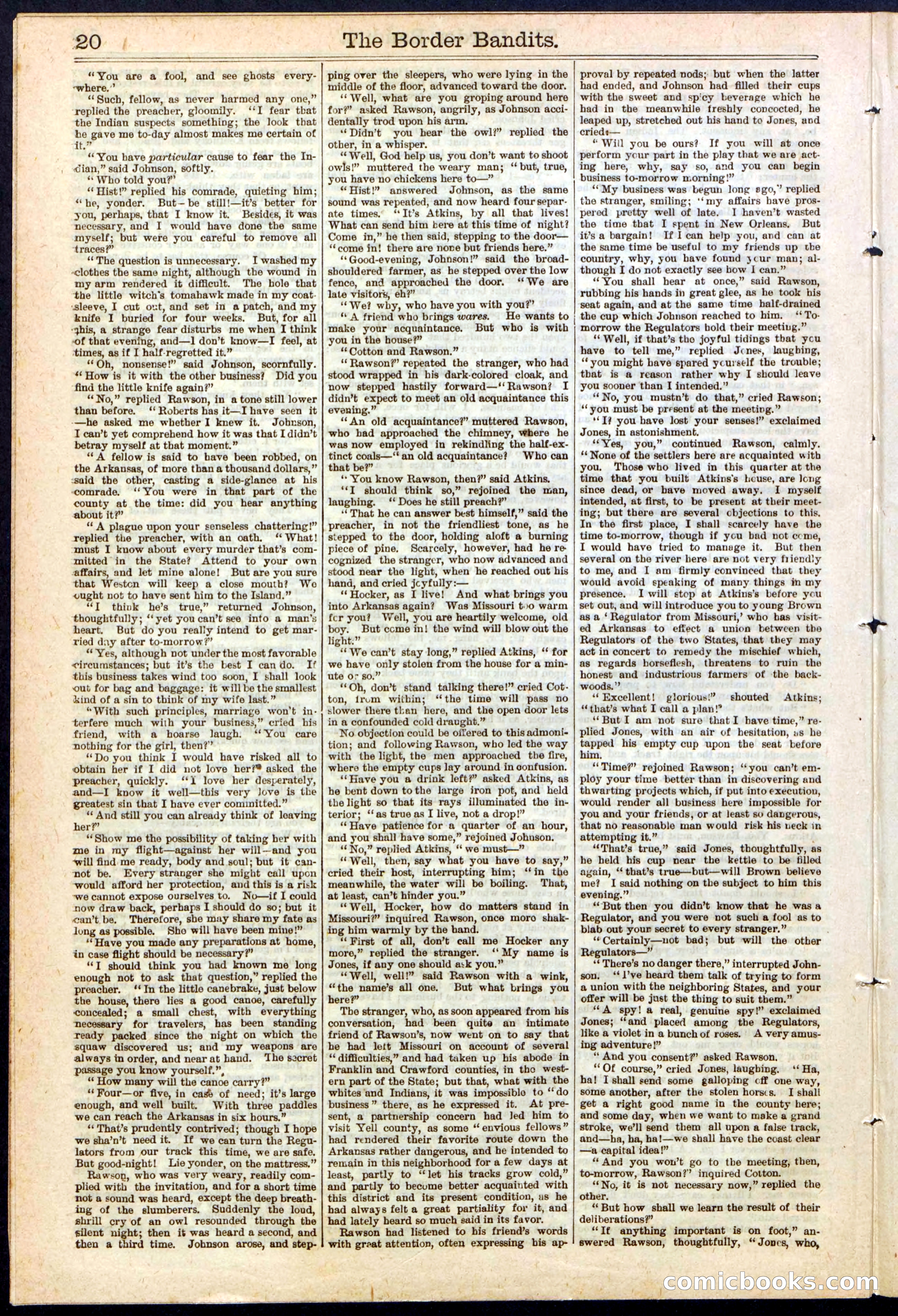
A restored page from Pulp Fiction, 1881. Page through the whole issue in the reader above.
📄 Transcribed text from this page (OCR, searchable)
Machine-transcribed from the original scan — historical spelling and the odd misread are preserved.
|} t ! | | | _—— < === —x< ——— = = = - ———_—— ————a = — ES Sen epee. “You are a fool, and see ghosts every- ‘where.” ‘Such, fellow, as never harmed any one,” replied the preacher, gloomily. ‘‘I fear tbat the Indian suspects something; the look that he gave me to-day almost makes me certain of 1h ““You have particular cause to fear the In- dian,” said Johnson, softly. ** Who told you?” “Hist!” replied his comrade, quieting him; **he, yonder. But—be still!—it’s better for you, perhaps, that I know it. Besides, it was necessary, and I would have done the same myself; but were you eareful to remove all traces?” ‘The question is unnecessary. I washed my clothes the same night, although the wound in my arm rendered it difficult. The hole that the little witch’s tomahawk made in my coat- ‘sleeve, I cut ont, and set in a patch, and my knife I buried for four weeks. But, for all ‘ghis, a strange fear disturbs me when I think of that evening, and—1 don’t know—I feel, at ‘times, as if I half-regretted it.” ‘Oh, nonsense!” said Johnson, scornfully. * How is it with the other business? Did you find the little knife again?” “No,” replied Rawson, in a tone still lower than before. ‘‘ Roberts has it—Ihave seen it -—he asked me whether I knew it. Johnson, T can’t yet comprehend how it was that I didn’t betray myself at that moment.” “A fellow is said to bave been robbed, on the Arkansas, of more than a thousand dollars,” ‘said the other, casting a side-glance at his comrade. ‘‘ You were in that part of the county at the time: did you hear anything about it?” * A plague upon your senseless chattering!” replied the preacher, with an oath. ‘‘ What! must I know about every murder that’s com- mitted in the State? Attend to your own affairs, and let mine alone! But are you sure that Westcn will keep a close mouth? We vught not to have sent him to the Island.” “T think he’s true,” returned Johnson, thoughtfully; ‘‘ yet you can’t see info a man’s heart. But do you really intend to get mar- ried day after to-morrow?” Yes, although not under the most favorable <ircumstances; but it’s the best I cando. If this business takes wind too soon, I shall look out for bag and baggage: it will be the smallest kind of a sin to think of my wife last.” “With such principles, marriage won't in- terfere much with your business,” cried his friend, with a hoarse laugh. ‘‘You care nothing for the girl, then?” ‘Do you think I would have risked all to obtain her if I did not love her?® asked the preacher, quickly. ‘‘i love her desperately, and—I know it well—this very Jove is the greatest sin that I have ever comunitted.” ** And still you can already think of leaving her?” “Show me the possibility of taking ber with me in my flight—against her will—and you ~will find me ready, body and soul; but it can- not be. Every stranger she might call upon would afford her protection, and this is a risk “we cannot expose ourselves to. No—if I could now draw back, perbaps I should do so; but it can’t be, Therefore, she may share my fate as long as possible. Sho will have been mine!” “Have you made any preparations at home, in case flight should be necessary?” “T should think you had known me long enough not to ask that question,” replied the preacher. ‘‘ In the little canebrake, just below the house, there lies a good canoe, carefully concealed; a small chest, with everything necessary for travelers, has been standing ready packed since the night on which the squaw discovered us; and my weapons are always in order, and nearat hand. ‘The secret passage you know yourself.”, “How many will the canoe carry?” “*Four—or five, in cass of need; it’s large enough, and well built. With three paddles we can reach the Arkansas in six hours.” “That’s prudently contrived; though I hope we sha’n’t need it. If we can turn the Regu- lators from our track this time, we are safe. But good-night! Lie yonder, on the mattress.” Rawson, who was very weary, readily com- plied with the invitation, and for a short time not a sound was heard, except the deep breath- ing of the slumberers. Suddenly the loud, shrill cry of an owl resounded through the silent night; then it was heard a second, and then a third time. Jobnson arose, and step- The Border Bandits, ping over the sleepers, who were lying in the middle of the floor, advanced toward the door. ‘‘ Well, what are you groping around here for?’ asked Rawson, angrily, as Johnson acci- dentally trod upon his arm. ‘“‘Didn’t you hear the owl?” replied the other, in a whisper. “Well, God help us, you don’t want to shoot owls!” muttered the weary man; “ but, true, you have no chickens here to—” “Hist!” answered Johnson, as the same sound was repeated, and now heard four separ- ate times. “It’s Atkins, by all that lives! What can send him bere at this time of night? Come in,” he then said, stepping to the door— ‘‘come in! there are nove but friends bere.” ‘*Good-evening, Johnson!” said the broad- shouldered farmer, as he stepped over the low fence, and approached the door. ‘We are late visitors, eh?” ‘‘We? why, who have you with you?” ‘A friend who brings wares. He wants to make your acquaintance. But who is with you in the house?” **Cotton and Rawson.” ‘Rawson?’ repeated the stranger, who had stood wrapped in his dark-colored cloak, and now stepped hastily forward—‘‘ Rawson? I didn’t expect to meet an old acquaintance this evening.” ‘An old acquaintance?” muttered Rawson, who had approached the chimney, Where he was now employed in rekindling the half-ex- tinct coals—‘‘ an old acquaintance? Who can that be?” ‘** You know Rawson, then?” said Atkins. **T should think so,” rejoined the man, laughing. ‘‘ Does he still preach?” ‘That he can answer best himself,” said the preacher, in not the friendliest tone, as he stepped to the door, holding aloft a burning piece of pine, Scarcely, however, had he re cognized the stranger, who now advanced and stood near the light, when he reached out his hand, and cried jcyfully:— ‘* Hocker, as I live! And what brings you into Arkansas again? Was Missouri t.o warm fcr you? Well, you are heartily welcome, old boy. But ccme in! the wind wil] blow out the light.” ‘‘ We can’t stay long,” replied Atkins, ‘‘ for we have only stolen from the house for a min- ute or so.” ‘‘Oh, don’t stand talking there!” cried Cot- ton, irom within; “the time will pass no slower there than here, and the open door lets in a confounded cold draught.” No objection could be offered to this admoni- tion; and following Rawson, who led the way with the light, the men approached the fire, where the empty cups lay around in confusion. ‘‘Have you a drink left?” asked Atkins, as he bent down tothe large iron pot, and held the light so that its rays illuminated the in- terior; ‘‘as true as I live, not a drop!” ‘‘Have patience for a quarter of an hour, and you shall have some,” rejoined Johnson. “No,” replied Atkins, ‘‘ we must—” ‘Well, then, say what you have to say,” cried their host, interrupting him; ‘‘in the meanwhile, the water will be boiling. That, at least, can’t hinder you.” “Well, Hocker, how do matters stand in Missouri?’ inquired Rawson, once moro shak- ing him warmly by the band. ‘First of all, don’t call me Hocker any more,” replied the stranger. ‘‘My name is Jones, if any one should a:k you.” “Well, well!” said Rawson with a wink, “the name’s all one. But what brings you here?” The stranger, who, as soon appeared from his conversation, had been quite an intimate friend of Rawson’s, now went on to say that he had lett Missouri on account of several *« difficulties,” and had taken up his abode in Franklin and Crawford counties, in the west- ern part of the State; but that, what with the whites and Indians, it was impossible to ‘‘do business ” there, as he expressed it. At pre- sent, a partnership concern had Jed him to visit Yell county, as some “ envious fellows” had rendered their favorite route down the Arkansas rather dangerous, and he intended to remain in this neighborhood for a few days at least, partly to “let his tracks grow cold,” and partly to becume better acquainted with this district and its present condition, us he had always felt a great partiality for it, and had lately heard so much said in its favor. Rawson had listened to bis friend’s words with great attention, often expressing bis ap- SE proval by repeated nods; but when the latter had ended, and Johnson had filled their cups with the sweet and sp'cy beverage which he had in the meanwhile freshly concocted, he leaped up, stretched out his hand to Jones, and criedt— “Will you be ours? If you will at once perform your part in the play that we are act- ing here, why, say so, and you can begin business to-morrow morning!” ‘*My business was begun long ego,” replied the stranger, smiling; ‘‘my affairs bave pros- pered pretty well of late. I haven’t wasted the time that I spent in New Orleans, But it’s a bargain! If I can help you, and can at the same time be useful to my friends up tbe country, why, you bave found ycur man; al- though I do not exactly see bow I can.” ‘You shall hear at once,” said Rawson, rubbing his hands in great glee, as he took his seat again, and at the same time half-drained the cup which Johnson reached to him. ‘“‘To- morrow the Regulators bold their meetiug.” ‘* Well, if that’s tho joyful tidings that ycu have to tell me,” replied Jcnes, laughing, “you might bave spared ycurself the trouble; tbat is a reason rather why I should leave you sooner than I intended.” ‘“No, you mustn’t do that,” cried Rawson; ‘‘you must be present at the meeting.” ‘*1? you bave lost your senses!” exclaimed Jones, in astonishment. ‘*Yes, you,” continued Rawson, calmly. ** None of the settlers here are acquainted with you. Those who lived in this quarter at the time that you built Atkins’s house, are Jong since dead, or bave moved away. I myself intended, at first, to be present at their meet- ing; but there are several cbjections to this. In the first place, I shall scarcely have the time to-morrow, though if you bad not ccme, I would have tried to manege it. But then several on the river here are not very friendly to me, and I am firmly convinced that they would avoid speaking of many things in my presence. I will stop at Atkins’s before you set out, and will introduce you to young Brown as a ‘ Regulator from Missouri,’ who bas visit- ed Arkansas to effect a union between the Regulators of the two States, that they may act in concert to remedy the mischief which, as regards horseflesh, threatens to ruin the honest and industrious farmers of the back- woods.” ‘* Excellent! glorious!” “that’s what I call a plan!” ‘*But I am not sure that I have time,” re- plied Jones, with an air of hesitation, us he why his empty cup upon the seat before shouted Atkins; “Time?” rejoined Rawson; “you can’t em- ploy your time better than in discovering and thwarting projects which, if put into execution, would render all business here impossible for you and your friends, or at least so dangerous, that no reasonable man would risk his neck in attempting it.” “‘That’s true,” said Jones, thoughtfully, as he held his cup near the kettle to be filled again, “ that’s true—but—will Brown believe me? I said nothing on the subject to him this evening.” “But then you didn’t know that he was a Regulator, and you were not such a fool as to blab out your secret to every stranger.” ‘*Certainly—not bad; but will the other : Regulators—” ‘*There’s no danger there,” interrupted John- son. ‘‘l’ve heard them talk of trying to form a union with the neighboring States, and your offer will be just the thing to suit them.” ‘““A spy! a real, genuine spy!” exclaimed Jones; ‘and placed among the Regulators, like a violet in a bunch of roses. A very amus- ing adventure!” “And you consent?” asked Rawson. “Of course,” cried Jones, laugbing. ‘‘ Ha, ha! I shall send some galloping off one way, some another, after the stolen horscs. I shall get a right good name in the county here; and some day, when we want to make a grand stroke, we’ll send them all upon a false track, and—ha, ha, ha!—we shall have the coast clear —a capital idea!” ‘And you won’t go to the meeting, then, to-morrow, Rawson?” inquired Cotton. ‘No, it is not necessary now,” replied the other. ‘But how shall we learn the result of their deliberations?” “Tf anything important is on foot,” an- swered Rawson, thoughtfully, “Jones, who, rAVICEl oveye) (eC cS (G “€O + <a on