
Pulp Fiction, 1881 · page 19 of 24
Beadle's New York Dime Library, No. 138 — page 19: what you’re looking at
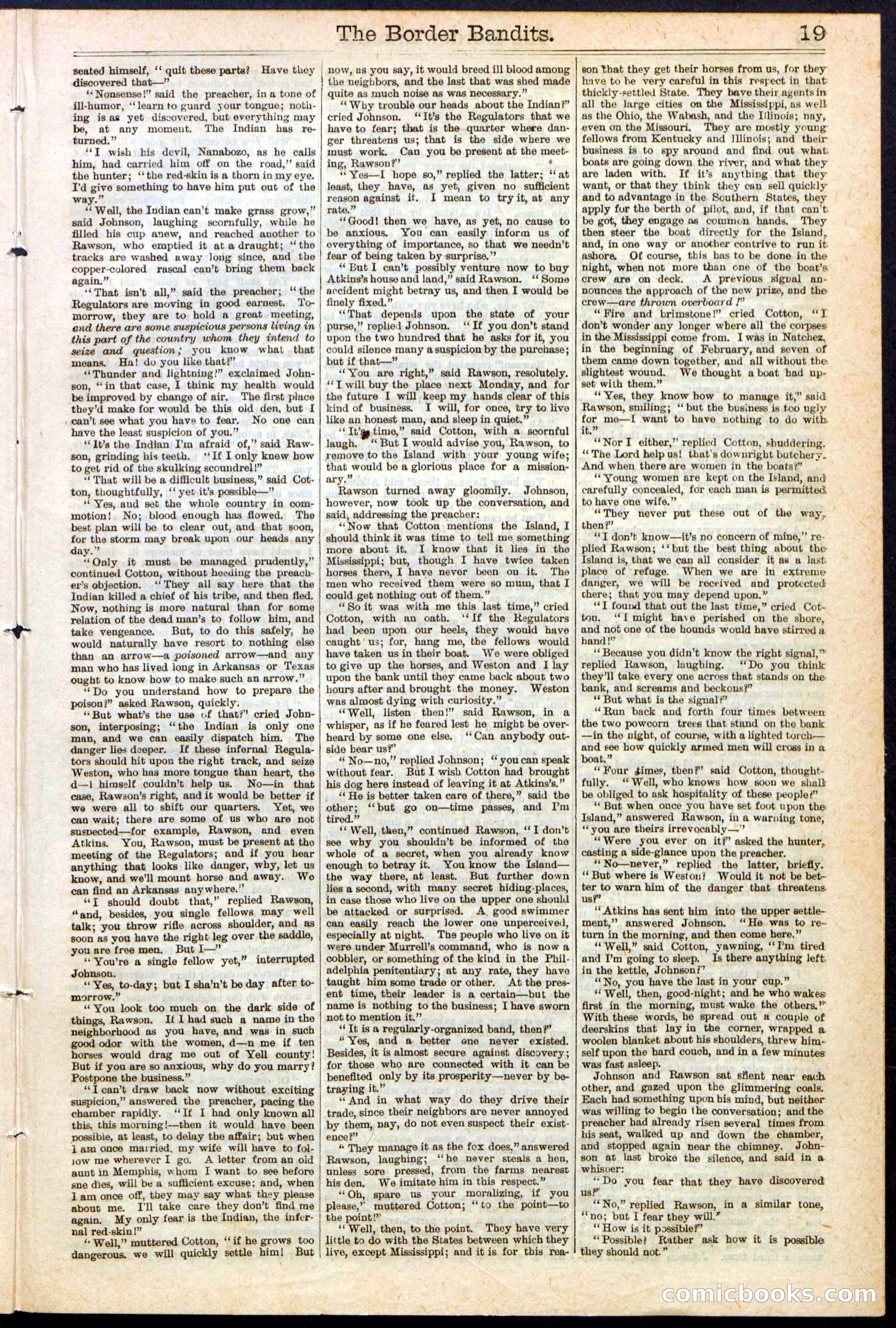
A restored page from Pulp Fiction, 1881. Page through the whole issue in the reader above.
📄 Transcribed text from this page (OCR, searchable)
Machine-transcribed from the original scan — historical spelling and the odd misread are preserved.
oe ————EaE - — ee seated himself, ‘‘ quit these parts? Have they discovered that—” ‘* Nonsense!” said the preacher, in a tone of ill-humor, ‘“‘learn to guard your tongue; noth- ing isas yet discovered, but everything may be, at any moment. The Indian has re- turned.” ‘‘T wish bis devil, Nanabozo, as he calls him, had carried him off on the road,’ said the hunter; ‘‘the red-skin is a thorn in my eye. I'd give something to have him put out of the way.” ‘* Well, the Indian can’t make grass grow,” said Johnson, laughing scornfully, while he filled his cup anew, and reached another to Rawson, who emptied it at a draught; ‘‘ the tracks are washed away Jong since, and the copper-colored rascal can’t bring them back again.” ‘‘That isn’t all,” said the preacher; “the Regulators are moving in good earnest. To- morrow, they are to hold a great meeting, and there are some suspicious persons living in this part of the country whom they intend to seize and question; you know what that means. Ha! do you like that?” “Thunder and lightning!” exclaimed John- son, “in that case, I think my health would be improved by change of air, The first place they’d make for would be this old den, but I can’t see what you have to fear. No one can have the least suspicion of you.” ‘It’s the Indian I’m afraid of,” said Raw- son, grinding his teeth. ‘If I only knew how to get rid of the skulking scoundrel!” ‘That will be a difficult business,” said Cot- ton, thoughtfully, ‘‘ yet it’s possible—” “Yes, aud set the whole country in com- motion! No; blood enough has flowed, The best plan will be to clear out, and that soon, for the storm may break upon our heads any day.” «Only it must be managed prudently,” continued Cotton, without heeding the preach- er’s objection. ‘‘They all say here that the Indian killed a chief of his tribe, and then fled. Now, nothing is more natural than for some relation of the dead man’s to follow him, and take vengeance. But, to do this safely, he would naturally have resort to nothing else than an arrow—a poisoned arrow—and any man who has lived long in Arkansas or Texas ought to know how to make such an arrow.” ‘‘Do you understand how to prepare the poison?” asked Rawson, quickly. ‘*But what’s the use of that?” cried John- son, interposing; “the Indian is only one man, and we can easily dispatch him. The danger lies deeper. If these infernal Regula- tors should hit upon the right track, and seize Weston, who has more tongue than heart, the d—1 himself couldn’t help us. No—in that case, Rawson’s right, and it would be better if we were all to shift our quarters, Yet, we can wait; there are some of us who are not suspected—for example, Rawson, and even Atkins. You, Rawson, must be present at the meeting of the Regulators; and if you hear anything that looks like danger, why, let us know, and we’ll mount horse and away. Wo can find an Arkansas anywhere.” “J should doubt that,” replied Rawson, “and, besides, you single fellows may well talk; you throw rifle across shoulder, and as soon as you have the right leg over the saddle, you are freemen. But I—” “You're a single fellow yet,” interrupted Jobnson, ‘Yes, to-day; but I sha’n’t be day after to- morrow.” ‘You look too much on the dark side of things, Rawson. If 1 had such a name in the neighborhood as you have, and was in such good odor with the women, d—n me if ten horses would drag me out of Yell county! But if you are so anxious, why do you marry? Postpone the business.” ““T can’t draw back now without exciting suspicion,” answered the preacher, pacing the chamber rapidly. ‘If I had only known all this, this morning!-—then it would have been possible, at least, to delay the affair; but when j am once married, my wife will have to fol- sow me wherever 1 go. A letter from an old aunt in Memphis, whom I want to see before sne dies, will be a sufficient excuse; and, when lam once off, they may say what they please about me. I'll take care they don’t find me again, My only fear is the Indian, the infer- nal red-skin!” ‘ Well,” muttered Cotton, ‘if he grows too | The Border Bandits. now, as you say, it would breed ill blood among the neighbors, and the last that was shed made quite as much noise as was necessary.” “Why trouble our heads about the Indian?” cried Johnson. ‘It’s the Regulators that we have to fear; that is the quarter where dan- ger threatens us; that is the side where we must work. Can you be present at the meet- ing, Rawson?” ¢ ‘*Yes—I hope so,” replied the latter; ‘‘ at least, they have, as yet, given no sufficient reason against it. I mean to tryit, at any rate.” ‘‘Good! then we have, as yet, no cause to be anxious. You can easily inform us of everything of importance, so that we needn’t fear of being taken by surprise,” “ But I can’t possibly venture now to buy Atkins’s house and land,” said Rawson. ‘‘ Some accident might betray us, and then I would be finely fixed,” ‘‘That depends upon the state of your purse,” replied Johnson. ‘If you don’t stand upon the two hundred that he asks for it, you could silence many a suspicion by the purchase; but if that—” ‘You are right,” said Rawson, resolutely. ‘‘T will buy the place next Monday, and for the future I will keep my hands clear of this kind of business. I will, for once, try to live like an honest man, and sleep in quiet.” ‘< Tt’ time,” said Cotton, with a scornful laugh. ‘‘ But I would advise you, Rawson, to remove to the Island with your young wife; that would be a glorious place for a mission- ary.” Rawson turned away gloomily. Johnson, however, now took up the conversation, and said, addressing the preacher: ‘“‘Now that Cotton mentions the Island, I should think it was time to tell me something more about it, I know that it lies in the Mississippi; but, though I have twice taken horses there, I have never been on it. The men who received them were so mum, that I could get nothing out of them.” “So it was with me this last time,” cried Cotton, with an oath. ‘‘If the Regulators had been upon our heels, they would have caught’ us; for, hang me, the fellows would have taken us in their boat. We were obliged to give up the horses, and Weston and I lay upon the bank until they came back about two hours after and brought the money. Weston was almost dying with curiosity.” ‘‘Well, listen then!” said Rawson, in a whisper, as if he feared lest he might be over- heard by some one else, ‘Can anybody out- side hear us?’ . *“ No—no,”’ replied Johnson; “ you can speak without fear. But I wish Cotton had brought his dog here instead of leaving it at Atkins’s,” ‘‘ He is better taken care of there,” said the other; ‘‘but go on—time passes, and I’m tired.” ‘* Well, then,” continued Rawson, “I don’t see why you shouldn’t be informed of the whole of a secret, when you already know enough to betray it. You know the Island— the way there, at least. But further down lies a second, with many secret hidiug-places, in case those who live on the upper one should be attacked or surprised. A good swimmer can easily reach the lower one unperceived, especially at night. The peuple who live on it were under Murrell’s command, who is now a cobbler, or something of the kind in the Phil- adelphia penitentiary; at any rate, they have taught him some trade or other. At the pres- ent time, their leader is a certain—but the name is nothing to the business; I have sworn not to mention it.” ‘“‘ Tt is a regularly-organized band, then?” “Yes, and a better one never existed. Besides, it is almost secure against discovery; for those who are connected with it can be benefited only by its prosperity—never by be- traying it.” ‘And in what way do they drive their trade, since their neighbors are never annoyed by them, nay, do not even suspect their exist- ence?” “« They manage it as the fox does,” answered Rawson, laughing; ‘“‘he never steals a hen, unless sore pressed, from the farms nearest his den. We imitate him in this respect,” ‘“‘Oh, spare us your moralizing, if you please,” muttered Cotton; “to the point—to the point!” ‘Well, then, to the point. They have very little to do with the States between which they dangerous. we will quickly settle him! But | live, except Mississippi; and it is for this rea- } son that they get their horses from us, for they have to be very careful in this respect in that thickly-settled State. They bave their agentsin all the large cities on the Mississippi, as well as the Ohio, the Wabash, and the Illinois; nay, even on the Missouri. They are mostly young fellows from Kentucky and Jllinois; and their business is to spy around and find out what. boats are going down the river, and what they are laden with. If it’s anything that they want, or that they think they can sell quickly and to advantage in the Southern States, they apply for the berth of pilot, and, if that can’t be got, they engage as common hands. They then steer the boat directly for the Island, and, in one way or another contrive to run it ashore, Of course, this bas to be done in the night, when not more than one of the boat's crew are on deck. A previous sigval an- nounces the approach of the new prize, and the crew—are thrown overboard !” “Fire and brimstone!” cried Cotton, ‘“T don’t wonder any longer where all the corpses in the Mississippi come from, I was in Natchez, in the beginning of February, and seven of them came down together, and all without the slightest wound. We thought a boat had up- set with them.” “Yes, they know how to manage it,” said Rawson, smiling; ‘‘ but the business is too ugly for me—I want to have nothing to do with it.” “‘NorI either,” replied Cotton, shuddering. “The Lord help us! that’s downright butchery- And when there are women in the boats?” “Young women are kept on the Island, and carefully concealed, for each man is permitted to have one wife,” “They never put these out of the way, then?” “T don’t know—it’s no concern of mine,” re- plied Rawson; ‘‘but the best thing about the Island is, that we can all consider it as a last place of refuge. When we are in extreme danger, we will be received and protected there; that you may depend upon.” ““T found that out the last time,” cried Cot- ton, “I might have perished on the shore, and not one of the hounds would have stirred a hand!” ‘‘ Because you didn’t know the right signal,” replied Rawson, laughing. ‘Do you think they’ll take every one across that stands on the bank, and screams and beckons?” ‘But what is the signal?” “Run back and forth four times between the two powcorn trees that stand on the bank —in the night, of course, with a lighted torch— and see how quickly armed men will cross in a boat.” “Four dimes, then?’ said Cotton, thought- fully. ‘‘ Well, who knows how soon we shalt be obliged to ask hospitality of these people?” ‘‘ But when once you have set foot upon the Island,” answered Rawson, in a warning tone, ‘‘yvou are theirs irrevocably —” “Were you ever on it?’ asked the hunter, casting a side-glance upon the preacher, ‘*No—never,” replied the latter, briefly. ‘But where is Weston! Would it not be bet- sor © warn him of the danger tbat threatens. us ‘‘ Atkins has sent bim into the upper settle- ment,’? answered Jobnson, ‘He was to re- turn in the morning, and then come here,” ‘““Well,” said Cotton, yawning, ‘‘I’m tired and I’m going to sleep, Is there anything left. in the kettle, Johnson?” “No, you have the last in your cup.” ‘Well, then, good-night; and he who wakes first in the morning, must wake the others,” With these words, he spread out a couple of deerskins that lay in the corner, wrapped a woolen blanket about his shoulders, threw him- self upon the hard couch, and in a few minutes was fast asleep. Johnson and Rawson sat silent near each other, and gazed upon the glimmering coals. Each had something upon bis mind, but neither was willing to begin the conversation; and the preacher had already risen several times from. his seat, walked up and down the chamber, and stopped again near the chimney. John- son at last broke the silence, and said in a whisper: “Do you fear that they haye discovered us?” “No,” replied Rawson, in a similar tone, “no; but I fear they will. ; “* How is it possible?” ‘Pe “Possible? Rather ask how it is possible they should not.” EOUMIE LOCO KS (G, (G (0) »