
Pulp Fiction, 1881 · page 1 of 24
Beadle's New York Dime Library, No. 138 — page 1: what you’re looking at
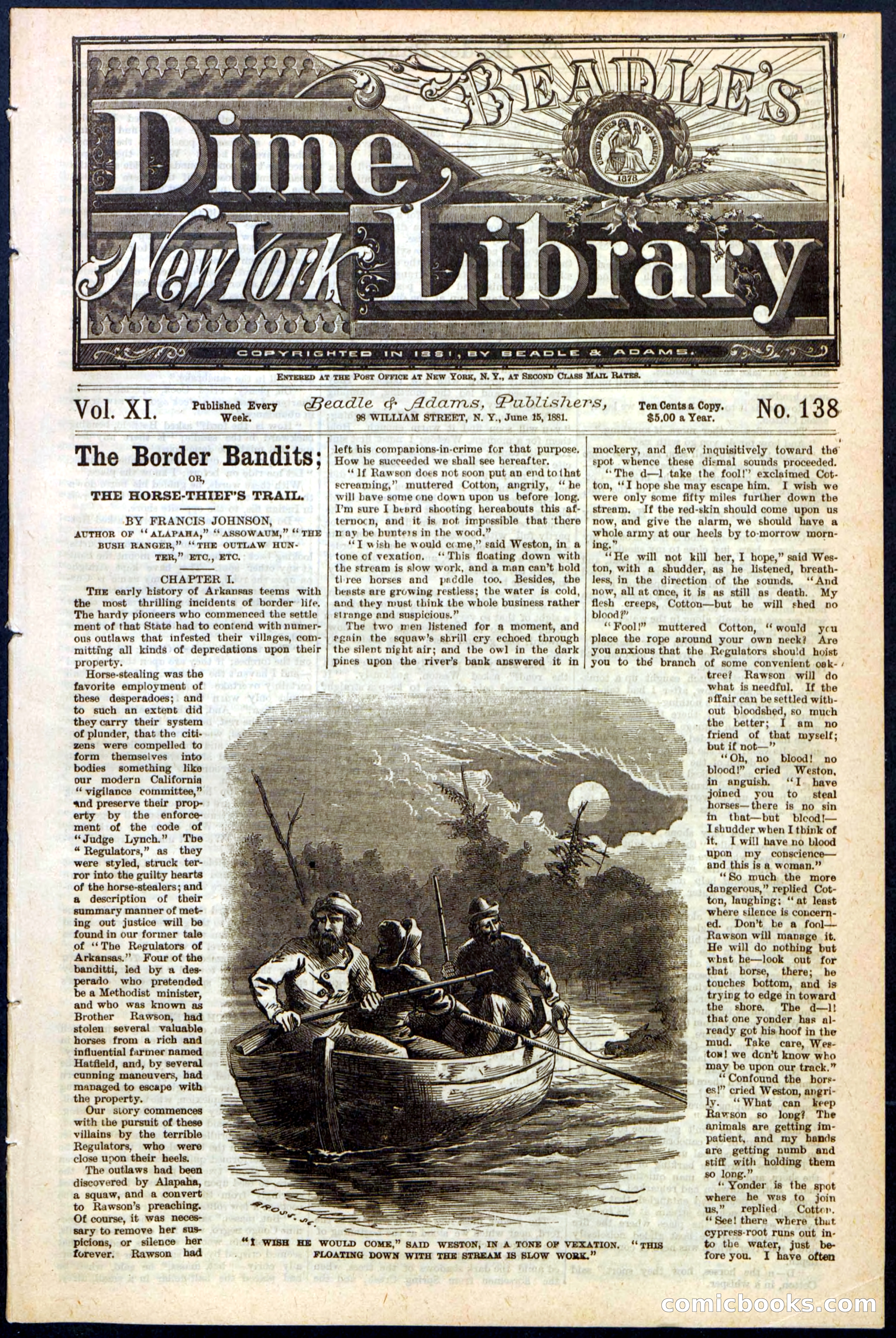
A restored page from Pulp Fiction, 1881. Page through the whole issue in the reader above.
📄 Transcribed text from this page (OCR, searchable)
Machine-transcribed from the original scan — historical spelling and the odd misread are preserved.
ee —* pill ies a nh ae Ms, Hy Ly 4555 ity “= > | AOA NN “Exreuup At sux Post Orvice at New Yous, N.Y, AT SROOND CLAss MATL Rares. Published Every Vol. XL. _ Pale The Border Bandits: THE penmatn TRAIL. BY FRANCIS JOHNSON, AUTHOR OF ‘‘ ALAPAHA,” “ ASSOWAUM,” “ THE BUSH RANGER,” “‘THE OUTLAW HUN- TER,” ETC,, ETC. CHAPTER I. Tne early history of Arkansas teems with the most thrilling incidents of border life. The hardy pioneers who commenced the settle ment of that State had to contend with numer- ous outlaws that infested their villages, com- mitting all kinds of depredations upon their property. Horse-stealing was the favorite employment of these desperadoes; and to such an extent did they carry their system of plunder, that the citi- zens were compelled to form themselves into bodies something like our modern California “ vigilance committee,” and preserve their prop- erty by the enforce ment of the code of “Judge Lynch.” The “ Regulators,” as they were styled, struck ter- ror into the guilty hearts of the horse-stealers; and a description of their summary manner of met- ing out justice will be found in our former tale of ‘‘The Regulators of Arkansas.’’ Four of the banditti, led by a des- perado who pretended be a Methodist minister, and who was known as Brother Rawson, had stolen several valuable horses from a rich and influential farmer named Hatfield, and, by several cunning maneuvers, had managed to escape with the property. Our story commences with the pursuit of these villains by the terrible Regulators, who were close upon their heels. The outlaws had been discovered by Alapaha, a squaw, and a convert to Rawson’s preaching. Of course, if was neces- sary to remove her sus- picions, or silence her forever. Rawson had IN I8BS8', ee lee FHeadle Py Adams, Publishers, 98 WILLIAM STREET, N. Y., June 15, 1881. left bis companions-in-crime for that purpose, How he succeeded we shall see hereafter. ‘‘1f Rawson does not soon put an end to that screaming,” muttered Cotton, angrily, ‘ he will bave some one down upon us before long. I’m sure I bewrd shooting hereabouts this af- ternocn, and it is not impossible that ‘there nay be bunters in the wood.” ‘“‘T wish he would ecme,” said Weston, in a tone of vexation. ‘' This floating down with the stream is slow work, and a man can’t bold tiree horses and peddle too, Besides, the beasts are growing restless; the water is cold, and they must think the whole business rather strange and suspicious.” The two men listened for a moment, and egain the squaw’s shrill ery echoed through the silent night air; and the ow] in the dark pines upon the river’s bank answered it in “¥ WISH HE WOULD COME,” SAID WESTON, IN A TONE OF VEXATION. FLOATING DOWN WITH THE STREAM IS SLOW WORK.” | | WM | { AN HN = a BEADLE &x ~~ CF FA RA SS s IN IAA I Mt Mt er Ten Cents a Copy. emg mockery, and flew inquisitively toward thé spot whence these dismal sounds proceeded. ‘The d—l take the fool!’ exclaimed Cot- ton, ‘‘I hope she may escape him. I wish we were only some fifty miles further down the stream, If the red-skin should come upon us now, and give the alarm, we should have a whole army at our heels by to-morrow morn- ing.” “‘He will not kill her, I hope,” said Wes- ton, with a shudder, as he listened, breath- less, in the direction of the sounds, ‘And now, all at once, it is as still as death. My flesh creeps, Cotton—but he will shed no blood?” “Fool!” muttered Cotton, “would yeu place the rope around your own neck? Are you anxious that the Regulators shou!d hoist you to thé branch tree? Rawson will do what is needful. If the offair can be settled with- out bloodshed, so much the better; I am no friend of that myself; but if not—” ‘Oh, no blood! no blood!” cried Weston, in anguish ‘I. have joined you to steal horses—there is no sin in that—but bleod!— I shudder when I think of it, I will have no blood upon my conscience— and this is a woman.” ‘So much the more dangerous,” replied Cot- ton, laughing; “at least where silence is concern- ed. Don’t be a fool— Rawson will manage it. He will do nothing but what he—look out for that horse, there; he touches bottom, and is trying to edge in toward the shore. The d—l! that one yonder has al- ready got his hoof in the mud. Take care, Wes- ton! we don’t know who may be upon our track.” “‘Confound the _hors- es!” cried Weston, angri- ly. “What can keep Ravson so lopg? The animals are getting im- patient, and my hands are getting numb and stiff with holding them so long.” “ Yonder is the spot where he was to join us,” replied Cotten. ‘See! there where thut cypress-root runs out in- to the water, just be- fore you. I have often ‘* ons $5.00 a Year. No 0. 4 38 of some convenient oak- <S AMIGELOOC) (FO) (E(0)