
Pulp Fiction, 1881 · page 18 of 24
Beadle's New York Dime Library, No. 138 — page 18: what you’re looking at
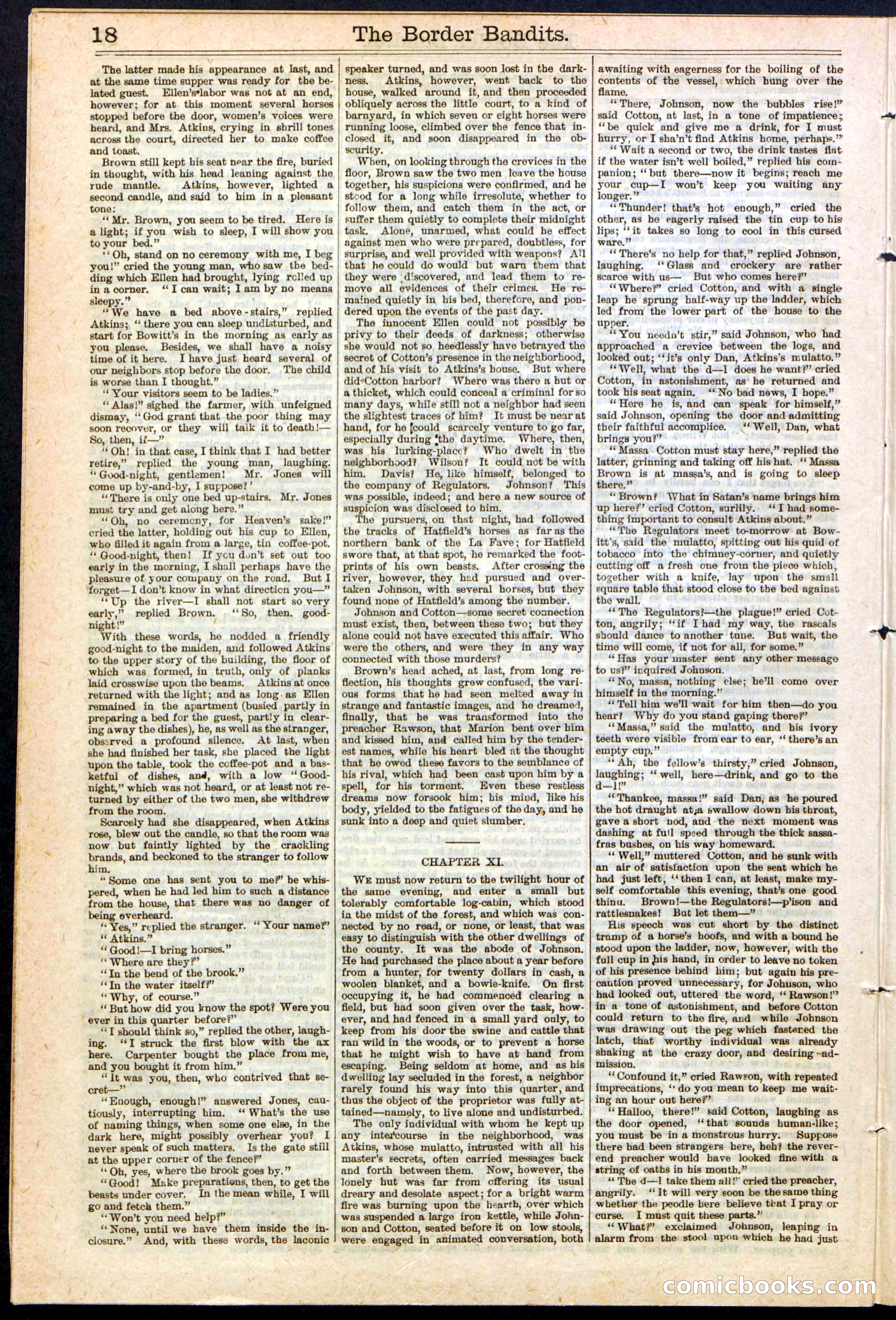
A restored page from Pulp Fiction, 1881. Page through the whole issue in the reader above.
📄 Transcribed text from this page (OCR, searchable)
Machine-transcribed from the original scan — historical spelling and the odd misread are preserved.
~ = eee oe - a - é 1 The latter made his appearance at last, and at the same time supper was ready for the be- lated guest. Ellen’s*labor was not at an end, however; for at this moment several horses stopped before the door, women’s voices were heard, and Mrs. Atkins, crying in sbrill tones across the court, directed her to make coffee and toast. Brown still kept his seat near the fire, buried in thought, with his head leaning against the rude mantle. Atkins, however, lighted a second candle, and said to him in a pleasant tone: ‘Mr, Brown, you seem to be tired. Here is a light; if you wish to sleep, I will show you to your bed.” ‘*Oh, stand on no ceremony with me, I beg you!” cried the young man, who saw the bed- ding which Ellen had brought, lying rolled up inacorner. ‘I can wait; Iam by no means sleepy.” ‘““We have a bed above-stairs,” replied Atkins; “ there you can sleep undisturbed, and start for Bowitt’s in the morning as early as you please. Besides, we shall have a noisy time of it here. I have just heard several of our neighbors stop before the door. The child is worse than I thought.” ‘Your visitors seem to be ladies.” * Alas!” sighed the farmer, with unfeigned dismay, ‘‘God grant that the poor thing may soon recover, or they will talk it to death!— So, then, if—” ‘Oh! in that case, I think that I had better retire,” replied the young man, laughing. ‘‘Good-night, gentlemen! Mr. Jones will come up by-and-by, I suppose?’ ‘There is only one bed up-stairs. Mr. Jones musi try and get along here.” ‘“Oh, no ceremony, for Heaven’s sake!” cried the latter, holding out his cup to Ellen, who filled it again from a large, tin coffee-pot. ‘* Good-night, then! If you dun’t set out too early in the morning, I shall perhaps have the pleasure of your company on the road. But I ‘forget—I don’t know in what direction you—” ‘‘Up the river—I shall not start so very early,” replied Brown. . ‘‘So, then. good- night!” With these words, he nodded a friendly good-night to the maiden, and followed Atkins to the upper story of the building, the floor of which was formed, in truth, only of planks laid crosswise upon the beams. Atkins at once returned with the light; and as long.as Ellen remained in the apartment (busied partly in preparing a bed for the guest, partly in clear- ing away the dishes), he, as well as the stranger, observed a profound silence. At last, when she had finished her task, she placed the light upon the table, took the coffee-pot and a bas- ketful of dishes, and, with a low ‘“ Good- night,” which was not heard, or at least not re- turned by either of the two men, she withdrew from the room. Searcely had she disappeared, when Atkins rose, blew out the candle, so that the room was now but faintly lighted by the crackling brands, and beckoned to the stranger to follow him, “Some one has sent you to me?’ he whis- pered, when he had led him to such a distance from the house, that there was no danger of being overheard. “Yes,” replied the stranger. ‘“‘ Your name?” ** Atkins.” “‘ Good!—I bring horses.” ‘Where are they?’ ‘“‘In the bend of the brook,” ‘In the water itself?’ “Why, of course.” “‘ But how did you know the spot? Were you ever in this quarter before?” “T should think so,” replied the other, laugh- ing. ‘“‘I struck the first blow with the ax here. Carpenter bought the place from me, and you bought it from him.” “It was you, then, who contrived that se- cret—”’ “Enough, enough!” answered Jones, cau- tiously, interrupting him. ‘‘ What’s the use of naming things, when some one else, in the dark here, might possibly overhear you? I never speak of such matters. Is the gate still at the upper corner of the fence?” ‘‘Oh, yes, where the brook goes by.” ““Good! Make preparations, then, to get the beasts under cover. In the mean while, I will go and fetch them.” ‘“Won’t you need help?” ‘None, until we have them inside the in- closure.” And, with these words, the laconic t The Border Bandits. speaker turned, and was soon lost in the dark- ness. Atkins, however, wenfi back to the house, walked around it, and then proceeded obliquely across the little court, to a kind of barnyard, in which seven or eight horses were running loose, climbed over the fence that in- closed it, and soon disappeared in the ob- scurity. When, on looking through the crevices in the floor, Brown saw the two men leave the house together, his suspicions were confirmed, and he stood for a long while irresolute, whether to follow them, and catch them in the act, or suffer them quietly to complete their midnight task. Alone, unarmed, what could he effect against men who were prepared, doubtless, for surprise, and well provided with weapons? All that he could do would but warn them that they were ‘discovered, and lead them to re- move all evidences of their crimes. He re- mained quietly in his bed, therefore, and pon- dered upon the events of the past day. The innocent Ellen could not possibly be privy to their deeds of darkness; otherwise she would not so heedlessly have betrayed the secret of Cotton’s presence in the neighborhood, and of his visit to Atkins’s house. But where did*Cotton harbor? Where was there a but or a thicket, which could conceal a criminal for so many days, while still not a neighbor had seen the slightest traces of him? It must be near at hand, for he {could scarcely venture to go far, especially during ‘the daytime. Where, then, was his lurking-place? Who dwelt in the neighborhood? Wilson? It could not be with him. Davis? He, like himself, belonged to the company of Regulators. Johnson? This was possible, indeed; and here a new source of suspicion was disclosed to him. he pursuers, on that night, had followed the tracks of Haffield’s horses as far as the northern bank of the La Fave; for Hatfield swore that, at that spot, he remarked the foot- prints of his own beasts. After crossing the river, however, they had pursued and over- taken Johnson, with several horses, but they found none of Hatfield’s among the number. Johnson and Cotton—some secret connection must exist, then, between these two; but they alone could not have executed this affair. Who were the others, and were ‘they in any way connected with those murders? Brown’s head ached, at last, from long re- flection, his thoughts grew confused, the vari- ous forms that he had seen melted away in strange and fantastic images, and he dreamed, finally, that he was transformed into the preacher Rawson, that Marion bent over him and kissed him, and called him by the tender- est names, while his heart bled at the thought that he owed these favors to the semblance of his rival, which had been cast upon him by a spell, for his torment. Even these restless dreams now forsook him; bis mind, like his body, yielded to the fatigues of the day, and he sunk into a deep and quiet slumber. CHAPTER XI. WE must now return to the twilight hour of the same evening, and enter a small but tolerably comfortable log-cabin, whivh stood in the midst of the forest, and which was con- nected by no read, or none, or least, that was easy to distinguish with the other dwellings of the county. It was the abode of Johnson. He had purchased the place about a year before from a hunter, for twenty dollars in cash, a woolen blanket, and a bowie-knife. On first occupying it, he had commenced clearing a field, but had soon given over the task, how- ever, and had fenced in a small yard only, to keep from his door the swine and cattle that ran wild in the woods, or to prevent a horse that he might wish to have at hand from escaping. Being seldom at home, and as bis dwelling lay secluded in the forest, a neighbor rarely found his way into this quarter, and thus the object of the proprietor was fully at- tained—namely, to live alone and undisturbed. The only individual with whom he kept up apy intercourse in the neighborhood, was Atkins, whose mulatto, intrusted with all his master’s secrets, often carried messages back and forth between them. Now, however, the lonely hut was far from offering its usual dreary and desolate aspect; for a bright warm fire was burning upon the hearth, over which was suspended a large iron kettle, while John- son and Cotton, seated before it on low stools, were engaged in animated conversation, both 2 awaiting with eagerness for the boiling of the contents of the vessel, which hung over the flame. “There, Jobnson, now the bubbles rise!” said Cotton, at last, in a tone of impatience; ““be quick and give me a drink, for I must hurry, or I sha’n’t find Atkins home, perhaps.’” ‘Wait a second or two, the drink tastes flat if the water isn’t well boiled,” replied his coim- panion; ‘but there—now it begins; reach me your cup—I won’t keep you waiting any longer.” “Thunder! that’s hot enough,” cried the other, as he eagerly raised the tin cup to his lips; ‘‘it takes so long to cool in this cursed ware.” ‘‘There’s no help for that,” replied Johnson, laughing. ‘‘Glass and crockery are rather scarce with us— But who comes here?’ **Where?” cried Cotton, and with a single leap he sprung half-way up the ladder, which led from the lower part of the house to the upper. “You needn’t stir,” said Johnson, who had approached a crevice between the logs, and looked out; ‘‘it’s only Dan, Atkins’s mulatto.” “Well, what the d—l does he want?’ cried Cotton, in astonishment, as he returned and took his seat again, ‘‘ No bad news, I hope.” “Here he is, and can speak for himself,” said Johnson, opening the door and admitting their faithful accomplice. ‘* Well, Dan, what brings you?” ‘“Massa Cotton must stay here,” replied the latter, grinning and taking off his hat. ‘‘ Massa Brown is at massa’s, and is going to sleep there.” “Brown! What in Satan’s name brings him up here?’ cried Cotton, surlily.. ‘‘ I had some- thing important to consult Atkins about.” “The Regulators meet to-morrow at Bow- itt's, said the mulatto, spitting out his quid of tobacco into the chimney-corner, and quietly cutting off afresh one from the piece which, together with a knife, lay upon the small equare table that stood close to the bed agains the wall. ‘“‘The Regulators?—the plague!” cried Cot- ton, angrily; “if I had my way, the rascals should dance to another tune. But wait, the time will come, if not for all, for some,” “Has your master sent any other message to us?” inquired Johnson. ‘No, massa, nothing else; he’ll come over himself in the morning.” ‘Tell him we'll wait for him then—do you hear? Why do you stand gaping there?” **Massa,” said the mulatto, and his ivory teeth were visible from ear to ear, ‘‘ there’s an empty cup.” ‘“Ah, the fellow’s thirsty,” cried Johnson, laughing; “‘ well, here—drink, and go to the d—|]!” ‘“Thankee, massa!” said Dan, as he poured the hot draught at,;a swallow down bis throat, gave a short nod, and the next moment was dashing at full speed through the thick sassa- fras bushes, on his way homeward. ‘* Well,” muttered Cotton, and he sunk with an air of satisfaction upon the seat which he had just left, ‘‘then I can, at least, make my- self comfortable this evening, that’s one good thinu. Brown!—the tors!—p’ison and rattlesnakes! But let them—” His speech was cut short by the distinct tramp of a horse’s hoofs, and with a bound he stood upon the ladder, now, however, with the full cup in his hand, in order to leave no token of his presence behind him; but again his pre- caution proved unnecessary, for Johuson, who had looked out, uttered the word, ‘‘ Rawson!” in a tone of astonishment, and before Cotton could return to the fire, and while Johnson was drawing out the peg which fastered the latch, that worthy individual was already shaking at the crazy door, and desiring ~ad- mission. *Confound it,” cried Rawson, with repeated imprecations, ‘‘do you mean to keep me wait- ing an hour out here?’ ‘* Halloo, there!” said Cotton, laughing as the door opened, ‘that sounds human-like; you must be in a monstrous hurry. Suppose there bad been strangers here, heh? the rever- end preacher would bave looked fine with a string of oaths in his mouth,” “The d—1 take them all!” cried the preacher, angrily. ‘‘It will very soon be the same thing whether the peodle bere believe tiat I pray or curse. I must quit these parts.” ‘* What?’ exclaimed Johnson, leaping in alarm from the stool upon which he had just Ss JOOKS GoOmic (E(0) | FS aie