
Pulp Fiction, 1881 · page 15 of 24
Beadle's New York Dime Library, No. 138 — page 15: what you’re looking at
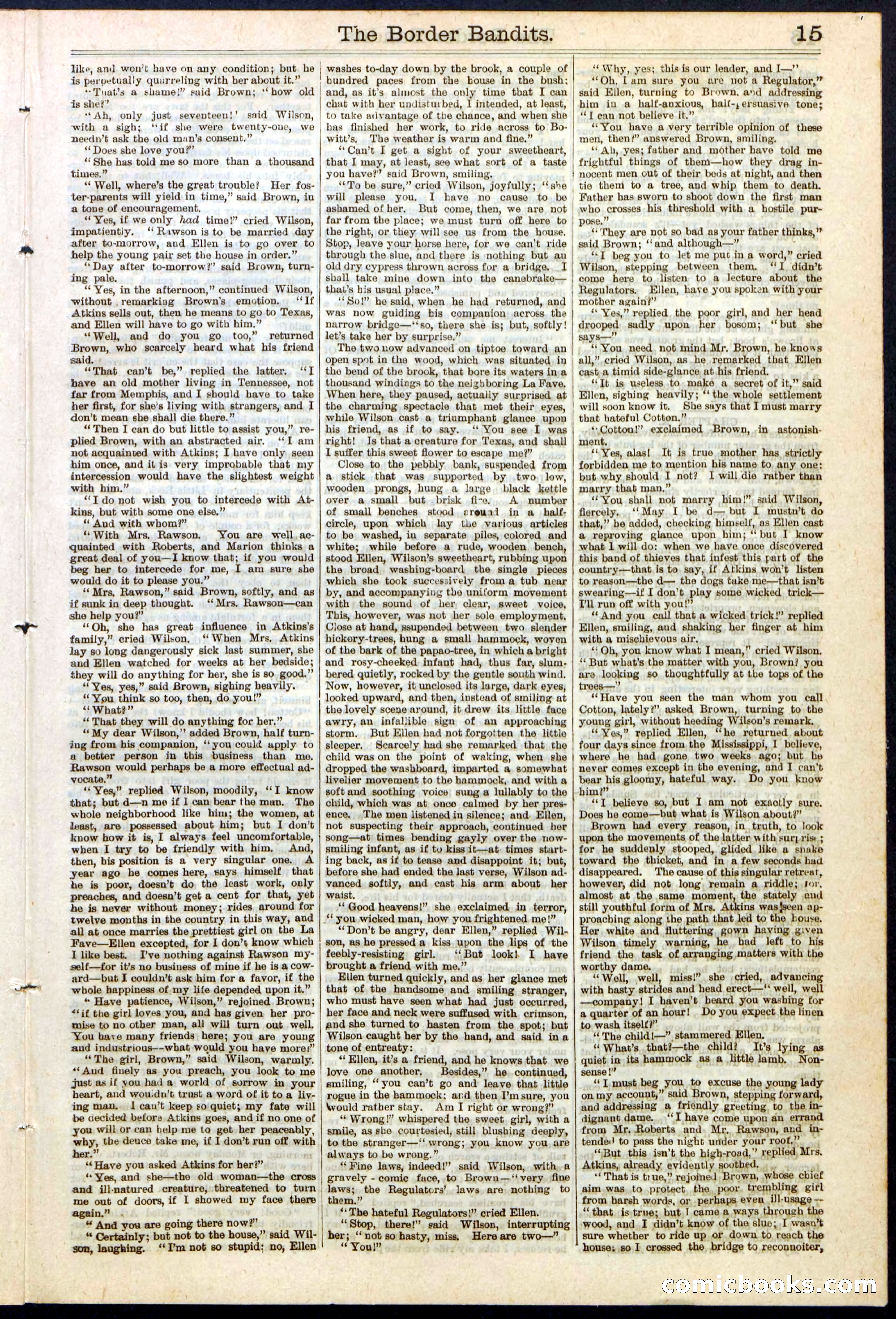
A restored page from Pulp Fiction, 1881. Page through the whole issue in the reader above.
📄 Transcribed text from this page (OCR, searchable)
Machine-transcribed from the original scan — historical spelling and the odd misread are preserved.
—_—_- ee like, and won’t have on any condition; but he is perpetually quarreling with ber about it.” is she?’ “Ah, only just seventeen!’ said Wilson, | ‘if she were twenty-one, we | with a sigh; needn’t ask the old man’s consent.” ‘Does she love you?” ‘‘ She has told me so more than a thousand times.” ‘‘ Well, where’s the great trouble? Her fos- ter-parents will yield in time,” said Brown, iu a tone of encouragement, ‘* Yes, if we only Aad time!” cried Wilson, impatiently. ‘‘ Rawson is to be married day after to-morrow, and Ellen is to go over to help the young pair set the house in order.” *‘Day after to-morrow?” said Brown, turn- ing pale. “Yes, in the afternoon,” continued Wilson, without .remarkisg Brown's emotion. ‘If Atkins sells out, then he means to go to Texas, and Ellen will have to go with him.” ‘Well, and do you go too,” returned Brown, who scarcely heard what his friend said. “That can’t be,” replied the latter, ‘J have an old mother living in Tennessee, not far from Memphis, and I should bave to take her first, for she’s living with strangers, and I don’t mean she shall die there.” “Then I can do but little to assist you,” re- plied Brown, with an abstracted air. ‘‘I am not acquainted with Atkins; I have only seen him once, and it is very improbable that my intercession would have the slightest weight with him.” “‘T do not wish you to intercede with At- kins, but with some one else,” “ And with whom?” ‘With Mrs, Rawson. You are well, ac- quainted with Roberts, and Marion thinks a great deal of you—I know that; if you would her to intercede for me, I am sure she would do it to please you.” ‘¢ Mrs, Rawson,” said Brown, softly, and as if sunk in deep thought. ‘‘ Mrs. Rawson—can she help you?” ‘“Oh, she has great influence in Atkins’s family,” cried Wilson, ‘When Mrs, Atkins lay so long dangerously sick last summer, she and Ellen watched for weeks at her bedside; they will do anything for her, she is so. good.”’ ‘Yes, yes,” said Brown, sighing heavily. “You think so too, then, do you!” “What?” “That they will do anything for her,” ‘“‘My dear Wilson,” added Brown, half turn- ing from his companion, ‘‘ you could apply to a better person in this business than me, Rawson would perhaps be a more effectual ad- vocate,” ‘*- Yes,” replied Wilson, moodily, “I know that; but d—n me if 1 can bear the man. The whole neighborhood like him; the women, at least, are possessed about him; but I don’t know bow it is, I always feel uncomfortable, when I try to be friendly with him. And, then, bis position is a very singular one, A ‘year ago be comes here, says himself that he is poor, doesn’t do, the least work, only preaches, and doesn’t get a cent for that, yet he is never without money; rides around for twelve months in the country in this way, and all at once marries the prettiest girl on the La Fave—Ellen excepted, for I don’t know which I like best. I’ve nothing against Rawson my- self—for it’s no business of mine if he is a cow- ard—but I couldn’t ask him for a favor, if the whole happiness of my life depended upon it.” “ Have patience, Wilson,” rejoined Brown; <‘if the girl loves you, and has given her pro- mise to no other man, all will turn out well You baye many friends here; you are young and industrious--wbat would you haye more?” “The girl, Brown,” said Wilson, warmly. ‘‘And fively as you preach, you look to me just as if you had a world of sorrow in your heart, and wou:dn’t trust a word of it to a liy- ing man. | can’t keep so quiet; my fate will be decided before Atkins goes, and if no one of you will or can help me to get her peaceably, why, the deuce take me, if I don’t run off with her.” “(Have you asked Atkins for her?” “Yes, and she—the old woman—the cross and ill-natured creature, threatened to turn me out of doors, if I showed my face there again.” . “ And you are going there now?” “ Certainly; but not to the house,” said Wil- son, laughing. ‘I’m not so stupid; no, Ellen *Tuat’?s a shame!” said Brown; *‘ bow old | ES LS tes Sa Ce ae el wie —- — The Border Bandits, washes to-day down by the brook, a couple of bundred paces from the house in the bush; and, as it’s almost the only time that I can chat with her undisturbed, I intended, at Jeast, to take advantage of the chance, and when she bas finished her work, to ride across to Bo- witt’s, The weather is warm and fine.” *Can’t I get a sight of your sweetheart, that I may, at least, see what sort of a taste you have?” said Brown, smiling. ‘*To be sure,” cried Wilson, joyfully; ‘‘she will please you. I have no cause to be ashamed of her. But come, then, we are not far from the place; we must turn off here to the right, or they will see us from the house, Stop, leave your horse here, for we can’t ride through the slue, and there is nothing but au old dry cypress thrown across for a bridge. _I shall take mine down into the canebrake— that’s bis usual place.” ‘‘ Sol” he said, when he had returned, and was now guiding bis companion across the narrow bridge—*‘‘so, there she is; but, softly! let’s take her by surprise.” The two now advanced on tiptoe toward an open spot in the wood, which was situated in the bend of the brook, that bore its waters ina thousand windings to the neighboring La Fave. When here, they paused, actually surprised at the charming spectacle that met their eyes, while Wilson cast a triumphant glance upon his friend, as if to say. ‘‘ You see I was right! Is that a creature for Texas, and shall I suffer this sweet flower to escape me?” Close to the pebbly bank, suspended from a stick that was supported by two low, wooden prongs, hung a large black kettle over a small but brisk five. A number of small benches stood creuadl in a half- circle, upon which lay the various articles to be washed, in separate piles, colored and white; while before a rude, wooden. bench, stood Ellen, Wilson’s sweetheart, rubbing upon the broad washing-board the single pieces which she took successively from a tub near by, and accompanying the uniform movement with the sound of her clear, sweet voice, This, however, was not her sole employment, Close at hand, ssupended between two slender hickory-trees, hung a small hammock, woven of the bark of the papao-tree, in which a bright and rosy-cheeked infant had, thus far, slum- bered quietly, rocked by the gentle south wind. Now, however, it unclosed its large, dark eyes, looked upward, and then, instead of smiling at the lovely scene around, it drew its little face awry, an infallible sign of an approaching storm. But Ellen had not forgotten the little sleeper. Scarcely had she remarked that the child was on the point of waking, when she dropped the washboard, imparted a somewhat livelier movement to the hammock, and with a softand soothing voice sung a lullably to the child, which was at once calmed by her pres- ence, The men listened in silence; and Ellen, not suspecting their approach, continued ber song—at times bending gayly over the now- smiling infant, as if tu kissiit—at times start- ing back, as it to tease and disappoint it; but, before she had ended the last verse, Wilson ad- vanced softly, and cast his arm about her waist. ‘Good heavens!” she exclaimed in terror, ‘you wicked man, how you frightened me!” ‘Don’t be angry, dear Ellen,” replied Wil- son, as he pressed a kiss upon the lips of the feebly-resisting girl. ‘‘But look! I have brought a friend with me,” Ellen turned quickly, and as her glance met that of the handsome and smiling stranger, who must have seen what had just occurred, her face and neck were suffused with crimson, and she turned to hasten from the spot; but Wilson caught ber by the hand, and said ina tone of entreaty: ‘‘ Ellen, it’s a friend, and he knows that we love one another, Besides,” he continued, smiling, “you can’t go and leave that little rogue in the hammock; ard then ’msure, you Would ratber stay. Am I right or wrong?’ ‘* Wrong!” whispered the sweet girl, with a smile, as ske courtesied, still blushing deeply, to the stranger—‘‘ wrong; you know you are always to be wrong.” : ** Fine laws, indeed!” said Wilson, with,.a gravely - comic face, to Brown-—‘‘very fine laws; the Regulators’ laws are nothing to them.” : ‘‘The hateful Regulators!” cried Ellen. “Stop, there!” said Wilson, interrupting — or so hasty, miss, Here are two—” ou : | eee 15 —— $$ “Why, yes; this is our leader, and I—’’ “Oh, Lam sure you are not a Regulator,” said Ellen, turning to Brown, and addressing him in a half-anxious, half-,ersuasive tone; ‘‘T ean not believe it,” ‘You have a very terrible opinion of these men, then?” answered Brown, smiling. ‘‘ Ah, yes; father and mother bave told me frightful things of theni—how they drag in- nocent men out of their beds at night, and then tie them to a tree, and whip them to death. Father bas sworn to shoot down the first man who crosses his threshold with a hostile pur- ose.” nat ‘They are not so bad as your fatber thinks,” said Brown; ‘‘and although—” “TI beg you to let me put ina word,” cried Wilson, stepping between them. ‘I didn’t come here to listen to a lecture about the Regulators. Ellen, have you spoken with your mother again?” ‘* Yes,” replied the poor girl, and her head drooped sudly upon her bosom; ‘“‘but she says-—”’ ‘You need. not mind Mr, Brown, he knows all,” cried Wilson, as.be remarked that Ellen cast a timid side-glance at his friend. “Tt is useless to make a_ secret of it,” said Ellen, sighing heavily; ‘‘ the whole settlement will soon know it. She says that I must marry that hateful Cotton.” ‘Cotton!’ exclaimed Brown, .in_astonish- ment, ‘Yes, alas! It is true mother has strictly forbidden me to mention his name to any one; but why should I not? I will die rather than marry thab man,” “You shall not marry bim!”, said Wilson, fiercely... ‘‘May I be d-— but I mustn’t do that,’”’ be added, checking himeelf, as Ellen cast a reproving glance upon him; ‘but I know what 1 will do: when we bave once discovered this band of thieves that infest this part of the country—that is to say, if Atkins won’t listen to reason—the d— the dogs take me—that isn’t swearing—if I don’t play some wicked trick— [Pll run off with you!” * And you call that a wicked trick!” replied Ellen, smiling, aud shaking her finger at him with a mischievous air, ‘‘Oh, you know what I mean,” cried Wilson. ‘< But what’s the matter with you, Brown! you are looking so thoughtfully at the tops of the trees—” ‘“‘“Have you seen the man whom you call Cotton, lately?” asked Brown, turning to the young girl, without heeding Wilson’s remark, ‘* Yes,” replied Ellen, “he returned about four days since from the Mississippi, I believe, where he had gone two weeks ago; but he never comes except in the evening, and I can't bear his gloomy, hateful way. Do you know him?” , ‘‘T believe so, but I am not exactly sure. Does he come—but what is Wilson about?” Brown had every reason, in truth, to look upon the movements of the latter with surpris: ; for he suddenly stooped, glided like a snak toward the thicket, and in a few seconds hud disappeared. The cause of this singular retreat, however, did not long remain a riddle; tor, almost at the same moment, the stately end still youthful form of Mrs. ns was r proaching along the path that led to the house. Her white and fluttering gown having give Wilson timely warning, he had left to friend the task of arranging matters with the worthy dame. todd es ‘‘ Well, well, miss!” she cried, advanci with hasty strides and head erect—" well, w —company! I haven’t heard you washing for a quarter of an hour! Do you expect the linen to wash itself?” | “The child!—” stammered Ellen, “ What's that?—the child? It’s lying as quiet in its hammock as a little lamb, Non- sense |’ ht ‘““T must beg you to excuse the young lady on my account,” said Brown, stepping forw , and addressing a friendly greeting to the dignant dame. “I have come upon an errant from Mr, Roberts and M . Rawson, an in- tende:! to pass the night under your root,” ‘But sus isn’t the hieherani replied, Mrs. Atkins, already evident jthed. , , } ‘“ That is true,” rejomed ‘Brown, whose chief aim was to protect. the poor trembling girl from barsh words, or perhaps even | sash “that is true; but | came a ways through th wood, and I didn’t know of the slue, I waso sure whether to up or down to reach the house; so I crossed the bridge to reconnoiter, Gomiicbooks (E() 2