
Pulp Fiction, 1881 · page 16 of 24
Beadle's New York Dime Library, No. 138 — page 16: what you’re looking at
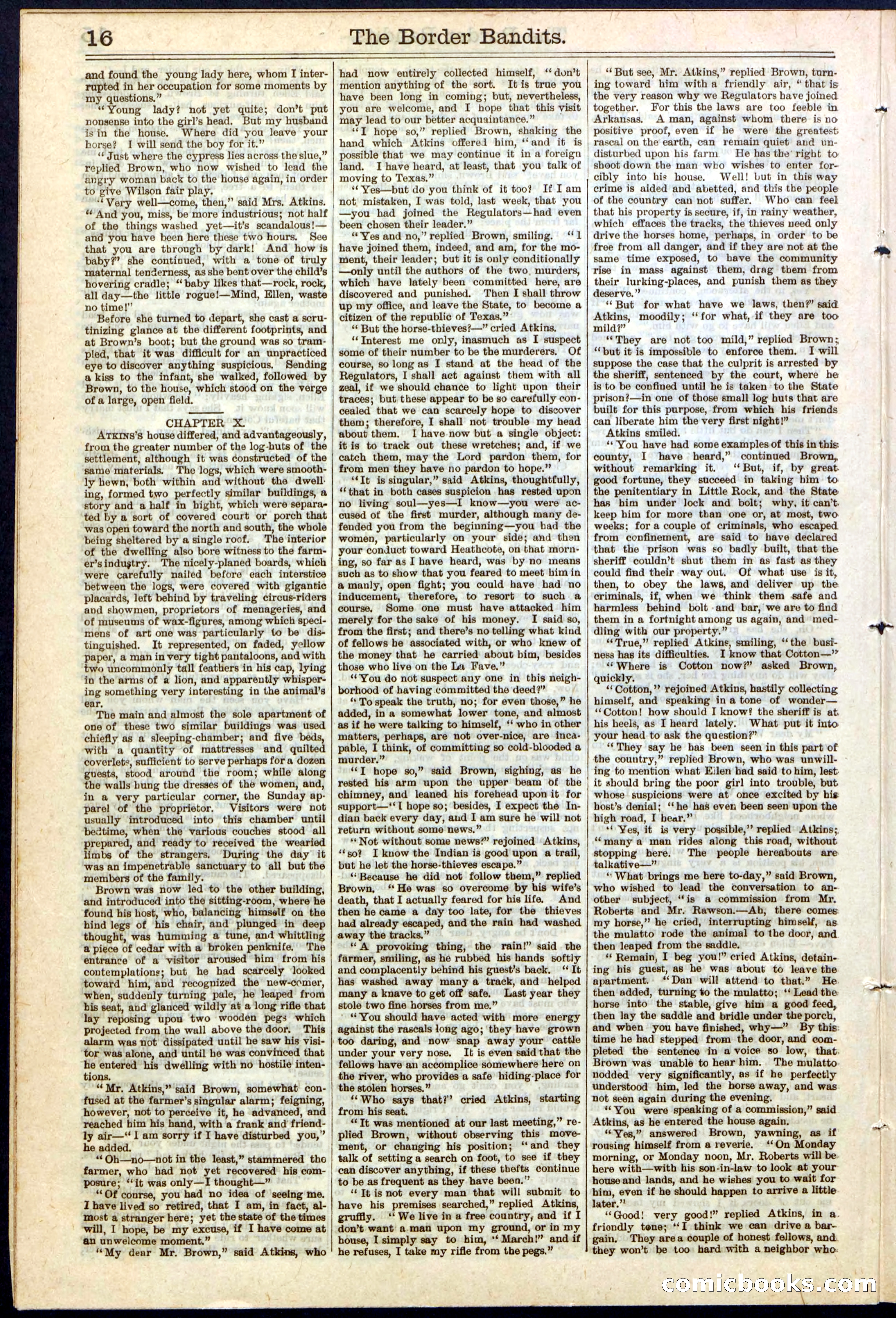
A restored page from Pulp Fiction, 1881. Page through the whole issue in the reader above.
📄 Transcribed text from this page (OCR, searchable)
Machine-transcribed from the original scan — historical spelling and the odd misread are preserved.
‘16 a eee —_ -—- -——— The Border Bandits. and found the young lady here, whom I inter- rupted in her occupation for some moments by my questions.” “Young lady? not yet quite; don’t put nonsense into the girl’s head, But my husband isin the house. Where did you leave your horse? I will send the boy for it.” ‘¢ Just where the cypress lies across the slue,” replied Brown, who now wished to lead the angry woman back to the house again, in order to give Wilson fair play, ‘‘Very well—come, then,” said Mrs. Atkins. “ And you, miss, be more industrious; not half of the things washed yet—it’s scandalous!— and you have been here these two hours, See that you are through by dark! And how is baby?’ she continued, with a tone of truly maternal tenderness, as she bent over the child’s hovering cradle; ‘baby likes that—rock, rock, all day—the little rogue!—Mind, Ellen, waste no time!” Before she turned to depart, she cast a scru- tinizing glance at the different footprints, and at Brown’s boot; but the ground was so tram- pled, that it was difficult for an unpracticed eye to discover anything suspicious, Sending a kiss to the infant, she walked, followed by Brown, to the house, which stood on the verge of a large, open field. CHAPTER X Atxrns’s house differed, and advantageously, from the greater number of the log-huts of the settlement, although it was constructed of the same materials. The logs, which were smooth- ly hewn, both within and without the dwell. ing, formed two perfectly similar buildings, a story and a half in hight, which were separa- ted by a sort of covered court or porch that was open toward the north and south, the whole being sheltered by a single roof. The interior of the dwelling also bore witness to the farm- er’sindugtry. The nicely-planed boards, which were carefully nailed before each interstice between the logs, were covered with gigantic placards, left behind by traveling circus-riders and showmen, proprietors of menageries, and of museums of wax-figures, among which speci- mens of art one was particularly to be dis- tinguished. It represented, on faded, yellow paper, a man in very tight pantaloons, and with two uncommonly tall feathers in his cap, lying in the arms of a lion, and apparently whisper- ing something very interesting in the animal’s ear. The main and almost the sole apartment of one of these two similar buildings was used chiefly as a sleeping-chamber; and five with a quantity of mattresses and quilted coverlets, sufficient to serve perhaps for a dozen guests, stood around the room; while along the walls hung the dresses of the women, and, in a very particular corner, the Sunday ap- parel of the proprietor. Visitors were not usually introduced into this chamber until bedtime, when the various couches stood all repared, and ready to received the wearied mbs of the strangers. During the day it was an impenetrable sanctuary to all but the members of the family. Brown was now led to the other building, and introduced into the sitting-room, where he found his host, who, balancing himself on the hind legs of his chair, and plunged in deep thought, was humming a tune, and whittling a piece of cedar with a broken penknife. The entrance of a visitor aroused him from his contemplations; but he had scarcely looked toward him, and recognized the new-comer, when, suddenly turning pale, he leaped from his seat, and glanced wildly at a long rifle that lay reposing upou two wooden pegs which projected from the wall above the door. This alarm was not dissipated until he saw his visi- tor was alone, and until he was convinced that = entered his dwelling with no hostile inten- tions, “Mr. Atkins,” said Brown, somewhat con- fused at the farmer’s singular alarm; feigning, however, not to perceive it, he advanced, and reached him his hand, with a frank and friend- ly air—“ I am sorry if I have disturbed you,” he added. “‘Oh—no—not in the least,” stammered tho farmer, who had not yet recovered his com- posure; “it was only—I thought—” “Of conrse, you had no idea of seeing me. I have lived so retired, that I am, in fact, al- most a stranger here; yet the state of the times ‘will, I hope, be my excuse, if I have come at ‘an unwelcome moment.” ei: “My dear Mr. Brown,” said Atkins, who had now entirely collected himself, ‘don’t mention anything of the sort. Itis true you have been long in coming; but, nevertheless, you are welcome, and I hope that this visit may lead to our better acquaintance.” ‘“‘T hope so,” replied Brown, shaking the hand which Atkins offered him, ‘‘and it is possible that we may continue it in a foreign | land. I have heard, at least, that you talk of moving to Texas,” ‘¢- Yes—but do you think of it too? If Iam not mistaken, I was told, last week, that you —you had joined the Regulators—had even been chosen their leader.” “Yes and no,” replied Brown, smiling. “1 have joined them, indeed, and am, for the mo- ment, their leader; but it is only conditionally —only until the authors of the two, murders, which have lately been committed here, are discovered and punished. ‘Then I shall throw up my office, and leave the State, to become a citizen of the republic of Texas.” “ But the horse-thieves?—” cried Atkins, ‘Interest me only, inasmuch as I suspect some of their number to be the murderers, Of course, so long as I stand at the head of the Regulators, I shall act against them with all zeal, if we should chance to light upon their traces; but these appear to be so carefully con- cealed that we can scarcely hope to discover them; therefore, I shall not trouble my head about them. I have now but a single object: it is to track out these wretches; and, if we catch them, may the Lord pardon them, for from men they have no pardon to hope.” **Tt is singular,” said Atkins, thoughtfully, ‘*that in both cases suspicion has rested upon no living soul—yes—I know—you were ac- cused of the firet murder, although many de- fended you from the beginning—you had the women, particularly on your side; and then your conduct toward Heathcote, on that morn- ing, so far as I have heard, was by no means such as to show that you feared to meet himin a manly, open fight; you could have had no inducement, therefore, to resort to such a course, Some one must have attacked him merely for the sake of bis money. [I said so, from the first; and there’s no telling what kind of fellows he associated with, or who knew of the money that he carried about bim, besides those who live on the La Fave,” “You do not suspect any one in this neigh- borhood of having committed the deed?” ‘‘To speak the truth, no; for even those,” he added, in a somewhat lower tone, and almost as if he were talking to himself, ‘‘ who in other matters, perhaps, are not over-nice, are inca- pable, I think, of committing so cold-blooded a murder.” ‘“T hope so,” said Brown, sighing, as he rested his arm upon the upper beam of the chimney, and leaned his forehead upon it for support—*‘ I hope so; besides, I expect the In- dian back every day, and I am sure he will not return without some news.” ‘* Not without some news?’ rejoined Atkins, ‘(so? I know the Indian is good upon a trail, but he let the horse-thieves escape.” ‘‘Because he did not follow them,” replied Brown, ‘He was so overcome by his wife’s death, that I actually feared for his life. And then he came a day too late, for the thieves had already escaped, and the rain had washed away the tracks.” “A provoking thing, the rain!” said the farmer, smiling, as he rubbed his hands softly and complacently behind his guest’s back. ‘ It has washed away many a track, and helped many a knave to get off safe. Last year they stole two fine horses from me.” ’ * You should have acted with more energy against the rascals long ago; they have grown ‘too daring, and now snap away your cattle under your very nose. It is even said that the fellows have an accomplice somewhere here on the river, who provides a safe hiding-place for the stolen horses.” ‘“Who says that?’ cried Atkins, starting from his seat. “Tt was mentioned at our last meeting,” re- plied Brown, without observing this move- ment, or changing his position; “and they talk of setting a search on foot, to see if they can discover anything, if these thefts continue to be as frequent as they have been.” “Tt is not every man that will submit to have his premises searched,” replied Atkins, gruffly. ‘‘ We live in a free country, and if I don’t want a.man upon my ground, or in my house, I simply say to him, ‘‘ March!” and if he refuses, I take my rifle from the pegs.” ‘But see, Mr. Atkins,” replied Brown, turn- ing toward him witha friendly air, “ that is the very reason why we Regulators have joined together. For this the laws are too feeble in Arkansas. A man, against whom there is no positive proof, even if he were the greatest rascal on the earth, can remain quiet and un- disturbed upon his farm He has the’ right to shoot down the man who wishes to enter for- cibly into his house. Well! but in this way crime is aided and abetted, and this the people of the country can not suffer. Who can feel that his property is secure, if, in rainy weather, which effaces the tracks, the thieves need only drive the horses home, perhaps, in order to be free from all danger, and if they are not at the same time exposed, to bave the community rise in mass against them, drag them from their lurking-places, and punish them as they deserve.” ‘But for what have we laws, then?’ said Atkins, moodily; “for what, if they are too mild?” “They are not too mild,” replied Brown; ‘but it is impossible to enforce them. I will suppose the case that the culprit is arrested by the sheriff, sentenced by the court, where he is to be confined until he is taken to the State prison?—in one of those small log huts that are built for this purpose, from which his friends can liberate him the very first night!” Atkins smiled. ‘‘You have had some examples of this in this county, I have heard,” continued Brown, without remarking it. ‘But, if, by great. good fortune, they succeed in taking him to the penitentiary in Little Rock, and the State has him under lock and bolt; why, it can’t. keep him for more than one or, at most, two weeks; for a couple of criminals, who escaped from confinement, are said to have declared that the prison was so badly built, that the sheriff couldn’t shut them in as fast as they could find their way out. Of what use is it, then, to obey the laws, and deliver up the criminals, if, when we think them safe and harmless behind bolt and bar, we are to find them in a fortnight among us again, and med- dling with our property.” “True,” replied Atkins, smiling, “the busi- ness has its difficulties. I know that Cotton—’’ “Where is Cotton now?” asked Brown, quickly. ‘‘ Cotton,’’ rejoined Atkins, hastily collecting himself, and speaking in atone of wonder— ‘“Cotton! how should I know? the sheriff is at, his heels, as I heard lately. What put it into your head to ask the question?” ‘They say he bas been seen in this part of the country,” replied Brown, who was unwill- ing to mention what Eilen bad said to him, lest: it should bring the poor girl into trouble, but whose suspicions were at once excited by his host’s denial; ‘“‘he has even been seen upon the high road, I bear.” ‘¢ Yes, it is very possible,” replied Atkins;. ‘many a man rides along this road, without stopping here. The people hereabouts are talkative—” ‘What brings me here to-day,” said Brown, who wished to lead the conversation to an- other subject, “is a commission from Mr, Roberts and Mr. Rawson.—Ab, there comes my horse,” he cried, interrupting himself, as the mulatto rode the animal to the door, and then leaped from the saddle. ‘* Remain, I beg you!” cried Atkins, detain- ing his guest, as he was about to leave the apartment. ‘‘Dan will attend to that.” He. then added, turning to the mulatto; ‘‘ Lead the horse into the stable, give him a good feed, then lay the saddle and bridle under the porch, and when you have finished, why—” By this: time he had stepped from the door, and com- pleted the sentence in a voice so low, that. Brown was unable to hear him. The mulatto nodded very significantly, as if he perfectly understood him, led the borse away, and was not seen again during the evening. “You were speaking of a commission,” said Atkins, as he entered the house again. “Yes,” answered Brown, yawning, as if rousing himself from a reverie. ‘‘On Monday morning, or Monday noon, Mr. Roberts will be. here with—with his son-in-law to look at your house and lands, and he wishes you to wait for him, even if he should happen to arrive a little. later.”’ “Good! very good!” replied Atkins, in a. friondly tone; ‘I think we can drive a bar- gain. They area couple of honest fellows, and they won’t be too hard with a neighbor who: GOomicodooks (e(o)|