
Pulp Fiction, 1881 · page 14 of 24
Beadle's New York Dime Library, No. 138 — page 14: what you’re looking at
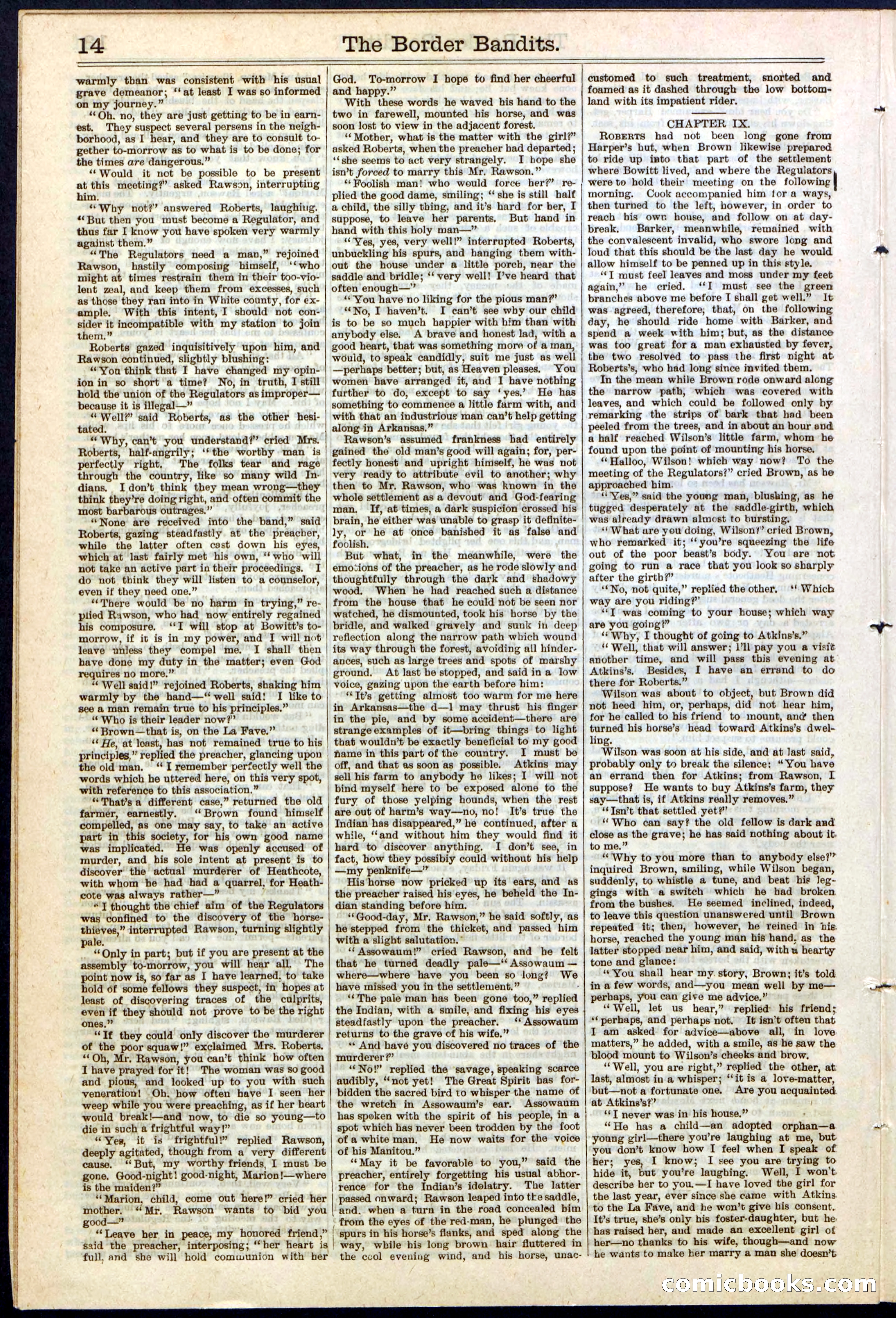
A restored page from Pulp Fiction, 1881. Page through the whole issue in the reader above.
📄 Transcribed text from this page (OCR, searchable)
Machine-transcribed from the original scan — historical spelling and the odd misread are preserved.
2 ee aa aS SSS — -_ pe _ ——— 14 The Border Bandits. warmly than was consistent with his usual grave demeanor; ‘at least I was so informed on my journey.” ““Oh. no, they are just getting to be in earn- est. They suspect several persens in the neigh- borhood, as I hear, and they are to consult to- gether to-morrow as to what is to be done; for the times are dangerous.” “Would it not be possible to be present at this meeting?’ asked Rawson, interrupting him. “Why not?’ answered Roberts, laughing. “But then you must become a Regulator, and thus far I know you have spoken very warmly against them.” “The Regulators need a man,” rejoined Rawson, hastily composing himself, ‘‘who might at times restrain them in their too-vio- lent zeal, and keep them from excesses, such as those they ran into in White county, for ex- ample. With this intent, I should not con- sider it incompatible with my station to join them.” Roberts gazed inquisitively upon him, and Rawson continued, slightly blushing: ‘““Yon think that I have changed my opin- ion in so short a time? No, in truth, I still hold the union of the Regulators as improper— because it is illegal—” “ Well?” said Roberts, as the other hesi- tated. “Why, can’t you understand?” cried Mrs. Roberts, half-angrily; ‘*the worthy man is perfectly right. The folks tear and rage through the country, like so many wild In- dians. I don’t think they mean wrong—they think they’re doing right, and often commit the most barbarous outrages.” “None are received into the band,” said Roberts, gazing steadfastly at the preacher, while the latter often cast down his eyes, which at last fairly met his own, “who will not take an active part in their proceedings. I do not think they will listen to a counselor, even if they need one.” “There would be no harm in trying,” re- plied Rawson, who had now entirely regained his composure. ‘I will stop at Bowitt’s to- morrow, if it is in my power, and I will not leave unless they compel me. I shall then have done my duty in the matter; even God requires no more.” “Well said!” rejoined Roberts, shaking him warmly by the band—‘“ well said! I like to see a man remain true to his principles.” “Who is their leader now?” “ Brown—that is, on the La Fave.” ‘“« He, at loast, has not remained true to his principles,” replied the preacher, glancing upon the old man. “I remember perfectly well the words which he uttered here, on this very spot, with reference to this association,” “That's a different case,” returned the old farmer, earnestly. “Brown found himself compelled, as one may say, to take an active part in this society, for his own good name was implicated. He was openly accused of murder, and his sole intent at present is to discover the actual murderer of Heathcote, with whom he had had a quarrel, for Heath- cote was always rather—” | “YT thought the chief aim of the Regulators was confined to the discovery of the ‘horse- thieves,” interrupted Rawson, turning slightly le. | . “Only in part; but if you are present at the assembly to-morrow, you will hear all, The point now is, so far as I have learned, to take hold of some fellows they suspect, in hopes at least of discovering traces of the culprits, even if they should not prove to be the right ones.” “If they could only discover the murderer of the poor squaw!” exclaimed Mrs. Roberts. ‘Oh, Mr. Rawson, you can’t think how often I have prayed for it! The woman was so good and pious, and looked up to you with such veneration! Oh. how often have I seen her weep while you were preaching, as if her heart would break!—and now, to die so young—to die in such a frightful way!” “Yes, it is frightful!’ replied Rawson, deeply agitated, though from a very different cause. ‘“ But, my worthy friends, I must be gone. Good-night! good-night, Marion!—where is the maiden?” “Marion. child, come out here!” cried her mother. “Mr, Rawson wants to bid you good—” ““Leave her in peace, my honored friend,” said the preacher, interposing; “her heart is God. To-morrow I hope to find her cheerful and happy.” With these words he waved his hand to the two in farewell, mounted his horse, and was soon lost to view in the adjacent forest. ‘‘ Mother, what is the matter with the girl?” asked Roberts, when the preacher had departed ; ‘(she seems to act very strangely. I hope she isn’t forced to marry this Mr. Rawson.” ‘‘Woolish man! who would force her?’ re- plied the good dame, smiling; “ she is still half a child, the silly thing, and it’s hard for ber, I suppose, to leave her parents, But hand in hand with this holy man—” “Yes, yes, very well!” interrupted Roberts, unbuckling his spurs, and banging them with- out the house under a little porch, near the saddle and bridle; ‘‘ very well! I’ve heard that often enough—” “You have no liking for the pious man?” “No, I haven’t. I can’t see why our child is to be so much happier with him than with anybody else. A brave and honest lad, with a good heart, that was something more of a man, would, to speak candidly, suit me just as well —perhaps better; but, as Heaven pleases. You women have arranged it, and I have nothing further to do, except to say ‘yes.’ He has something to commence a little farm with, and with that an industrious man can’t help getting along in Arkansas.” Rawson’s assumed frankness had entirely gained the old man’s good will again; for, per- fectly honest and upright himself, he was not very ready to attribute evil to another; why then to Mr. Rawson, who was known in the whole settlement as a devout and God-fearing man. If, at times, a dark suspicion crossed his brain, he either was unable to grasp it definite- ly, or he at once banished it as false and foolish. But what, in the meanwhile, were the emosions of the preacher, as he rode slowly and thoughtfully through the dark and shadowy wood. When he had reached such a distance from the house that he could not be seen nor watched, he dismounted, took his horse by the bridle, and walked gravely and sunk in deep reflection along the narrow path which wound its way through the forest, avoiding all hinder- ances, such as large trees and spots of marshy ground. At last be stopped, and said ina low voice, gazing upon the earth before him: “Tt’s getting almost too warm for me here in Arkansas—the d—1l may thrust his finger in the pie, and by some accident—there are strange examples of it—bring things to light that wouldn’t be exactly beneficial to my good name in this part of the country. I must be off, and that as soon as possible. Atkins may sell his farm to anybody he likes; I will not bind myself here to be exposed alone to the fury of those yelping hounds, when the rest are out of harm’s way—no, no! It’s true the Indian has disappeared,” he continued, after a while, ‘‘and without him they would find it hard to discover anything. I don’t see, in fact, how they possibiy could without his help —my penknife—” His‘horse now pricked up its ears, and as the preacher raised his eyes, he beheld the In- dian standing before him. ‘*Good-day, Mr. Rawson,” he said softly, as he stepped from the thicket, and passed him with a slight salutation. ‘* Assowaum!” cried Rawson, and he felt that he turned deadly pale—‘‘ Assowaum — where—where have you been so long? We have missed you in the settlement.” ‘The pale man has been gone too,” replied the Indian, with a smile, and fixing his eyes steadfastly upon the preacher. ‘* Assowaum returns to the grave of his wife.” ** And havé you discovered no traces of the murderer?” ‘““No!” replied the savage, speaking scarce audibly, “not yet! The Great Spirit bas for- bidden the sacred bird to whisper the name of the wretch in Assowaum’s ear, Assowaum has spoken with the spirit of his people, in a spot which has never been trodden by the foot of a white man. He now waits for the voice of his Manitou.” “May it be favorable to you,” said the preacher, entirely forgetting his usual abhor- rence for the Indian’s idolatry. The latter passed onward; Rawson leaped into tke saddle, ‘and. when a turn in the road concealed bim from the eyes of the red-man, he plunged the spurs in his horse’s flanks, and sped along the way, while his long brown hair fluttered in full, and she will hold communion with her the cvol evening wind, and his horse, unac- customed to such treatment, snorted and foamed as it dashed through the low bottom- land with its impatient rider. CHAPTER IX. Roperts had not been long gone from Harper’s hut, when Brown likewise prepared to ride up imto that part of the settlement where Bowitt lived, and where the Regulators were to hold their meeting on the following morning. Cook accompanied him tor a ways, then turned to the left, however, in order to reach his own house, and follow on at day- break. Barker, meanwhile, remained with the convalescent invalid, who swore long and loud that this should be the last day he would allow himself to be penned up in this style, ‘“T must feel leaves and moss under my feet again,” he cried. ‘‘I must see the green branches above me before I shall get well.” It was agreed, therefore; that, on the following day, he should ride home with Barker, and spend a week with him; but, as the distance was too great fora man exhausted by fever, the two resolved to pass the first night at Roberts’s, who had long since invited them. In the mean while Brown rode onward along the narrow path, which was covered witb leaves, and which could be followed only by remarking the strips of bark that had been peeled from the trees, and in about an hour and a half reached Wilson’s little farm, whom he found upon the point of mounting his horse. ‘‘Halloo, Wilson! which way now? To the meeting of the Regulators?” cried Brown, as be approached him. ‘*' Yes,” said the young man, blushing, as he tugged desperately at the saddle-girth, which was already drawn almost to bursting. ‘‘ What ure you doing, Wilson?’ cried Brown, who remarked it; ‘‘you’re squeezing the life out of the poor beast’s body. You are not going to run a race that you look so sharply after the girth?” ‘*No, not quite,” replied the other, way are you riding?” ‘“‘T was coming to your house; which way are you going?” ‘““Why, I thought of going to Atkins’s,” “Well, that will answer; 1’ll pay you a visit another time, and will pass this evening at Atkins’s. Besides, I have an errand to do there for Roberts.” Wilson was about to object, but Brown did not heed him, or, perhaps, did not hear him, for he called to his friend to mount, an@ then turned his horse’s head toward Atkins’s dwel- ling. Wilson was soon at his side, and at Jast said, probably only to break the silence: “You have an errand then for Atkins; from Rawson, I. suppose? He wants to buy Atkins’s farm, they say—that is, if Atkins really removes.” ‘*Isn’t that settled yet?’ ‘Who can say? the old fellow is dark and close as the grave; he has said nothing about it. to me.” “Why to you more than to anybody else?” inquired Brown, smiling, while Wilson began, suddenly, to whistle a tune, and beat his leg- gings with a switch which he had broken from the bushes. He seemed inclined, indeed, to leave this question unanswered until Brown repeated it; then, however, he reined in bis horse, reached the young man his hand, as the latter stopped near him, and said, with u hearty tone and glance: ‘“You shall hear my. story, Brown; it’s told in a few words, and—you mean well by me— haps, you can give me advice.” “Well, let us hear,” replied his friend; ‘* perhaps, and perhaps not. It isn’t often that I am asked for advice—above all, in love matters,” he added, with a smile, as he saw the blood mount to Wilson’s cheeks and brow, ‘Well, you are right,” replied the other, at last, almost in a whisper; ‘‘it is a love-matter, but—not a fortunate one. Are you acquainted. at Atkins’s?” ‘‘T never was in his house.” . “He has a child—an adopted orphan—a young girl—there you’re laughing at me, but. you don’t know how I feel when I speak of her; yes, I know; I see you are trying to hide it, but you’re laughing. Well, I won't describe her to you.—I have loved the girl for the last year, ever since she came with Atkins. to the La Fave, and he won’t give his consent. It’s true, she’s only his foster-daughter, but he. has raised her, and made an excellent girl of her—no thanks to his wife, though—and now he wants to make her marry a man she doesn’t “ Which comicbooks (E(0)