
Pulp Fiction, 1881 · page 21 of 32
Beadle's New York Dime Library, No. 136 — page 21: what you’re looking at
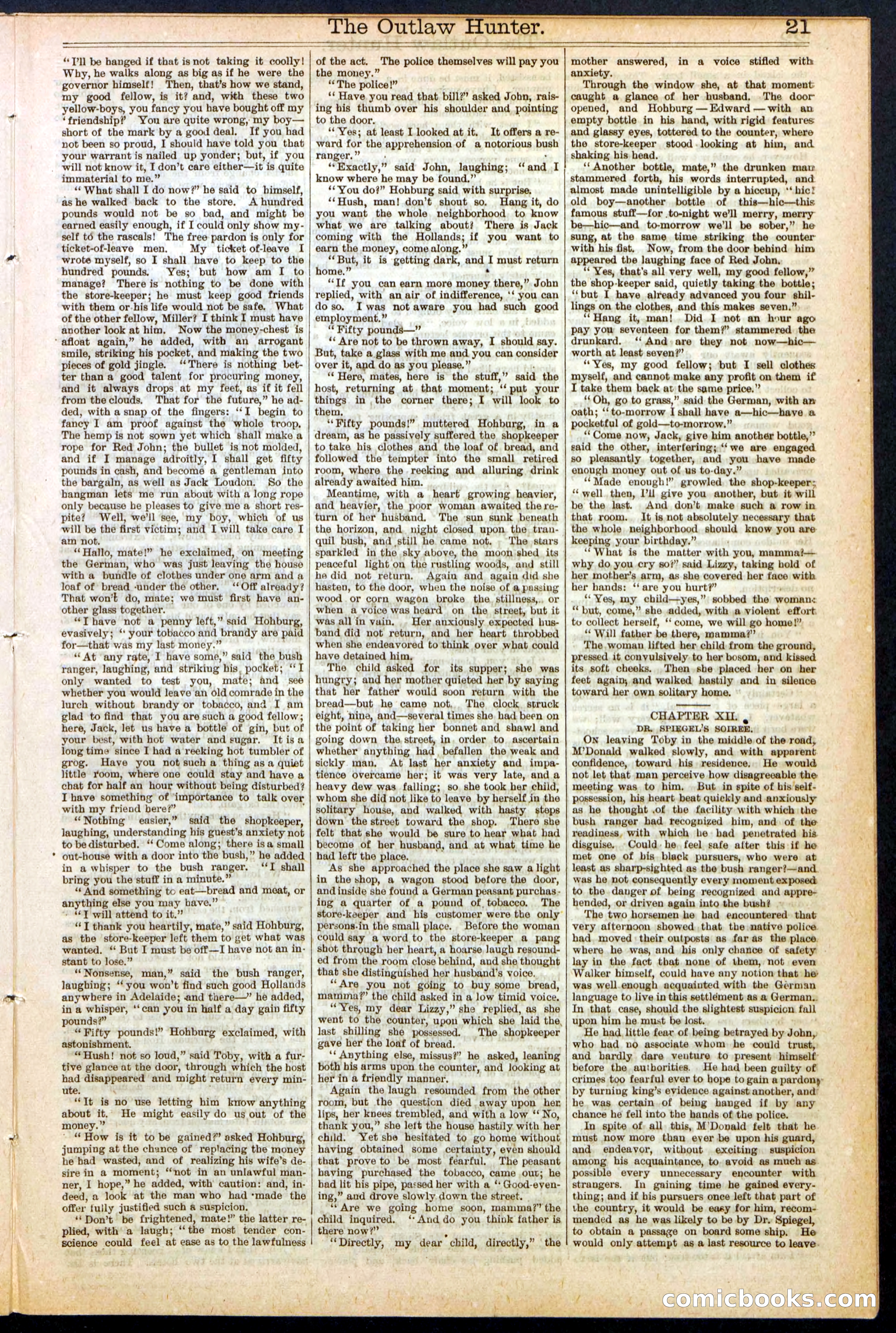
A restored page from Pulp Fiction, 1881. Page through the whole issue in the reader above.
📄 Transcribed text from this page (OCR, searchable)
Machine-transcribed from the original scan — historical spelling and the odd misread are preserved.
——_— [== ——— fe aa - OT wen Cie oie ee ‘afloat again,” he added, with an arrogant Se —- “Tl be hanged if that isnot taking it coolly! Why, he walks along as big as if he were the governor himself! Then, that’s how we stand, my good fellow, is it? ‘and, with these two yellow-boys, you fancy you have bought off my ‘friendship? You are quite wrong, my boy— short of the mark by a good deal. If you had not been so proud, I should have told you that your warrant is nailed up yonder; but, if you will not know it, I don’t care either—it is quite immaterial to me.” ‘‘ What shall I do now?” he said to himself, as he walked back to the store. A hundred pounds would not be so bad, and might be earned easily enough, if I could only show my- self t6 the rascals! The free pardon is only for ticket-of-leave men. My ticket of-leave I wrote myself, so I shall have to keep to the hundred pounds. Yes; but how am I to manage? There is nothing to be done with the store-keeper; he must keep good friends with them or-his life would not be safe, What of the other fellow, Miller? I think I must have another look at him. Now the money-chest is smile, striking his pocket, and making the two pieces of gold jingle. ‘There is nothing bet- ter than a good talent for procuring money, and it always drops at my feet, as if it fell from the clouds, That for the future,” he ad- ded, with a snap of the fingers: ‘‘I begin to fancy I am proof against the whole troop, The hemp is not sown yet which shall make a rope for Red John; the bullet is not molded, and if I manage adroitly, I shall get fifty pounds in cash, and become a gentleman into the bargaln, as well as Jack Loudon. §So the hangman lets me run about with a long rope only because he pleases to give me a short res- pite? Well, we'll see, my boy, which of us will be the first victim; and I will take care I am not. ‘Hallo, mate!” he exclaimed, on meeting the German, who was just leaving the house with a bundle of clothes under one arm and a loaf of bread -under the other. ‘Off already? That won't do, mate; we must first have an- other glass together. “Thave not a penny left,” said Hohburg, evasively; ** your tobacco and brandy are paid for—that was my last money.” “At any rate, I have some,” said the bush ranger, laughing, and striking his, pocket; ‘TI only wanted to test you, mate; and see whether you would leave an old comrade in the lurch without brandy or tobacco, and I am glad to find that you are such a good fellow; here, Jack, let us have a bottle of gin, but of your best, with hot water andsugar. Itisa long time since I had a reeking hot tumbler of grog. Have you not such a thing as a quiet little room, where one could stay and have a chat for half an hour without being disturbed? I have something of ‘importance to talk over with my friend bere?” “Nothing easier,” said the shopkeeper, laughing, understanding his guest’s anxiety not to be disturbed. ‘‘ Come along; there isa small out-house with a door into the bush,” he added in a whisper to the bush ranger. **T shall bring you the stuff in a minute.” “ And something to eat—bread and meat, or anything else you may have.” - “T will attend to it.” ‘“‘T thank you heartily, mate,” said Hohburg, as the store-keeper left them to get what was wanted. “ But I must be off—I have not an in- stant to lose.” “Nonsense, man,” said the bush ranger, laughing; “‘ you won’t find such good Hollands anywhere in Adelaide; and there—” he added, in a whisper, ‘‘can you in half a day gain fifty pounds?” “Fifty pounds!” Hohburg exclaimed, with astonishment. “Hush! not so loud,” said Toby, with a fur- tive glance at the door, through which the host had disappeared and might return every min- ute. : “It is no use letting him know anything about it. He might easily do us out of the money.” “How is it to be gained?’ asked Hohburg, jumping at the chance of replacing the money he had wasted, and of realizing his wife’s de- sire in a moment; “not in an unlawful man- ner, I hope,” he added, with caution: and, in- deed, a look at the man who had ‘made the offer fully justified such & suspicion. ‘Don’t be frightened, mate!” the latter re- plied, with a laugh; ‘the most tender con- science seonid feel at ease as to the lawfulness eit SSS nS ed eS eee of the act. The police themselves will pay you the money.” “The police!” ‘** Have you read that bill?’ asked Jobn, rais- ing his thumb over his shoulder and pointing to the door. ‘Yes; at least I looked at it. It offers a re- ward for the apprehension of a notorious bush ranger.” “Bxactly,” said John, laughing; know where he may be found,” **'You do?” Hohburg said with surprise, ‘Hush, man! don’t shout so. Hang it, do you want the whole neighborhood to know what we are talking about! There is Jack coming with the Hollands; if you want to earn the money, come along. & **But, it is getting dark, and 3 must return home. i “Tf you can earn more money there,” John replied, with an air of indifference, ‘‘ you can do so. I was not aware you had such good employment.” “ Fifty pounds—” ‘‘ Are not to be thrown away, I should say. But, take a glass with me and you can consider over it, and do as you please.” se Here, mates, here is the stuff,” said the host, returning at that moment; ci put your things in the corner there; I ‘will look . to them, ‘Fifty pounds!” muttered Hohburg, in a dream, as he passively suffered the shopkeeper to take his clothes and the loaf of bread, and followed the tempter into the small retired room, where the reeking and alluring drink already awaited him. Meantime, with a_ heart growing heavier, and heavier, the poor woman awaited the re- turn of her husband. The ‘sun sunk beneath the horizon, and. night closed upon the tran- quil bush, and still he came not. . The stars sparkled in the sky above, the moon shed its peaceful light on the rustling woods, and still he did not return, Again and again did she hasten, to the door, when the noise of a passing wood or corn wagon broke the. stillness,., or when a voice was heard on the street, but it was allin vain. . Her anxiously expected bus- band did not return, and her heart throbbed when she endeavored to think over what could have detained him, The child asked for its supper; she was hungry; and her mother quieted her by saying that her father would soon return with the bread—but he came not, The clock struck eight, nine, and—several times she had been on the point of taking her bonnet and shaw! and going down the street, in. order to ascertain whether anything had befallen the weak and sickly man, At last her anxiety and impa- tience overcame her; it was very late, and a heavy dew was falling; so she took her child, whom she did not like to leave by herself in the solitary house, and walked with hasty steps down the street toward the shop. There she felt that she would be sure to hear what had become of ber husband, and at what time he had left the place. As she approached the place she saw a light in the shop, a wagon stood before the door, and inside she found a German peasant purchas- ing a quarter of a pound of tobacco. The “and I store-keeper and his customer were the only persons-in the small place. Before the woman could say a word to the store-keeper a pang shot through her heart, a hoarse Jaugh resound- ed from the room close behind, and she thought that she distinguished her husband's voice. “Are you not going to buy some bread, mamuna?” the child asked in a low timid voice, “Yes, my dear Lizzy,” she replied, as she went to the counter, upo1 which she laid the last shilling she possessed. The shopkeeper gave her the loaf of bread. ‘* Anything else, missus?” he asked, leaning both bis arms upon the counter, and looking at her in a friendly manner. Again the laugh resounded from the other room, but the question died away upon her lips, ber knees trembled, and with a low ‘‘ No, thank you,” she left the house hastily with her child. Yet she hesitated to go home without having obtained some certainty, even should that prove to be most fearful. The peasant having purchased the tobacco, came out; he bad lit his pipe, passed her with a “ Good-even- ing,” and drove slowly down the street. ‘““Are we going home soon, mamma?” the child inquired. ‘And do you think father is there now?” Meier: f my dear’ child, jos inkl ‘the ‘ — —— eee sss... ___.___ = ———————————————————————— al mother answered, in a voice stifled with anxiety. Through the window she, at that moment caught a glance of her husband, The door opened, and Hohburg — Edward —with an empty bottle in his hand, with rigid features and glassy eyes, tottered to the counter, where the store-keeper stood looking at him, and shaking his head, ‘‘ Another bottle, mate,” the drunken maw stammered forth, his words interrupted, and almost made unintelligible by a hiccup, *‘ hic! old boy—another bottle of this—hic—this famous stuff—for .to-night we'll merry, merry be—hic—and to-morrow we'll be sober,” he sung, at the same time striking the counter with his fist. Now, from the door behind him appeared tbe laughing face of Red John, ** Yes, that’s all very well, my good fellow,” the shop-keeper said, quietly taking the bottle; ‘‘but I have already advanced you four ghil- lings on the clothes, and this makes seven.” “Hang it, man! Did I not an hour ago pay you seventeen for them?’ stammered the drunkard. ‘‘And-are they not now—hic— worth at least seven?’ “Yes, my good fellow; but I sell clothes myself, and cannot make any profit on them if I take them back at the same price.” ‘Oh, go to grass,” said the German, with am oath; ‘‘ to-morrow I shall have a—hic—have a pocketful of gold—to-morrow,” ‘“Come now, Jack, give him another bottle,” eaid the other, interfering; ‘we are engaged so pleasantly together, aud you have made enough money out of us to-day.” ‘*Made enough!” growled, the shop-keeper: “well then, VU give you another, but it will be the last. And don’t make such a row in that room. It is not absolutely necessary that the whole neighborhood should know you are keeping your birthday.” “What is the matter with you, mammai—+- why do you cry so?” said Lizzy, taking hold of her mother’s arm, as she covered her face «ihe her hands: ‘‘ are you hurt?” ‘Yes, my child—yes,” sobbed the wostiane *“ but, come,” she added, with a violent effort. to collect herself, ‘‘ come, we will go home!” *‘ Will father be there, mamma?’ The woman lifted her child from the ground, pressed it conyulsively to her bosom, and kissed its soft cheeks. Then she placed her on her feet again, and walked hastily and in silence toward her own solitary home. CHAPTER XII. , DR. SPIEGEL’S SOIRER. ON leaving Toby in the middle of the road; M’Donald walked slowly, and with apparent. confidence, toward his residence, He would not let that man perceive how disagreeable the meeting was to him. But in spite of bis self- possession, his heart beat quickly and anxiously as he thought .of the facility with which the bush ranger had recognized him, and of the readiness, with which he bad penetrated his disguise, Could. he. feel safe after this if he met one of bis black pursuers, who were at least as sharp-sighted as the bush ranger?—~and. was he not consequently every moment exposed to the danger of being recognized and appre- hended, or driven again into the bush? ~ The two horsemen he bad encountered that very afternoon showed that the native police. had moved their outposts as far as the place. where he was, and his only chance of safety | lay in the fact that none of them, not even Walker himself, could have any notion that he was well enough acquainted with the German language to live in this settlément as a German.. In that case, should the slightest cit fall upon him he must be lost. He had little fear of being betrayed by John, who bad no associate whom he could trust, and bardly dare veuture to present himself: before the autborities. He had been guilty of crimes too fearful ever to hope to gain a pardon»: by turning king’s evidence against another, and’ he was certain of being hanged if by any chance he fell into the hands of the police. In spite of all this, M’Donald felt that he. must now more than eyer be upon his guard, and endeavor, without exciting suspicion among his acquaintance, to. avoid as much as. possible every unnecessary encounter with strangers. In gaining time he gained every- thing; and if bis pursuers once left that part of vhe country, it would be easy for him, recom- mended as he was likely to be by Dr. Spiegel, to obtain a passage on board some ship, He would only attempt as a last resource to leave. (G comicbooks Patd by AWS %