
Pulp Fiction, 1881 · page 22 of 32
Beadle's New York Dime Library, No. 136 — page 22: what you’re looking at
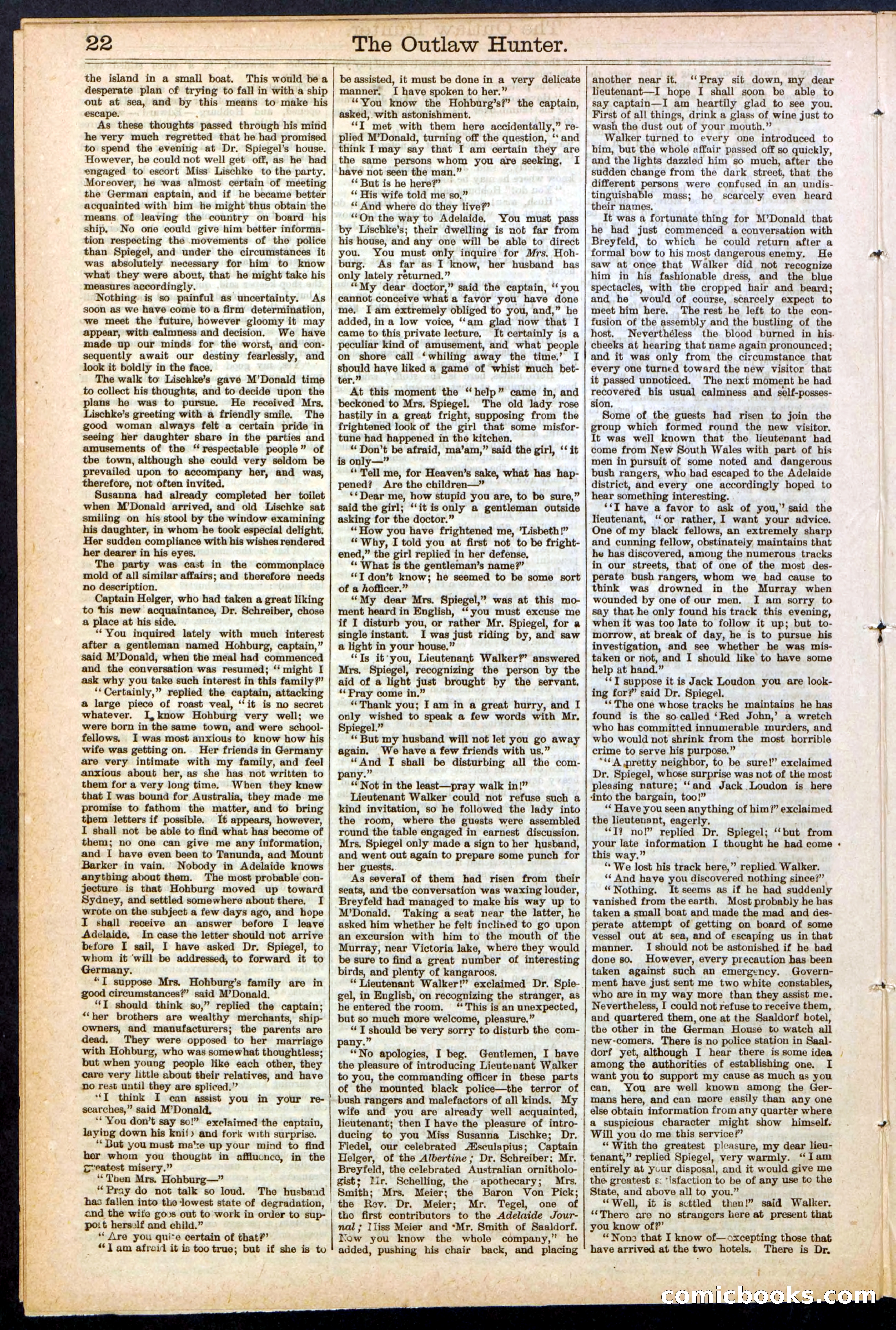
A restored page from Pulp Fiction, 1881. Page through the whole issue in the reader above.
📄 Transcribed text from this page (OCR, searchable)
Machine-transcribed from the original scan — historical spelling and the odd misread are preserved.
eS ee — > eee ee a ere ee A A a lt ‘ —— a ~~ by 22 : the island in a small boat. This would bea desperate plan of trying to fall in with a ship out at sea, and by this means to make his escape. ; As these thoughts passed through his mind he very much regretted that he had promised to spend the evening at Dr. Spiegel’s house. However, be could not well get off, as he had engaged to escort Miss Lischke to the party. Moreover, he was almost certain of meeting the German captain, and if he became better acquainted with him he might thus obtain the means of leaving the country on board his ship. No one could give him better informa- tion respecting the movements of the police than Spiegel, and under the circumstances it was absolutely necessary for him to know what they were abovt, that he might take his measures accordingly. Nothing is so painful as uncertainty. As soon as we have come to a firm determination, we meet the future, however gloomy it may appear, with calmness and decision. We have made up our minds for the worst, and con- sequently await our destiny fearlessly, and look it boldly in the face. The walk to Lischke’s gave M’Donald time to collect his thoughts, and to decide upon the plans he was to pursue. He received Mrs. Lischke’s greeting with a friendly smile. The good woman always felt a certain pride in seeing her daughter share in the parties and amusements of the ‘respectable people” of tbe town, although she could very seldom be prevailed upon to accompany her, and was, therefore, not often invited. Susanna had already completed her toilet when M’Donald arrived, and old Lischke sat smiling on his stool by the window examining his daughter, in whom he took especial delight. Her sudden compliance with his wishes rendered her dearer in his eyes. The y was cast in the commonplace mold of all similar affairs; and therefore needs no description. Captain Helger, who had taken a great liking to ‘this new acquaintance, Dr. Schreiber, chose a place at his side. “You inquired lately with much interest after a gentleman named Hohburg, captain,” said M’Donald, when the meal had commenced and the conversation was resumed; “ might I ask why you take such interest in this family?” ‘* Certainly,” replied the captain, attacking a large piece of roast veal, “it is no secret whatever. I, know Hohburg very well; we were born in the same town, and were school- fellows. I was most anxious to know how his wife was getting on. Her friends in Germany are very intimate with my family, and feel anxious about her, as she has not written to them for a very long time. When they knew that I was bound for Australia, they made me promise to fathom the matter, and to bring them letters if possible. It appears, however, I shall not be able to find what has become of them; no one can give me any information, and I have even been to Tanunda, and Mount Barker in vain. Nobody in Adelaide knows anything about them. The most probable con- jecture is that Hohburg moved up toward Sydney, and settled somewhere about there. I wrote on the subject a few days ago, and hope I shall receive an answer before I leave Adelaide, In case the letter should not arrive before I sail, I have asked Dr. Spiegel, to whom it ‘will be addressed, to forward it to Germany. “I suppose Mrs. Hohburg’s family are in circumstances?” said M’Donald. “I should think sv,” replied the captain; “her brothers are wealthy merchants, ship- owners, and manufacturers; the parents are dead. They were opposed to her marriage with Hohburg, who was somewhat thoughtless; but when young people like each other, they care very little about their relatives, and have mo reat until they are spliced.” “IT think I can assist you in your re- searches,” said M’Donald, ‘* You don’t say so!” exclaimed the captain, laying down his knif> and fork with surprise. ‘* But you must mae up your mind to find hor whom you thought in afflucnco, in the Cveatest misery.” “Tboen Mrs. Hohburg—” “Pray do not talk so loud. Tho husband has fallen into tho lowest state of degradation, and the wife gous out to work in order to sup- po:t herself and child.” “Are you quite certain of that?’ _ “Tam afraid it is too true; but if she is to —— — — . SETS ST SE 1A SS ee. —— = a - ; ~ n 5 re ) - we ad ’ why - The Outlaw Hunter. be assisted, it must be done in a very delicate manner. I have spoken to her.” “You know the Hohburg’s?” the captain, asked, with astonishment. “IT met with them here accidentally,” re- plied M’Donald, turning off the question, ‘* and think I may say that [ am certain they are the same persons whom you are seeking, I have not seen the man.” ‘** But is he here?’ “‘ His wife told me so.” ** And where do they live?’ **On the way to Adelaide, "You must pass by Lischke’s; their dwelling is not far from his house, and any one will be able to direct you. You must only inquire for Mrs, Hoh- burg. As far as I know, her husband has only lately returned.” ““My dear doctor,” said the captain, ‘ you cannot conceive what a favor you have done me. I am extremely obliged to you, and,” he added, in a low voice, ‘‘am glad now that I came to this private lecture. It certainly is a peculiar kind of amusement, and what people on shore call ‘whiling away the time.’ I should have liked a game of whist much bet- ter.” At this moment the “help” came in, and beckoned to Mrs. Spiegel. The old lady rose hastily in a great fright, supposing from the frightened look of the girl that some misfor- tune had happened in the kitchen. “Don’t be afraid, ma’am,” said the girl, ‘‘ it is only—” ** Tell me, for Heaven’s sake, what has hap- pened? Are the children—” **Dear me, how stupid you are, to be sure,” said the girl; “‘it is only a gentleman outside asking for the doctor.” “How you have frightened me, ’Lisbeth!” “Why, I told you at first not to be fright- ened,” the girl replied in her defense, “ What is the gentleman’s name?’ **T don’t know; he seemed to be some sort of a hofficer.” ‘““My dear Mrs. Spiegel,” was at this mo- ment heard in English, “‘you must excuse me if I disturb you, or rather Mr. Spiegel, for a single instant. I was just riding by, and saw a light in your house.” “Ts it’ you, Lieutenant Walker?” answered Mrs. Spiegel, recognizing the person by the aid of a light just brought by the servant. «Pray come in.” “Thank you; Iam in a great hurry, and I only wished to speak a few words with Mr, Spiegel.” ** But my husband will not let you go away again. We have a few friends with us.” “And I shall be disturbing all the com- ” ‘Not in the least—pray walk in!” Lieutenant Walker could not refuse such a kind invitation, so he followed the lady into the room, where the guests were assembled round the table engaged in earnest discussion. Mrs, Spiegel only made a sign to her husband, and went out again to prepare some punch for her guests. As several of them had risen from their seats, and the conversation was waxing louder, Breyfeld had managed to make his way up to M’Donald. Taking a seat near the latter, he asked him whether he felt inclined to go upon an excursion with him to the mouth of the Murray, near Victoria lake, where they would be sure to find a great number of interesting birds, and plenty of kangaroos, “Lieutenant Walker!” exclaimed Dr. Spie- gel, in English, on recognizing the stranger, as he entered the room. “This is an unexpected, but so much more welcome, pleasure.” “*T should be very sorry to disturb the com- pany.” **No apologies, I beg. Gentlemen, I bave the pleasure of introducing Lieutenant Walker to you, the commanding officer in these parts of the mounted black police—the terror of bush rangers and malefactors of all kinds. My wife and you are already well acquainted, lieutenant; then I have the pleasure of intro- ducing to you Miss Susanna Lischke; Dr. Fiedel, our celebrated Aisculapius; Captain Helger, of the Albertine ; Dr. Schreiber; Mr. Breyfeld, the celebrated Australian ornitholo- gist; Tir. Schelling, the apothecary; Mrs, Smith; Mrs. Meier; the Baron Von Pick; the Rev. Dr. Meier; Mr. Tegel, one of tho first contributors to the Adelaide Jour- nal ; Iliss Meier and ‘Mr. Smith of Saaldorf. Now you know the whole company,” he added, pushing his chair back, and placing another near it. ‘‘Pray sit down, my dear lieutenant—I hope I shall soon be able to say captain—I am heartily glad to see you. First of all things, drink a glass of wine just to wash the dust out of your mouth.” Walker turned to every one introduced to him, but the whole affair passed off so quickly, and the lights dazzled him so much, after the sudden change from the dark street, that the different persons were confused in an undis- tinguishable mass; he scarcely even heard their names, It was a fortunate thing for M’Donald that he had just commenced a conversation with Breyfeld, to which he could return after a formal bow to his most dangerous enemy. He saw at once that Walker did not recognize him in his fashionable dress, and the blue spectacles, with the cropped hair and beard; and he would of course, scarcely expect to meet him here. The rest he left to the con- fusion of the assembly and the bustling of the host. Neverthéless the blood burned in his. cheeks at hearing that name again pronounced; and it was only from the circumstance that every one turned toward the new visitor that it passed unnoticed. The next moment be had recovered his usual calmness and self-posses- sion. Some of the guests had risen to join the group which formed round the new visitor. It was well known that the lieutenant had come from New South Wales with part of his men in pursuit of some noted and dangerous bush rangers, who had escaped to the Adelaide district, and every one accordingly hoped to hear something interesting. . ‘*T have a favor to ask of you,” said the lieutenant, “or rather, I want your advice. One of my black fellows, an extremely sharp and cunning fellow, obstinately maintains that he has discovered, among the numerous tracks in our streets, that of one of the most des- perate bush rangers, whom we had cause to think was drowned in the Murray when wounded by one of our men. [ am sorry to say that he only found his track this evening, when it was too late to follow it up; but to- morrow, at break of day, he is to pursue his investigation, and see whether he was mis- taken or not, and I should like to have some help at hand.” ‘**T suppose it is Jack Loudon you are look- ing for?’ said Dr. Spiegel. ‘** The one whose tracks he maintains he has found is the so called ‘Red John,’ a wretch who has committed innumerable murders, and who would not shrink from the most horrible crime to serve his purpose,” *“* A pretty neighbor, to be sure!” exclaimed Dr. Spiegel, whose surprise was not of the most pleasing nature; ‘‘and Jack Loudon is here ‘into the bargain, too!” ** Have you seen anything of him?” exclaimed the lieutenant, eagerly. “I? no!” replied Dr. Spiegel; ‘‘but from your late information I thought he had come this way.” ** We lost his track here,” replied Walker. ** And haye you discovered nothing since?’ “Nothing. It seems as if he had suddenly vanished from theearth. Most probably he bas taken a small boat and made the mad and des- perate attempt of getting on board of some vessel out at sea, and of escaping us in that manner. I should not be astonished if he bad done so. However, every precaution has been taken against such an emergency. Govern- ment have just sent me two white constables, who are in my way more than they assist me. Nevertheless, I could not refuse to receive them, aud quartered them, one at the Saaldorf hotel, the other in the German House to watch all new-comers. There is no police station in Saal- dorf yet, although I hear there is some idea among the authorities of establishing one. I want you to support my cause as much as you can, You are well known among the Ger- mans here, and can more easily than any one else obtain information from any quarter where a suspicious character might show himself. Will you do me this service?” “With the greatest pleasure, my dear lieu- tenant,” replied Spiegel, very warmly. ‘‘ lam entirely at yur disposal, and it would give me the greatest s: ‘isfaction to be of any use to the State, and above all to you.” “Well, it is scttled then!” said Walker. ‘*Thero are no strangers here at present that you know of?” **Nono that I know of—oxcepting those that have arrived at the two hotels. There is Dr. ~ Econ zt (| { | LL ’