
Pulp Fiction, 1881 · page 20 of 32
Beadle's New York Dime Library, No. 136 — page 20: what you’re looking at
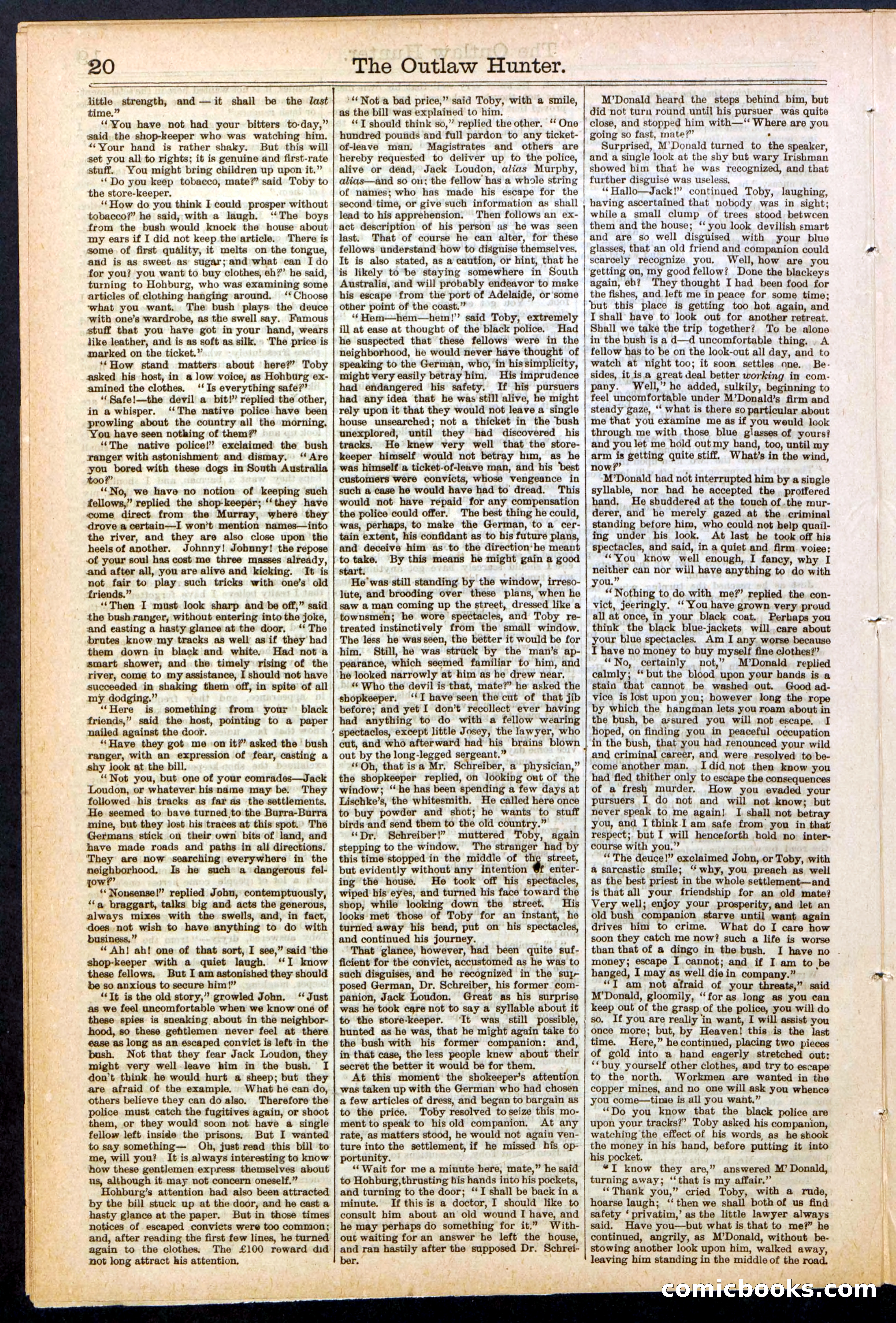
A restored page from Pulp Fiction, 1881. Page through the whole issue in the reader above.
📄 Transcribed text from this page (OCR, searchable)
Machine-transcribed from the original scan — historical spelling and the odd misread are preserved.
—— oe eee = — — ogee a * on“? 8 er ew = A a ee ay ee 20 ‘The Outlaw Hunter. little strength, and—#it shall be the last time.” ‘You have not had your bitters to-day,” said the shop-keeper who was watching him. *“‘Your hand is rather shaky. But this will set you all to rights; it is genuine and first-rate stuff. You might bring children up upon it.” ‘* Do you keep tobacco, mate?” said Toby to the store-keeper. “How do you think I could prosper without tobacco?” he said, with a laugh. ‘The boys from the bush would knock the house about my ears if I did not keep the article. There is some of first quality, it melts on the tongue, and is as sweet as sugar; and what can I do for you? you want to buy clothes, eh?’ he said, turning to Hohburg, who was examining some articles of clothing hanging around. ‘‘ Choose what you want. The bush plays the deuce ‘with one’s wardrobe, as the swell say. Famous stuff that you have got in your hand, wears like leather, and is as soft as silk. ‘The price is marked on the ticket.” ‘*How stand matters about here?’ Toby asked his host, in a low voice, as Hohburg ex- amined the clothes. ‘‘Is everything safe?’ “‘Safel—the devil a bit!” replied the other, in a whisper. ‘‘The native police have been prowling about the country all the morning. “You have seen nothing of them?’ ‘The native police!” exclaimed the bush ranger with astonishment and dismay. ‘Are you bored with these dogs in South Australia too?” ‘“No, we have no notion of keeping such fellows,” replied the shop-keeper; ‘‘they have come direct from the Murray, where they drove a certain—I won’t mention names—into the river, and they are also close upon the heels of another. Johnny! Jobuny! the repose of your soul has cost me three masses already, and after all, you are alive and kicking. It is not fair to play such tricks with one’s old friends.” ‘‘Then I must look sharp and be off,” said the bush ranger, without entering into the joke, and easting a hasty glance at the door. ‘“ The brutes know my tracks as well as if they had them down in black and white: Had not a smart shower, and the timely rising of the river, come to my assistance, I should not have succeeded in shaking them off, in spite of all my dodging.” “Here is something from your black friends,” said the host, pointing to a paper nailed against the door. “Have they got me on it?” asked the bush ranger, with an expression of fear, casting a shy look at the bill. “Not you, but one of your comrades—Jack Loudon, or whatever his name may be. They followed his tracks as far as the settlements. He seemed to bave turned to the Burra-Burra mine, but they lost his traces at this spot. The Germans stick on their own bits of land, and have made roads and paths in all directions. They are now searching everywhere in the oo gai Is he such a dangerous fel- ‘** Nonsense!” replied John, contemptuously, ‘‘a braggart, talks big and acts the generous, always mixes with the swells, and, in fact, does not wish to have anything to do with business,” ‘‘ Ah! ah! one of that sort, I see,” said ‘the shop-keeper with a quiet laugh. “I know these fellows. But I am astonished they should be so anxious to secure him!” “Tt is the old story,” growled John. ‘Just as we feel uncomfortable when we know one of these spies is sneaking about in the neighbor- hood, so these gehtlemen never feel at there ease as long as an escaped convict is left in the bush. Not that they fear Jack Loudon, they might very well leave him in the bush. I don’t think he would hurt a sheep; but they are afraid of the example. What he can do, others believe they can do also. Therefore the police must catch the fugitives again, or shoot them, or they would soon not have a single fellow left inside the prisons. But I wanted to say something— Oh, just read this bill to me, will you! It is always interesting to know how these gentlemen express themselves about us, although it may not concern oneself.” Hohburg’s attention had also been attracted by the bill stuck up at the door, and he cast a hasty glance at the paper. But in those times notices of escaped convicts were too common; and, after reading the first few lines, he turned again to the clothes. The £100 reward did not long attract his attention. ‘** Not a bad price,” said Toby, with a smile, as the bill was explained to him. ‘‘T should think so,” replied the other. ‘‘ One hundred pounds and full pardon to any ticket- of-leave man. Magistrates and others are hereby requested to deliver up to the police, alive or dead, Jack Loudon, alias Murphy, alias—and so ou; the fellow has a whole string of names; who has made his escape for the second time, or give such information as shall lead to his apprehension. Then follows an ex- act description of his person as he was seen last. That of course he can alter, for these fellows understand how to disguise themselves, It is also stated, as a caution, or hint, that he is likely to be staying somewhere in South Australia, and will probably endeavor to make his escape from the port of Adelaide, or some other point of the coast.” ‘‘ Hem—hem—hem!”’ said Toby, extremely ill at ease at thought of the black police. Had he suspected that these fellows were in the neighborhood, he would never have thought of speaking to the German, who, in his simplicity, might very easily betray him, His imprudence had endangered his safety. If his pursuers had any idea that he was still alive, he might rely upon it that they would not leave a single house unsearched; not a thicket in the bush unexplored, until they had discovered his tracks. He knew very well that the store- keeper himself would not betray him, as he was himself a ticket-of-leave man, and his ‘best customers were convicts, whose vengeance in such a case he would have had to dread. This would not have repaid for any compensation the police could offer. The best thing he could, was, perhaps, to make the German, to a cer- tain extent, his confidant as to his future plans, and deceive him as to the direction*he meant to take. By this means he might gain a good start. He was still standing by the window, irreso- lute, and brooding over these plans, when he saw a man coming up the street, dressed like a townsmen; he wore spectacles, and Toby re- treated instinctively from the small window. The less he wasseen, the better it would be for him. Still, he was struck by the man’s ap- pearance, which seemed familiar to him, and he looked narrowly at him as he drew near. ‘Who the devil is that, mate?” he asked the shopkeeper. ‘‘I have seen the cut of that jib before; and yet I don’t recollect ever having had anything to do with a fellow wearing spectacles, except little Josey, the lawyer, who cut, and who afterward had his brains blown out by the long-legged sergeant.” ‘Oh, that isa Mr, Schreiber, a physician,” the shopkeeper replied, on looking out of the window; ‘he has been spending a few days at Lischke’s, the whitesmith. He called here once to buy powder and shot; he wants to stuff birds and send them to the old country.” “Dr, Schreiber!” muttered Toby, again stepping to the window. The stranger had by this time stopped in the middle of the street, but evidently without any intention Of enter- ing the house. He took off his spectacles, wiped bis eyes, and turned his face toward the shop, while looking down the street. His looks met those of Toby for an instant, he turned away his bead, put on his spectacles, and continued his journey. That glance, however, had been quite suf- ficient for the convict, accustomed as he was to such disguises, and he recognized in the sup- posed German, Dr. Schreiber, his former com- panion, Jack Loudon. Great as his surprise was he took care not to say a syllable about it to the store-keeper. It was still possible, hunted as he was, that he might again take to the bush with his former companion: and, in that case, the less people knew about their secret the better it would be for them. At this moment the shokeeper’s attention was taken up with the German who had chosen a few articles of dress, and began to bargain as to the price. Toby resolved toseize this mo- ment to speak to his old companion. At any rate, as matters stood, he would not again ven- ture into the settlement, if he missed his op- portunity. ‘Wait for me a minute here, mate,” he said to Hohburg,thrusting his hands into his pockets, and turning to the door; ‘‘I shall be back in a minute. If this is a doctor, I should like to consult him about an old wound I have, and he may perhaps do something for it.” With- out waiting for an answer he left the house, and ran hastily after the supposed Dr. Schrei- ber. 7 y M’Donald heard the steps behind him, but did not turn round until his pursuer was quite close, and stopped him with—‘‘ Where are you going so fast, mate?” , Surprised, M’Donald turned to the speaker, and a single look at the shy but wary Irishman showed him that he was recognized, and that further disguise was useless, ‘* Hallo—Jack!” continued Toby, laughing, having ascertained that nobody was in sight; while a small clump of trees stood between them and the house; ‘‘ you look devilish smart and are so well disguised with your blue glasses, that an old friend and companion could scarcely recognize you, Well, how are you getting on, my good fellow? Done the blackeys again, eh? They thought I had been food for the fishes, and left me in peace for some time; ‘but this place is getting too hot again, and I shall have to look out for another retreat. Shall we take the trip together? To be alone in the bush is a d—d uncomfortable thing, . A fellow has to be on the look-out all day, and to watch at night too; it soon settles one. Be- sides, it isa great deal better working in com- pany. Well,” he added, sulkily, beginning to feel uncomfortable under M’Donald’s firm and steady gaze, ‘‘ what is there so particular about me that you examine me as if you weuld look through me with those blue glasses of yours? and you let me hold ou{my hand, too, until my arm is getting quite stiff. What’s in the wind, now?’ M’Donald had not interrupted him by a single syllable, nor had he accepted the _protfered hand, He shuddered at the touch of.the mur- derer, and be merely gazed at the criminal standing before him, who could not help quail- ing under his look. At last he took off his spectacles, and said, in a quiet and firm. voiee: “You know well enough, I fancy, why I neither can nor will have anything to do with you.’ “Nothing to do with me?’ replied the con- vict, jeeringly. ‘‘ You have grown very proud all at once, in your black coat. Perbaps you think the black blue-jackets will care about your blue spectacles. Am I any. worse because I have no money to buy myself fine clothes?’ “No, certainly . not,’ M’Donald replied calmly; ‘but the blood upon your hands is a stain that cannot be washed out. Good ad- vice is lost upon you; however long the rope by which the hangman lets you roam about in the bush, be assured you will not escape. I hoped, on finding you in peaceful occupation _in the bush, that you had renounced your wild and criminal career, and were resolved to be- come another man. I did not then know you had fled thither only to escape the consequences of a fresh murder. How you evaded your pursuers I do not and will not know; but never speak to me again] I shall not betray you, and I think._I am safe from yon in that respect; but I will henceforth hold no inter- course with you.” “The deuce!” exclaimed Jobn, or Toby, with a sarcastic smile; “why, you preach as well as the best priest in the whole settlement—and is that all your friendship for an old mate? Very well; enjoy your prosperity, and let an old bush companion starve until want again drives him to crime. What do I care how soon they catch me now? such a life is worse than that of a dingo in the bush. I have no . money; escape I cannot; and if I am to be hanged, I may as well diein company.” ~ “T am not afraid of your threats,” said M'Donald, gloomily, “for as long as you can keep out of the grasp of the police, you will do so, If you are really in want, I will assist you once more; but, by Heaven! this is the last time. Here,” he continued, placing two pieces of gold into a hand eagerly stretched out: **buy yourself other clothes, and try to escape to the north, Workmen are wanted in the copper mines, and no one will ask you whence you come—tinae is all you want,” “Do you know that the black police are upon your tracks?” Toby asked his companion, watching the effect of his words, as he shook the money in his hand, before putting it into his pocket. “I know they are,” answered M’ Donald, turning away; ‘‘that is my affair.”’ “Thank you,” cried Toby, with a rude, hoarse laugh; ‘‘ then we shall both of us find safety ‘ privatim,’ as the little lawyer always said. Have you—but what is that to me?” he continued, angrily, as M’Donald, without be- stowing another look upon him, walked away, leaving him standing in the middle of the road. ¥ : | 4 f - sy # © a i. \ Seles, re m