
Pulp Fiction, 1881 · page 19 of 32
Beadle's New York Dime Library, No. 136 — page 19: what you’re looking at
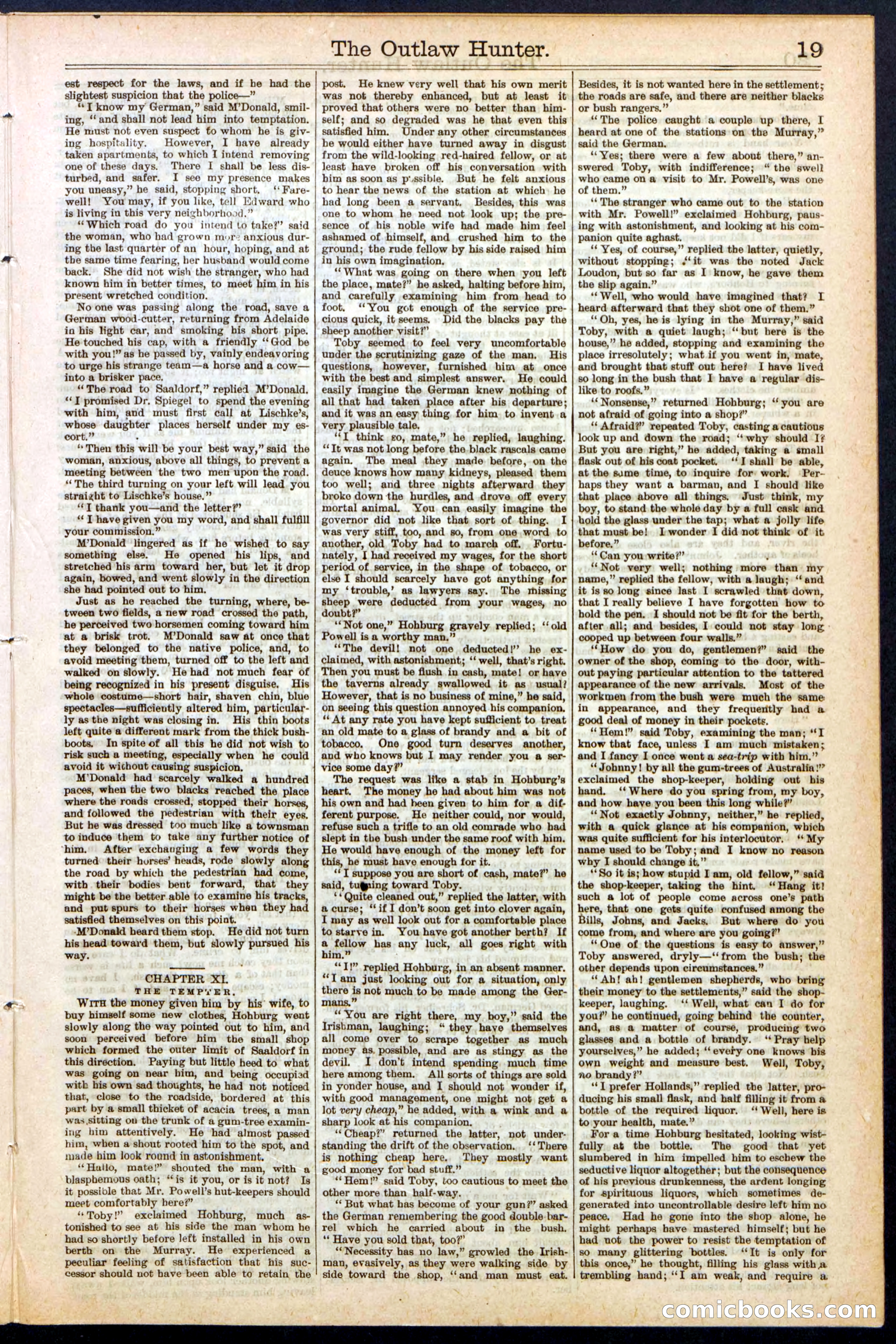
A restored page from Pulp Fiction, 1881. Page through the whole issue in the reader above.
📄 Transcribed text from this page (OCR, searchable)
Machine-transcribed from the original scan — historical spelling and the odd misread are preserved.
0 re me mm 2-2. a - — A * <2 ~ : est respect for the laws, and if he had the slightest suspicion that the police—” “IT know my German,” said M’Donald, smil- ing, ‘and shall not lead him into temptation. He must not even suspect fo whom he is giv- ing hospitality. However, I bave already taken apartments, to which I intend removing one of these days. There I shall be less dis- turbed, and safer. I see my presence makes you uneasy,” he said, stopping short, ‘ Fare- well! You may, if you like, tell Edward who is living in this very neighborhood.” “Which road do you intend to take?” said the woman, who had grown mor? anxious dur- ing the last quarter of an hour, hoping, and at the same time fearing, her husband would come back. She did not wish the stranger, who had known him in better times, to meet him in his present wretched condition. No one was passing along the road, save a German wood-cutter, returning from Adelaide in his light car, and smoking his short pipe. He touched his cap, with a friendly ‘‘God be with you!” as he passed by, vainly endeavoring to urge his strange team—a horse and a cow— into a brisker pace, “The road to Saaldorf,” replied M’Donald. ‘‘T promised Dr, Spiegel to spend the evening with him, and must first call at Lischke’s, whose daughter places herself under my es- cort.”’ . * Then this will be your best way,” said the woman, anxious, above all things, to prevent a meeting between the two men upon the road. “The third turning on your left will lead. you straizht to Lischke’s house.” **T thank you—and the letter?” ‘*T have given you my word, and shall fulfill your commission.” M’Donald lingered as if he wished to say something else. He opened his lips, and stretched his arm toward her, but let it drop again, bowed, and went slowly in the direction she had pointed out to him. Just as he reached the turning, where, be- tween two fields, a new road crossed the path, he perceived two horsemen coming toward him at a brisk trot. M’Donald saw at once that they belonged to the native police, and, to avoid meeting them, turned off to the left and walked on slowly. He had not much fear of being recognized in his present disguise, His whole costume—short hair, shaven chin, blue spectacles—sufficieutly altered him, particular- ly as the night was closing in. His thin boots left quite a different mark from the thick bush- boots, In spite of all this he did not wish to risk such a meeting, especially when he could avoid it without causing suspicion, M'Donald had scarcely walked a hundred paces, when the two blacks reached the place where the roads crossed, stopped their horses, and followed the pedestrian with their eyes, But he was dressed too much like a townsman to induce them to take any further notice of ‘him, After exchanging a few words they turned their hurses’ heads, rode slowly along the road by which the pedestrian had come, with their bodies bent forward, that they might be the better able to examine his tracks, and put spurs to their horses when they had satisfied themselves on this point. -M’Donald heard them stop. He did not turn his head toward them, but slowly pursued his way. CHAPTER XL THE TEMP''ER.,. WirH the money given him by his’ wife, to buy himself some new clothes, Hohburg went slowly along the way pointed out to him, and soon perceived before him the small shop which formed the outer limit of Saaldorf in this direction. Paying but little heed to what was going on near him, and being occupicd with his own sad thoughts, he had not noticed that, close to the roadside, bordered at this part by a small thicket of acacia trees, a man was sitting on the trunk of a gum-tree examin- ing him attentively. He had almost passed him, when a shout rooted him to the spot, and made bim look round in astonishment. ‘Hallo, mate!” shouted the man, with a blasphemous oath; “is it you, or is it not? Is it possible that Mr. Powell’s hut-keepers should meet comfortably here?” ‘*Toby!” exclaimed Hohburg, much as- tonished to see at his side the man whom he had so shortly before Jeft installed in his own berth on the Murray. He experienced a peculiar feeling of satisfaction that his suc- cessor should not have been able to retain the The Outlaw Hunter. = post, He knew very well that his own merit was not thereby enhanced, but at least it proved that others were no better than him- self; and so degraded was he that even this satisfied him. Under any other circumstances be would either have turned away in disgust from the wild-looking red-haired fellow, or at least have broken off his conversation with bim as soon as p'ssible. But he felt anxious to hear the news of the station at which he had long been a servant, Besides, this was one to whom he need not look up; the pre- sence of his noble wife had made him feel ashamed of himself, and crushed him to the ground; the rude fellow by his side raised him in his own imagination, “What was going on there when you left the place, mate?” he asked, halting before him, and carefully examining him from head to foot. ‘“‘You got enough of the service pre- cious quick, it seems. Did the blacks pay the sheep another visit?” Toby seemed to feel very uncomfortable under the scrutinizing gaze of the man, His questions, however, furnished him at once with the best and simplest answer. He could easily imagine the German knew nothing of all that had taken place after his departure; and if was an easy thing for him to invent a very plausible tale, “IT think so, mate,” he replied, laughing. “Tt was not long before the. black rascals came again. The meal they made before, on the deuce knows how many kidneys, pleased them too well; and three nights afterward they broke down the hurdles, and drove off every mortal animal. You can easily imagine the governor did not like that sort of thing. I was very stiff, too, and so, from one word to another, old Toby had to march off. Fortu- nately, | had received my wages, for the short period of service, in the shape of tobacco, or else I should scarcely have got anything for my ‘trouble,’ as lawyers say. The shissing sheep were deducted from your wages, no doubt?’ ‘Not one,” Hohburg gravely replied; ‘old Powell is a worthy man,” “The devil! not one deducted!’ he ex- claimed, with astonishment; ‘‘ well, that’s right. Then you must be flush in cash, mate! or have the taverns already swallowed it as usual? However, that is no business of mine,” he said, on seeing this question annoyed his companion, ** At any rate you have kept sufficient to treat an old mate to a glass of brandy and a bit of tobacco. One good turn deserves another, and who knows but I may render you a ser- vice some day?” The request was like a stab in Hohburg’s heart. The money he had about him was not his own and had heen given to him for a dif- ferent purpose. He neither could, nor would, refuse such a trifle to an old comrade who had slept in the bush under the same roof with him. He would have enough of the money left for this, he must have enough for it. ‘*T suppose you are short of cash, mate?” he said, tugning toward Toby. ** Quite cleaned out,” replied the latter, with a curse; ‘if I don’t soon get into clover again, I may as well look out for a comfortable place to starve in. You have got another berth? If a fellow has any luck, all goes right with him.” | “I!” replied Hohburg, in an absent manner. “Tam just looking out for a situation, only there is not much to be made among the Ger- mans,” “You are right there, my boy,” said the Irisbman, laughing; “ they haye themselves all come over to scrape together as much money as, possible, and are as stingy as the devil. I don’t intend spending much time here among them. All sorts of things are sold in yonder house, and I should not wonder if, with good management, one might not get a lot very cheap,” he added, with a wink and a sharp look at his companion. , ‘‘Cheap?” returned the latter, not under- standing the drift of the observation... ‘‘ There is nothing cheap here, They mostly want good money for bad stuff.” ‘*Hem!” said Toby, too cautious to meet the other more than half-way. : ** But what has become of your gun?” asked the German remembering the good double. bar- rel which he carried about in the _ bush, ‘“‘ Have you sold that, too?” ‘Necessity has no law,” growled the Irish- man, evasively, as they were walking side by side toward the shop, ‘‘and man must eat. ~N 1 ® a: as meee, . 19 Besides, it is not wanted here in the settlement; the roads are safe, and there are neither blacks or bush rangers.” | “The police caught a couple up there, I heard at one of the stations on the Murray,” said the German. “Yes; there were a few about there,” an- swered Toby, with indifference; “ the swell who came on a visit to Mr. Powell’s, was one of them.” ‘The stranger who came out to the station with Mr. Powell!” exclaimed Hohburg, paus- ing with astonishment, and looking at his com- panion quite aghast. “* Yes, of course,” replied the latter, quietly, without stopping; “‘it was the noted Jack Loudon, but so far as I know, he gave them the slip again.” ‘* Well, who would have imagined that? I heard afterward that they shot one of them.” ““Oh, yes, he is lying in the Murray,” said Toby, with a quiet laugh; ‘‘but here is the house,” he added, stopping and examining the place irresolutely; what if you went in, mate, and brought that stuff out here? I have lived so long in the bush that I have a regular dis- like to roofs.” ‘“* Nonsense,” returned Hohburg; “you are not afraid of going into a shop?” “* Afraid?’ repeated Toby, casting a cautious look up and down the road; ‘why should I? But you are right,” he added, taking a small flask out of his coat pocket, ‘‘I shall be able, at the sume time, to inquire for work. Per- haps they want a barman, and I should like that place above all things. Just think, my boy, to stand the whole day by a full cask and hold the glass under the tap; what a jolly life that must be! LIwonder I did not think of it before.” “Can you write?” d ‘Not very well; nothing more than my name,” replied the fellow, with a laugh; ‘and it is so long since last I scrawled that down, that I really believe I have forgotten how to hold the pen. I should not be fit for the berth, after all; and besides, I could not stay long - cooped up between four walls.” ‘‘How do you do, gentlemen?” said the owner of the shop, coming to the door, with- out paying particular attention to the tattered appearance of the new arrivals. Most of the workmen from the bush were much the same in appearance, and they frequeritly had a good deal of money in their pockets. . “Hem!” said Toby, examining the man; ‘I know tbat face, unless I am much mistaken; and I fancy I once went a sea-trip with him,” “Johnny! by all the gum-trees of Australia!’ exclaimed the shop-keeper, holding out bis hand, ‘‘Where do you spring from, my boy, and how have you been this long while?’ ‘““Not exactly Johnny, neither,” he replied, with a quick glance at his companion, which was quite sufficient for his interlocutor. ‘My name used to be Toby; and I know no reason why I should change it,” **So it is; how stupid I am, old fellow,” said the shop-keeper, taking the hint. “ Hang it! such a lot of people come across one’s path here, that one gets quite confused among the Bills, Johns, and Jacks, But where do you come from, and where are you going?” “One of the questions is easy to answer,” Toby answered, dryly—‘‘from the bush; the other depends upon circumstances.” ‘“‘Ah! ah! gentlemen shepherds, who bring their money to the settlements,” said the shop- keeper, laughing. ‘‘ Well, what can I do for you?” he continued, going behind the counter, and, as a matter of course, producing two glasses and a bottle of brandy. ‘ Pray help yourselves,” he added; ‘‘every one knows bis own weight and measure best. Well, Toby, no brandy?” 4 ‘I prefer Hollands,” replied the latter, pro- ducing his small flask, and half filling it from a bottle of the required liquor. ‘ Well, here is to your health, mate.” . For a time Hohburg hesitated, looking wist- fully at the bottle. The good that yet slumbered in him impelled him to eschew the seductive liquor altogether; but the consequence of his previous drunkenness, the ardent longing for spirituous liquors, which sometimes de- generated into uncontrollable desire left him no peace. Had he gone into the shop alone, he might perhaps have mastered himself; but he had uot the power to resist the temptation of so many glittering bottles. “It is only for this once,” he thought, filling his glass with a trembling hand; “‘I am weak, and require a > comire oKoye) ES com