
Pulp Fiction, 1881 · page 18 of 32
Beadle's New York Dime Library, No. 136 — page 18: what you’re looking at
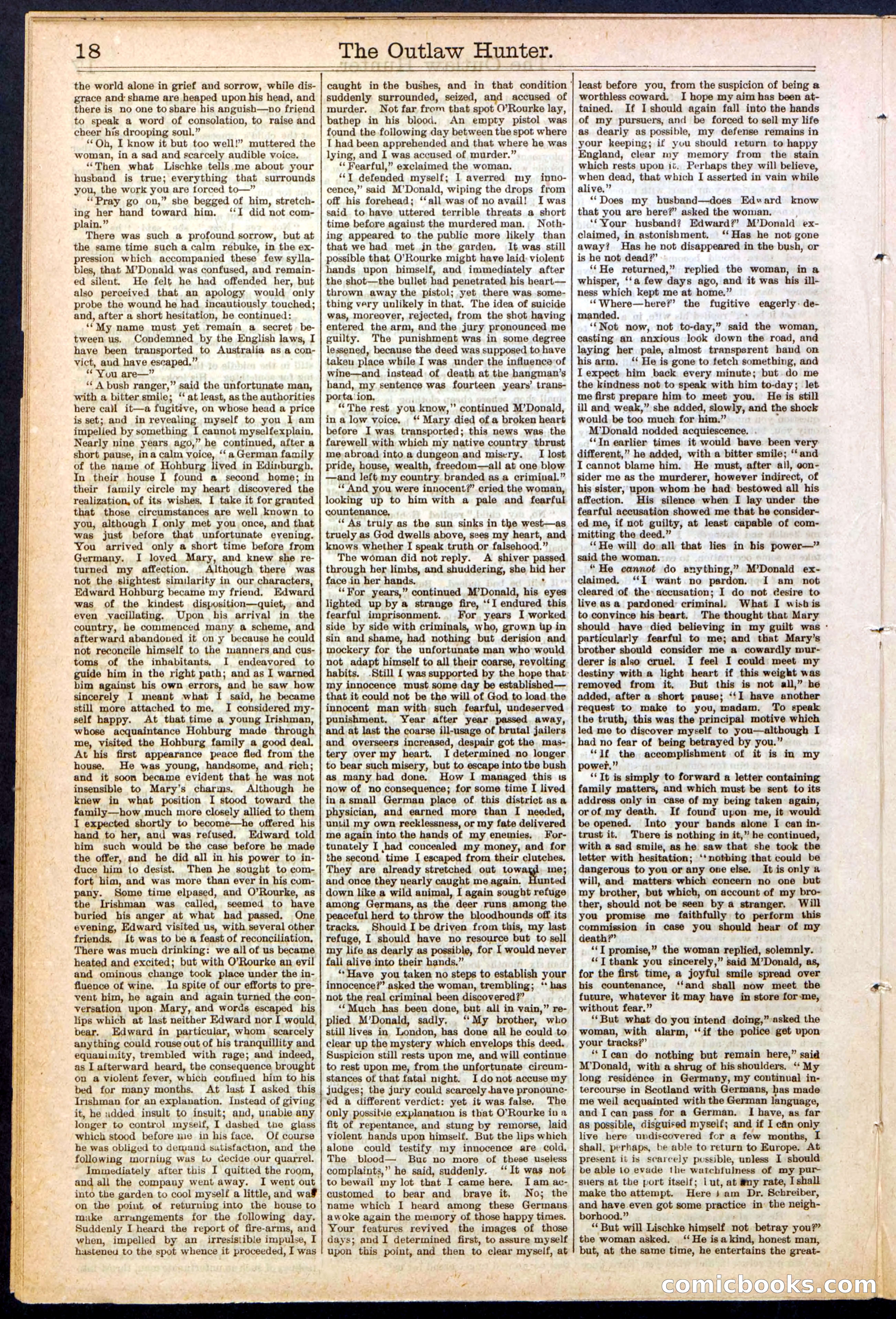
A restored page from Pulp Fiction, 1881. Page through the whole issue in the reader above.
📄 Transcribed text from this page (OCR, searchable)
Machine-transcribed from the original scan — historical spelling and the odd misread are preserved.
a 3 ot RR ro ae pe. ae 2 ee Oe : . ~ WAY . ~ wa - SS See ee. ae - an : = — A eel ¢ ose iamea — x z a ~ a. .~ . -* 5 . . ‘ po ee +P the world alone in grief and sorrow, while dis- grace and: shame are heaped upon his head, and there is no one to sbare his anguish—no friend to speak a word of consolation, to raise and cheer his drooping soul.” ‘Oh, I know it but too well!” muttered the woman, in a sad and scarcely audible voice. “Then what Lischke tells.me about your husband is true; everything that surrounds you, the work you are torced to—” “Pray go on,” sbe begged of him, stretch- ing her hand toward him. ‘I did not com- plain.” There was such a profound sorrow, but at the same time such a calm rebuke, in the ex- pression which accompanied these few sylla- bles, that M’Donald was confused, and remain- ed silent. He felt he had offended her, but also perceived that an apology would only probe the wound he had incautiously touched; and, after a short hesitation, he continued: ‘*My name must yet remain a secret. be- tween us, Condemned by the English laws, I have been transported to Australia as a con- vict, aud have eseaped.” * You are—” ** A bush ranger,” said the unfortunate man, with a bitter smile; “‘ at least, as the authorities here call it—a fugitive, on whose head a price is set; and in revealing myself to you 1 am impelied by something I cannot myselfexplain, Nearly nine years ago,” he continued, after a short pause, ina calm voice, ‘‘a German family of the name of Hohburg lived in Edinburgh. In their house I found a second home; in their family circle my heart discovered the realization, of its wishes, I take it for granted that those circumstances are well known to you, although I only met you once, and that was just before that unfortunate evening. You arrived only a short time before from Germany. I loved Mary, and knew she re- turned my affection. Although there was not the slightest similarity in our characters, Edward Hohburg became my friend. Edward was of the kindest disposition—quiet, and even .vacillating. Upon his arrival in the country, he commenced many a scheme, and afterward abandoved if on y because he could not reconcile himself to the manners and cus- toms of the inhabitants. I endeavored to guide him in the right path; and as I warned bim against his own errors, and he saw how sincerely I meant what I said, he became still more attached to me. I considered my- self happy. At that time a young Irishman, whose acquaintance Hohburg made through me, visited the Hohburg family a good deal. At his first appearance peace fled from the house. He was young, handsome, and rich; and it soom became evident that he was not insensible to Mary’s charms. Although he knew in what position I stood toward the family—how much more closely allied to them I expected shortly to become—he offered his hand to her, and was refused. Edward told him such would be the case before he made the offer, and he did all in his power to in- duce him to desist. Then he sought to com- fort ‘him, and was more than ever in his com- pany. Some time elpased, and O’Rourke, as the Irishman was called, seemed to have buried his anger at what had passed, One evening, Edward visited us, with several other friends, It was to be a feast of reconciliation, There was much drinking: we all of us became heated and excited; but with O’Rourke an evil and ominous change took place under the in- fluence of wine. In spite of our efforts to pre- vent him, he again and again turned the con- versation upon Mary, and words escaped his lips which at last neither Edward nor I would, bear. Edward in particular, whom scarcely anything could rouse out of his tranquillity and equanimity, trembled with rage; and indeed, as Lafterward heard, the consequence brought on a violent fever, which confined him to his bed for many months. At last I asked this Irishman for an explanation. Instead of giving it, he udded insult to insult; and, unable any longer to control myself, I dashed tbe glass which stood before me in his face. Of course he was obliged to demand satisfaction, and the following morning was tu cecide our quarrel. Fe a gone after this I quitted the room, all the compauy went away. I went out ane the garden to cool myself a little, and wa¥ on the point of returnipg into the house to muke arrangements for the following day. Suddenly I heard the report of fire-arms, and when, impelled by an_ irresistible impulse, I hasteneu to the spot whence it proceeded, I was = The Outlaw Hunter. caught in the bushes, and in that condition’ suddenly surrounded, seized, a accused of murder. Not far from that spot O’Rourke lay, bathep in his blood. An empty pistol was found the following day between the spot where I had been apprehended and that where he was lying, and I was accused of murder.” “‘ Fearful,” exclaimed the woman, ‘1 defended myself; 1 averred my inno- cence,” said M’Donald, wiping the drops from off his forehead; ‘‘all was of no avail! Iwas said to have uttered terrible threats a short time before against the murdered man. Noth- ing appeared to the public more likely than that we had met jn the garden. It was still possible that O’Rourke might have laid: violent hands upon himself, and immediately after the shot—the bullet had penetrated his bheart— thrown away the pistol; yet there was some- thing very unlikely in that. The idea of suicide was, moreover, rejected, from the shot having entered the arm, and the jury pronounced me guilty. The punishment was in some degree lessened, because the deed was supposed to have takeu place while I was under the influence of wine—and instead of death at the hangman’s band, my sentence was fourteen years’ trans- porta ion, “The rest. you know,” continued M’Donald, in a low voice, ‘‘ Mary died of a broken heart before I was transported; this news was the farewell with which my native country thrust me abroad into a dungeon and misery. I lost pride, house, wealth, freedom—all at one blow —and left my country branded as a criminal.” ‘“‘ And you were innocent?” cried the woman, looking up to him with a pale and fearful countenance, ‘* As truly as the sun sinks in the west—as truely as God dwells above, sees my heart, and knows whether I speak truth or falsehood.” The woman did not reply. A shiver passed through her limbs, and shuddering, she a her face in her hands. “For years,” continued M’Donald, his ‘ae lighted up by a strange fire, ‘‘I endured this fearful imprisonment... For years I worked side by side with criminals, who, grown up in sin and shame, had nothing but derision and mockery for the unfortunate man who would not adapt himself to all their coarse, revolting habits. .Still 1 was supported by the hope that my innocence must some day be established— that it could not be the will of God to load the innocent man with such fearful, undeserved punishment. Year after year passed away, and at last the coarse ill-usage of brutal jailers and overseers increased, despair got the mas- tery over my heart. I determined no longer to bear such misery, but to escape into tbe bush as many had done. How I managed this ts now of no consequence; for some time I lived ina small German place of this district as a physician, and earned more than I needed, until my own recklessness, or my fate delivered me again into the hands of my enemies. For- tunately I had concealed my money, and for the second time I escaped from their clutches. They are already stretched out tow Ine; and once they nearly caught me again. ted down like a wild animal, I again sought refuge among Germans, as the deer runs among the peaceful herd to throw the bloodhounds off its tracks, Should I be driven from this, my last refuge, I should have no resource but to sell my life as dearly as possible, for | would never fall alive into their hands.” **Have you taken no steps to establish your innocence?” asked the woman, trembling; ‘ has not the real criminal been discovered?” ‘Much has been done, but all in vain,” re- plied M’Donald, sadly. ‘‘My brother, who still lives in London, bas done all he could to clear up the mystery which envelops this deed. Suspicion still rests upon me, and will continue to rest upon me, from the unfortunate circum- stances of that fatal night. Idonot accuse my judges; the jury could scarcely have pronounc- ed a different verdict: yet it was false, The only possible explanation is that O’Rourke in a fit of repentance, and stung by remorse, laid violent hands upon himself. But the lips which alone could testify my innocence are cold, The blood— Buc no more of these useless complaints,” he said, suddenly. “It was not to bewail my lot that I came here. I am ac- customed to bear and brave it, No; the name which I heard among these Germans awoke again the memory of those happy times. Your features revived the images of those days; and I determined first, to assure myself upon this point, and then to clear myself, at ° © least before you, from the suspicion of being a worthless coward. I hope my aim has been at- tained. If I should again fall into the hands of my pursuers, and be forced to sell my life as dearly as possible, my defense remains in your keeping; if you should return to happy England, clear my memory from the stain which rests upon it. Perbaps they will believe, when dead, that which I asserted in vain while alive.” ‘“‘Does my husband—does Edvard know that you are bere?” asked the woman. ‘‘Your husband? Edward?’ M’Donald ex- claimed, in astonishment. ‘*‘Has he not gone away? Has he not disappeared in the bush, or is he not dead?’ ‘*He returned,” replied the woman, in a whisper, ‘‘a few days ago, and it was his ill- ness which kept me at home.” ‘‘Where—here?’ the Sugitive eagerly: de- manded. ‘‘Not now, not to-day,” said the woman, casting an anxious look down the road, and laying her pale, almost transparent hand on hisarm. ‘' He is gone to fetch something, and I expect him back every minute; but do me the kindness not to speak with him to-day; let me first prepare him to meet you. He is still ill and weak,” she added, slowly, and the shock would be too much for him.” M'‘Donald nodded acquiescence. . ‘‘In earlier times it would bave been very different,” he added, with a bitter smile; ‘and I cannot blame him. He must, after all, oon- sider me as the murderer, however indirect, of his sister, upon whom he bad bestowed all his affection. His silence when I lay under the fearful accusation showed me that he consider- ed me, if not guilty, at least capable of com- mitting the deed.” ‘He will do all that lies in his power—” said the woman. “He cannot do anything,” M’Donald ex- claimed. ‘‘I want no psrdon. I am not cleared of the accusation; I do not cesire to live as a pardoned criminal. What I wisbis to convince his beart. The thought that Mary should have died believing in my guilt was - particularly fearful to me; and that Mary’s brother should consider me a cowardly mur- derer is also cruel. I feel I could meet my destiny with a light heart if this weight was removed from it. But this is not all,” he added, after a short pause; ‘‘1 have another request to make to you, madam. To speak the truth, this was the principal motive which led me to discover myself to you—although I had no fear of being betrayed by you.” “If the accomplishment of it is in my power,” ‘It is simply to forward a letter containing family matters, and which must be sent to its address only in case of my being taken again, orof my death. If found upon me, it would be opened. Into your bands alone I can in- trust it, There is nothing in it,” he continued, with a sad smile, as he saw that she took the letter with hesitation; ‘‘notbing that could be dangerous to you or any one else. It is only a will, and matters which concern no one but my ‘brother, but which, on account of my bro- ther, should not be seen by a stranger. Will you promise me faithfully to perform this commission in case you should hear of my death?” ‘‘T promise,” the woman replied, solemnly. ‘‘T thank you sincerely,” said M’Donald, as, for the first time, a joyful smile spread over his countenance, ‘‘and shall now meet the future, whatever it may have in store forme, without fear.” ‘‘But what do you intend doing,” asked the woman, with alarm, ‘if the police get upon your tracks?’ ‘‘Ican do nothing but remain here,” said M’Donald, with a shrug of his shoulders. “* My long residence in Germany, my continual in- tercourse in Scotland with Germans, has made me weil acquainted with the German language, and I can pass for a German. I have, as far as possible, disguised myself; and if I cin only live here undiscovered for a few months, I shall, perhaps, be able to return to Europe. "At present it is scarcely possible, unless I should be able to evade the watchfulness of my pur- suers at the port itself; l ut, at @ny rate, I shall make the attempt. Here jam Dr. Schreiber, and have even got some pmation in the neigh- borhood.” *‘ But will Lischke himself not betray you?’ the woman asked. ‘He isakind, honest man, but, at the same time, he entertains the great- ~~ rn (E(o)/ A AILICE 300 cS. ee ee et pre et gy Se a