
Pulp Fiction, 1881 · page 17 of 32
Beadle's New York Dime Library, No. 136 — page 17: what you’re looking at
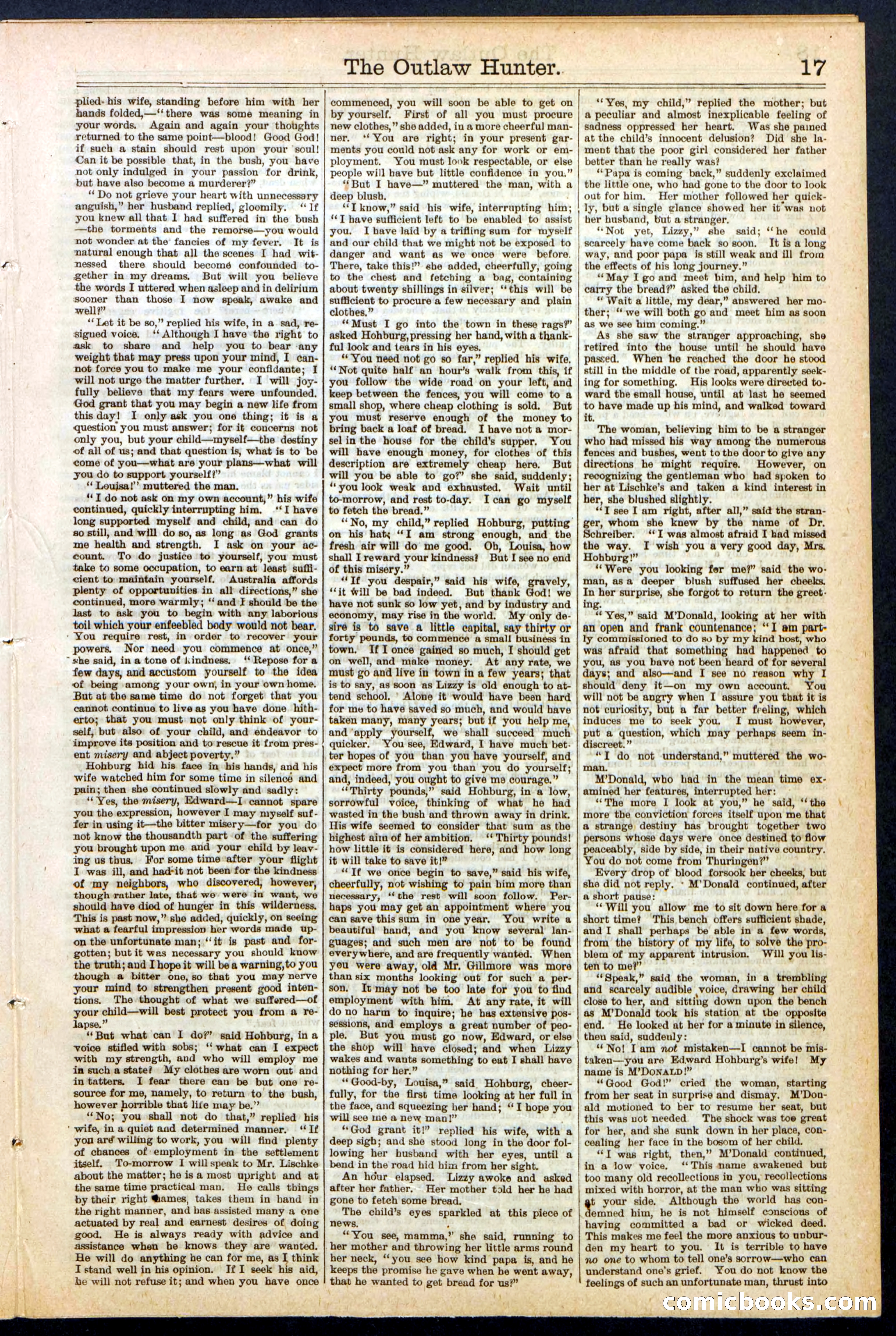
A restored page from Pulp Fiction, 1881. Page through the whole issue in the reader above.
📄 Transcribed text from this page (OCR, searchable)
Machine-transcribed from the original scan — historical spelling and the odd misread are preserved.
“she said, in a tone of kindness. —_— == SS — Ct plied- his wife, standing before him with her hands folded,—‘‘ there was some meaning in your words. Again and again your thotghts returned to the same point—blood! Good God! if such a stain should rest upon your ‘soul! Can it be possible that, in the bush, you have not only indulged in your passion for drink, but have also become a murderer?” “Do not grieve your heart with unnecessary anguish,” her husband replied, gloomily. “If you knew all that 1 had suffered in the bush —the torments and the remorse—you would not wonder at the fancies of my fever. It is natural enough that all the scenes I had wit- nessed there should becomé confounded to- gether in my dreams, But will you believe the words I uttered when asleep and in delirium sooner than those I now speak, awake and well?” ‘“‘ Let it be so,” replied his wife, in a sad, re- sigued voice, ‘* Although I have the right to ask to share and help you to bear -any weight that may press upon your mind, I can- not force you to make me your confidante; I will not urge the matter further. I will joy- fully believe that my fears were unfounded. God grant that you may begin a new life from this day! I only ask you one thing; it is a question you must answer; for it concerns not only you, but your child—myself—the destiny of all of us; and that question is, what is to be come of you—what are your plans—what will you do to support yourself?” ‘* Loujsa!l’’ muttered the man. ‘*T do not ask on my own account,” his wife continued, quickly interrupting him. ‘I have long supported myself and child, and can do so still, and will do so, as long as God grants me health and strength. I ask on your ac- count. To do justice to yourself, you must take to some occupation, to earn at least suffi- cient to maintain yourself. Australia affords plenty of opportunities in all directions,” she continued, more warmly; ‘‘ and I should be the last to ask you to begin with any laborious toil which your enfeebled body would not bear. ‘ You require rest, in order to recover your powers. Nor need you commence at once,” ‘‘ Repose for a few days, and accustom yourself to the idea of being among your own, in your own home. But at the same time do not forget that you cannot continue to live as you have done _ hith- erto; that you must not only think of your- self, but also of your child, and endeavor to improve its position and to rescue it from pres- ent misery and abject poverty.” Hohburg hid his face in his hands, and his wife watched him for some time in silencé and pain; then she continued slowly and sadly: ‘Yes, the misery, Edward—lI. cannot spare you the expression, however I may myself suf- fer in using it—the bitter misery—for you do not know the thousandth part of the suffering you brought upon me and your child by leav- ing us thus, For some time after your flight I was ill, and had-it not been for the kindness of my neighbors, who discovered, however, though rather late, that we were in want, we should have died of hunger in this wilderness, This is past now,” she added, quickly, on seeing what a fearful impression her words made up- on the unfortunate man;.‘‘it is past and for- gotten; but it was necessary you should know the truth; and I hope it will be a warning,to you though a bitter ono, so that you may nerve your mind to strengthen present good inten- tions. The thought of what we suffered—of your child—will best protect you from a re- lapse.” ‘‘But what can I do?’ said Hohburg, ina voice stifled with sobs; “what can I expect with my strength, and who will employ me in such a state? My clothes are worn out and in tatters. I fear there can be but one re- source for me, namely, to return to the bush, however horrible that life may be.” “No; you shall not do that,” replied his ‘ wife, in a quiet aad determined manner. “ If you ard willing to work, you will find plenty of chances of employment in the settlement itself. To-morrow I willspeak to Mr. Lischke about the matter; he is a most upright and at the same time practical man. He calls things by their right Games, takes them in band in the right manner, and bas assisted many a one actuated by real and earnest desires of doing good. He is always ready with advice and assistance when be knows they are wanted. He will do anything be can for me, as [ think I stand well in his opinion. IfI seek aid, he will not refuse it; and when you have once hd : b XK. j ‘ . _— Ml we’. 2 @ ~- a »* - = =e Se ee SS elle ~ ee Ps : woe. eee 2 ee SE The Outlaw Hunter. commenced, you will soon be able to get on by yourself. First of all you must procure new clothes,” she added, iu a more cheerful man- ner. ‘f You are right; in your present gar- ments you could not ask any for work or em- ployment. You must look respectable, or else people will have but little confidence in you.” “But I have—” muttered the man, with a deep blush, . “‘T know,” said his wife, interrupting him; **T have sufficient left to be enabled to assist you. I have laid by a trifling sum for myself and our child that we might not be exposed to danger and want as we once were before. There, take this!” she added, cheerfully, going to the chest and fetching a bag, containing about twenty shillings in silver; “this will be sufficient to procure a few necessary and plain clothes,” ‘Must I go into the town in these rags?’ asked Hohburg, pressing her hand, with a thank- ful look and tears in his eyes. “You need not go so far,” replied his wife, “Not quite half an hour’s walk from this, if you follow the wide road on your left, and keep between the fences, you will come to a small shop, where cheap clothing is sold. But you must reserve enough of the money to bring back a loaf of bread. I have not a mor- selin the housé for the child's supper. You will have enough money, for clothes of this description are extremely cheap here. But will you be able to go?” she said, suddenly; “you look weak and exhausted, Wait until to-morrow, and rest to-day. Ican go myself to fetch the bread.” *“No, my child,” replied Hohburg, putting on his haty “I am strong enough, and the fresh air will do me good. Ob, Louisa, how shall Ireward your kindness? But I see no end of this misery.” “If you despair,” said his wife, gravely, “it Will be bad indeed. But thank God! we have not sunk so low yet, and by industry and economy, may rise in the world. My only de- sire is to save a little capital, say thirty or forty pounds, to commence a small business in town. If TI once gained so much, I should get on well, and make money. At any rate, we must go and live in town in a few years; that is to say, as soon as Lizzy is old enough to at- tend school. ' Alone it would have been hard for me to have saved so much, and would bave taken many, many years; but if you help me, and ‘apply yourself, we shall succeed much quicker. You see, Edward, I have much bet- ter hopes of you than you have yourself, and expect more from you than you do yourself; and, indeed, you ought to give me courage.” “Thirty pounds,” said Hohburg, in a low, sorrowful voice, thinking of what he had wasted in the bush and thrown away in drink. His wife seemed to consider that sum as the highest air of her ambition. ‘‘ Thirty pounds! how little it is considered here, and how long it will take to save it!” “Tf we once begin to save,” said his wife, cheerfully, not wishing to pain him more than necessary, ‘‘the rest will soon follow. Per- haps you may get an appointment where you can save this sum in one year. You write a beautiful hand, and you know several lan- guages; and such men are not to be found everywhere, and are frequently wanted. When you were away, old Mr. Gillmore was more than six months looking out for such a per- son. It'may not be too late for you to find employment with him, At any rate, it will do no harm to inquire; he has extensive pos- sessions, and employs a great number of peo- ple. But you must go now, Edward, or else the shop will have closed; and when Lizzy wakes and wants something to eat I shall have nothing for her.” **Good-by, Louisa,” said Hohburg, cheer- fully, for the first time looking at her full in the face, and squeezing her hand; “I hope you will see ine a new man!” “God grant it!” replied his wife, with a deep sigh; and she stood long in the door fol- lowing her husband with her eyes, until a bend in the road hid him from her sight. An hour elapsed. Lizzy awoke and asked after her father. Her mother told her he had gone to feteh some bread. The child’s eyes sparkled at this piece of news. : “You see, mamma,” she said, running to her mother and throwing her little arms round her neck, “you see how kind papa is, and he keeps the promise he gave when be went away, that he wanted to get bread for us?” \ 4 N vw? - § é 9 f . BL Le + « »- ah #i.6 r may. ST. adi. “=! — 4 ees | - a a ee ee ee ee ee Te ee » = ws ™ é ~ ¥ te * * “4 = © ‘ i 17 ‘*Yes, my child,” replied the mother; but a peculiar and almost inexplicable feeling of sadness oppressed her heart. Was she pained at the child’s innocent delusion? Did she la- ment that the poor girl considered her father better than he really was? **Papa is coming back,” suddenly exclaimed the little one, who had gone to the door to look out for him. Her mother followed her quick- ly, but a single glance showed her it was not her husband, but a stranger. “Not yet, Lizzy,” she said; ‘‘he could scarcely have come back so soon. It is a long way, and poor papa is still weak and ill from the effects of his long journey.” ‘May I go and meet him, and help him to carry the bread?” asked the child. * Wait a little, my dear,” answered her mo- ther; “ we will both go and meet him as soon as we see him coming.” As she saw the stranger approaching, she retired into the house until he should have passed. When he reached the door he stood still in the middle of the road, apparently seek- ing for something. His looks were directed to- ward the small house, until at last he seemed to have made up his mind, and walked toward it. The woman, believing him to be a stranger who had missed his way among the numerous fences and bushes, went to the door to give any directions he might require. However, on recognizing the gentleman who had spoken to her at Lischke’s and taken a kind interest in her, she blushed slightly. “‘T see I am right, after all,” said the stran- ger, whom she knew by the name of Dr. Schreiber. ‘I was almost afraid I had missed the way. I wish you a very good day, Mrs. Hohburg!” | ' “Were you looking for me?” said the wo- man, asa deeper blush suffused her cheeks. In her surprise, she forgot to return the greet- ing. “Yes,” said M’Donald, looking at her with an open and frank countenance; “I am ly commissioned to do sv by my kind host, who was afraid that something had happened to you, as you bave not been heard of for several days; and also—and I see no reason why I should deny it—on my own account. You will not be angry when I assure you that it is not curiosity, but a far better feeling, which induces me to seek you. I must however, put a question, which may perhaps seem in- discreet.” “TI do not understand,” muttered the wo- man. M’Donald, who had in the mean time ex- amined her features, interrupted her: | ‘‘The more I look at you,” he said, ‘‘ the more the conviction forces itself upon me that a strange destiny has brought together two persons whose days were once destined to flow peaceably, side by side, in their native country. You do not come from Thuringen?”’ Every drop of blood forsook her cheeks, bu she did not reply. * M’Donald continued, after a short pause: “Will you allow me to sit down here for a short time? This bench offers sufficient shade, and I shall perhaps be able in a few words, from the history of my life, to solve the pro- blem of my apparent intrusion. Will you lis- ten to me?” ‘*Speak,” said the woman, in a trembling and scarcely audible voice, drawing her child close to her, and sitting down upon the bench as M’Donald took his station at the opposite end. He looked at her for a minute in silence, then said, suddenly: ; “No! Iam not mistaken—I cannot be mis- taken—you are Edward Hohburg’s wife! My name is M’DoONALD!” “Good God!” cried the woman, starting from her seat in surprise and dismay. M’Don- ald motioned to ber to resume her seat, but this was not needed. The shock was toe great for her, and she sunk down in her place, con- cealing her face in the bosom of her child. “T was right, then,” M’Donald continued, in a low voice, ‘This mame awakened but too many old recollections in you, recollections mixed with horror, at the man who was sitting 4 your side. Although the world has con- emned him, he is not himself conscious of having committed a bad or wicked deed. This makes me feel the more anxious to unbur- den my heart to you. It is terrible to have mo one to whom to tell one’s sorrow—who can understand one’s grief. You do not know the feelings of such an unfortunate man, thrust into