
Pulp Fiction, 1881 · page 16 of 32
Beadle's New York Dime Library, No. 136 — page 16: what you’re looking at
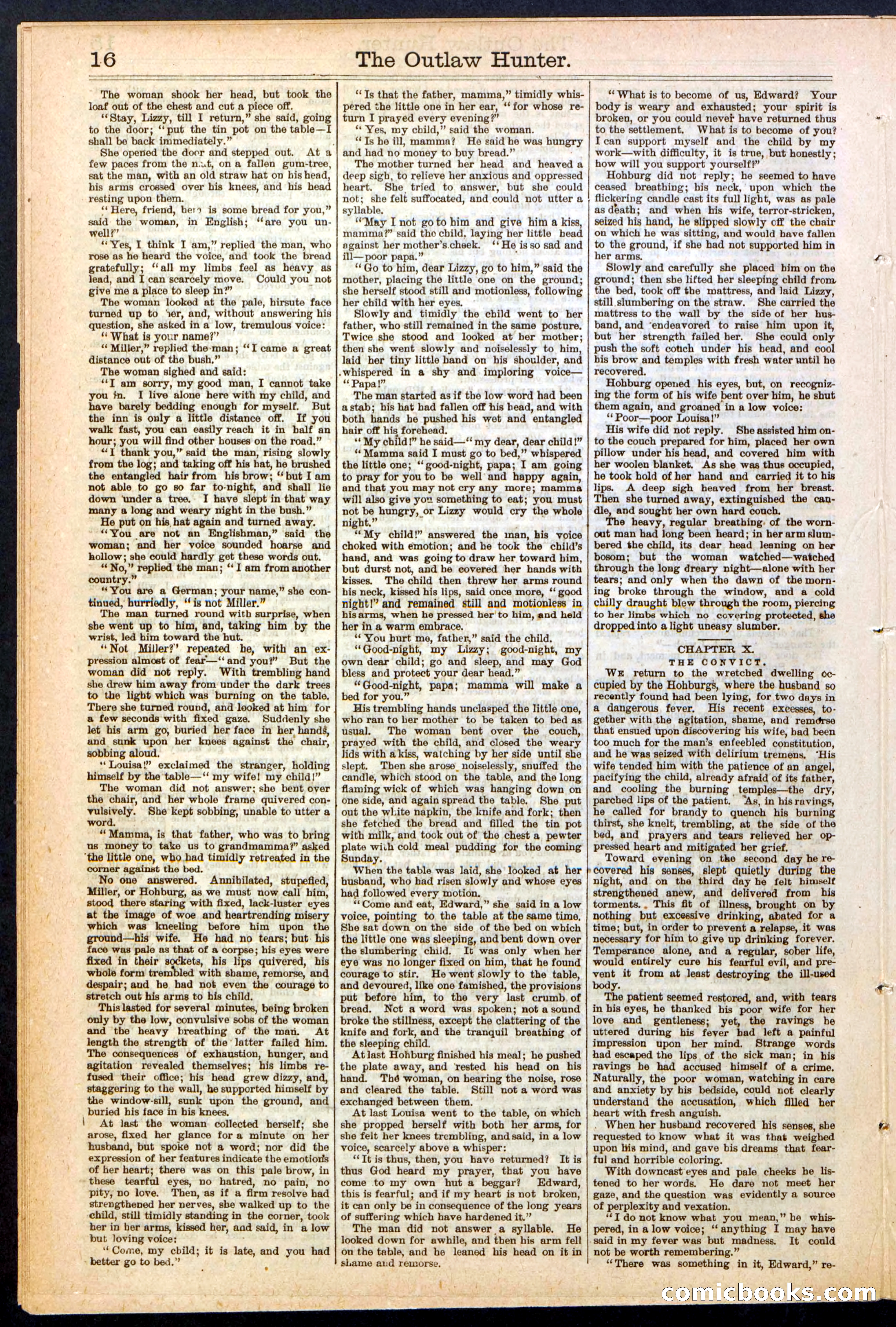
A restored page from Pulp Fiction, 1881. Page through the whole issue in the reader above.
📄 Transcribed text from this page (OCR, searchable)
Machine-transcribed from the original scan — historical spelling and the odd misread are preserved.
16 loaf out of the chest and cut a piece off. ‘Stay, Lizzy, till I return,” she said, going to the door; ‘‘put the tin pot on the table—I shall be back immediately.” She opened the door and stepped out. few paces from the nut, on a fallen gum-tree, sat the man, with an old straw hat on his head, his arms crossed over bis knees, and his head resting upon them. ‘Here, friend, bers is some bread for you,” said the woman, in English; ‘fare you un- well?’ “Yes, I think I am,” replied the man, who rose as he heard the voice, and took the bread gratefully; “all my limbs feel as heavy as lead, and I can scarcely move. Could you not give me a place to sleep in?” The woman looked at the pale, hirsute face turned up to ‘er, and, without answering his question, she asked in a low, tremulous voice: ‘‘ What is your name?” “Miller,” replied the-man; “I came a great distance out of the bush,” The woman sighed and said: *“*‘T am sorry, my good man, I cannot take you in. I live alone here with my child, and have barely bedding enough for myself. But the inn is only a little distance off. If you walk fast, you can easily reach it in balf an hour; you will find other houses on the road.” “T thank you,” said the man, rising slowly from the log; and taking off his hat, he brushed the entangled hair from his brow; “ but I am not able to go so far to-night, and shall lie down ‘under a tree. I have slept in that way many a long and weary night in the bush.” He put on his, hat again and turned away. ' “You are not an Englishman,” said the woman; and her voice sounded hoarse and hollow; she could hardly get these words out. “No,” replied the man; “I am from another country.” “You are a German; your name,” she con- tinued, burriedly, ‘is not Miller.” The man turned round witb surprise, when she went up to him, and, taking him by the wrist, led him toward the hut. “Not Miller?’ repeated he, with an ex- pression almost of fear—‘‘and you?’ But the woman did not reply. With trembling hand she drew him away from under the dark trees to the light which was burning on the table. There she turned round, and leoked at him for a few seconds with fixed gaze. Suddenly she let his arm go, buried her face in her hands, and sunk upon her knees against the chair, sobbing aloud. ‘** Louisa!” exclaimed the stranger, holding himself by the table—‘‘ my wife! my child!” The woman did not answer; she bent over the chair, and her whole frame quivered con- vulsively. She kept sobbing, unable to utter a word. “Mamma, is that father, who was to bring us money to take us to grandmamma?” asked ‘the little one, who had timidly retreated in the corner against the bed. No one answered. Annibilated, stupefied, Miller, or Hohburg, as we must now call him, stood there staring with fixed, lack-luster eyes at the image of woe and heartrending misery which was kneeling before him tupon the ground—his wife. He had no tears; but. his face was pale as that of a corpse; his eyes were fixed in their sockets, his lips quivered, his whole form trembled with shame, remorse, and despair; aud he had not even the courage to stretch out his arms to his child. This lasted for several minutes, being broken only by the low, convulsive sobs of the woman and the heavy breathing of the man. At length the strength of the’ latter failed him. The consequences of exhaustion, hunger, and agitation revealed themselves; his limbs re- fused their office; his head grew dizzy, and, staggering to the wall, he supported himself by the window-sill, sunk upon the ground, and buried his face in bis knees, | At last the woman collected herself; she arose, fixed her glance fora minute on her husband, but spoke not a word; nor did the expression of her features indicate the emotioris of her heart; there was on this pale brow, in 'these tearful eyes, no hatred, no pain, no pity, no love. Then, as if a firm resolve had strengthened her nerves, she walked up to the child, still timidly standing in the corner, took ber in her kissed her, and said, in a low but loving voice: ‘Come, my cbild; it is late, and you had - better go to bed.” The woman shook her head, but took the At a ‘ o The Outlaw Hun er. ‘Ts that the father, mamma,” timidly whis- pered the little one in her ear, ‘‘ for whose re- turn I prayed every evening?’ ** Yes, my child,” said the woman. “Ts he ill, mamma? He said he was bungr and had no money to buy bread.” , The mother turned her head and heaved a deep sigh, to relieve her anxious and oppressed heart. She tried to answer, but she could not; she felt suffocated, and could not utter a syllable, “May I not goto him and give him a kiss, mamma?” said tho child, laying her little head against her mother’s.cheek. ‘‘ He isso sad and ill— poor papa.” “Go to him, dear Lizzy, go to him,” said the mother, placing the little one on the ground; she herself stood still and motionless, following her child with her eyes. Slowly and timidly the child went to her father, who still remained in the same posture. Twice she stood and looked at ber mother; then she went slowly and noiselessly to him, laid her tiny little band on his shoulder, and .whispered in a shy and imploring voice— sc Papa \” The man started as if the low word had been a stab; his hat had fallen off his head, and with both hands he pushed his wet and entangled hair off his forehead. ‘My child!” he said—“ my dear, dear child!” ‘* Mamma said I must go to bed,” whispered the little one; “‘ good-night, papa; I am going to pray for you to be well and happy again, and that you may not cry any more; mamma will also give you something to eat; you must not be hungry, or Lizzy would cry the whole night.” : *“My child!” answered the inan, his voice choked with emotion; and he took the child’s hand, and was going to draw her toward bim, but durst not, and be eovered her hands with kisses. The child then threw her arms round his neck, kissed his lips, said once more, ‘‘ good night!” and remained still and motionless in hisarms, when he pressed her to him, and held her in a warm embrace. ** You burt me, father,” said the child. “Good-night, my Lizzy; good-night, my own dear child; go and sleep, and may God bless and protect your dear head.” “Good-night, papa; mamma will make a bed for you.” His trembling hands unclasped the little one, who ran to ber mother to be taken to bed as usual. The woman bent over the couch, prayed with the child, and closed the weary lids with akiss, watching by her side until she slept. Then she arose_noiselessly, snuffed the candle, which stood on the table, and the long flaming wick of which was hanging down on one side, and again spread the table. She put out the white napkin, the knife and fork; then she fetched the bread and filled the tin pot with milk, and took out of the chest a pewter plate with cold meal pudding for the coming Sunday. When the table was laid, she looked at her husband, who had risen slowly and whose eyes had followed every motion. ““Come and eat, Edward,” she said in a low voice, pointing to the table at the same time, She sat down on the side of the bed on which the little one was sleeping, and bent down over the slumbering child. It was only when her eye was no longer fixed on him, that he found courage to stir. He went slowly to the table, and devoured, like one famished, the provisions put before him, to the very last crumb. of bread. Not a word was spoken; not a sound broke the stillness, except the clattering of the knife and fork, and the tranquil breathing of the sleeping child. Atlast Hohburg finished his meal; he pushed the plate away, and rested his head on his hand. Thé woman, on hearing the noise, rose and cleared the table. Still not a word was exchanged between them. ° At last Louisa went to the table, on which she propped herself with both her arms, for she felt her knees trembling, and said, in a low voice, scarcely above a whisper: **Tt is thus, then, you have returned? It is thus God heard my prayer, that you have come to my own hut a beggar? Edward, this is fearful; and if my heart is not broken, it can only be in consequence of the long years of suffering which have hardened it.” The man did not answer a syllable. He looked down for awhile, and then his arm fell on the table, and be leaned his head on it in sLame aud remorse, : ‘ _ oe — ge ** What is to become of us, Edward? Your body is weary and exhausted; your spirit is broken, or you could never have returned thus to the settlement. What is to become of you? Iecan support myself and the child by my work—with difficulty, it is true, but honestly; how will you support yourself?” Hohburg did not reply; he seemed to have ceased breathing; bis neck, upon which the flickering candle cast its full light, was as pale as death; and when his wife, terror-stricken, seized his hand, he slipped slowly off the chair on which he was sitting, and would have fallen to the ground, if she had not supported him in her arms. Slowly and carefully she placed him on the ground; then she lifted her sleeping child from the bed, took off the mattress, and laid Lizzy, still slumbering on the straw. She carried the mattress to the wall by the side of her hus- band, and ‘endeavored to raise him upon it, but her strength failed her. She could only push the soft cotch under his bead, and cool bis brow and temples with fresh water until he recovered. Hohburg opened his eyes, but, on recogniz- ing the form of his wife bent over him, he shut them again, and groaned in a low voice: ** Poor—poor Louisa!” His wife did not reply. She assisted him on- to the couch prepared for him, placed her own pillow under his head, and covered him with her woolen blanket. As she was thus occupied, he took hold of her hand and carried it to his lips. A deep sigh heaved from her breast. Then she turned away, extinguished the can- die, and sought her own hard couch. The heavy, regular breathing. of the worn- out man had long been heard; in her arm slum- bered the child, its dear head leaning on her bosom; but the woman watched—watched through the long dreary night—alone with her tears; and only when the dawn of the morn- ing broke through the window, and a cold chilly draught blew through the room, piercing to her limbs which no covering protected, she droppedinto alight uneasy slumber. CHAPTER X, THE CONVICT. Wer return to the wretched dwelling oc- cupied by the Hohburgs, where the husband so recently found had been lying, for two days in a dangerous fever. His recent excesses, to- gether with the agitation, shame, and remérse that ensued upon discovering his wife, bad been too much for the man’s enfeebled constitution, and he was seized with delirium tremens. ‘His wife tended him with the patience of an angel, pacifying the child, already afraid of its father, and cooling the burning temples—the dry, parched lips of the patient. “As, in his ravings, he called for brandy to quench his burning thirst, she knelt, trembling, at the side of the bed, and prayers and tears relieved her op- pressed heart and mitigated her grief. _ Toward evening on the second day he re- covered his senses, slept quietly during the night, and on the third day he felt himself strengthened anew, and delivered from his torments. , This fit of illness, brought on by nothing but excessive drinking, abated for a time; but, in order to prevent a relapse, it was necessary for him to give up drinking forever. Temperance alone, and a regular, sober life, would entirely cure his fearful evil, and pre- vent it from at least destroying the ill-used body. The patient seemed restored, and, with tears in his eyes, he thanked his poor wife for her love and gentleness; yet, the ravings he uttered during his feyer had left a painful impression upon her mind, Strange words had escaped the lips of the sick man; in his ravings be had accused himself of a crime. Naturally, the poor woman, watching in care and anxiety by his bedside, could not clearly understand the accusation, which filled her heart with fresh anguish. a SS SS ——$——$____——— - Tee > rey ° . When her husband recovered his senses, she — requested to know what it was that weighed upon his mind, and gave bis dreams that fear- ful and horrible coloring. With downcast eyes and pale cheeks he lis- tened to her words. He dare not meet her gaze, and the question was evidently a source of perplexity and vexation. “*T do not know what you mean,” he whis- pered, in a low voice; ‘anything I may have said in my fever was but madness, It could not be worth remembering.” “There was something in it, Edward,” re- ~~ comicbooks.c Dae 1