
Pulp Fiction, 1881 · page 15 of 32
Beadle's New York Dime Library, No. 136 — page 15: what you’re looking at
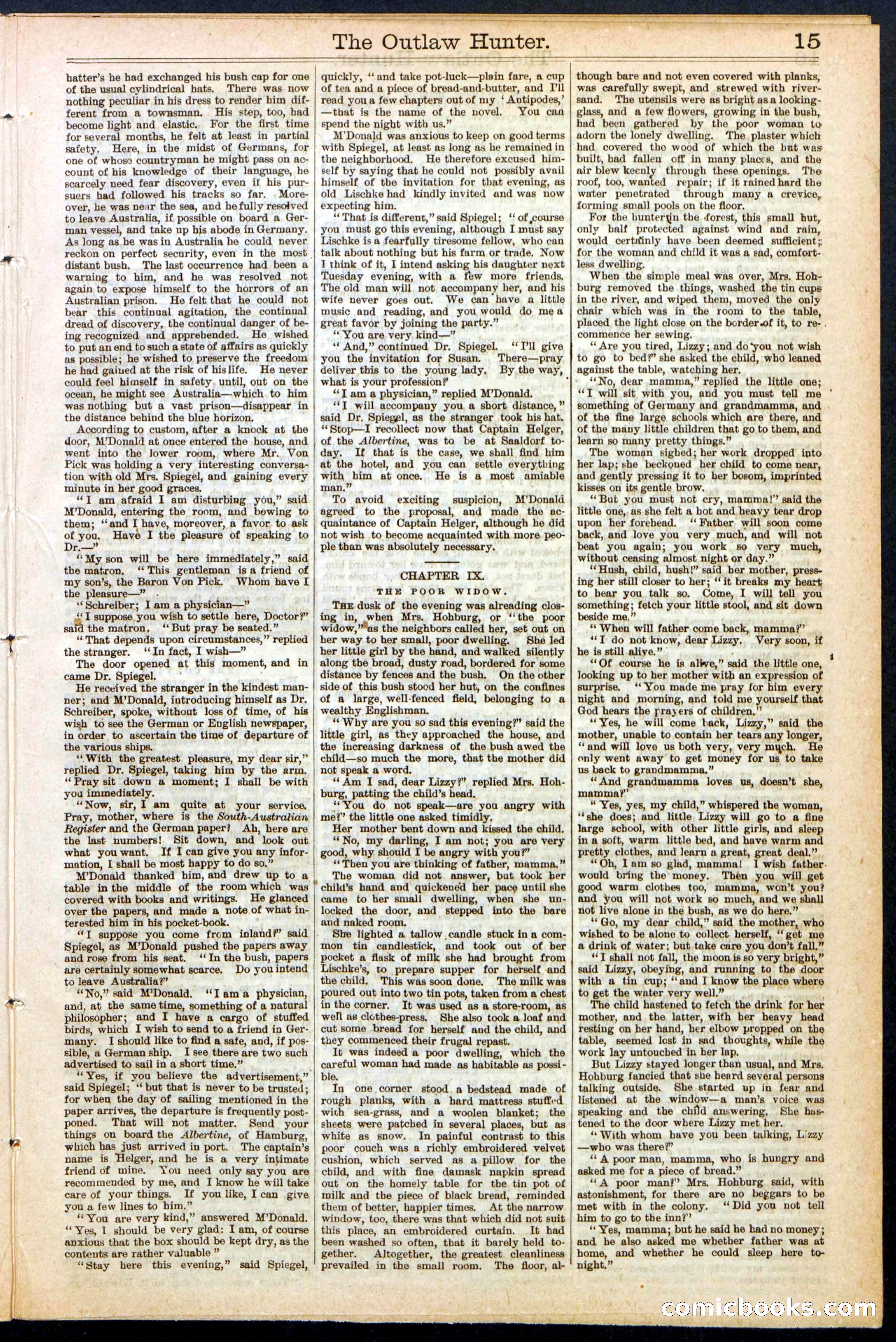
A restored page from Pulp Fiction, 1881. Page through the whole issue in the reader above.
📄 Transcribed text from this page (OCR, searchable)
Machine-transcribed from the original scan — historical spelling and the odd misread are preserved.
eee unter. —_—— hatter’s he had exchanged his bush cap for one | quickly, “‘ and take pot-luck—plain fare, a cup of the usual cylindrical hats. There was now nothing peculiar in his dress to render him dif- ferent from a townsman. His step, too, had become light and elastic. For the first time for several months, he felt at least in partial safety. Here, in the midst of Germans, for one of whose countryman he might pass on ac- count of his knowledge of their language, he scarcely need fear discovery, even if his pur- suers had followed his tracks so far. - More- over, he was neur the sea, and he fully resotved to leave Australia, if possible on board a Ger- man vessel, and take up his abode in Germany. As long as be wasin Australia he could never reckon on perfect security, even in the most distant bush. The last occurrence had been a warning to him, and he was resolved not again to expose himself to the horrors of an Australian prison. He felt that he could not bear this continual agitation, the continual dread of discovery, the continual danger of be- ing recognized and apprebended. He wished to put an end to such a state of affairs as quickly as possible; he wished to preserve the freedom he had gained at the risk of hislife. He never could feel bimself in safety. until, out on the ocean, he might see Australia—-which to him was nothing but a vast prison—disappear in the distance behind the blue horizon. According to custom, after a knock at the door, M’Donald at once entered the house, and went into the Jower room, where Mr. Von Pick was holding a very interesting conversa- tion with old Mrs. Spiegel, and gaining every minute in her good graces, “JT am afraid I am disturbing you,” said M’Donald, entering the room, and bewing to them; ‘“‘and I have, moreover, a favor to ask Have I the pleasure of speaking to ‘*My son will be here immediately,” said the matron. ‘‘ This gentleman isa friend of my son’s, the Baron Von Pick. Whom have [ the pleasure—” . ‘Schreiber; I am a physician—” ‘*T suppose you wish to settle here, Doctor?’ said the matron, ‘ But pray be seated.” “‘That depends upon circumstances,” replied the stranger. ‘‘In fact, I wish—” The door opened at this moment, and in came Dr. Spiegel. , | He received the stranger in the kindest man- ner; and M’Donald, introducing himself as Dr. Schreiber, spoke, without loss of time, of his wish to see the German or English newspaper, in order to ascertain the time of departure of the various ships. ‘With the greatest pleasure, my dear sir,” replied Dr. Spiegel, taking him by the arm, “Pray sit down a moment; I shall be with you immediately. “Now, sir, 1 am quite at your service, Pray, mother, where is the South-Australian Register and the German paper? Ah, here are the last numbers!. Sit down, and look out what youwant. If I can give you any infor- mation, I shall be most happy to do so,” M’Donald thanked him, and drew up to a table in the middle of the room which was covered with books and writings. He glanced over the papers, and made a note of what in- terested him in his pocket-book. “T suppose you come from inland?’ said |. Spiegel, as M’Donald pushed the papers away and rose from his seat. ‘‘In the bush, papers are certainly somewhat scarce. Do youintend to leave Australia?” “No,” said M’Donald. “Iam a physician, and, at the same time, something of a natural philosopher; and I haye a cargo of stuffed birds, which I wish to send to a friend in Ger- many. I should like to find a safe, and, if pos- sible, a German ship. I see there are two such advertised to sail in a short time.” “Yes, if you believe the advertisement,” said Spiegel; ‘‘ but that is never to be trusted; for when the day of sailing mentioned in the paper arrives, the departure is frequently post- poned. That will not matter. Send your things on board the Albertine, of Hamburg, which bas just arrived in port. The captain’s name is Helger, and he is a very intimate friend of mine. You need only say you are recommended by me, and I know he will take care of your things. If you like, I can give you a few lines to him.” ‘You are very kind,” answered M’Donald. “Yes, 1 should be very glad: I am, of course anxious that the box should be kept dry, as the contents are rather valuable ” “Stay here this evening,” said Spiegel, — mm SOC of tea and a piece of bread-and-butter, and Vll read youa few chapters out of my ‘ Autipodes,’ —that is the name of the novel. You cana spend the night with us,” M'Donald was anxious to keep on good terms with Spiegel, at least as long as he remained in the neighborhood. He therefore excused him- self by saying that he could not possibly avail himself of the invitation for that evening, as old Lischke had kindly invited and was now expecting him. ‘That is different,” said Spiegel; ‘‘ of course you must go this evening, although I must say Lischke is a fearfully tiresome fellow, who can talk about nothing but his farm or trade. Now I think of it, | intend asking his daughter next Tuesday evening, with a few more friends. The old man will not accompany her, and his wife never goes out. We can have a little music and reading, and you would do mea great favor by joining the party.” * You are very kind—” ‘* And,” continued Dr. Spiegel. you the invitation for Susan. “Tl give There—pray deliver this to the young lady. By the way, what is your profession? “‘T am a physician,” replied M’Donald. ‘*T will accompany you a short distance, ” said Dr, Spiegel, as the stranger took his hat. ““Stop—I recollect now that Captain Helger, of the Albertine, was to be at Saaldorf to- day. If that is the case, we shall find him at the hotel, and you can settle everything with him at once. He is a most amiable man,” To avoid exciting suspicion, M’Donald agreed to the proposal, and made the ac- quaintance of Captain Helger, although he did not wish to become acquainted with more peo- ple than was absolutely necessary. CHAPTER IX. THE POOR WIDOW. THE dusk of the evening was alreading clos- ing in, when Mrs. Hohburg, or ‘‘the poor widow,’”as the neighbors called her, set out on her way to her small, poor dwelling. She led her little girl by the hand, and walked silently along the broad, dusty road, bordered for some distance by fences and the bush, On the other side of this bush stood her hut, on the confines of a large, well-fenced field, belonging to a wealthy Englishman. _“ Why are you so sad this evening?” said the little girl, as they approached the house, and the increasing darkness of the bush awed the child—so much the more, that the mother did not speak a word. ‘* Am I sad, dear Lizzy?” replied Mrs. Hoh- burg, patting the child’s head. “You do not speak—are you angry with me?” the little one asked timidly. Her mother bent down and kissed the child. ‘No, my darling, I am not; you are very good, why should I be angry with you?” ‘*Then you are thinking of father, mamma,” The woman did not answer, but took her child’s hand and quickened her pace until she came to her small dwelling, when she un- locked the door, and stepped into the bare and naked room, She lighted a tallow candle stuck in a com- mon tin candlestick, and took out of ber pocket a flask of milk she had brought from Lischke’s, to prepare supper for herself and the child, This was soon done. The milk was poured out into two tin pots, taken from a chest in the corner, It was used as a store-room, as well as clothes-press, She also took a loaf and cut some bread for herself and the child, and they commenced their frugal repast. It was indeed a poor dwelling, which the careful woman had made as habitable as possi- ble. In one corner stood a bedstead made of rough planks, with a hard mattress stuffed with sea-grass, and a woolen blanket; the sheets were patched in several places, but as white as snow. In painful contrast to this poor couch was a richly embroidered velvet cushion, which served as a pillow for the child, and with fine damask napkin spread out on the homely table for the tin pot of milk and the piece of black bread, reminded them of better, happier times. At the narrow window, too, there was that which did not suit this place, an embroidered curtain. It had been washed so often, that it barely held to- gether. Altogether, the greatest cleanliness prevailed in the small room. The floor, al- - - - 4 - _ i Packs 4% in as iy.d4d Mhhed ’ soutphaguesn>-tapetinasioaieas 2 a om We ed Need inl Fr “~ . ss +; : a wit ad) Mel ry ~ “15 though bare and not even covered with planks, was carefully swept, and strewed with river- sand. The utensils were as bright as a looking- glass, and a few flowers, growing in the bush, had been gathered by the poor woman to adorn the lonely dwelling. ‘The plaster which had covered tho wood of which the bat was built, bad fallen off in many places, and the air blew keenly through these openings. The roof, too, wanted repair; if it rained hard the water penetrated through many a crevice, forming small pools on the floor, For the bunterqin the forest, this small but, only half protected against wind and rain, would certainly have been deemed sufficient; for the woman and child it was a sad, comfort- less dwelling. When the simple meal was over, Mrs, Hoh- burg removed the things, washed the tin cups in the river, and wiped them, moved the only chair which was in the room to the table, placed the light close on the border.of it, to re-. commence her sewing. “ Are you tired, Lizzy; and do*you not wish to go to bed?” she asked the cbild, who leaned against the table, watching her, ‘‘No, dear mamma,” replied the little one; *T will sit with you, and you must tell me something of Germany and grandmamma, and of the fine large schools which are there, and of the many little children that go to them, and learn so many pretty things.” The woman sighed; her work dropped into her lap; she beckoned her child to come near, and gently pressing it to her bosom, imprinted kisses on its gentle brow. “But you must not ery, mamma!” gaid the little one, as she felt a hot and heayy tear drop upon her forehead. ‘‘ Father will soon come back, and love you very much, and will not beat you again; you work so very much, without ceasing almost night or day.” ; “Hush, child, hush!” said her mother, press- ing her still closer to her; ‘‘it breaks my heart; to hear you talk so. Come, I will tell you something; fetch your little stool, and sit down beside me,” “When will father come back, mamma?’ “‘T do not know, dear Lizzy, Very soon, if he is still alive.” ; | “Of course he is ale,” said the little one, . looking up to her mother with an expression of surprise. ‘‘ You made me pray for him every night and morning, and told me yourself that God hears the prayers of children,” ‘Yes, he will come back, Lizzy,” said the mother, unable to contain her tears any longer, “and will love us both very, very mych. He only went away to get money for us to take us back to grandmamma,” “And grandmamma loves us, doesn’t she, mamma?’ “Yes, yes, my child,” whispered the woman, ‘‘she does; and little Lizzy will go to a fine large school, with other little girls, and slee in a soft, warm little bed, and have warm an pretty clothes, and learn a great, great deal,” “Oh, 1am so glad, mamma! would bring the money. Thén you will get good warm clothes too, Mamma, won’t you? and you will not work so much, and we not live alone in the bush, as we do here.” “Go, my dear child,” said the mother, who wished to be alone to collect. herself, “get mi a drink of water; but take care you don’t fall, “T shall not fall, the moon is so very bright,” me i obeying, Apa ap InS he oor with a tin cup; “and I know the to get the water very well.” vai The child hastened to fetch the drink for her mother, and the latter, with ber heavy head resting on her hand, her elbow propped on the table, seemed lost in sad thoughts, while the work lay untouched in her lap. But Lizzy stayed longer than usual, and Mrs. Hohburg fancied that she heard several persons talking outside. She started up in fear and listened at the window—a man’s voice was speaking and the child answering, She has- tened to the door where Lizzy met her. ‘* With whom have you been talking, Lizzy —who was there?” “A poor man, mamma, who is hungry and asked me for a piece of bread.” ‘‘A poor man?” Mrs. Hohburg said, with astonishment, for there are no beggars to be met with in the colony. ‘Did you not tell him to go to the inn?” ‘Yes, mamma; but he said he had no money; and he also asked me whether father was at home, and whether he could sleep here to- night.” I wish father. r= * JOO AMIE LE bb de . B aed 7 ed