
Pulp Fiction, 1881 · page 14 of 32
Beadle's New York Dime Library, No. 136 — page 14: what you’re looking at
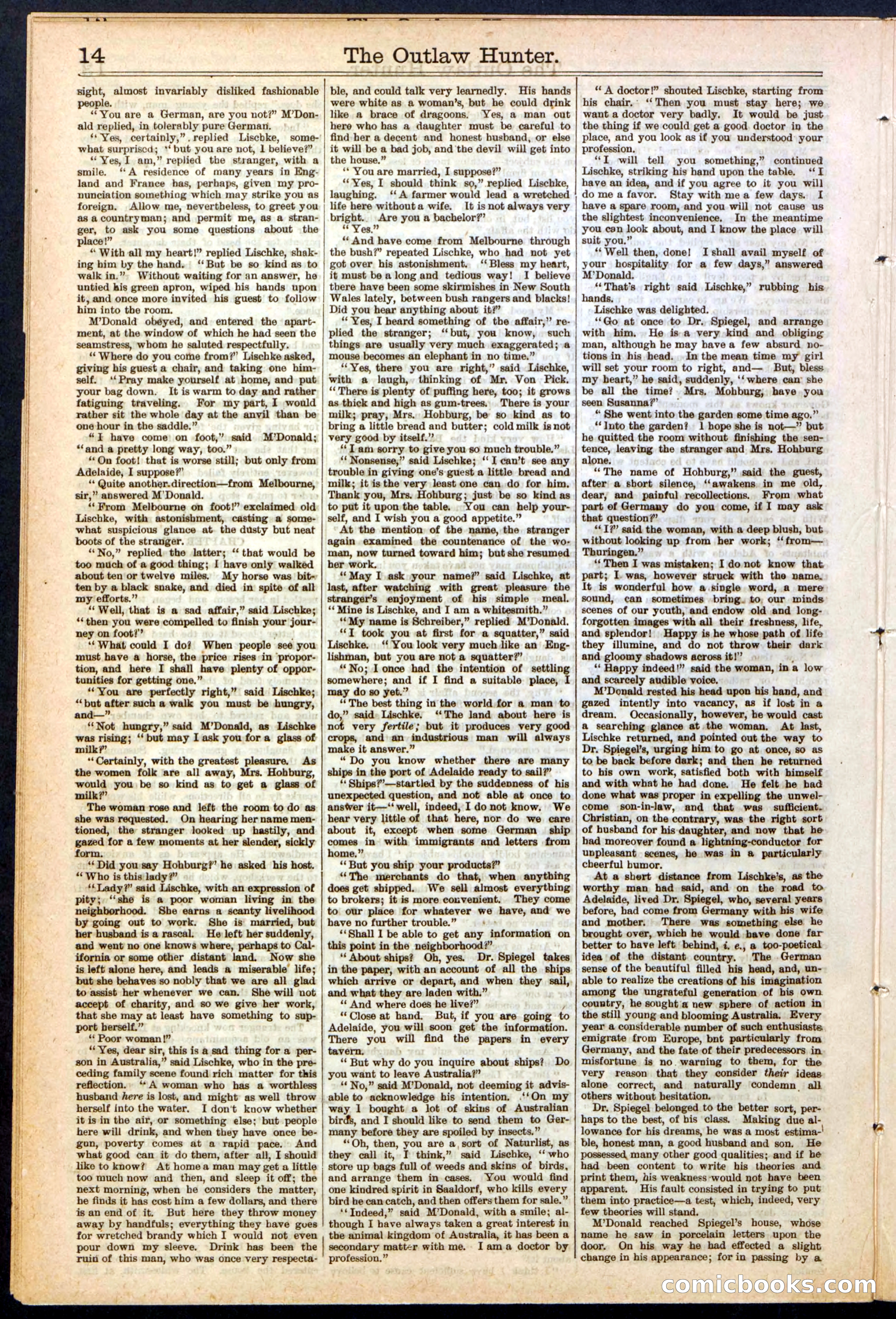
A restored page from Pulp Fiction, 1881. Page through the whole issue in the reader above.
📄 Transcribed text from this page (OCR, searchable)
Machine-transcribed from the original scan — historical spelling and the odd misread are preserved.
: : a ce oper ee _—_———- - + Sn a ee z —: a —— “sT —» -- ~-- 7 wt ty ee el — ee ee ¥ i > — ee ~s — > ewer = a eae . - . oe ee - ~~ 14 sight, almost invariably disliked fashionable people. “You are a German, are you not?” M’Don- ald replied, in tolerably pure German. ‘* Yes, certainly,”. replied Liscbke, some- what surprised; *‘ but you are not, 1 believe?” ‘Yes, I am,” replied the stranger, with a smile. “A residence of many years in Eng- land and France bas, perhaps, given my pro- nunciation something which may strike you as foreign. Allow me, nevertbeless, to greet you as a countryman; and permit me, as a stran- ger, to ask you some questions about the place!” “ With all my heart!” replied Lischke, shak- ing him by the hand. ‘‘ But be so kind as to walk in.” Without waiting for an answer, he untied his green apron, wiped his hands upon it, and once more invited his guest to follow him into tbe room. M’Donald obéyed, and entered the apart- ment, at the window of which he had seen the seamstress, whom he saluted respectfully. ‘Where do you come from?’ Lischke asked, giving his guest a chair, and taking one him- self. ‘‘Pray make yourself at home, and put your bag down. It is warm to day and rather fatiguing traveling. For my part, I would rather sit the whole day at the anvil than be one hour in the saddle.” “I have come on foot,” said M’Donald; “‘and a pretty long way, too.” | **On foot! that is worse still; but only from Adelaide, I suppose?” “« Quite another. direction—from Melbourne, sir,” answered M’ Donald. ‘*From Melbourne on foot!” exclaimed old Lischke, with astonishment, casting a some- what suspicious glance at the dusty but neat boots of the stranger. “No,” replied the latter; ‘‘ that would be too much of a good thing; I have only walked about ten or twelve miles. My horse was bit~ ten by a black snake, and died in spite of all my efforts.” “Well, that is a sad affair,” said Lischke; ‘then you were compelled to finish aa jour- ney on foot?’ ‘What could I do? When people see you must have a horse, the price rises in ‘propor- tion, and here I shall have plenty of oppor- tunities for getting one.” “You are perfectly right,” said Lischke; “but after such a walk you must be hungry, and—” ‘Not hungry,” said M’Donald, as Lischke was rising; ‘‘ but may Il ask you fora glass of milk?’ “Certainly, with the greatest pleasure. As the women folk are all away, Mrs. Hohburg, would you be so kind as to get a glass of milk?” — The woman rose and left the room to do as she was requested. On hearing her name men- tioned, the stranger looked up hastily, and gazed for a few moments at her slender, sickly form. ** Did you:say Hohburg?’ he asked his host. “Who is this lady?’ ‘*Lady?” said Lischke, with an expression of pity; “she is a poor woman living in the neighborhood. She earns a scanty livelihood by going out to work. She is married, but her husband is a rascal. He left her suddenly, and went no one knows where, perhaps to Cal- ifornia or some other distant land. Now she is left alone here, and leads a miserable’ life; butshe behaves so nobly that we are all glad to assist her whenever we can. She will not accept of charity, and so we give her work, that she may at least have something to sup- port herself.” “Poor woman!” “‘ Yes, dear sir, this is a sad thing for a per- son in Australia,” said Lischke, who in the pre- ceding family scene found rich matter for this reflection. “A woman who has a worthless husband here is lost, and might as well throw herself into the water. I don't know whether it is in the air, or something else; but people here will drink, and when they have once be- gun, poverty comes at a rapid pace. And what good can it do them, after all, I should like to know? At homea man may get a little too much now and then, and sleep it off; the next morning, when he considers the matter, he finds it has cost him a few dollars, and there is an end of it. But here they throw money away by handfuls; everything they have gues for wretched brandy which I would not even pour down my sleeve. Drink has been the ruin of this man, who was once very respecta- aa +. >; as -_-——— ee oe ee The Outlaw Hunter. ble, and could talk very learnedly. His hands were white as a woman’s, but he could drink like a brace of dragoons. Yes, a man out here who has a daughter must be careful to find her a decent and honest husband, or else it will be a bad job, and the devil will get into the house.” ** You are married, I suppose?” ‘Yes, I should think so,” replied Lischke, laughing. ‘‘ A farmer would lead a wretched life here withouta wife. It is not always very bright.. Are you a bachelor?’ ‘ Yes.” *‘ And have come from Melbourne through the bush?” repeated Lischke, who had not yet got over his astonishment. ‘‘ Bless my heart, it must be a long and tedious way! I believe there have been some skirmishes in New South Wales lately, between bush rangers and blacks! Did you hear anything about it?’ ** Yes, I heard something of the affair,” re- plied the stranger; ‘‘but, you know, such things are usually very much exaggerated; a mouse becomes an elephant in no time.” ‘Yes, there you are right,” said Lischke, with a laugh, thinking of Mr. Von Pick. ‘There is plenty of puffing here, too; it grows as thick and high as gum-trees. There is your milk; pray, Mrs. Hohburg, be so kind as to bring a little bread and butter; cold milk is not very good by itself.” ‘*] am sorry to give you so much trouble.” ** Nonsense,” said Lischke; ‘‘ I can’t see any trouble in giving one’s guest a little bread and milk; it isthe very least one can do for him. Thank you, Mrs. Hohburg; just be so kind as to put it upon the table. You can help your- self, and I wish you a good appetite.” At the mention of the name, the stranger again examined the countenance of the wo- man, now turned toward him; but she resumed her work. ‘May I ask your name?” said Lischke, at last, after watching with great pleasure the stranger’s enjoyment of his simple meal. ** Mine is Lischke, and I am a whitesmith.” ‘*My name is Schreiber,” replied M’Donald. ““T took you at first for a squatter,” said Lischke. ‘‘ You look very much like an Eng- lishman, but you are not a squatter?’ “No; Lonce had the intention of settling somewhere; and if I find a suitable place, I may do so yet.” “The best thing in the world for a man to do,” said Lischke. ‘The land about here is not very fertile; but it produces very good and an industrious man will always make it answer.” “Do you know whether there are many ships in the port of Adelaide ready to sail?’ ‘* Ships?’—startled by the suddenness of his unexpected question, and not able at once to anstver it—‘‘ well, indeed, I do not know. We hear very little of that here, nor do we care about it, except when some German § ship comes in with immigrants and letters from home,” “But you ship your products?” “The merchants do that, when anything does get shipped. We sell almost everything to brokers; it is more convenient. They come to our place for whatever we have, and we bave no further trouble.” tes ‘*Shall I be able to get any information on this point in the neighborhood?” ‘“‘ About ships? Oh, yes. Dr. Spiegel takes in the paper, with an account of all the ships which arrive or depart, and when they sail, and what they are laden with.” ‘* And where does he live?” “Close at band, But, if you are going to Adelaide, you will soon get the information. There you will find the papers in every tavern. “ But why do you inquire about ships? Do you want to leave Australia?” “No,” said M’Donald, not deeming it advis- able to acknowledge his intention. ‘‘On my way 1 bought a lot of skins of Australian birds, and I should like to send them to Ger- many before they are spoiled by insects.” ‘‘Oh, then, you are a, sort of Naturlist, as they call it, I think,” said Lischke, ‘‘ who store up bags full of weeds and skins of birds, and arrange them in cases. You would find one kindred spirit in Saaldorf, who kills every bird he can catch, and then offers them for sale.” ‘* Indeed,” said M’Donald, with a smile; al- though I have always taken a great interest in the animal kingdom of Australia, it has been a secondary matter with me. I ama doctor by profession.” “A doctor!” shouted Lischke, starting from his chair. ‘‘Then you must stay here; we want a doctor very badly. It would be just the thing if we could get a good doctor in the place, and you look as if you understood your profession. “I will tell you something,” continued Lischke, striking his hand upon the table. “I have an idea, and if you agree to it you will do me a favor. Stay with mea few days. I have a spare room, and you will not cause us the slightest inconvenience, In the meantime you can look about, and I know the place will suit you.” ‘‘ Well then, done! Ishall avail myself of your hospitality for a few days,” answered M’Donald. “That's right said Lischke,” rubbing his hands, Lischke was delighted. ““Go at once to Dr. Spiegel, and arrange with him, He is a very kind and obliging man, although he may bave a few absurd no- tions in his head. In the mean time my girl will set your room to right, and— But, bless my heart,” he said, suddenly, ‘‘where can’ she be all the time? Mrs. Mohburg, have you seen Susanna?’ “ She went into the garden some time ago.” ‘Into the garden? 1 hope she is not—” but he quitted the room without finishing the sen- tence, leaving the stranger and Mrs. Hohburg alone. “The name of Hohburg,’’ said the guest, after a sbort silence, ‘‘awakens in me old, dear, and painful recollections. From what part ef Germany do you come, if I may ask that question?’ ‘1? said the woman, with a deep blush, but without looking up from her work; ‘‘ from— Thuringen.” ‘Then I was mistaken; I do not know that part; I. was, however struck with the name. It is wonderful how a single word, a mere sound, can sometimes bring. to, our minds scenes of our youth, and endow old and long- forgotten images with all their freshness, life, and splendor! Happy is he whose path of life they illumine, and do not throw their dark and gloomy shadows across it!” | ‘Happy indeed!” said the woman, in a low and scarcely audible voice. M’Donald rested his head upon his hand, and gazed intently into vacancy, as if lost in a dream. Occasionally, however, be would cast a searching glance at the woman. At last, Lischke returned, and pointed out the way to Dr. Spiegel’s, urging him to go at once, so as to be back before dark; and then he returned to his own work, satisfied both with himself and with what he had done. He felt he had done what was proper in expelling the unwel- come son-in-law, and that was sufficient. Christian, on the contrary, was the right sort of husband for his daughter, and now that he had moreover found a pp pe pate pe for unpleasant scenes, he was @ particularly cheerful bumor. At a shert distance from as the worthy man had said, and on the road to Adelaide, lived Dr. Spiegel, who, several years before, had come from Germany with his wife and mother. There was something else he brought over, which he would bave done far better to have left behind, i, ¢., a too-poetical idea of the distant country. The German sense of the beautiful filled his head, and, un- able to realize the creations of his imagination among the ungrateful generation of his own country, he sought a new sphere of action in the still young and blooming Australia. Every year a considerable number of such enthusiasts emigrate from Europe, bnt particularly from Germany, and the fate of their predecessors in misfortune is no. warning to them, for the very reason that they consider their ideas alone correct, and naturally condemn all others without hesitation, Dr. Spiegel belonged to the better sort, per- haps to the best, of bis class. Making due al- lowance for his dreams, he was a most estima-' ble, honest man, a good husband and son. He possessed many other good qualities; and if be had been content to write his theories and print them, his weakness would not have been apparent. His fault consisted in trying to put them into practice—a test, which, indeed, very few theories will stand. M’Donald reached Spiegel’s house, whose name he saw in porcelain letters upon the door. On his way he had effected a slight change in his appearance; for in passing by a ~ > comicbooks.