
Pulp Fiction, 1881 · page 13 of 32
Beadle's New York Dime Library, No. 136 — page 13: what you’re looking at
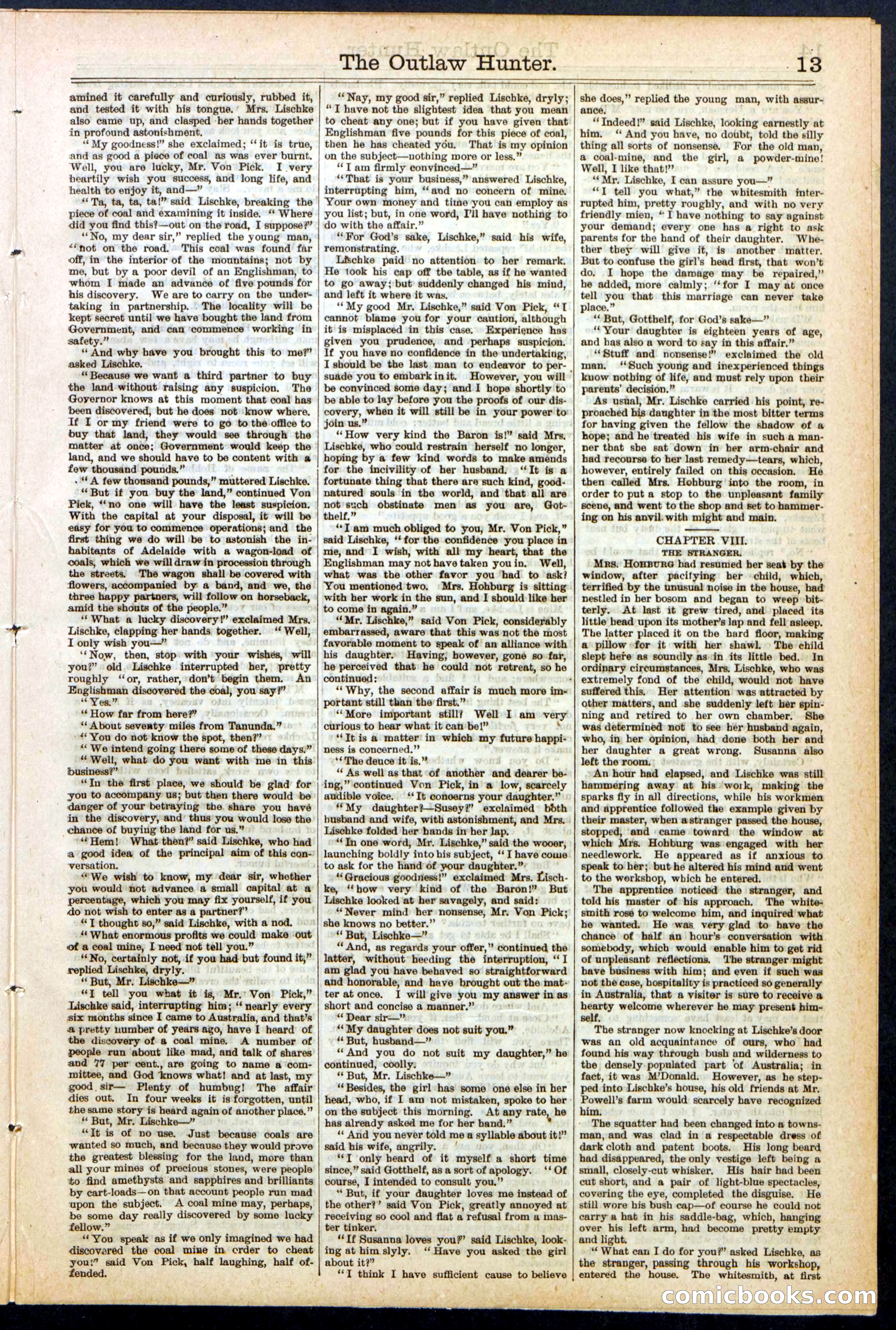
A restored page from Pulp Fiction, 1881. Page through the whole issue in the reader above.
📄 Transcribed text from this page (OCR, searchable)
Machine-transcribed from the original scan — historical spelling and the odd misread are preserved.
al . a” ieee chance of buying the land for us.” The Outlaw Hunter. 13 amined it carefully and curiously, rubbed it, and tested it with his tongue.’ Mrs. Lischke also came up, and clasped ‘her hands together in profound astonishment, ‘“My goodness!” she exclaimed; ‘“‘it is true, and as good a piece of coal as was ever burnt. Well, you are lucky, Mr. Von Pick. I very heartily wish you success, and long life, and health to enjoy it, and—” “Ta, ta, ta, tal!” said Lischke, breaking the piece of coal and examining it inside. *‘ Where did you find this?—out on the road, I suppose?’ ‘*No, my dear sir,” replied the young map, “*not on the road. This coal was found far off, in the interior of the mountains; not by me, but by a poor devil of an Englishman, to whom I made an advance of five pounds for his discovery. We are to carry on the under- taking in partnership. . The locality will be kept secret until we have bought the land from Government, and can commence working in safety.” ‘“‘ And why bave you brought this to me?” asked Lischke. “Because we want a third partner to buy the land without raising any suspicion. The Goyernor knows at this moment that coal has been discovered, but he does not know where. If I or my friend were to go to the office to buy that land, they would see through the matter at once; Government would keep the land, and we should have to be content with a few thousand pounds.” . “(A few thousand pounds,” muttered Lischke. ‘But if you buy the land,” continued Von Pick, ‘‘no one will have the least suspicion. With the capital at your disposal, it will be easy for you to commence operations; and the first thing we do will be to astonish the in- habitants of Adelaide with a wagon-load of coals, which we will draw in procession through the streets. The wagon shall be covered with flowers, accompanied by a band, and we, the three happy partners, will follow on horseback, amid the shouts of the people.” ‘* What a lucky discovery!” exclaimed Mrs, Lischke, clapping her hands together. ‘“‘ Well, I only wish you” ‘*Now, then, stop with your wishes, will you?” old. Lischke interrupted her, pretty roughly ‘or, rather, don’t begin them. An Englishman discovered the coal, you say?” “ Yes. ” “ How far from here?” “About seventy miles from Tanunda.” ** You do not know the spot, then?” “We intend going there some of these days.” “Well, what do you want with me in this business?” “In the first place, we should be glad for ‘you to accompany us; but then there would be danger of your betraying the share you havé in the discovery, and’ thus you would lose the “Hem! What then?” said Lischke, who had a good idea of the principal aim of this con- versation, ‘““We wish to know, my dear sir, whether you would not advance a small capital at a percentage, which you may fix yourself, if you do not wish to enter as a partner?” “T thought so,” said Lischke, with a nod. “‘ What enormous profits we could make out of a coal mine, I need not tell you.” ‘No, certainly not, if you had but found it,” replied "Lischke, dryly. “ But, Mr. Lischke—” “T tell you what it is, Mr.’ Von Pick,” Lischke said, interrupting him; ‘‘ nearly every six months since I came to Australia, and that’s & pretty number of years ago, have I heard of the discovery of a coal mine. A number of people run about like mad, and talk of shares and 77 per cent., are going to name a com- mittee, and God ‘knows what! and at last, my good sir— Plenty of humbug! The affair dies out. In four weeks it is forgotten, until the same story is heard again of another place.” * But, Mr. Lischke—” “Tt is of no use. Just because coals are wanted so much, and because they would prove the greatest blessing for the land, more than all your mines of precious stones, were people ‘to find amethysts and sapphires and brilliants by cart-loads—on that account people run mad upon the subject. A coal mine may, perbaps, be some day really discovered by some lucky fellow.” ‘You speak as if we only imagined we had discovered the coal mine in crder to cheat you!” said Von Pick, half laughing, half of- fended. eres ae se ee ~ , ae say . ‘. alla l 4 —————————— LLL LLL LLL LLL LLL LLLDLADLAL LLL is” : : a a re oe eee ee =" t is ” ver = “Nay, my good sir,” replied Lischke, dryly; “T have not the slightest idea that you mean to cheat any one; but if you have given that Englishman five pounds for this piece of coal, then he has cheated you. That is my opinion on the subject—nothing more or less.” “‘T am firmly econvinced—” ‘*That is your business,” answered Lischke, interrupting him, ‘‘and no concern of mine. Your own money and time you can employ as you list; but, in one word, [ll have nothing to do with the affair.” *‘For God’s sake, Lischke,” said his wife, remonstrating. Lischke paid no attention to her remark. He took his cap off the table, as if he wanted to go away; but suddenly changed his mind, and left it where it was, ‘*My good Mr, Lischke,” said Von Pick, “T cannot blame you for your caution, although it is misplaced in this case. Experience has given you prudence, and perhaps suspicion. If you have no confidence in the undertaking, I should be the last man to endeavor to per- suade you to embarkinit. However, you will be convinced some day; and I hope shortly to be able to lay before you the proofs of our dis- covery, when it will still be in your power to join us.” ‘“‘How very kind the Baron is!” said Mrs. Lischke, who could restrain herself no longer, hoping by a few kind words to make amends for the incivility of her husband. ‘It is a fortunate thing that there are such kind, good- natured souls in the world, and that all are not such obstinate men as you are, Got- thelf.” “‘T am much obliged to you, Mr. Von Pick,” said Lischke, ‘‘ for the confidence you place in me, and’ I wish, with all my heart, that the Englishman may not bavetaken youin. Well, what was the other favor you had to ask? You mentioned two, Mrs. Hohburg is sitting with ber work in the sun, and I should like her to come in again.” “Mr. Lischke,” said Von Pick, considerably embarrassed, aware that this was not the most favorable moment to speak of an alliance with his daughter. Having; however, goné so far, he perceived that he could not retreat, so he continued: ‘“‘ Why, the second affair is much more im- portant still than the first.” ‘‘More important still? Well I am very curious to hear what it can be!” ‘‘It is a matter in which my future happi- ness is concerned.” ‘The deuce it is.” ‘“* As well ag that of another and dearer be- ing,” continued Von Pick, in a low, scarcely audible voice. ‘It concerns your daughter.” “My daughter?—Susey?” exclaimed bbdth she does,” replied the young man, with assur- ance, “‘Indeed!” said Lischke, looking earnestly at him. “ And you have, no doubt, told the silly thing all sorts of nonsense. For the old man, a coal-mine, and the girl, a powder-mine! Well, I like that!” “ Mr. Lischke, I can assure you—” “I tell you what,” the whitesmith imter- rupted him, pretty roughly, and with no very friendly mien, “ I have nothing to say against your demand; every one has a right to ask parents for the hand of their daughter. Whe- ther they will give it, is another matter. But to confuse the girl's head first, that won't do. I hope the damage may be repaired,” he added, more calmly; ‘‘for I may at once tell you that this marriage can never take place.” ** But, Gotthelf, for God’s sake—” “Your daughter is eighteen years of age, and has also a word to say in this affair.” “Stuff and nonsense!” exclaimed the old man, ‘Such young and inexperienced things know nothing of life, and must rely upon their parents’ decision.” As usual, Mr. Lischke carried his point, re- proached bis daughter in the most bitter terms for having given the fellow the shadow of a hope; and he treated his wife in such a man- ner that sbe sat down in ber arm-chair and had recourse to her last remedy—tears, which, however, entirely failed on this occasion. He then called Mrs. Hohburg into the room, in order to put a stop to the unpleasant family scene, and went to the shop and set to hammer- ing on his anvil. with might and main. CHAPTER VIII. THE STRANGER, Mrs. Honsvure had resumed ber seat by the window, after pacifying ber child, which, terrified by the unusual noise in the house, had nestled in ber bosom and began to weep: bit- terly. At last it grew tired, and placed its little head upon its mother’s lap and fell asleep. The latter placed it on the hard floor, making a pillow for it with her shawl. Tbe ehild slept here as soundly as in its little bed. In ordinary circumstances, Mrs, Lischke, who was ‘| extremely fond of the child, would not have husband and wife, with astonishment, and Mrs. Lischke folded her bands in her lap. “(In one word, Mr. Lischke,” said the wooer, launching boldly into his subject, ‘‘ I have come to ask for the hand of your daughter.” “Gracious goodness!” exclaimed Mrs. Lisch- ke, ‘‘how very kind of the Baron!” But Lischke looked at her savagely, and said: “Never mind her nonsense, Mr. Von Pick; she knows no better.” “ Bat, Lischke—” “And, as regards your offer,” continued the latter, without heeding the interruption, ne | am glad you have behaved so straightforward and honorable, and have brought out the mat- ter at once. I will give you my answer in as short and concise a manner.” a Dear sir—” “My daughter does not suit you.” “ But, husband—” “And you do not suit my daughter,” he continued, coolly, ‘* But, Mr. Lischke—” “‘ Besides, the girl has some one else in her head, who, if I am not mistaken, spoke to her: on the subject this morning. At any rate, he has already asked me for her band.” ‘* And you never told mea syllable about it!” said his wife, angrily. **T only heard of if myself a short time since,” said Gotthelf, as a sort of apology. ‘‘ Of course, I intended to consult you.” “ But, if your daughter loves me instead of the other?’ said Von Pick, greatly annoyed at receiving so cool and flat a refusal from a mas- ter tinker. ‘If Susanna loves you?’ said Lischke, look- ing at himslyly. ‘Have you asked the girl about it?” **T think I have sufficient cause to believe ‘ ‘ ~~ A” ' ; “ +5 &4 ; ‘ , . = * 4 ‘a suffered this. Her attention was attracted by other matters, and she suddenly left her spin- ning and retired to her own chamber. She was determined not to see her husband again, who, in her opinion, had done both her and her daughter a great wrong. Susanna also left the room. An hour had elapsed, and Lischke was still hammering away at his work, making the sparks fly in all directions, while bis workmen and apprentice followed the example given by their master, when astranger passed the house, stopped, and came toward the window at which Mrs. Hohburg was engaged with her needlework. He appeared as if anxious to speak to her; but he altered his mind and went to the werkshop, which he entered. The apprentice noticed the stranger, and told his master of his approach. The white- smith rose to welcome him, and inquired what he wanted. He was very glad to have the chance of half an hour’s conversation with. somebody, which would enable him to get rid of unpleasant reflections, ‘The stranger might have ness with him; and even if such was not the case, hospitality is practiced so generally in Australia, that a visitor is sure to receive a hearty welcome wherever he may present him- self The stranger now knocking at Lischke’s door was an old acquaintance of ours, who had found his way through bush and wilderness to the densely populated part of Australia; in fact, it was M’Donald. However, as he step- ped into Lischke’s house, his old friends at Mr. Powell’s farm would scarcely have recognized him. The squatter had been changed into a towns- man, and was clad in a respectable dress of dark cloth and patent boots. His long beard had disappeared, the only vestige left being a small, closely-cut whisker, His hair bad been cut short, and a pair of light-blue spectacles, covering the eye, completed the disguise. He still wore his bush cap—of course he could not earry a hat in his saddle-bag, which, hanging over his left arm, had become pretty empty and light. “What can I do for you?” asked Lischke, as the stranger, passing through his workshop, entered the house. The whitesmith, at first ~~ Eeomicbooks ero} ’ a yh Re he ee ¢ en ayer ten nee ~~ re ares -