
Pulp Fiction, 1881 · page 12 of 32
Beadle's New York Dime Library, No. 136 — page 12: what you’re looking at
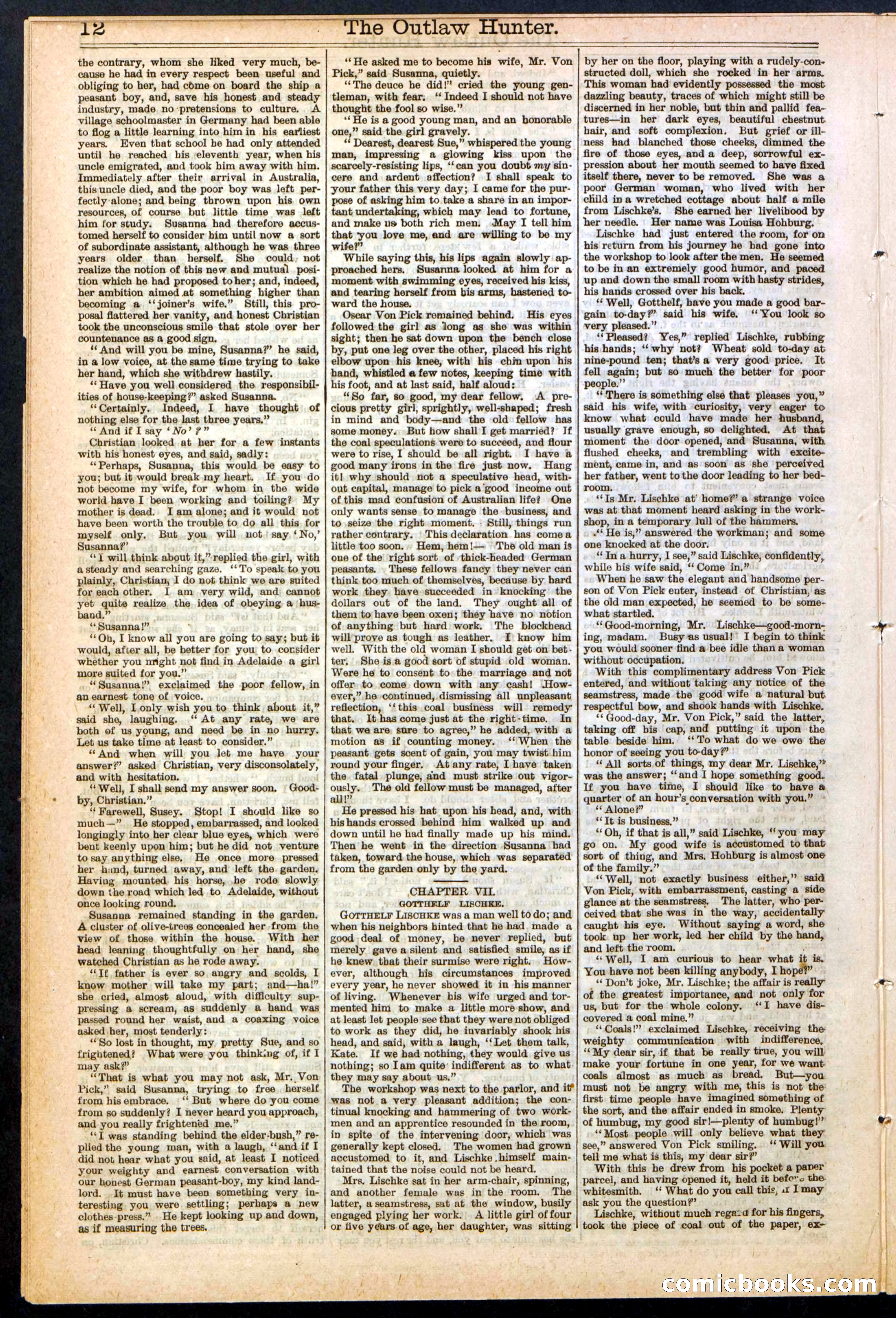
A restored page from Pulp Fiction, 1881. Page through the whole issue in the reader above.
📄 Transcribed text from this page (OCR, searchable)
Machine-transcribed from the original scan — historical spelling and the odd misread are preserved.
a. . 3 =~ ‘ -— ae oS . —~— +o a : . tyro me 16 Outlaw Hunter. the contrary, whom she liked very much, be- cause he had in every respect been useful and obliging to her, had cOme on board the ship a peasant boy, and, save his honest and steady industry, made no-pretensions to culture. A village schoolmaster in Germany had been able to flog a little learning into himin his earliest years. Even that school be had only attended until he reached his ‘eleventh year, when his uncle emigrated, and took bim away with him. Immediately after their arrival in Australia, this uncle died, and the poor boy was left per- fectly alone; and being tbrown upon his own resources, of course but little time was left him for study. Susanna had therefore accus- tomed herself to consider bim until now a sort of subordinate assistant, although he was three years older than herself. She could, not realize the notion of this new and mutual posi- tion which he had proposed to her; and, indeed, her ambition aimed at something higher than becoming a ‘‘joiner’s wife.” Still, this pro- posal flattered her vanity, and honest Christian took the unconscious smile that stole over her countenance as a good sign, ‘And will you be mine, Susanna?’ he said, in a low voice, at the same time trying to take her hand, which she withdrew hastily. ‘‘Have you well considered the responsibil- ities of house-keeping?” asked Susanna. ‘Certainly. Indeed, I have thought of nothing else for the last three years,” “And if I say ‘No’ ?” Christian looked at her for a few instants with his honest eyes, and said, sadly: “Perhaps, Susanna, this would be easy to you; but it would break my heart, If you do not become my wife, for whom in the wide world have I been working and toiling? My mother is dead. Iam alone; and it would not have been worth the trouble to do all this for myself only. But you will not’ say ‘No,’ Susanna?’ “YJ will think about it,” replied the girl, with asteady and searching gaze. ‘‘To speak to you plainly, Christian; I do not think we are suited for each other. I am very wild, and: cannot yet quite realize the idea of obeying a hus- band,” “Susanna!” ‘*Oh, I know all you are going to say; but it would, after all, be better for you to consider wkether you night not find in Adelaide a girl more suited for you.”’ _“Susanna!” exclaimed the poor fellow, in an earnest tone of voice. “Well, Lonly wish you to think about it,” said she, laughing. ‘ At any rate, we are both of us young, and need be in no hurry. Let us take time at least to consider.” ‘And when will you let me have your answer?’ asked Christian, very disconsolately, and with hesitation. “Well, I shall send my answer soon. Good- by, Christian.” ‘* Farewell, Susey. Stop! I should like so much—” He stopped, embarrassed, and looked longingly into her clear blue eyes, which were bent keenly upon him; but he did not venture to say anything else, He once more pressed ber hind, turned away, and left the. garden. Having mounted his horse, he rode slowly down the road which led to Adelaide, without once looking round, Susanna remained standing in the garden, A cluster of olive-trees concealed her from the view of those within the house. With her head leaning thoughtfully on her hand, she watched Christian as he rode away. ‘Tf father is ever so angry and scolds, I know mother will take my part; and—ha!” she cried, almost aloud, with difficulty sup- pressing a scream, as suddenly a hand was passed round her waist, and a coaxing voice asked her, most tenderly: ‘So lost in thought, my pretty Sue, and so trightened? What were you think:ng of, if I may ask?” “That is what you may not ask, Mr. Von Pick,” said Susanna, trying to free herself from his embrace. ‘‘ But where do you come from so suddenly? I never heard you approach, and you really frightened me,” ‘‘] was standing behind the elder-bush,” re- _ plied the young man, with a laugh, ‘‘and if I did not hear what you said, at least I noticed your weighty and earnest conversation with our honest German peasant-boy, my kind land- lord. It must have been something very in- teresting you were settling; perhaps a new clothes-press.” . He kept looking up and down, as if measuring the trees. ‘He asked me to become his wife, Mr. Von Pick,” said Susanna, quietly. “The deuce he did!” cried the young gen- tleman, with fear. ‘‘ Indeed I should not have thought the fool so wise.” ‘He is a good young man, and an bonorable one,” said the girl gravely. ‘** Dearest, dearest Sue,” whispered the young man, impressing a glowing kiss upon the scarcely-resisting lips, ‘‘can you doubt my sin- cere and ardent affection? I shall speak to your father this very day; I came for the pur- pose of asking him to take a share in an impor- tant undertaking, which may lead to fortune, and make us both rich men, May I tell him that ‘you love me, and are willing to be my wife?” While saying this, his lips again slowly ap- proached hers, Susanna looked at him for a moment with swimming eyes, received his kiss, and tearing herself from bis arms, hastened to- ward the house. Oscar Von Pick remained behind. His eyes followed the girl as long as she was within sight; then he sat down upon the bench close by, put one leg over the other, placed his right elbow upon his knee, with his chin upon his hand, whistled a few notes, keeping time with his foot, and at last said, balf aloud: “So far, so good, my dear fellow. A pre- cious pretty girl, sprightly, well-shaped; fresh in mind and body—and the old fellow has some money. But how shall I get married? If the coal speculations were to succeed, and flour were to rise, I should be all right. I have a good many irons in the fire just now. Hang it! why should not a speculative head, with- out capital, manage to pick a’good income out of this mad confusion of Australian life? One only wants sense to manage the. business, and to seize the right moment. - Still, things run rather contrary. This declaration has comea little too soon... Hem, hem!— The old man is one of the right sort of thick-headed German peasants. These fellows fancy they never can think too much of themselves, because by hard work they haye sueceeded in knocking the dollars out of the land. They ought all of them to have been oxen; they have no notion of anything but hard work. The blockhead will prove as tough as leather. I know him well, With the old woman I should get on bet- ter, She is a good sort of stupid old woman. Were he to consent to the marriage and not offer to come down with any cash! .How- ever,” he continued, dismissing all unpleasant reflection, ‘‘this coal business will remedy that. It has come just at the right-time. In that we are sure to agree,” he added, with a motion as if counting money. ‘‘ When the peasant gets scent of gain, you may twist him round your finger. Atany rate, I have taken the. fatal plunge, and must strike out vigor- ously. The old fellow must be managed, after all!” He pressed his hat upon his head, and, with his hands crossed behind him walked up and down until he had finally made up his mind. Then he went in the direction Susanna bad taken, toward the house, which was separated from the garden only by the yard. CHAPTER VIL GOTTHFLF LISCHKE, GorrTHELrY LISCHKE was a man well to do; and when his neighbors hinted that he had made a good deal of money, he never replied, but merely gave a silent and satisfied smile, as if he knew tbat their surmise were right. _How- ever, although his circumstances improved every year, he never showed it in his manner of living. Whenever his wife urged and tor- mented him to make a little more show, and at least let people see that they were not obliged to work as they did, he invariably shook his head, and said, with a laugh, ‘‘ Let them talk, Kate. If we had nothing, they would give us nothing; so lam quite’ indifferent as to what. they may say about us,” The workshop was next to the parlor, and it? was not a very pleasant addition; the con- tinual knocking and hammering of two work- men and an apprentice resounded in the room, in spite of the intervening door, which was generally kept closed. The women had grown accustomed to it, and Lischke .himself main- tained that the noise could not be heard. Mrs. Lischke sat in her arm-chair, spinning, and another female was in the room, latter, a seamstress, sat at the window, busily engaged plying her work. A little girl of four or five years of age, her daughter, was sitting by her on the floor, playing with a rudely-con- structed doll, which she rocked in her arms. This woman had evidently possessed the most dazzling beauty, traces of which might still be discerned in her noble, but thin and pallid fea- tures—in her dark eyes, beautiful chestnut. hair, and soft complexion. But grief or ill- ness had blanched those cheeks, dimmed the fire of those eyes, anda deep, sorrowful ex- pression about her mouth seemed to have fixed itself there, never to be removed. She was a poor German woman, who lived with her child in a wretched cottage about half a mile from Lischke’s. She earned her livelihood by her needle. Her name was Louisa Hohburg. Lischke had just entered the room, for on his return from his journey he had gone into the workshop to look after the men. He seemed to be in an extremely good humor, and up and down the small room with hasty strides, his hands crossed over his back, ‘* Well, Gotthelf, have you made a good bar- gain to-day?” said his wife. ‘‘ You look so very pleased.” ‘*Pleased? Yes,” replied Lischke, rubbing his hands; “‘ why not? Wheat sold to-day at nine-pound ten; that’s a very good price, It fell again; but so much the better for poor people.”’ ‘There is something else that pleases you,” said his wife, with curiosity, very eager to know what could have made her husband, usually grave enough, so delighted. At that moment the door opened, and Susanna, with flushed cheeks, and trembling with excite- ment, came in, and as soon as she perceived her father, went to the door leading to her bed- room. ‘*Is Mr. Lischke at’ home?’ a strange voice was at that moment heard asking in the work- shop, in a temporary lull of the hammers. -“* He is,” answered the workman; and some one knocked at the door. ‘Ina hurry, I see,” said Lischke, confidently, while his wife said, ‘‘Come in,” When he saw the elegant and handsome per- son of Von Pick enter, instead of Christian, as the old man expected, he seemed to be some- what startled. **Good-morning, Mr. Lischke—good-morn- ing, madam. Busy as usual!’ I begin to think you would sooner find a bee idle than a woman without occupation. With this complimentary address Von Pick entered, and without taking any notice of the seamstress, made the good wife a natural but respectful bow, and shook hands with Lischke. rT; Good-day, Mr. Von Pick,” said the latter, taking off bis cap, and putting it upon the table beside him. ‘‘To what do we owe the honor of seeing you to-day?” “ All sorts of things, my dear Mr. Lischke,”* was the answer; “‘and I hope something good. If you have time, I should like to have a quarter of an hour’s conversation with you.” ‘* Alone?” ' **Tt is business.” ‘Oh, if that is all,” said Lischke, ‘you may go on. My good wife is accustomed to that sort of thing, and Mrs, Hohburg is almost one of the family.” ‘“ Well, not exactly business either,” said Von Pick, with embarrassment, casting a side glance at the seamstress, The latter, who per- ceived that she was in the way, accidentally caught his eye. Without saying a word, she took up her work, led her child by the hand, and left the room, ‘“‘Well, I am curious to hear what it is, You have not been killing anybody, I ho _“ Don’t joke, Mr. Lischke; the affair is really of the greatest importance, and not only for us, but for the whole colony, ‘I have dis- covered a coal mine.” . fin ‘“‘ Coals!” exclaimed Lischke, receiving the weighty communication ‘with indifference, ‘My dear sir, if that be really true, you will make your fortune in one year, for we want: coals almost as much as bread, But—you must not be angry with me, this is not the first time people bave imagined something of the sort, and the affair ended in smoke, Plenty of humbug, my good sir!—plenty of humbug!’” ‘‘Most people will only believe what they see,” answered Von Pick smiling. ‘* Will you tell me what is this, my dear sir?’ | With this he drew from his pocket a paper parcel, and having opened it, held it befor the. whitesmith. ‘ What do you call this, .« Imay ask you the question?’ faa Pe Lischke, without much rega-d for his fingers, took the piece of coal out of the paper, ex- mnircbook