
Pulp Fiction, 1881 · page 11 of 32
Beadle's New York Dime Library, No. 136 — page 11: what you’re looking at
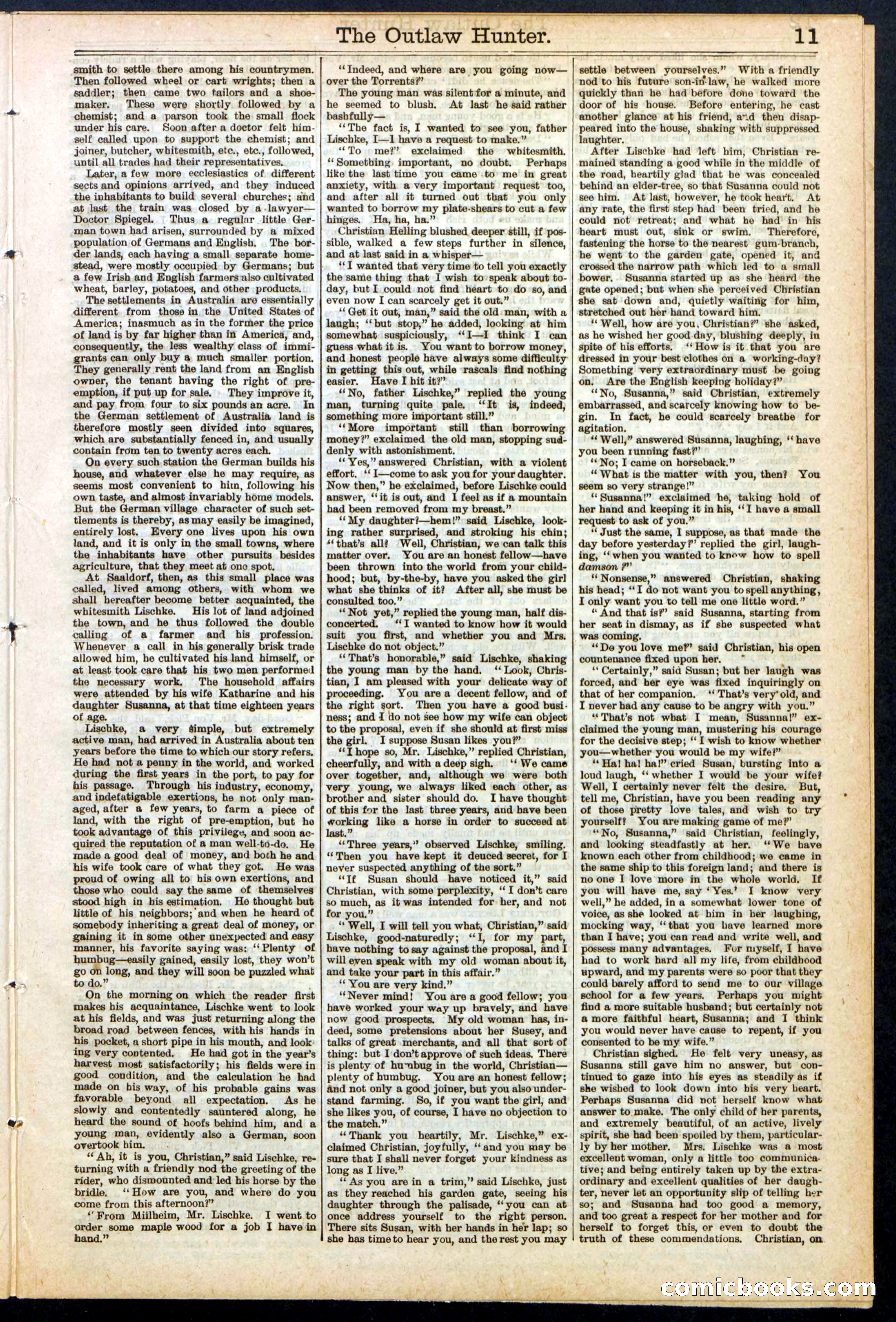
A restored page from Pulp Fiction, 1881. Page through the whole issue in the reader above.
📄 Transcribed text from this page (OCR, searchable)
Machine-transcribed from the original scan — historical spelling and the odd misread are preserved.
smith to settle there among his countrymen. Then followed wheel or cart wrights; then a saddler; then came two tailors and a shoe- maker. These were shortly followed by a chemist; and a parson took the small flock under his care. Soon after a doctor felt him- self called upon to support the chemist; and joiner, butcher, whitesmith, etc., etc., followed, until all trades had their representatives. Later, a few more ecclesiastics of different sects and opinions arrived, and they induced the inhabitants to build several churches; and at last the train was closed by a-.lawyer— Doctor Spiegel. Thus a regular little Ger- man town had arisen, surrounded by a mixed population of Germans and English. The bor- der lands, each having a small separate home- stead, were mostly occupied by Germans; but a few Irish and English farmers also cultivated wheat, barley, potatoes, and other products. The settlements in Australia are essentially different from those im the United States of America; inasmuch as in the former the price of land is by far higher than in America, and, consequently, the less wealthy class of immi- grants can only buy &@ much smaller portion. They generally rent the land from an English owner, the tenant having the right of pre- emption, if put up for sale. They improve it, and pay from four to six pounds an acre. In the German settlement of Australia land is therefore mostly seen divided into squares, which are substantially fenced in, and usually contain from ten to twenty acres each. On every such station the German builds his house, and whatever else he may require, as seems most convenient to hit, following his own taste, and almost invariably home models. But the German village character of such set- tlements is thereby, as may easily be imagined, entirely lost. Every one lives upon his own land, and it is only in the small towns, where the inhabitants have other pursuits besides agriculture, that they meet at ono spot. At Saaldorf, then, as this small place was called, lived among others, with whom we shall hereafter become better acquainted, the whitesmith Lischke. His lot of land adjoined the town, and he thus followed the double calling of a farmer and his _ profession. Whenever a call in his generally brisk trade allowed him, he cultivated his land himself, or at least took care that his two men performed the necessary work, The household affairs were attended by his wife Katharine and his daughter Susanna, at that time eighteen years of age. Lischke, a very simple, but extremely active man, had arrived in Australia about ten years before the time to which our story refers, He had not a penny in the world, and worked during the first years in the port, to pay for his passage. Through his industry, economy, and indefatigable exertions, he not only man- aged, after a few years, to farm a piece of land, with the right of pre-emption, but ho took advantage of this privilege, and soon ac- quired the reputation of a man well-to-do. He made a good deal of money, and both he and his wife took care of what they got. He was proud of owing all to his own exertions, and those who could say the same of themselves stood high in his estimation. He thought but little of his neighbors;'and when he heard of somebody inheriting a great deal of money, or gaining it in some other unexpected and easy manner, his favorite saying was: ‘‘ Plenty of b ug—easily gained, easily lost, they won’t go on long, and they will soon be puzzled what to do.” ' On the morning on which the reader first makes his acquaintance, Lischke went to look at his fields, and was just returning along the broad road between fences, with his hands in his pocket, a short pipe in his mouth, and look: ing very contented. He had got in the year’s harvest most satisfactorily; his fields were in good condition, and the calculation he had on his way, of his probable gains was favorable beyond all expectation. As he slowly and contentedly sauntered along, he heard the sound of hoofs behind him, and a young man, evidently also a » soon overtook bim. ; *“ Ah, it is you, Christian,” said Lischke, re- turning with a friendly nod the greeting of the rider, who dismounted and led his horse by the bridle, ‘‘How are you, and where do you come from this afternoon?” ‘From Miilheim, Mr. Lischke. I went to order some maple wood for a job I have in band.” — ee The Outlaw Hunter. “Indeed, and where are you going now— over the Torrents?’ The young man was silent for a minute, and he seemed to blush. At last he said rather bashfully— ‘*The fact is, I wanted to see you, father Lischke, I—1 have a request to make.” “To me?’ exclaimed the whitesmith. “‘Sometbing: important, no doubt. Perhaps like the last time you came to me in great anxiety, with a very important request too, and after all it turned out that you only wanted to borrow my plate-shears to cut a few hinges. Ha, ha, ha.” , Christian Helling blushed, deeper still, if pos- sible, walked a few steps further in silence, and at last said in a whisper— ‘**T wanted that very time to tell you exactly the same thing that I wish to speak about to- day, but I could not find heart to do so, and even now I can scarcely get it out.” “Get it out, man,” said the old man, with a laugh; ‘‘ but stop,” he added, looking at him somewhat suspiciously, “‘I—I think I can guess what it is. You want to borrow money, and honest people have always some difficulty in getting this out, while rascals find nothing easier. Have I bit it?’ ‘‘No, father Lischke,” replied the young man, turning quite pale, “It is, indeed; something more important still.” ‘‘More important still than borrowing money?” exclaimed the old man, stopping sud- denly with astonishment. ** Yes,” answered Christian, with a violent effort. ‘‘1—come to ask you for your daughter. Now then,” be exclaimed, before Lischke could answer, ‘it is out, and I feel as if a mountain had been removed from my breast.” ‘My daughter?—hem!” said Lischke, look- ing rather surprised, and strokiug his chin; **that’s all? Well, Christian, we can talk this matter over. You are an honest fellow—have been thrown into the world from your child- hood; but, by-the-by, have you asked the gir] what she thinks of it? After all, she must be consulted too.” “Not yet,” replied the young man, half dis- concerted. ‘I wanted to know how it would suit you first, and whether you and Mrs, Lischke do not object.” ‘‘That’s honorable,” said Lischke, shaking the young man by the hand. ‘“ Look, Chris- tian, I am pleased with your delicate way of proceeding. You area decent fellow, and of the right sort. Then you have a good busi- ness; and I do not see how my wife can object to the proposal, even if she should at first miss the girl. I suppose Susan likes you?” ‘‘T hope so, Mr. Lischke,” replied Christian, cheerfully, and with adeep sigh. ‘‘ We came over together, and, although we were both very young, we always liked each other, as brother and sister should do. I have thought of this for the last three years, and have been working like a horse in order to succeed at last.” ‘“‘Three years,’ observed Lischke, smiling. ‘‘Then you have kept it deuced secret, for I never suspected anything of the sort.” “Tf Susan should have noticed it,” said Christian, with some perplexity, ‘“‘ I don’t care so much, as it was intended for her, and not for you.” “* Well, I will tell you what, Christian,” said Lischke, good-naturedly; “I, for my part, have nothing to say against the proposal, and I will even speak with my old woman about it, and take your part in this affair.” “You are very kind.” ‘‘Never mind! ‘You are a good fellow; you have worked your way up bravely, and have now good prospects, My old woman has, in- deed, some pretensions about her Susey, and talks of great merchants, and all that sort of thing: but I don’t approve of such ideas. There is plenty of huunbug in the world, Christian— plenty of humbug. You are an honest fellow; and not only a good joiner, but you also under- stand farming. So, if you want the girl, and she likes you, of course, I have no objection to the match.” “Thank you heartily, Mr. Lischke,” ex- claimed Christian, joyfully, ‘‘and you may be sure that I shall never forget your kindness as long as I live.” ‘As you arein a trim,” said Lischke, just as they reached his garden gate, seeing his daughter through the “vou can at once address yourself to the right person. There sits Susan, with her hands in her lap; so she has time to hear you, and the rest you may ‘, ty e : 4 jor’ ye vue” eC ee eS et ee a - : settle between yourselves.” With a friendly nod to his future son-in-law, he walked more quickly than he had before done toward the door of his house. Before entering, he cast another glance at his friend, aid then disap- peared into the house, shaking with suppressed laughter. After Liscbke had left him, Christian re- mained standing a good while in the middle of the road, heartily glad that be was concealed behind an elder-tree, so that Susanna could not see him. At last, however, he took heart. At any rate, the first step had been tried, and he could not retreat; and what he had in his heart must out, sink or swim. Therefore, fastening the horse to the nearest gum-branch, he went to the garden gate, opened it, and crossed the narrow path which led to a small bower, Susanna started up as she heard the gate opened; but when she perceived Christian she sat down and, quietly waiting for him, stretched out her hand toward him. | ** Well, how are you, Christian?” she asked, as he wished her good day, blushing deeply, in spite of his efforts. ‘‘How is it that you are dressed in your best clothes on a working-day? Something very extraordinary must be going on. Are the English keeping holiday?” “No, Susanna,” said Christian, extremely embarrassed, and scarcely knowing how to be- gin. In fact, he could scarcely breathe for agitation. ** Well,” answered Susanna, laughing, ‘‘ have you been running fast?’ **'No; I came on horseback.” “What is the matter with you, then? You seem 80 very strange!” ‘* Susanna!” exclaimed he, taking hold of her hand and keeping it in his, ‘‘I have a small request to ask of you.” ** Just the same, I suppose, as that made the day before yesterday?” replied the girl, laugh- ing, ‘‘when you wanted to know how to spell damson ?” ** Nonsense,” answered Christian, shaking his head; ‘I do not want you to spell anything, I only want you to tell me one little word.” “ And that is?’ said Susanna, starting from her seat in dismay, as if she suspected what was coming. “De you love me?” said Christian, his open countenance fixed upon her. ~ , ‘* Certainly,” said Susan; but ber laugh was forced, and ber eye was fixed inquiringly on that of her companion, ‘‘ That’s very’ old, and I never bad any cause to be angry with you.” “That’s not what I mean, Susanna!” ex- claimed the young man, mustering his courage for the decisive step; ‘‘ I wish to know whether you—whether you would be my wife?’ ** Ha! ha! ha!” cried Susan, bursting Into a loud laugh, ‘‘ whether I would be your wife? Well, I certainly never felt the desire, But, tell me, Christian, have you been reading any of those pretty love tales, and wish to try yourself? You are making game of me?” “No, Susanna,” said Christian, feelingly, and looking steadfastly at her. ‘‘We have known each other from childhood; we came in the same ship to this foreign land; and there is no one I love more in the whole world, If you will have me, say ‘Yes.’ I know very well,” he added, in a somewhat lower tone of voice, as she looked at him in ber laughing, mocking way, “‘that you have learned more than I have; you can read and write well, and possess many advantages. For myself, I have had to work hard all my life, from childhood upward, and my parents were so poor that they could barely afford to send me to our village school for a few years. Perhaps you might find a more suitable husband; but certainly not a more faithful heart, Susanna; and I think you would never have cause to repent, if you consented to be my wife.” Christian sighed. He felt very uneasy, as Susanna still gave him no answer, but con- tinued to gaze into his eyes as steadily as if she wished to look down into bis very beart. Perhaps Susanna did not herself know what answer to make. The only child of her parents, and extremely beautiful, of an active, lively spirit, she had been spoiled by them, particular- ly by her mother, Mrs. Lischke was a most excellent woman, only a little too communica. tive; and being entirely taken up by the extra- ordinary and excellent qualities of her daugh- ter, never let an opportunity slip of telling her so; and Susanna had too good a memory, and too great a respect for her mother and for herself to forget this, or even to doubt the truth of these commendations. Christian, on. : » ‘vos we + ’ * cS comichboo ie Te ae