
Pulp Fiction, 1881 · page 6 of 32
Beadle's New York Dime Library No. 125 — page 6: what you’re looking at
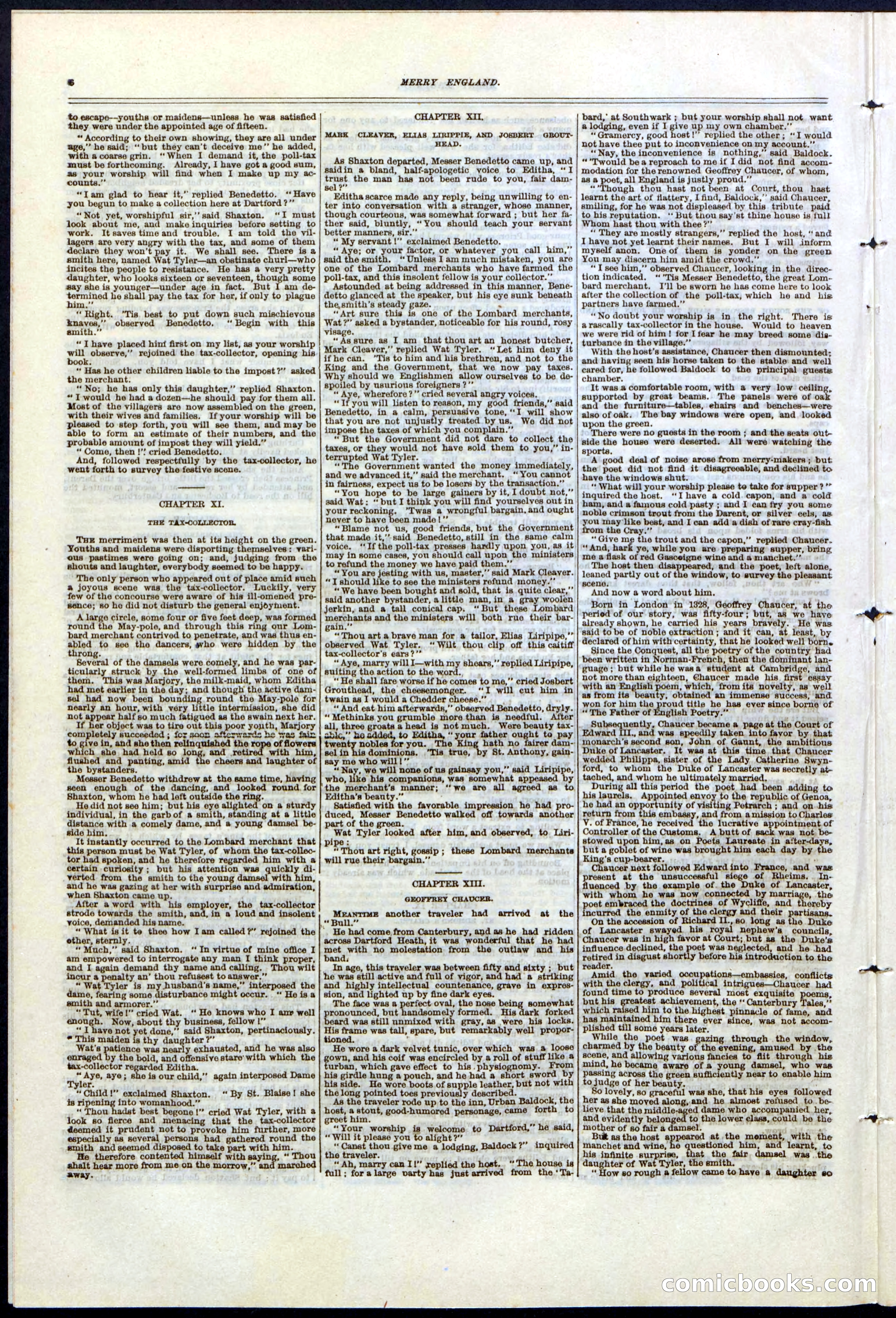
A restored page from Pulp Fiction, 1881. Page through the whole issue in the reader above.
📄 Transcribed text from this page (OCR, searchable)
Machine-transcribed from the original scan — historical spelling and the odd misread are preserved.
MERRY ENGLAND. ——— + to escape--youths or maidens—unless he was satisfied they were under the appointed age of fifteen. “ According to their own showing, they are all under age,” he said; “but they can’t deceive me”’ he added, with a coarse grin. ‘“‘When I demand it, the poll-tax must be forthcoming. Already, I have got a good sum, as your worship will find when I make up my ac- counts.” “Iam glad to hear it,” replied Benedetto. ‘Have you begun to make a collection here at Dartford?” “Not yet, worshipful sir,’’ said Shaxton. “I must look about me, and make inquiries before setting to work. It saves time and trouble. I am told the vil- lagers are very angry with the tax, and some of them declare they won't pay it. We shall see. There is a smith here, named Wat Tyler—an obstinate churl—who incites the people to resistance. He has a very pretty daughter, who looks sixteen or seventeen, though some #ay she is younger—under age in fact. But I am de- he he shall pay the tax for her, if only to plague Te odd “Right. ‘Tis. best to put down such mischievous aang, / observed Benedetto. “ Begin with this smith.” “I have placed hint first on my list, as your worship ae observe,” rejoined the tax-collector, opening his “* Has he other children liable to the impost?’ asked the merchant. ‘No; he has only this daughter,’’ replied Shaxton. “I would he had a dozen—he should pay for them all. Most of the villagers are now assembled on the green, with their wives and families. If your worship will be pleased to step forth, you will see them, and may be able to form an estimate of their numbers, and the probable amount of impost they will yield.” * Come, then !’! cried Benedetto. And, followed respectfully by the tax-collector, he went forth to survey the festive scene. CHAPTER XI. THE TAX-COLLECTOR. THE merriment was then at its height on the green. Youths and maidens were disporting themselves: vari- ous pastimes were going on; and, judging from the shouts and laughter, everybody seemed to be happy. The only person who appeared out of place amid such a joyous scene was the tax-collector. Luckily, very few of the concourse were aware of his ill-omened pre- sence; so he did not disturb the general enjoyment. A large circle, some four or five feet deep, was formed round the May-pole, and through this ring our Lom- bard merchant contrived to penetrate, and was thus en- spied to see the dancers, who were hidden by the ong. ng Several of the damsela were comely, and he was par- ticularly struck by the well-formed limbs of one of them. This was Marjory, the milk-maid, whom Editha ee earlier in the day; and though the active dam- ad now been bounding round the May-pole for nearly an hour, with very little intermission, she did not Apont half s0 much fatigued aa the awain next her. If her object was to tire out this poor youth, Marjory com ev awrasedess is ange swasds he svas. frit to give in, and she then the of flowers which she had held so ne Se re with him, flushed and panting, amid cheers and laughter of the bystanders. Messer Benedetto withdrew at the same time, having seen enough of the dancing, and looked round, for Shaxton, whom he had left outside the zing. He did not see him; but his eye alight on a sturdy individual, in the garbof a th, standing at a little bre with a comely dame, and a young damsel be- It instantly occurred to the Lombard merchant that this person must be Wat Tyler, of whom the tax-collec- tor spoken, and he therefore regarded him with a curiosity ; but his attention was quickly di- verted from the smith to the yong cases with and he was gazing at her with surp and admiration, when Shaxton came up. After a word with his employer, the tax-collector strode towards the smith, in a loud and insolent voice, demanded his name. “What is it te thee how Iam called?” rejoined the other, sternly. “Much,” said Shaxton. “In virtue of mine office I cr LL i ———————————————____________________,, d CHAPTER XII, MARK CLEAVER, ELIAS LIRIPPIE, AND JOSBERT GROUT- HEAD. As Shaxton departed, Messer Benedetto came up, and saidin a bland, half-apologetic voice to Editha, “I ae the man has not been rude to you, fair dam- se i Editha scarce made any reply, being unwilling to en- ter into conversation with a stranger, whose manner, though courteous, was somewhat forward ; but her fa- ther said, bluntly, “You should teach your servant better manners, sir.” “ My servant!” exclaimed Benedetto. “ Aye; or son factor, or whatever you call him,’’ said the smith. ‘“ Unless Iam much mistaken, you are one of the Lombard merchants who have farmed the poll-tax, and this insolent fellow is your collector.”’ Astounded at being addressed in this manner, Bene- detto glanced at the speaker, but his eye sunk beneath the, smith’s steady gaze. . “Art sure this is one of the Lombard merchants, Wat?’ asked a bystander, noticeable for his round, rosy visage. ry sure as I am that thou art an honest butcher, Mark Cleaver,’ replied Wat Tyler. “Let him deny it ifhecan. “Tis to him and his brethren, and not to the King and the Government, that we now pay taxes. Why should we Englishmen allow ourselves to be de- spoiled by usurious foreigners ?”’ “ Aye, wherefore?” cried several angry voices. “If you will listen to reason, my good friends,” said Benedetto, in a calm, persuasive tone, ‘I will show that you are not unjustly treated by us. We did not impose the taxes of which you complain.” “But the Government did not dare to collect the taxes, or they would not have sold them to you,” in- be ge Wat Tyler. “The Government wanted the money immediately, and we advanced it,”’ said the merchant. “You cannot in fairness, expect us to be losers by the transaction.” “You hope to be large gainers by it, Idoubt not,” said Wat: “ but I think you will find yourselves out in your yey ’Twas a wrongful bargain, and ought never to have been made !”’ “Blame not us, good friends, but the Government that made it,’’ said Benedetto, still in the same calm voice. ‘Ifthe poll-tax presses hardly upon you, as it may in some cases, you should call upon the ministers to refund the money we have paid them.’’ “You are jesting with us, master,’’ said Mark Cleaver. “IT should like to see the ministers refund money.’”’ “We have been bought and sold, that is quite clear,” said another bystander, alittle man,in a gray woolen jerkin, and a tall conical cap. “But these Lombard masse ants and the ministers will both rue their bar- g + ag “Thou art a brave man for a tailor, Elias Liripipe,’” observed Wat Tyler. “ Wilt thou clip off this caitiff tax-collector’s ears?’’ “ Aye, marry will I—with my shears,’’ replied Liripipe, suiting the action to the word., “ He shall fare worse if he comes to me,”’ cried Josbert Grouthead, the cheesemonger. “I will cut him in twain as I would a Chedder cheese.” —_—_ “And eat him afterwards,” observed Benedetto, dryly. “Methinks you grumble more than is needful. After three groats a head is not much. Were beauty tax- twen : sel in dominions. true, say me who will!’ y St. Anthony, gain- } his companions, was somewhat appeased the merchant’s manner; “‘we are all agreed as Editha’s beauty.” Satisfied with the favorable im on he had pro- duced, Messer Benedetto walked off towards another part of the green. Wat Tyler looked after him, and observed, to Liri- pipe : “Thou art right, goeeip ; these Lombard merchants will rue their bargain.” CHAPTER XIII. GEOFFREY CHAUCER. MEANTIME another traveler had arrived at the He had come from Canterbury, and ashe had ridden across Dartford Heath, it was wonderful that he had met with no molestation from the outlaw and his “Bull.” am empowered to interrogate any man I think proper, | band, and I again demand thy name and calling. Thou wilt incur a penalty an’ thou refusest to answer.” “Wat Tyler is my husband's name,” interposed the dame, fearing some disturbance might occur. “ He is a smith and armorer.”’ “Tut, wife!” cried Wat. ‘He knows who I amp well énough. Now, about thy business, fellow |” “‘ I have not yet done,”’ said Shaxton, pertinaciously. * This maiden is thy daughter ?” Wat's patience was nearly exhausted, and he was also enraged by the bold, and offensive stare’ with which the tax-collector oe Editha. “Aye, aye; is our child,” again interposed Dame ler. “ Child!” exclaimed Shaxton. “ By St. Blaise! she is ri into womanhood.” “4 Pou hadst best begone {” cried Wat Tyler, with a look so fierce and menacing deemed it prudent not to provoke him further, more ns had round the him. “ Thou marched He shalt hear more from me.on the morrow,” away. : In age, this traveler was between fifty and sixty ; but he was still active and full of vigor, and had a striking and highly intellectual countenance, grave in expres- sion, and lighted up by fine dark eyes. , The face was & ect oval, the nose neing acre ronounced, but handsomely formed. His dark forked Cora was still with gray, as were his locks. pe oy was tall, spare, but remarkably well propor- n: , He wore a dark velvet tunic, over which was a loose own, and his coif was encircled by a roll of stuff like a urban, which gave effect to his. physiognomy. From his girdle hung a pouch, and he had a short sword ae his side. He wore boots of supple leather, but not wit the long pointed toes previously described. As the traveler rode up to the inn, Urban Baldock, the noe rd good-humored personage, came forth to m. that the tax-collector | gree “Your worship is welcome to Dartford,” he said, “Will it please you to alight?” * Canst thou give me a lodging, Baldock?” inquired ee host.” The house ia y marry can I!’ replied the host.“ ouse full ; for a large varty has just arrived from the ‘Ta- all, a Leben for you._ The cing Poth hn hainee an “ Nay, we will none of us gainsay you,”’ said ery y to | his laurels. Ap ‘Chaucer was in hig bard,’ at Southwark ; but your worship shall not want a lodging, even if I give up my own chamber.”’ “Gramercy, good host!” replied the other; “I would not have thee put to inconvenience on my account.’’ ‘‘Nay, the inconvenience is nothing,’ said Baldock. “’T would bea reproach to me if Idid not find accom- modation for the renowned Geoffrey Chaucer, of whom, as a yoek, all England is IRA REGUS “’Though thou hast not been at Court, thou hast learnt the art of flattery, I find, Baldock,’’ said Chaucer, smiling, for he was not displeased by this tribute paid to his reputation. ‘‘ But thou say’st thine house is full Whom hast thou with thee ?”’ ‘They are mostly strangers,’’ replied the host, “and I have not yet learnt their names. But I will inform myself anon. Oneof them is yonder on the greep You may discern him amid the crowd.” “I see him,” observed Chaucer, looking in the direc- tion indicated. “Tis Messer Benedetto, the great Lom- bard merchant, I'll be sworn he has come here to look after the collection of the poll-tax, which he and his partners have farmed.” “No doubt your worship is in the right. There is arascally tax-collector in the house. Would to heaven we were rid of him! for I fear he may breed some dis- turbance in the village.”’ With the host's assistance, Chaucer then dismounted: and having seen his horse taken to the stable and wel) cared for, he followed Baldock to the principal gueste chamber. It was a comfortable room, with a very low ceiling, supported by great beams. The panels were of oa and the furniture—tables, ehairs and benches—were also of oak. The bay windows were open, and looked upon the green. There were no guests in the room ; and the seata out- side the house were deserted. All were watching the sports. A good deal of noise arose from merry-makers ; but: the poet did not find it disagreeable, and declined to have the windows shut. ‘* What will your worship please te take for supper ?’” inquired the host. ‘I have a cold. capon, and a cold ham, and a famous cold pasty ; and I can fry you some noble crimson trout from the Darent, or silver eels, as = may like best, and I can add a dish of rare cray-fish m the Cray.’’ “Give me the trout and the capon,” replied Chaucer. “And, hark ye, while you are preparing supper, bring me a flask of red Gasceigne wine and a manchet.’’ The host then disa , and the poet, left alone, leaned partly out of the window, to survey the pleasant scene, And now a word about him, Born in London in 1928, Geéoffrey Chancer, at the period of our story, was fifty-four; but, as we have already shown, he carried his years bravely. He was said tobe of noble extraction ; and it can, at least, by declared of him with certainty, that he looked well born. Since the Conquest, all the poetry of the country had been written in Norman-French, then the dominant lan- fuage; but while he wasa student at Cambridge, and not more than eighteen, Chaucer made his. first essay with an English , which, from its novelty, as well as from its uty, obtained an immense success, and won for him the proud title he has ever since borne of “The Father of English Poetry.” _ Subsequently, Chaucer became a page at the Court of Edward III., and was speedily taken into fayor by that monarch’s second son, John of Gaunt, the ambitious Duke of Lancaster. It wes at this time that Chaucer wedded Philippa, sister of the Lady Catherine Swyn- ford, to whom the Duke of Lancaster was secretly at- tached, and whom he ultimately married, During all this period the poet had been adding to inted pat Pag the republic of Genoa, he had an opportunity of visiting Pe ; and on. his return from this rssaaria” and from amission to Charles V. of France, he receiv 6 lucrative appointment of Controller of the Customs. A butt of was not be- stowed upon him, as on Poets Laureate in after-days, but a goblet of wine was brought him each day by King’s cup-bearer. . Chaucer next followed Edward into France, and was present at the unsuccessful siege of Rheims. _ In- fluenced by the example of. the Duke of Lancaster, with whom he was now connected Sgediy ®, the t embraced the doctrines of Wycliffe, and t urred the enmity of the clergy and their partisans On the accession of Richard Il.,#0 long as the Duke of Lancaster ewayed. his royal nephew's councils, favor at Court; but as the Duke's influence declined, the was neglected, he had retired in disgust sh before his introduction to the reader Amid the varied occupa es, conflicts with the clergy, and political in es—Chaucer had found time to produce several most exquisite : but his achievement, the ‘Canterbury Tales.” which raised him to the highest pinnacle of fame, and has maintained him there ever since, was not accom- Mae op eo some years later. . 6 the poet was gazing through the window, charmed by the beauty of” tha evening, amused by the scene, and allowing various fancies to flit through hie mind, he became aware of a young damsel, who was passing across the green Sufticlently near to enable him to judge of her beauty. . So lovely, so graceful was she, that his eyes followed her as she moved along, and he almost refused to. be- lieve that the eee paN g dame who accompanied her, and evidently belonged to the lower class, could be the me tho hoat’' anaes t the mement, with th asthe host a at the m the tanchet and wile, he arse him, and learnt, to his infinite 5 ’ t the fair damsel was the daughter of Wat Tyler, the smith. eee “ _ pe so rough a fellow came to have a daughter eo SS) Gomichdoo (E(0)