
Pulp Fiction, 1881 · page 5 of 32
Beadle's New York Dime Library No. 125 — page 5: what you’re looking at
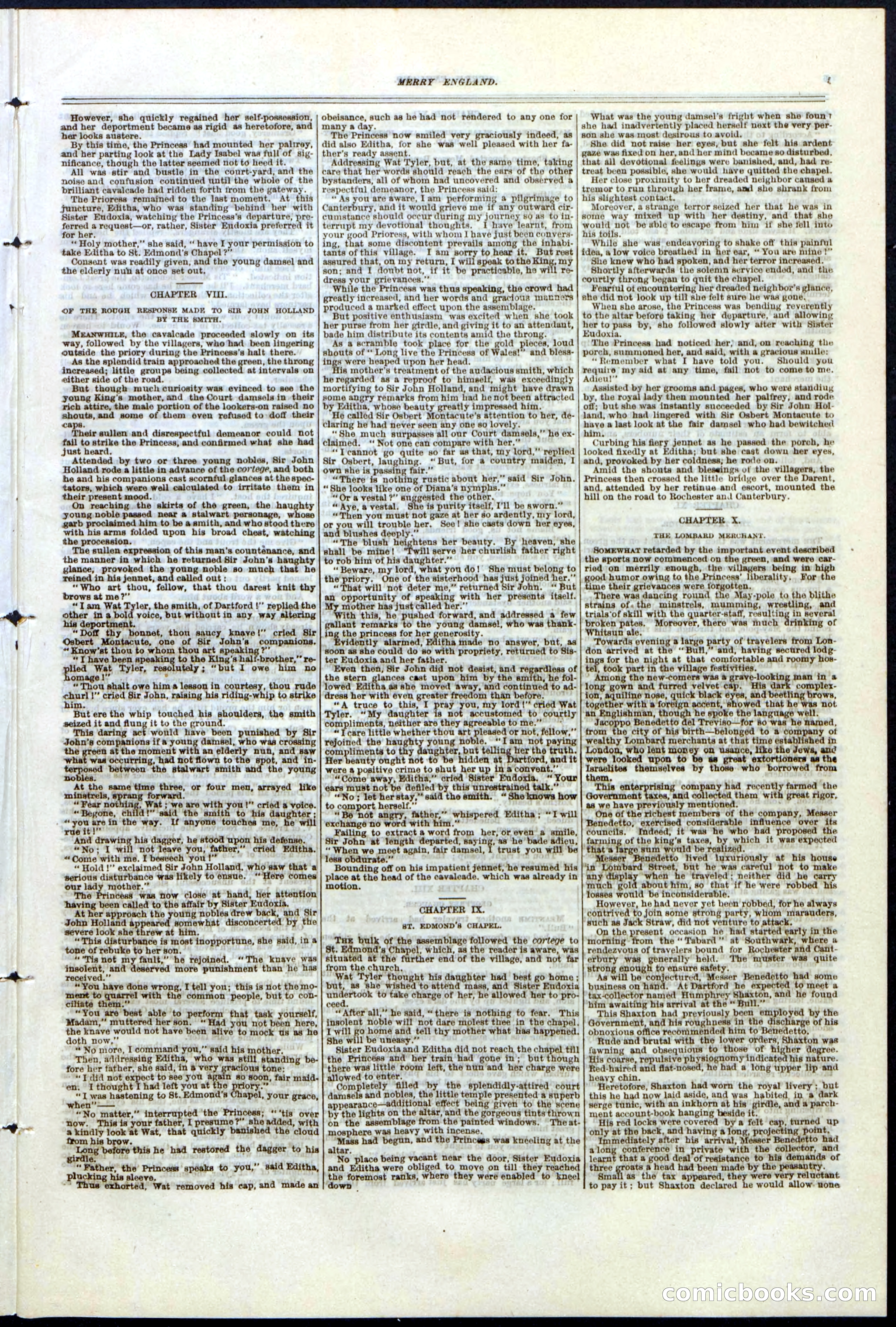
A restored page from Pulp Fiction, 1881. Page through the whole issue in the reader above.
📄 Transcribed text from this page (OCR, searchable)
Machine-transcribed from the original scan — historical spelling and the odd misread are preserved.
Ry MERRY ENGLAND. 4 a ee ee re -~ ---- -_——_-—= ee However, she quickly regained her self-posseasion, and her deportment became as rigid as heretofore, and her looks austere. By this time, the Princess had mounted her palrrey, and her parting look at the Lady Isabel waa full of sig- nificance, though the latter seemed not to heed it. All was stir and bustle in the court-yard, and the noise and confusion continued until the whole of the brilliant cavalcade had ridden forth trom the gateway. The Prioress remained to the last moment. At this jancture, Editha, who was standing behind her with Sister Eudoxia, watching the Princess's departure, pre- ferred a request—or, rather, Sister Endoxia preferred it for her. **Holy mother,” she said, “ have I your permission to take Editha to St. Edmond’s pee ? Consent was readily given, and the young damsel and the elderly nun at once set out, CHAPTER VIII. OF THE ROUGH RESPONSE MADE TO SIR JOHN HOLLAND BY THE SMITH. MEANWHILE, the cavalcade proceeded slowly on its way, followed by the villagers, who had been lingering outside the priory during the Princess's halt there. As the splendid train approached the green, the throng increased; little groups being collected at intervals on either side of the road. But though much curiosity was evinced to see the young King’s mother, and the Court damsels in their rich attire, the male portion of the lookers-on raised no shouts, and some of them oven refused to doff their caps. Their sullen and disrespectful demeanor could not fail to strike the Princess, and confirmed what she had just heard. Attended by two or three young nobles, Sir John Holland rode a little in advance of the cortege, and both he and his companions cast scornful glances at the spec- tators, which were well calculated to irritate them in their present mood. On reaching the skirts of the green, the nay young noble near a stalwart personage, whose garb proclaimed him to be a smith, and who stood there with his arms folded upon his broad chest, watching the procession. . The sullen expression of this man's countenance, and the manner in which he returned Sir John's haughty glance, provoked the yoaes noble so much that reined in his jennet, and called out : “Who art thou, fellow, that thou darest knit thy brows at me?”’ “Tam Wat Tyler, the smith, of Dartford !’’ rep the we. in a bold voice, but without in any way al ” panions. 8 Osbert Montacute, one of Sir Be shat thou to whom “T have King’s half-brother,” re- ler, resolutely; “but I owe him no pile Wat Ey “ Thou shalt owe hima leason in courtesy, thou rude cpnth 1” cried Sir John, raising his riding-whip to strike m. But ere the whip touched his shoulders, the smith seized it and fang it to the ground. This daring act wonld have been punished by Sir John’s companions ifs young damsel, who waa c g beer ita at the moment with an elderly nun, and saw waa occutring, had not flown to the t, and in- between the stalwart smith and the young nO Mal At the time three, or four men, arrayed like ma Fear 0 Wat :'we kee wi 1 ortbdt ; we are out’ ‘ oF ALERTS ge PL A Moe . he . in the way. If anyone touches me, fe itl é ” ut és > ri ‘And drawing his dagger, he stood upon defense. “No; I will not leave you,’ ‘4 crled Editha. “Come with me. I beseech youl” - ——w : “ Hold !” exclaimed Sir John Holland, who saw that a seriotis diaturbance was likely to ensue. “Here comes our lady mother.” . having leon cally tothe attr by Bitar Bada, vi c to the affair by er Eudoxia., At her erry 2 the youtig nobles drew back, bi ae John Holland sppeared somewhat disconcerted by the severe look she at him. . “This optar 7 tone of rebuke to her son. — “"Tig not my fault,” he rejoined. “The knave was — ‘and deserved more punishment than he has ved,” “You haye done , I tell yon; this is not the mo- ment to irre with the common people, but to con- “You are best able to perfo tha’ k yourself, Madam,” muttered herson. “ Hn a ae Pet here, the knave would not have been alive to mock us as he dal ” - : “a . “No more, I command you,” sai other. Then, addressing Editha, who ak Piananay be- fore her father, she said, in 8 very gracious tone: ~“ T did not eye to see you again 80 soon, fair maid. en. I thought I had left you at the Footy bt, was hastening to St. Edmond’s Chapel, your grace, when”’—— “No ive pip soil ‘the stake "tig Fas a kindly look dt Wat, that quickly banished the cloud ce is most inopportune, she said, in a) from wW. ag before this he ‘had restored the dagger to his | al Father, the’ Princess spéska to you,” said Editha, ; eave. ? : ed, Wat removed his cap, and made an y bonnet, thou pauey, Eneye ’ cried Sir |“ When we meet again, fair damsel, obeisance, such as he had not rendered to any one for many a day. The Princess now smiled very graciously indeed, as did also Editha, for she was well pleased with her fa- ther’s ready assent. Addressing Wat Tyler, but, at the same time, taking care that her words should reach the ears of the other bystanders, all of whom had uncovered and observed a respectful demeanor, the Princess said: “As you are aware, lam performing 4 pilgrimage to Canterbury, and it would grieve me if any outward cir- cumstance should occur during my journey 80 as to in- terrupt my devotional thoughts. I have learnt, from your good Prioress, with whom I have Just been convers- ing, that some discontent prevails among the inhabi- tants of this village. I am sorry to hear it. But rest assured that, on my return, I will speak tothe King, my son; and I doubt not, if it be practicable, he will re- dreas your grievances.”’ While the Princess was thus speaking, the crowd had greatly increased, and her words and gracious manners produced a marked effect upon the assemblage. But positive enthusiasm was excited when she took her purse from her girdle, and giving it to an attendant, bade him distribute its contents amid the throng. As a scramble took place for the ge pieces, loud shouts of “* Long live the Princess of Wales!” and bless- ings were heaped upon her head. is mother’s treatment of the audacious smith, which he regarded as a reproof to himself, was exceedingly mortifying to Sir John Holland, and might have drawn some angry remarks from him had he not been attracted by Editha, whose beauty greatly impressed him. He called Sir Osbert Montacute’s attention to her, de- claring he had never seen any one 80 lovely. “She much surpasses all our Court damsels,” he ex- claimed. ‘ Not one can compare with her.” “‘Tcannot go quite so far aa that, my lord,” replied Sir Osbert, laughing. “But, for a country maiden, I own she is passing fair.”’ ‘ “There is nothing rustic about her,” said Sir John. “She looks like one of Diana’s nymphs.” “Or a vestal ?”’ eauggested the other. “Aye, a vestal. She is purity itself, I'll be sworn.” “Then you must not gaze at her so ardently, my lord, or you will trouble her, See! she casts down her eyes, a | blushes deeply.” “The blush heightens her beauty. By heaven, she shall be mine! lserve her churlish father right to rob him of his daughter.” “ Beware, my lord, what you do! She must belong to the priory. One of the sisterhood has just coined her.” “That will not deter me,” returned dir n. “But an opportunity of speaking with her presents itself. Pages has just called her.”’ th this, he pushed forward, and addressed a few gallant remarks to the young damse!, who was thank- ing the princess for her pa gee yidently alarmed, Edifha m no ape yet, but, as soon as she could do #o with propriety, returned to Sis- ter Eudoxia and her father. Even then, Sir John did not desist, and re ess of the stern glances cast upon him by the he fol- lowed Editha as she moved away, and continued to ad- dress her with éven greater freedom than before. “A truce to this, I pray hp my lord |" cried Wat Tyler. “My daughter not accustomed to courtly compliments, neither are they agreeable tome.” = “Tcare little whether thou art pleased or not, fellow,” from the city of his birth—belonged to a Seatoany ot rejoined the yt a young noble. “Iam not paying | wealthy Lom merchants at that time established in compliments to thy daughter, but telling her the truth. ho len ata tae usauce, like the Jews, and fee voatity ought not ‘to be hidden at Dartford, and it | were looked to 6s as the were & tive crime to shut her up in a convent.” Israelites themselves by those who borrowed from “Come away, Editha,” cried Sister Enudoxis. “Your| them, = ears must not be defiled bj eg Fer taaey te talk.” This eka kasha. coer had recently farmed the ‘No; let herstay,” said the smith. “She knows how | Government and ctel them with great rigor, a Spay saat hispered Editha ; “TI will one bea eet Wientbery or th pm pany Messe ” not an er,” whispere es r) le embe ec 6 r exchange no word ith him.” Benedetto, exercised considerable influence over i. gto extract a word from her, or even a smile, posed the , councils. Indeed, it was he who had prop Sir John at length departed, saying, a8 he’ bade adieu, |. ng of the king’s taxes, by which it was expected trust you will be} thats large ‘word be leas obdurate.” ake lived luxuriously at his house Bounding off on his impatient jennet, he resumed his nbard Street, but he was careful not to make place at the head of the cavaleade. which was already in | any display “when he traveled: neither did he carry motion. much gold about him, so that if he were robbed his loases would be inconsiderable. é; What was the young damsel's fright when she fount she had inadvertently placed herself next the very per- son she was most desirous to avoid. She did not raise her eyes, but she felt his ardent gaze was fixed on her, and her mind became so disturbed, that all devotional feelings were banished, and, had re- treat been possible, she would have quitted the chapel. Her close proximity to her dreaded neighbor cansed a tremor to run through her frame, amd she shrank from his slightest contact. Moreover, a strange terror seized her that he was in some way mixed up with her destiny, and that she would not be able to escape from him if she fell into his toils. While she was endeavoring to shake off this painful idea, a low voice breathed in her ear, “ You are mine?” She knew who had spoken, and her terror increased. Shortly afterwarda the solemn service ended, and the courtly throng began to quit the Poa ak Fearful of encountering her dreaded neighbor's glance, she did not look up till she felt sure he waa gone, When she arose, the Princess was bending reverently to the altar before taking her departure, and allowing her to pass by, she followed slowly after with Sister Eudoxia. The Princess had noticed her; and, on reaching the porch, summoned her, and said, with a gracious muile: “Remember what I have told you. Should you re hy my aid at any time, fail not to come to me. Adieu!" Assisted by her grooms and pages, who were standiuy by, the royal lady then mounted her frey, and rode off; but she was instantly succeeded by Sir John Hol- land, who had lingered with Sir Osbert Montacute to uae a last look at the fair damsel who had bewitched m. Curbing his fiery jennet as he passed the porch, he looked fixedly at Editha; but she cast down her eyes, and, provoked by her coldness; he rode on. Amid the shonts and blessings of ‘the villagers, the Princess then crossed the little bridge over the Darent, and, attended by her retinue and escort, mounted the hill on the road to Rochester anv Canterbury. CHAPTER X. THE LOMBARD MERCHANT. Somewnat retarded by the important event described the sports now commenced on the green, and were car- ried on merrily enough, the villagers being in ood humor owing to the givens iberality. For the n. e May-pole to the blithe e their grievances were to There was dancing round strains of. the minstrels, mumming, wrestling, and trials‘of skill with the quarter-staff, a a in several broken pates. Moreover, there was much drinking of Whitsun ale. Towards evening 3 large party of trayelers from Lon- don arrived at the “Bull,” and, having sectired lodg- ings for the night at that comfortable and roomy hos- , took part in the village festivities. ‘ ' Among the new-comers waa & graye-l man in a Poa ae RD Me on, nose, qu ‘brows, toghehbe tha ovtern: € showed that hetis not ‘an Englishman, here e spoke the language well. J Benedetto del Treviso—for bo was he named, However, he had never yet heen robbed, for he always contrived to join some strong party, whom ‘marauders, such as Jack Straw, did not venture to attack. — - On the present occasion he had started early in the morning from the “Tabard” at Southwark, where a rendezvous of travelers bound for fore and Cant- erbury was generally held. The muster was quite Pe epouRl to ensure safety. . CHAPTER IX. 8ST. EDMOND'S CHAPEL. THE ty 3 of the assemblage followed the cortege to St. ae Chapel, which, as the reader is aware, was situa a ke the ether end of the village, and not far from the church, at er Yoongit his daughter had best go home ; bec dotted Afedees Benedetto had some but, as she wished to attend mass, and Sister Enudoxia | business on hand. At Dartford he cted to meet a undertook to take charge of her, he allowed her to pro- | tax-collector naméd Humphrey wa and he found ceed. é him awaiting his arrival at the “Bull,” . “After all,” he said, “there is nothing to fear. This| This Shaxton had previously been employed by the insolent noble will not dare molest thee in the chapel. | Government, and his roughness in the di of his I will go home and tell thy mother what has happened. | obnoxious office recommended him to Benedetto, She will be uneasy.”’ Sister Eudoxia and Editha did not reach the chapel till the Princéss and her train had gone in; but though ‘there was little room left, the nun‘and her charge were allowed to enter. . Completely filled by the splendidly-attired court damsels and nobles, the little temple presented a superb appearance tional effect being given to the scene by the lights on the altar, and the gorgeous tints thrown on the assemblage from the painted windows. |The at- mosphere was heavy with incense, "Mass had begun, and the Princess was knécling at the tar. No place being vacant near the door, Sister Eudoxia and Editha were obliged to move on till they ‘hed Ape foremost ranks, where they were enabled to kneel wits Rude and brutal with the lower orders, Shaxton was are and ob Nan ipetiothys a h ny a : ‘His coarse, ve physiognomy indicat nature. Red-haired is at nicer he had a long upper lip and heayy chin. ey eee Heretofore, Shaxton had worn the royal livery ;_ but this he had now laid aside, and was habited in a dark serge tunic, with an inkhorn at his girdle, and # parch- ment account-book hanging beside it. | asset eS See ind ake by a felt cap, turned As at the , and having a ton point, Ymnmediately after his arttval: i Ra Benedetto had along conference in private with the collector, and lenge that a good deal of ce to his Samat. of t ats & head had been made by the peasantry. Small ¢ as the tax appeared, th were very reluctant to pay it; but Shaxton declared he would allow. none Go JOO cS (E©)