
Pulp Fiction, 1881 · page 7 of 32
Beadle's New York Dime Library No. 125 — page 7: what you’re looking at
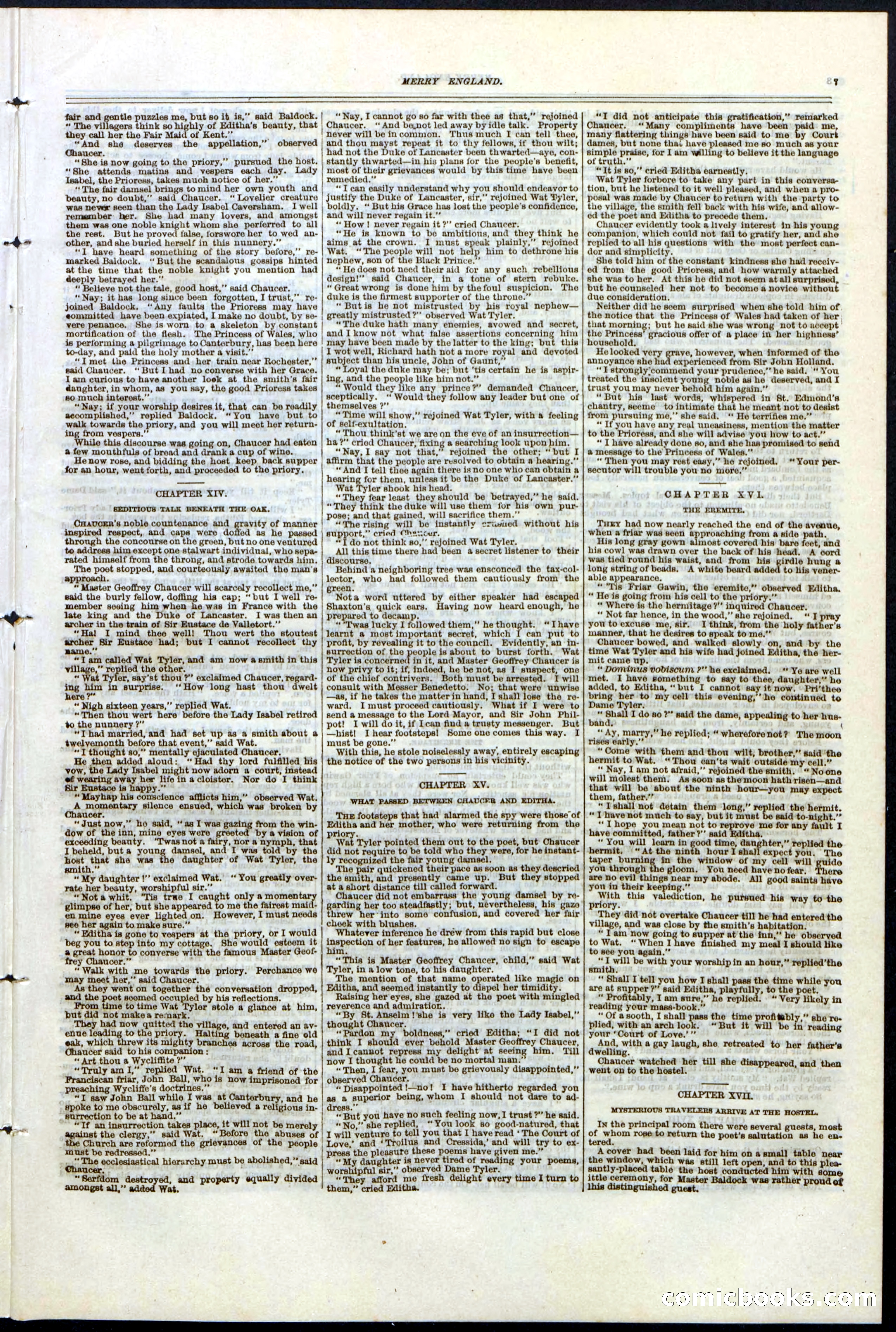
A restored page from Pulp Fiction, 1881. Page through the whole issue in the reader above.
📄 Transcribed text from this page (OCR, searchable)
Machine-transcribed from the original scan — historical spelling and the odd misread are preserved.
_ spoke to me obscurely, as if he believed a rel _ §urrection to be at hand.” MERRY ENGLAND. fair and tle puzzles me, but so it is,” said Baldock. “ The villagers think so highly of Editha’s beanty, that they call her the Fair Maid of Kent.” “And she deserves the appellation,” observed Chaucer. “She is now going to the priory,” pursued the host. “She attends mating and vespers each day. Lady Isabel, the Prioress, takes muoh notice of her.” "The fair damsel brings tomind her own youth and beauty, no doubt,”’ said Chaucer. “ Loyelier creature was never seen than the Lady Isabel Caversham. I well remember her. She had many lovers, and amongst them was one noble knight whom she perferred to all the rest. But he aaa false, forswore her to wed an- other, and she buried herself in this nunnery.” “Il have heard something of the story before,’’ re- marked Baldock. “But the scandalous gossips hinted at the time that the noble knight you mention had deeply betrayed her.” * Believe not the tale, good host,’’ said Chaucer. ‘Nay; it has long since been forgotten, I trust,’’ re- joined Baldock, ‘Any faults the Prioress may have eommmitted have been expiated, I make no doubt, by se- vere penance. She is worn to a skeleton by constant mortification of the flesh. The Princess of Wales, who is performing 4 pilgrimage to Canterbury, has been here to-day, and paid the holy mother a visit.” “I met the Princess and her train near Rochester,” said Chaucer. ‘“ But Il had no converse with her Grace. I am curious to have another loek at the smith’s fair danghter, in whom, as you say, the good Prioress takes #0 much intereat.”’ “Nay; if your worship desires it, that can be readily accomplished,’”’ replied Baldock. “You have but to walk towards the priory, and you will meet her return- ing from vespers.”’ this discourse was going on, Chaucer had eaten a few mouthfuls of bread and drank a cup of wine. He now rose, and bidding the host keep back supper for an hour, went forth, and proceeded to the priory. CHAPTER XIV. SEDITIOUS TALK BENEATH THE OAK. Cravorer’s noble countenance and vity of manner inspired respect, and caps were doffed as he through the concourse on the green, but no one ventured to address him except one stalwart individual, who sepa- rated himself from the throng, and strode towards him. The poet stopped, and courteously awaited the man's Pastas Geoffrey Chaucer will scarcely recollect me,” gaid the burly fellow, doffing his cap; “but I well re- member seeing him when he was in France with the late king and the Duke of Lancaster. I was then an archer in the train of Sir Eustace de Valletort.”’ “Hal I mind thee well! Thou wert the stoutest archer Sir Eustace had; but I cannot recollect thy mame.” “Tam called Wat er, and am now a smith in this wee "replied the other. oe 1 e , say’st thou ?” exclaimed Chaucer, regard- ing him surprise. ‘‘How long hast thou dwelt here 7” ' “ Nigh sixteen years,”’ replied Wat. “Then thou wert here before the Lady Isabel retired to the nunnery ?” “T had married, and had set up as a smith about a _twelyemonth before that event,’ said Wat. “I thought so,” mentally ejaculated Chaucer. He then added aloud: “Had thy lord fulfilled his vow, the Lady Isabel might now adorn a court, instead poeta ew Si her life in a cloister. Nor do I think “Mayhap his conscience afflicts him,” observed Wat. A momentary silence ensued, which was broken by Chaucer. “Just now,” ho said, “as I was from the win- dow of the inn, mine eyes were sot by 4 vision of exceeding beauty. "Twas nota , nor a nymph, that 8 I beheld, but a young. dansel, and I was told by th host that she was the daughter of Wat Tyler, the “ My daughter !’’ exclaimed Wat. “ You greatly over- rate her beauty, worshipful sir.” “Notawhit. “Tis trae I cag only giet engin? glimpse of her, but she red pel mé the fairest maid- en mine eyes ever lighted on. However, I must needs pee her to make sure.” “ Editha is gone to vespers at the priory, or I would beg you to step into my cottage. She would esteem it @ great honor to converse with the famous Master Geof- frey Chaucer.” ’ “Walk with me towards the priory. Perchance we may meet her,” said Chaucer. As they went on together the conversation dropped, and the Pony ietines sooumied by his reflections. “ay? time to time er stole a glance a m, but di Bez fose vadel eB gl They now qu 6, and entered an av- aor as to she Uri ’ ape beneath a fine old , whic w ghty branches across the road, Ohaucer said to his companion : “ Art thou a Wycliffite ?” “Truly am I,” replied Wat. “I am a friend of the Franciscan friar, John Ball, whois now imprisoned for Wycliffe’s doctrines.” “I saw John Ball while I was at Canterbury, and he ous in- “Tf an insurrection takes place, it will not be merely t the clergy,” said Wat, “Before the abuses of Church are reformed the grievances of the people must be redressed.”” _ "The ecclesiastical hierarchy must be abolished,” said “ Serfdom 6d, and property equally dividea amongst all,” addod Wes. Fy “Nay, I cannot go so far with thee as that,” rejoined Chaucer. “And benot led away byidle talk. Property never will be incommon. Thus much I can tell thee, and thou mayst repeat it to thy fellows, if thou wilt; had not the Duke of Lancaster been thwarted—aye, con- stantly thwarted—in his plans for the people's benefit, most of their grievances would by this time have been remedied,” “IT can easily understand why you should endeavor to justify the Duke of Lancaster, sir,” rejoined Wat Pyler, boldly. “ But his Grace has lost the people's confidence, and will never regain it.” ‘How ! never regain it ?’”’ cried Chaucer. “He is known to be ambitions, and they think he aims at the crown. I must speak plainly,” rejoined Wat. “The people will not help him to dethrone his nephew, son of the Black Prince.” “ He does not need their aid for any such rebellious design!"” said Chaucer, in a tone of stern rebuke. “Great wrong is done him by thefoul suspicion. The duke is the firmest supporter of the throne.” “Butis he not mistrusted by his royal nephew— greatly mistrusted ?”’ observed Wat Tyler. “The duke hath many enemies, avowed and secret, and I know not what talse assertions concerning him may have been made by the latter to the king; but this I wot well, Richard hath not a more royal and devoted subject than his uncle, John of Gaunt,” “ Loyal the duke may be; but ‘tis certain he is aspir- ing, and the people like him not.” ‘Would they like any prince?” demanded Chaucer, sceptically. ‘* Would they follow any leader but one of themselves ?’’ “Time will show,” rejoined Wat Tyler, with & feeling of self-exultation. “Thou think’st we are on the eve of an insurrection— ha?” cried Chaucer, fixing a searching look upon him. “Nay, I say not that,” rejoined the other; “but I affirm that the people are resolved to obtain a hearing.” “And I tell thee again there is no one who can obtain a hearing for them, unless it be the Duke of Lancaster.” Wat Tyler shook his head. “They fear least they should be betrayed,” he said. “They think the duke will use them for his own pur- pose; and that gained, will sacrifice them.” “The rising will be instantly cruvued without his support,” cried Chexcur. “I do not think so,”’ rejoined Wat Tyler. All this time there had been a secret listener to their discourse, Behind a neighboring tree was ensconced the tax-col- lector, who had followed them cautiously from the green. Nota word uttered by either speaker had escaped Shaxton’s quick ears. Having now heard enough, he prepared to decamp. a as lucky I followed them,” he thought. “Ihave learnt a most important secret, which I can put to profit, by revealing it to the council. Evidently, an in- surrection of the ple is about to burst forth. Wat Tyler is concerned in it, and Master Geoffrey Chaucer is now privy to it; if, indeed, he be not, as I suspect, one of the chief contrivers. Both must be arrested. T will consult with Messer Benedetto. No; that were unwise —as, if he takes the matterin hand, I shall lose the re- ward. I must proceed cautiously. What if I were to send a message to the Lord Mayor, and Sir John Phil- pot! I will do it, if Lcan find a trusty messenger. But —hist! I hear footsteps! Some one comes this way. I must be gone.” £ With this, he stole noiselessly away, entirely escaping the notice of the two persons in his vicinity. CHAPTER XV. WHAT PASSED BETWEEN CHAUCKB AND EDITHA. THE footateps that had alarmed the spy were those of Editha and her mother, who were returning from the riory. » Wat Tyler pointed them out to the poet, but Chaucer did not require to be told who they were, for he instant- ly recognized the fair young damsel. os Meaitn: Ged’ pepe ty Gate Nip BU tive wediyed th, an y came up. ey stop at a short distance till called forward. Chaucer did not embarrass the young ing her too steadfastly; but, nevert hrew Akar ‘into some confusion, and covered her fair cheek with blushes. _ . Whatever inference he drew from this rapid but close a pm of her features, he allowed no sign to escape “This is Master Geoffrey Chaucer, child,” said Wat Tyler, in a low tone, to his daughter. The mention of that name operated like magic on Fdlitha, and seemed instantly to dispel her timidity. Raising her eyes, she gazed at the poet with mingled reverence and admiratior. “By St. Anselm !she is very like the Lady Isabel,” thought Chaucer. “Pardon my boldness,” cried Editha; “I did not think I should ever behold Master Geoffrey Chaucer, and I cannot repress my delight at seeing him. Till now I thought he could be no mortal faber” “Then, I fear, you must be grievously disappointed,” observed Chaucer. “ Disappointed !—no! I have hitherto ed you as a superior being, whom I should not to ad- “But you have no such feeling now, 1 trust ?” he said. “No,” she replied, “You look so good-natured, that I will venture to tell you that I have read ‘ The Court of Love,’ and ‘Troilus and Cressida,’ and will try to ex- the pleasute these poems have given me.” “My daughter is never tired of your poems, rshipful sir,” observed e Tyler. wy They ms me fresh ht every time I turn to them,” cried Editha. damsel by re- eless, his gazo “TI did not anticipate this gratification,” remarked Chaucer. “Many compliments have been d me many flattering things have been said to me by Cov dames, but none tha. have pleased me so much as your ae te for lam willing to believe it the language of truth.” “It is so,” cried Editha earnestly. Wat Tyler forbore to take any part in thie conversa- tion, but he listened to it well pleased, and when a pro- posal was made by Chaucer toreturn with the party to the village, the amith fell back with his wife, and allow- ed the poet and Editha to precede them. Chaucer evidently took a lively interest in his young companion, which could not fail to gratify her, and she replied to all his questions with the most perfect can- dor and simplicity. - She told him of the constant kindness she had receiv- ed from the good Priorees, and how warmly attached she was to her. At this he did not seem at all surprised, but he counseled her not to become a novice without due consideration. Neither did he seem surprised when she told him of the notice that the Princess of Wales had taken of her that morning ; but he said she was wrong not to accept’ the Princess’ gracious offer of a place in her highness’ household, He looked very grave, however, when informed of the annoyance she had experienced from Sir John Holland. “IT strongly'’commend your prudence,” he said. ‘You treated the insolent young noble aé he deserved, and I trust you may never behold him again.” “But his last words, whispered in St. Edmond’s chantry, seeme to intimate that he meant not to desist from pursuing me,” she said. “ He terrifies me.” * “ If you have any real uneasiness, mention the matter to the Prioress, and she will advise you how to act.” — “ T have already done so, and she has promised to send & message to the Princess of Wales.” “ Then you may rest easy,” he rejoined. “Your per- secutor will trouble you no more,” CHAPTER XVL THE EREMITE. Tey had now nearly reached the end of the avenue, when a friar was seen approaching from a side path. His long gray gown almost covered his bare feet, and his cowl was drawn over the back of his ‘head. A cord was tied round his waist, and from his girdle hung a long string of beads. A white beard ad to his vener- able appearance. “ "Tis Friar Gawin, the eremite,” observed Editha. “ He is going from his cell to the priory.” ; “ Where is the hermitage ?”’ inquired Chaucer. “ Not far hence, in the wood,” she rejoined. “I pray you to excuse me, sir. I think, from the holy father's manner, that he desires to speak to me.” Chaucer bowed, and walked slowly on, and by the time Wat Tyler and his wife had joined Editha, the her- mit came up. : * Dominus vodbiscum ?"' he exclaimed. “ Ye are well met. I have something to say to thee, daughter,” he alded, to Edlitha, “but I cannot say it now. Pri’thee re her to my cell this evening,’’he continued to ame or. . ; —e I do 80 ?” said the dame, appealing to her hus- bf { “Ay, m »” he replied; “ wherefore not ? ) vail." p The moon “Come with them and thou wilt, brother,” said'the hermit to Wat. “Thou can’'ts wait outside my cell.” * Nay, I am not afraid,” rejoined the smith. “Noone Chat wih be sbowd the uiatl hens yo a en u e our—you t them, father.’’ aa ; ty gods “Tshall not detain them long,” ed the hermit. ont — not much to my, er it must be said to-night.” *“Thope you mean no 6 me for any fault I Re oe “ You earn e, ter,” replied the hermit. “At the nin boat Xatall expeck your The taper burning in the window of my cell will de you through gloom. You need have no fear, are no evil things near my abode. All good saints have you in their roaeaee a this y ction, he putened his way to the priory. They did not overtake Chaucer till he had entered the e, and was close by the smith’s habitation. “Tam now going to ap ae at the inn,” he observed a Wat. “ When I have hed my meal I should like see you ? Ps. will be with your worship in an hour,” replied’the th. * Shall I tell you how I shall pass the time while you are at sup P paid Editha, playfully, to the poet. os “ Profitably, I am sure,” he replied. “Very likely in ve Of asooth, T aball poss the. tm “Of a sooth, e time profitably,” she re- “But it will Se th reading plied, with an arch look. your ‘Court of Love.’”’ And, with a gay laugh, she retreated to her father’s ee aucer watched her till she disappeared then went on to the hostel. noe CHAPTER XVII. MYSTERIOUS TRAVELERS ARRIVE AT THE HOSTEL. Ix the principal room there were several guests, most of whom rose to return the poet’s salutation as he en- A cover had been laid for him on a small table near the window, which was still left open, and to this plea- santly-placed table the host conducted him with some ittle ceremony, for Master Baldock was rather prou 0)(0)©) Go (C <S (c(©)