
Pulp Fiction, 1881 · page 4 of 32
Beadle's New York Dime Library No. 125 — page 4: what you’re looking at
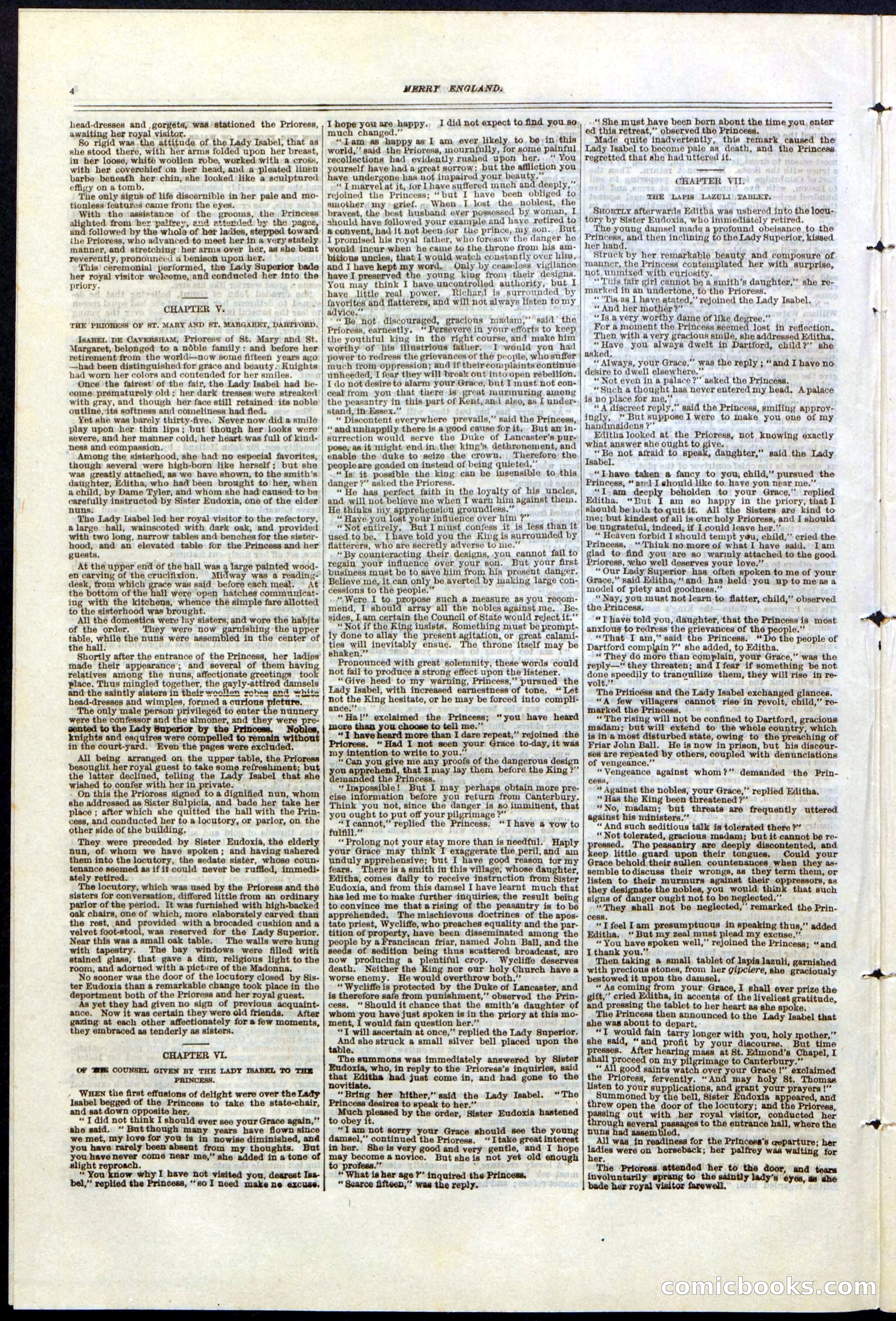
A restored page from Pulp Fiction, 1881. Page through the whole issue in the reader above.
📄 Transcribed text from this page (OCR, searchable)
Machine-transcribed from the original scan — historical spelling and the odd misread are preserved.
head-dresses and ,go awaiting her royal visitor. ale So rigid was the attitude of the Lady Isabel, that as she stood there, with her arms folded upon her breast, in her loose, white woollen robe, worked with a cross, with her coverchief om her head, and a pleated linen barbe beneath her chin, she looked like a sculptured effigy on a tomb. The only signs of life discernible in her pale and mo- tionless features came from the eyes. With the ‘assistance of the grooms, the Princess alighted from ‘her "palfrey, and attended by the pages und followed by the whole of her ladies, stepped tow the Prioress, who advanced to meet her in a very stately manner, and stretching her arms over her, as she bent reverently, pronounced a benison upon her. This ceremonial formed, the Lady Su her royal visitor welcome, and conducted her into the priory. ° éta, waa stationed the Prioress, CHAPTER YV. THE PRIORESS OF ST. MARY AND ST. MARGARET, DARTYORD, ISABEL DE CavEersHAM, Prioress of St. Mary and St. Margaret, belonged to a ndéble family: and before her retirement from the world—now some fifteen years ago —had been distinguished for grace and beauty. Knights had worn her colors and contended for her smiles. Once the fairest of the fair, the Lady Isabel had be- come prematurely old; her dark tresses were streaked with gray, and though her face still retained its noble outline, its softness and comeliness had fled. Yet she was barely thirty-five. Never now did a smile play upon her thin lips; but though her looks were severe, and her manner cold, her heart was full of kind- ness and compassion. Among the sisterhood, she bad no especial favorites, though several were high-born like herself; but she was greatly attached, as we have shown, to the smith's daughter, Editha, who had been brought to her, when a child, by Dame to ew and whom she had caused to be caretully instructed by Sister Eudoxia, one of the elder nuns. The Lady Isabel led her royal visitor to the refectory, a large , wainscoted with dark oak, and provided with two long, narrow tables and benches for the sister- hood, and an elevated table for the Princess and her guests. At the upper end of the hall was a large painted wood- en carving of the crucifixion. Midway was a readiny- desk, from which e was said before each meal. ~ At the bottom of the were open hatches communicat- he the kitchens, whence the simple fare allotted to the sisterhood was brought. All the domestics were lay sisters, and wore the habits of the order. ‘They were now garnishing the upper table, while the nuns were assembled in the center of the hall. Shortly after the entrance of the Princess, her ladies made their appearance; and several of them Na | relatives among the nuns, affectionate greetings too place. Thus mingled together, the gayly-sttired damsels and the saintly sisters in their weollen rohes and white head-dresses and wimples, formed a curious picture. The only male person privileged to enter nunnery were et payer and the Or ee and they were pre- fy irom sidullen tere eherpalied te rocaeid in Gouik add: Even the pages were excluded. All ed on the upper table, the Prioress refreshment; bu ll being arrang besonagtth her royal guest to take som t the latter decli y Isabel that she ned, telling the wished to confer with her in private. his the Prioress signed toa dignified nun, whom she addressed as Sister Sulpicia, and bade her take her place ; after which she quitted the hall with the Prin- cess, and conducted her to a locutory, or parlor, on the other side of the building, They were preceded by Sister Eudoxia, the elderly nun, of whom we have spoken; and having ushered them into the locutory, the sedate sister, whose coun- tenance seemed as ifit could never be ruffled, immedi- ately retired. The locutory, which was used by the Prioress and thé sisters for conversation, differed little from an ordinary parlor of the period. It was furnished with high-backed oak chairs, one of which, more elaborately carved than the rest, and vided with a brocaded cushion and a velvet foot-stool, was reserved for the Lady Superior. Near this was 4 small oak table. The walls were hung with tapestry. The bay windows were filled with stained glass, that gave a dim, religious light to the room, adorned with a picture of the Madonna. No sooner was the door of the locutory closed by Sis- ter Eudoxia than a remarkable change took place in the deportment both of the Prioress and her royal guest. As yet they had given no sign of previous acquaint- ance. Now it was certain they were old friends. After gazing at each other affectionately for a few moments, they embraced as tenderly as sisters. CHAPTER VIL. PRINCESS. - Wen the first effusions of delight were over the Lady Isabel begged of the Princess to take the state-chair, and sat down opposite her. “ I did not think I should ever see your Grace again,” she said. “ Butthough many years have flown since we met, my love for you is in nowise diminished, and you have rarely been absent from my thoughts. But Ferree muted come near me,”’ she added in a tone of g. * * You know why I have not visited you, dearest Isa- bel,” replied the Princess, ‘‘e0 I need make ne excuse. . een HERRY ENGUAND, ee ._—-— I hope you are happy. I did not expect to find you. so much changed.” Lamas happy as L am ever, likely, to. bein this world,” said the Prioress, mournfully, for some painful recollections had evidently rushed upon her. ‘‘ You ourself haye had a great sorrow; but the aflliction you ve undergone has not impaired your beauty. “ J marvel at it, jor Lhave suffered much and deeply,” rejoined the Princess; “but I have been obliged to smother, my grief. «When .I lost the noblest, the bravest, the best husband ever possessed by woman, I should have followed your example and haye retired to a convent, had it not been,tor the prince, my son. But I promised his royal father, who foresaw the danger he would incur when he came to the throne from his am- bitious uncles, that I would watch constantly over him, bade | and I have kept ay word. Only by ceaseless vigilance t have I preserved the young king from their designs. You may think I have uncontrolled authority, but. 1 have little real power, Richard is surrounded by favorites and flatterers, and will not always listen tomy advice,” ’“ Be not. discouraged, gracious madam,” said’ the Prioress, earnestly. ‘ Persevere in your efforts to keep the youthful king in the right course, and make him worthy of his illustrious father. I would you had power to redress the grievances of the people, who suffer much from oppression; and if theircom plaints continue unheeded, I fear they will break ont into open rebellion. I do not desire to alarm your Grace, but T must not con- ceal from you that there is great murmuring among the peasantry in this part of Kent, an also, as I under- stand, in Essex.” “ Discontent everywhere prevails,” said the Princess, “and unhappily there is a good cause for it, But an in- surrection would serve the Duke of Lancaster's pur- pose, as it might end in. the king's dethronement, and enable the duke to seize the crown. Therefore the people are goaded on instead of being quieted,’’ ** Is! it ble the king can be insensible to this danger ?”’ asked the Prioress. “He has perfect faith in the loyalty of his uncles, and. will not. belieye me when I warn him against them. He thinks my apprehension groundless.” “ Haye you lost your influence oyer him ?” “Not entirely, But I must confess it is less than it used. to be.’ I have told you the King is surrounded by flatterers, who are secretly adverse to me.” “ By counteracting their, designs, .you_eannot fail to regain your influence over your son. But your first business must be to save him from his present danyer. Believe mé, it. can only be averted by making large con- cessions to the people.” “Were I to prove such @ measure as you recom- mend, I should array all the nobles against me. Be- sides, Lam certain the Council of State would reject it.”’ “Not if the King insists, Something must be prompt- ly done to allay the present gree or great calami- ties will inevitably ensue. e throne itself may be shaken.” Pronounced with great solemnity, these words could not fail to produce a strong effect upon the listener. “Give heed to my warning, Princess,” pursued the Lady Isabel, with increased earnestness of tone. “ Let not the King hesitate, or he may be forced into compli- ance.”’ * Hal’ exclaimed the Princess; “you have heard more than you choose to tell me.”’ “T have more than I dare repeat,” rejoined the Prioress. “Had I not seen your Grace to-day, it was my reget write to FORss Jara 4 e ou give me any proofs of the dangerous des ou & ~ I may lay them before the King ?”’ the Princess. _ “Impossible! But I may perhaps obtain more pre- cise ietarpiaton before you return from Canterbury, Think you not, since the danger is 80 imminent, that you ought to put off your pilgrimage ?” “ ere replied the neess. “I have a yow to “Prolong not your stay more than is needful. Haply your Grace may think I exaggerate the peril, and am unduly apprehensive; but I have good reason tor my fears. There is a smith in this village, whose daughter, Editha, comes daily to receive instrnction from Sister Eudoxia, and from this damsel I have learnt much that has led me to make further inquiries, the result being to convince me thatarising of the peasantry is to be app . The mischievous doctrines of the apos- tate priest, Wycliffe, who preaches equality and the par- tition of pro , have been disseminated among the people by a ciscan friar, named John Ball, and the } as of sedition being thus scattered broadcast, aro now producing a Sree cones crop. Wycliffe deserves death. Neither the King nor our holy Church have a worse enemy. He would overthrow both,” “ Wycliffe wet tomtom by the Duke of Lancaster, and is therefore safe from punishment,” observed the Prin- cess. “Should it chance that the smith’s daughter of whom have just spoken is in the priory at this mo- ment, I would fain question her.” “I will ascertain at once," replied the Lady Superior. on she struck a small silver bell placed upon the e. The summons was immediately answered by Sister Eudoxia, who, in reply to the Prioress’s inquiries, said that Editha had just come in, and had gone to the “Bring her hither,” said the Lady Isabel. “The Princess desires to to her.”’ ; Much — by order, Sister Eudoxia hastened to obey it. “Iam not sorry your Grace should see the youn ,” continued the Prioress. “Itake great interest in her. She is v good and very may become & no - Butsheis not yet old enough to profess.” * What is her age ?’’ inquired the Princesa, “ Searce fifteen,” was the reply. ‘She must have been bern abont the time you, enter ed this retreat,”” observed the CBS, Made quite inadvertently, this remark caused the Lady Isabel to become pale as death, and the Princess regretted that ahe had uttered it. CHAPTER VII. THE LAPIS LAZULI .TABLET, SuHortyy afterwards Editha was ushered into the locu- tory by Sister Eudoxia, who immediately retired. The young damsel made a profound obeisance to the Princess, and then inclining to the Lady Superior, kissed her hand, Struck by her remarkable act manner, the Princess contemplate not unmixed with curiosity. “ Tils fair girl cannot be a smith’s daughter,” she re- marked in an undertone, to’the Prioress. “Tis as I have stated,’’ rejoined the Lady Isabel. “ And her mother?” “Tg avery worthy dame of like deyree.” For a moment the Princess seemed lost in reflection. Then with a very gracious smile, she addressed Editha, wae you always dwelt in Dartford, child?’ she asked, ‘* Always, your Grace,”’ was the reply ; “and I have no desire to dwell elsewhere.” “ Not even in a palace?’ asked the Princess. “Such a thought has never entered my head, A palace is no place for me,” , “ A discreet reply,” said the Princess, smiling approy- ingly, ‘ But suppose I were to Make you one of my handinaidens ?’’ Editha looked at the Prioress, not knowing exactly what answer she ought to give. Hh ie not airaid to s , daughter,” said the Lady el. “Lhave taken a fancy to you, child,” pursued the Princess, “ and I should like to. have you near me.” “I. am onhy beholden to your Grace,” replied Editha. “But am so happy in the priory, that I should be luth to quit it. All the Sisters are kind to me; but kindest of all is our holy Prioress, and I should be ungrateful, indeed, if I could leave her.” “* Heaven forbid I should tempt yéu, ehild,’’ cried the Princess, “Think no more of what I have said. Iam glad to find you are so warmly attached to the good Prioress, who well deserves your love.’”’ “Our Lady Superior has often spoken to me of your Grace,” said Editha, ‘sand has held: you up to meas a model of piety and goodness.” “ Nay, you must not learn to flatter, child,” observed the Princess. “T have told you, daughter, that the Princess is most anxious to redress the grievances of the people.” “That I am,” said the Princess. “Do the people of Dartford complain ?” she added, to Editha. “ They do more than complain, your Grace,” was the reply—“ they threaten; and I fear if something be not pe speedily to traneuilize them, they will rise in re- volt.’* . The Priricéss and the Lady Isabel exchanged glances. “A few villagers cannot rise in revolt, child,” re- marked the Princess. “The rising will not be confined to Dartford, gracious madam; but will extend to the whole country, which is in a most disturbed state, owing to the ing of Friar John Ball. He is now in prison, but his discour- ses are repeated by others, coupled with denunciations of vengeance.”’ “Vengeance against whom?’ demanded the Prin- cers, “ Against the nobles, your Grace,” replied Editha. “Has the King been threatened ?” “No, madam; but threats are frequently uttered against his ministers.’’ “ And such seditious talk is tolerated there ?” “ Not tolerated, gracious madam; but it cannot be re- ressed. The peasantry are deeply discontented, and eep little anew upon their tongues, Could your Grace behold their sullen countenances when they as- semble todiscuss their wrongs, as they term them, or listen to their murmurs against their oppressors, as they fepignete the neplet, ou would that such signs of danger omens not to be neglected,” “They shall not be neglected,” remarked the Prin- 88. “TI feelIlam presumptuous in speaking thus,” added Editha. ‘ But my zeal must meee = excnse,”’ n and composure of her with surprise, ce gentle, and I hope | ladi “ You have spoken well,’’ rejo I chan you.” 6 Princess; “and a amall tablet of lapis lazuli, en garnished with precious stones, from her gipciere, she graciously bestowed it upon the damsel, “ As co gift,’ cried Editha, in accents of she was about to depart, “TI would fain tarry longer with you, she said, presses. bare? Bane on my p good saints watch over your the Prioress, fervently. Summoned by the bell, from your Grace, “and profit by your discourse. After h mass at St. Edmond’s e to Canterbury. Kad ay Bol Ba Thomas - may . Thomas listen to your supplications, and grant your pra t Sister fadoxia foake threw open the door of the locutory; and out with her royal visitor, conducted her I shall ever prize the the liveliest and pressing the tablet to her heart as she g The Princess then announced to the Lad eect @. po y Isabel that other,’’ ne time Chapel, I ers ae d, and 6 Prioreas, seat cant ges to the entrance hall, where the i Manbon Pra nuns ° All was in readiness for the Princess's aeparture: es were on horseback; her palfrey was waiting a er. The Prioress attended her to the door, and involuntarily sprang bade her royal visitor farewell, to the saintly lady’s (E(0) (C JOO ’ eyes, as ah he 2 cs (E(0)