
Pulp Fiction, 1881 · page 3 of 32
Beadle's New York Dime Library No. 125 — page 3: what you’re looking at
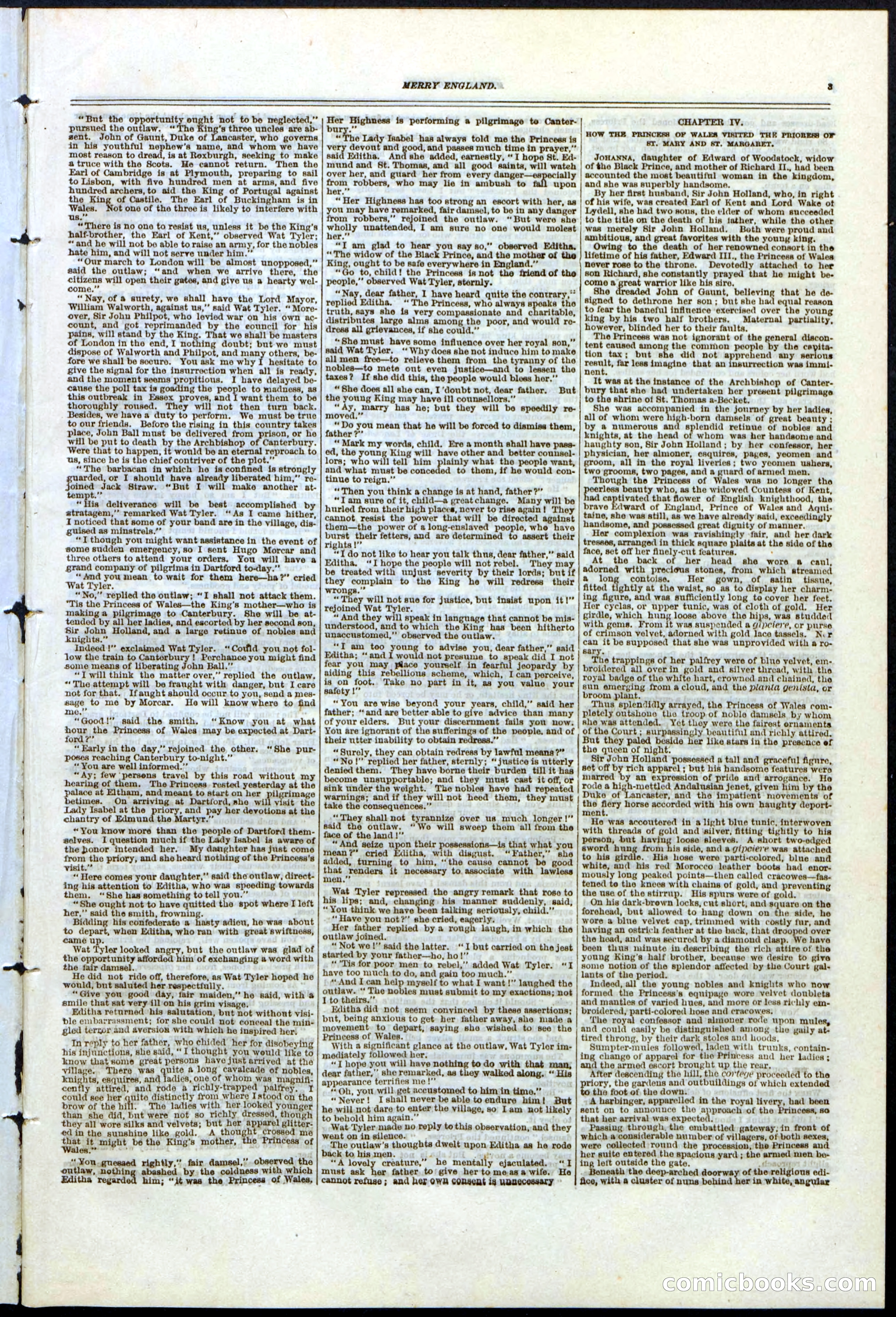
A restored page from Pulp Fiction, 1881. Page through the whole issue in the reader above.
📄 Transcribed text from this page (OCR, searchable)
Machine-transcribed from the original scan — historical spelling and the odd misread are preserved.
MERRY ENGLAND. . “But the it pb sar igh not to be meglected,” pursued the outlaw. “The Si Beeehe uncles are ab- sent. John of Gaunt, Duke of caster, who governs in his youthful nephew’s name, and whom we have most reason to dread, is at Roxburgh, seeking to make a truce with the Scots. Me cannot return. Then the Earl of Cambridge is at Plymouth, preparing to sail to Lisbon, with five hundred men at arms, and five hundred archers, to aid the King of Portugal against the King of Castile. The Earl of Buckingham is in Wales. Not one of the three is likely to interfere with us.” “There is no one to resist us, unless it be the King’s half-brother, the Earl of Kent,” observed Wat Tyler; “‘and he will not be able to raise an army, for the nobles hate him, and will not serve under him.” “Our march to London will be almost unopposed,” aaid the outlaw; “and when we arrive there, the citizens will open their gates, and give us a hearty wel- come.” “Nay, of a surety, we shall have the Lord Mayor, William Walworth, against us,” said Wat Tyler. “ More- over, Sir John Philpot, who levied war on his own ac- count, and got reprimanded by the eouncil for his pains, will stand by the King. That wo shall be masters of London in the end, I no ing doubt; but we must dispose of Walworth and Philpot, and many others, be- fore we shall be secure. You ask mo why I hesitate to give the signal for the insurrection when all is ready, and the moment seems propitious. I have delayed be- cause the poll tax is goading the apg 2 to madness, as this outbreak in Essex proves, and I want them to be thoroughly roused. They will not then turn back. Besides, we have a duty to perform. We must be true to our friends. Before the rising in this country takes place, John Ball must be delivered from prison, or he will be put to death by the Archbishop of Canterbury. Were that to an Sipe it would be an eternal reproach to us, since he is the chief contriver of the plot.” “The barbacan in which he is confined is strongly arded, or I should have already liberated him,’’ re- oined Jack Straw. “But I will make another at- tempt.”’ “Mia deliverance will be best accomplished by atratagem,’’ remarked Wat Tyler. ‘As I came hither, I noticed that some of your band are in the village, dis- guised as minstrels.”’ “I though you might want assistance in the event of some sudden emergency, so I sent Hugo Morcar and three others to attend your orders. You will have a grand company of pilgrims in Dartford to-day.” “And you mean to wait for them here—ha?” cried Wat Tyler. “No,” replied the outlaw; “I shall not attack them. "Tis the Princess of Wales—the King’s mother—who is making a p age to Canterbu She will be at- tended by all her ladies, and escorted by her second son, pe sae Holland, and a large retinue of nobles and nights.” Indeed !” exclaimed Wat Tyler. ‘Covfld you not fol- low the train to Canterbury! Perchance you might find some means of liberating John Ball.” “T will think the matter over,” replied the outlaw. “The attempt will be fraught with danger, but I care not for that. Ifaught should occur to you, send a mes- sage to me by Morcar. He will know where to find me,” “Good!” said the smith. “Know you at what bom the Princess of Wales may be expected at Dart- ford?” “ Barly in the day,” rejoined the other. poses reaching Canterbury to-night.” “You are well informed.’’ “Ay; few ‘persons travel by this road without my hearing of them. The Princess rested yesterday at the alace at Eltham, and meant to start on her lgrimege times. On arriving at Dartford, she will visit the Lady Isabel at the bie , and pay her devotions at the chantry of Edmund the yr.’’ “You know more than the people of Dartford them- selves. I question much if the Lady Isabel is aware of the honor intended her. My danghter has just come from the priory, and she heard nothing of the Princess's visit.” “Here comes your daughter,” said the outlaw, direct- ing his attention to Editha, who was speeding towards them. “She has something to tell you.” “She Er not to have quitted the spot where I left her,”’ said the smith, vate oe - - bout y adieu, he was a “She pur- Bida his confederate a to de when Edlitha, who ran with great swiftness, came up. Wat Tyler looked angry, but the outlaw was glad of the o unity afforded of exchanging a word with the tair damsel. He did not ride off, therefore, as Wat Tyler hoped he would, but saluted her respectfully. “Give you good day, fair maiden,” he said, with a smile that sat 7 ill on his visage. Editha returned his salutation, but not withont visi- ble embarrassment; for she could not coneeal the min- giled terror and aversion with which he inspired her. In reply to her father, who chided her for disobeying his injunctions, she said, “I thought you would like to know that some great persons have just arrived at the village. There fe eae a ap PN cig of nobles, knights, esquires, an es, one of Whom was . cent nttived, and rode a richly-trapped alfrey. T cond see her quite distinctly from where I stood on the brow of the hill. The ladies with her looked younger than she did, but were not so richly dressed, though they all wore silks and velvets; but her payee glitter- ed in the sunshine like gold. A thought crossed me that it might be the King’s mother, the Princess of “¥ou.gnesaed rightly,”’ fair damsel,” observed the ou r Hothing ps vad by the coldness with which Editha regarded him; “it waa the Princess of Wales, repli said Wat Tyler. all men free—to relieve them from the tyranny of the nobles—to mete ont even justice—and to lessen the taxes? If she did this, the people would bless her.” wend Highness is performing a pilgrimage to Canter- uu * . he Lady Isabel has always told me the Princess is very devout and good, and passes much time in prayer,” said Editha. An mund and St. Thomas, and all good sainta, will wateh over her, and guard her from every danger from robbers, who may lie in ambush to she added, earnestly, “I hope St. Ed- jally upon her.” oy “Her Highness has too strong an escort with her, as you may have remarked, fair damsel, to bo in any danger from robbers,” rejoined the outlaw. “But were she ware, unattended, I am sure no one would molest =." “T am glad to hear you say so,” observed Editha, “The widow of the Black Prince, and the mother of the King, ought to be safe everywhere in England.” w to, child! the Princess is not the friend of the people,”’ observed Wat Tyler, sternly. “Nay, dear father, I have heard qnite the contrary,” Editha. “The Princess, who always 8 a the truth, says she is very compassionate and charitable, distributes large alms among the poor, and would re- dress all grievances, if she could.” “She must have some influence over her royal son,” “Why does she not induce him to make “Bhe does all she can, I ‘doubt not, dear father. But the young King may have ill counsellors.” “Ay, marry has he; but they will be speedily re- moved,” ander mean that he will be forced to dismiss them, er?” “Mark my words, child. Ere a month shall have pass- ed, the young King will have other and better counsel- lors; who will tell him plainly what the people want, and what muat be con to them, if he would con- tinue to reign.” “Then you think a change is at hand, father?” “Tam sure of it, child—a greatchange. Many will be hurled from their high places, never to rise again! They cannot resist the power that will be directed against them—the power of a long-enslaved pocgl®. who have burst their fetters, and are determined assert their rights!’ “I do not like to hear you talk thus, dear father,” said Editha, “I hope the people will not rebel. They ma be treated with unjust severity by their lords; but if they complain to the King he will redress their wrongs.” “They will not sue for justice, but insist upon it!” rejoined Wat Tyler. “ And they will speak in language that cannot be mis- understood, and to which the King has been hitherto unaccustomed,"’ observed the outlaw. “IT am too young to advise you, dear father,” said tgp “and I wou Anot- essyipe, fos poet I oe ear you may place you eopar aiding this rebellions scheme, which, I pak we eh is on foot. Take no part in it, as you value your safety |” “You are wise beyond your years, child,” said her father; ‘‘and are better able to give advice than many of your elders. But your t fails you now. You are ignorant of the sufferings of the people, and of their utter inability to obtain 5 ad “Surely, they can obtain redress by lawful means?” “No!” replied her father, sternly; “justice is utterly denied them. They have borne their burden till it has become unsupportable; and they must cast it off, or sink under the weight. The nobles have had repeated warnings; and if they will not heed them, they must take the consequences.” “They shall not tyrannize over us much longer!” said the outlaw. “We will sweep them all from the face of the land!" “And seize upon their ons—is that what you mean?” cried tha, with disgust. “Father,” she added, turning to him, ‘the cause cannot be good that renders it necessary to associate with lawless men,” Wat Tyler repressed the angry remark that rose to his lips; and, changing his manner suddenly, said, “You think we have been talking seriously, child.’ ‘‘ Have you not?” she cried, erly. Her father replied by a rough laugh, in which the outlaw joined. “ Not we !’’ said the latter. ‘I but carried on the jest started by your father—ho, ho!” “'Tis for poor men to rebel,’ added Wat Tyler. “I have too much to do, and gain too much.” “And I can help myself to what I want!" laughed the outlaw. “ The nobles must submit to my exactions; not 1 to theirs.” Editha did not seem convinced by these assertions; but, being anxious to get her father away, she made a movement to depart, saying she wished to see the Princess of Wales. With a significant glance at the outlaw, Wat Tyler im- mediately followed her, “TI hope you will have not todo with that dear father,” she remarked, as walked along. “ appearance terrifies me!" “Oh, you will get accustomed to him in time.’ “Never! Ishall never be able to endure him! But he will not dare to enter the village, so Lam not likely to behold him again.” aye Wat Tyler e no reply tothis observation, and they went on in silence. The outlaw’s thoughts dwelt upon Editha as he rode back to his men. ja a OME “A lovely creature,” he mentally ejaculated... “I must ask father to give her tomeasa wife. Hoe cannot refuse; and her owm consent ig unnecessary » His Es Lr CHAPTER IV. HOW THE PRINCESS OF WALES VIAITED THE PRIORESS oF ST. MARY AND S&T. MARGARET. JOHANNA, daughter of Edward of Woodstock, widow of the Black Prince, and mother of Richard Il., had been accounted the most beautiful woman in the kingdom, and she was superbly handsome. By her first husband, Sir John Holland, who, in right of hia wife, was created Earl of Kent and Lord Wake ot Lydell, she had two sons, the elder of whom succeeded to the title on the death of his tather, while the other was merely Sir John Holland, Beth were proud and ambitious, and great favorites with the young king. to the death of her renowned consort in the lifetime of his father, Edward III., the Princesa of Wales never rose tothe throne. Devotedly attached to her son Richard, she constantly prayed that he might be- come a t warrior like his sire. She ronded John of Gaunt, believing that he de- signed to dethrone her son; but she had equal reason to fear the baneful infinenice exercised over the young king by his two half brothers. Maternal partiality, however, blinded her to their faults. The Princess was not ignorant of the general discon- tent caused among the common le by the cepita- tion tax; but she did not a prenaud any ous cone far less imagine that an insurrection was immi- nen It was at the instance of the Archbishop of Canter- bt that she had undertaken her present pilgrimage to the shrine of St. Thomas a-Becket. She was pees, in the journey by her ladies, all of whom were high-born damsels of great beauty ; by @ numerous an a Ope retinue of nobles and knights, at the head of whom was her handsome and haughty son, Sir John Holland; by her confessor, her physician, her almoner, esquires, pages, yeomen and groom, all in the royal liveries; two yeomen ushers, two grooms, two pages, and a guard of armed men. Though the Princess of Wales was no longer tho rless beauty who, as the widowed Countess of Kent, ee that flower of English knighthood, the brave Edward of England, Prince of Wales and Aqni- taine, she was still, as we have already said, exceedingly handsome, and great dignity of manner. Her complexion was ravishingly fair, and her dark tresses, arranged in thick square plaits at the side of the face, set off her finely-cut features. . At the back of her head she wore a caul, adorned with precious stones, from which streamed a long contoise, Her gown, of satin tissue, fitted tightly at the waist, so as to display her charm- ing figure, and was sufficiently long to cover her feet. Her cyclas, or upper tunic, was of cloth of gold. Her girdle, which hung loose above the hips, was studded with goms. From it was suspended a gipciere, or purse of crimson velvet, adorned with gold lace tassels. Nir can it be supposed that she was unprovided with a ro- sar . The trappings of her palfrey were of bluo velvot, em- broidered all over in gold and silver thread, with the royal badge of the white hart, crowned and chainad, the sun emerging from a cloud, and the planta genista, or broom plant. Thus splendidly arrayed, the Princess of Wales com- pletely ontshone the troop of noble damsels by whom she was attended. Yet they were the fairest ornaments of the Court ; surpassingly beautiful and richly attired. But they paled beside her like stars in the presence ef the queen of night. Sir John Holland possessed a tall and graceful fignre, set off Mf ine apparel ; but his handsome features were marred by an expression of priile and arrogance. Hoe rode a high-mettled Andalusian jenet, given him by the Duke of caster, and the impatient movements of the tel! horse accorded with his own haughty deport- ment. He was accoutered in a light blue tunic, interwoven with threads of gold and \silver, fitting tightly to hia person, but hay loose sleeves. A short two-edged sword h from his side, and a gipeiere was attached to his . His hose were parti-colored, blue and white, and his red Morocco leather boots had enor- rector ye peaked A apa aon called cracowes—fas- tened to the knecs with chains of gold, and preventing the use of the cain} His spurs were of gold. On hig dark-brown locks, cut short, and square on the forehead, but allowed to hang down on the side, he wore a blue velvet cap, trimmed with costly fur, and having an ostrich feather at the back, that drooped over the head, and was securod by a diamond clasp. We have been thus minute in describing the rich attire of the young King’s half brother, because we desire to give sone notion of the splendor affected by the Court gal. lants of the period. : Indeed, all the young nobles and knights who now formed the Princess's equipaye wore velvet doublets and mantles of varied hues, and more or less richly em- broidered, parti-colored hose and cracowes, ‘The royal confessor and almoner rode upon mules, and could easily be distinguished among the yuily at- tired throng, by their dark stoles and hoods, Sumpter-muies followed, laden with trunks, contain- ing chango of apparel for the Princess and her ladies; and the armed escort brought up the rear, After descending the hill, the cortege proceeded to the ory, the gardens and outbuildings of which extended the foot of the down. A harbinger, apparelled in the royal livery, had been sent on to announce the approach of the apie 80 that her arrival was expected. Passing through. the embattled gateway; in front of which a considerable number of villagers, of both sexes, were collected round the procession, the Princess and her suite entered the spacions yard ; the armed men be- ing left outside the gate. hoary Honeath the deep-arched doorway of the religious edi- fice, with a cluster of nuns behind her in white, angular (EO) JOOKSHG (0)