
Pulp Fiction, 1881 · page 2 of 32
Beadle's New York Dime Library No. 125 — page 2: what you’re looking at
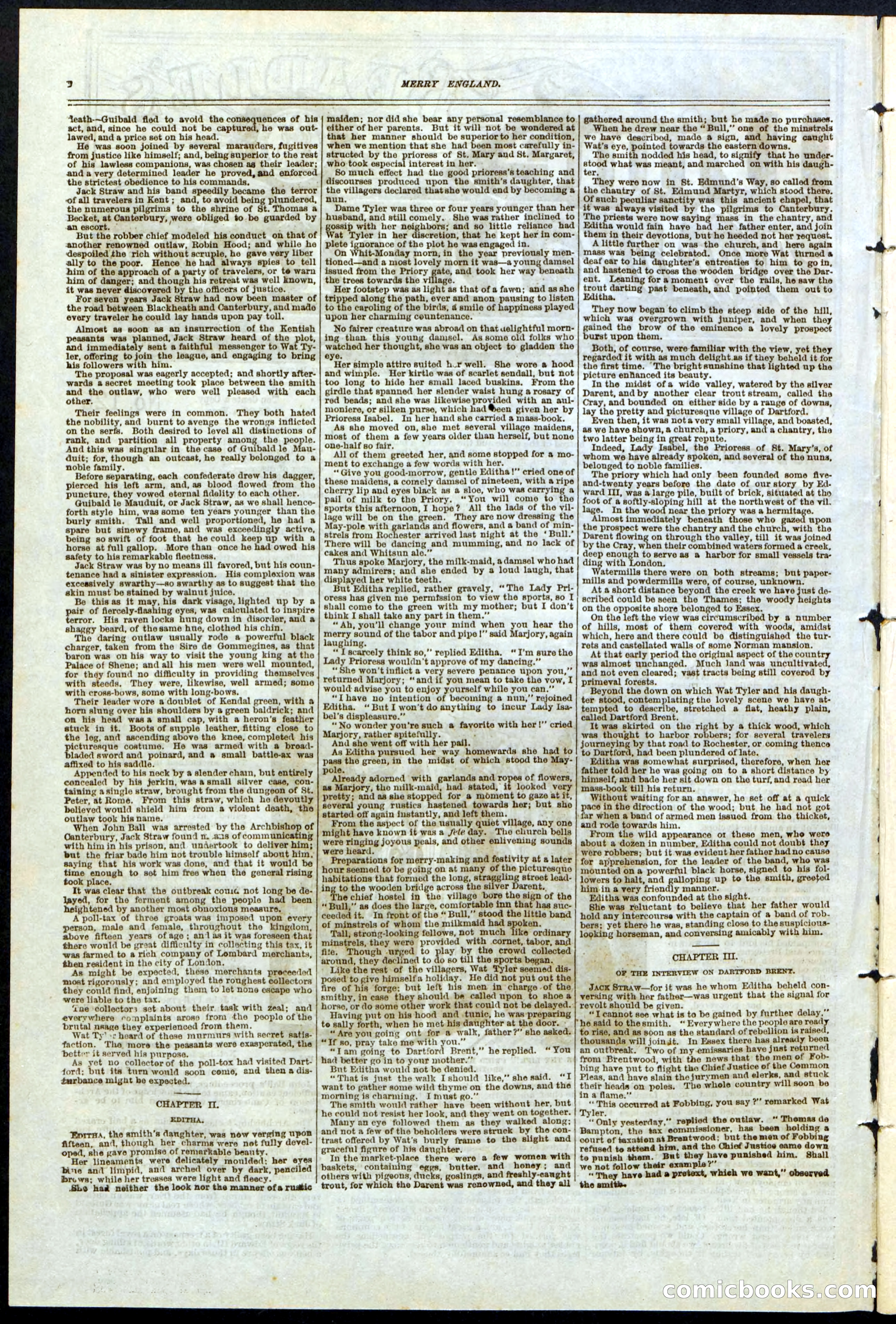
A restored page from Pulp Fiction, 1881. Page through the whole issue in the reader above.
📄 Transcribed text from this page (OCR, searchable)
Machine-transcribed from the original scan — historical spelling and the odd misread are preserved.
9 MERRY ENGLAND. eath-—Guibald fled to avoid the mences of his act, and, since he could not be capt he was out- lawed, and a price set on his head. He was soon joined by several marauders, fugitives from justice like himself; and, being superior to the rest of his lawless companions, was chosen ag their leader; anda very determined leader he proved,and enforced the strictest obedience to his commands, —— Jack Straw and his band speedily became the terror of all travelers in Kent; and, to avoid plundered, the numerous pilgrims to the shrine of St. Thomas a Becket, at Canterbury, were obliged to be guarded by But the robber chief modeled his conduct on that of ‘another ihe toh br pl Robin mot and meee despoiled the without scruple, he gave very ally to the poor. Hence he had always spies to tell him of the approach of a party of travelers, or te warn him of ; and though his retreat was well known, it was never discovered by the officers of justice. For seven years Jack Straw had now been master of the road between Blackheath and Canterbury, and made every traveler he could lay hands upon pay toll. Almost as soon as an insurrection of the Kentish peasants was planned, Jack Straw heard of the Pet and immediately sent a faithful messenger to Wa - ler, offering to join the league, and engaging to bring his followers with him. The proposal was eagerly accepted; and shortly after- wards asecret meeting took place between the smith and the outlaw, who were well pleased with each other. Their feelings were in common. They both hated the nobility, and burnt to avenge the wrongs inflicted on the serfs. Both desired to level all distinctions of rank, and partition all property eng the people. And this was singular in the case of Guibald le - duit; for, though an outcast, he really belonged to a noble family. Before separating, each confederate drew his dagger, pierced his left arm, and, as blood flowed from the puncture, they vowed eternal fidelity to each other. Guibald le Mauduit, or Jack Straw, as we shall hence- forth style him, was some ten years younger than the burly smith. Tall and well proportioned, he had a spare but sinewy frame, and was exceedingly active, being so swift of foot that he could keep up with a horse at full gallop. More than once he had owed his safety to his remarkable fleetness. Jack Straw was by no means ill favored, but his coun- tenance had a sinister expression. His complexion was excessively swarthy—so swarthy as to suggest that the skin must be stained by walnut juice. Be this as it an his dark visage, lighted up by a r of flercely-flashing eyes, was calculated to inspire r. His raven locks hung down in disorder, and a shaggy beard, of the same hue, clothed his chin. The daring outlaw usually rode a powerful black charger, taken from the Sire de Gommegines, as that baron was on his way to visit the young king at the Palace of Shene; and all his men were well mounted, for thay found no difficulty in providing themselves with eds, They were, likewise, well armed; some with cross-bows, some with long-bows. Their leader wore a doublet of Kendal green, with a horn slung over his shoulders by a green baldrick; and on his head wasa small cap, with a heron’s feather stuck in it. Boots of supple leather, fitting close to the leg, and ascending above the knee, completed his cturesque costume. He was armed with a broad- laded sword and poinard, and a small battle-ax was affixed to his saddle. Appended to his neck by a slender chain, but entirely concealed by his jerkin, was asmall silver case, con- taining asingle straw, brought from the dungeon of St. Peter, at Romé. From this straw, which he devoutly believed would shield him from a violent death, the outlaw took his name. When John Ball was arrested by the Archbishop of ‘might have known it was a Jele Oanterbury, Jack Straw found mn. aas ofcomm ; with him in his prison, and undertook to deliver him; but the friar bade him not trouble himself about him, saying that his work was done, and that it would be poe none to sot him free when the general rising e. : Tt was clear that the outbreak comic not long be de- layed, for the ferment among the people had been heightened by another most obnoxions measure, _ A poll-tax of three groats was imposed upon every person, male and female, throughout the kingdom, above fifteen years of age; an‘ as it was foreseen that there would be great difficulty in collecting this tax, it was farmed to a rich company of Lombard merchants, then resident in the city of London. As might be expected, these merchants arpa most rigorously; and employed the roughest collectors they could find, enjoining them to let none escape who were liable to the tax. ‘ne ‘collectors sect about their. task with zeal; and everywhere complaints aroso from the people of the brutal neage they experienced from them. >. Wat Ty’ «rc heard of these murmurs with secret satis- faction. The more the peasants were exasperated, the better it served his purpose. As yet no collector of the poll-tox had visited Dart- ford; but its turn would soon come, and then a dis- turbance might be expected. CHAPTER I. EKDITHA, Eorrna, the smith’s daughter, was now verging upon fifteen, and, though her charms were not fully devel- oped, she gave promise of remarkable beauty. Her lineaments were delicately moulded: her eyes bine and limpid, and arched over by dark, penciled brows: while her tresses were light and fleecy. She had neither the look nor the manner ofa rustic maiden; nor did she bear any personal resemblance to either of her parents. But it will not be wondered at that her manner should be superior to her condition, when we mention that she had most carefully in- structed by the prioress of St. Mary and St. Margaret, who took especial interest in her. So much effect had the good prioress’s teaching and discourses produced upon the smith’s daughter, that the villagers declared thatshe would end by becoming a nun. Dame Tyler was three or four years younger than her husband, and still comely. She was rather inclined to ossip with her ge op ie and so little reliance had at Tyler in her tion, that he kept her in com- plete ignorance of the plot he was engaged in. On Whit-Monday morn,in the year previously men- tioned—and a most lovely morn it was—a young damsel issued from the Priory gate, and took her way beneath the trees towards the v e. . Her footstep was as light as that of a fawn; and as she tripped along the path, ever and anon pausing to listen to the caroling of the birds, d smile of happiness played upon her charming countenance. ~ No fairer creature was abroad on that uelightful morn- ing than this young damsel. As some old folks who watched her thought, she was an object to gladden the eye. Her simple attire suited hr well. She wore a hood and wimple. Her kirtle was of scarlet sendall, but not too long to hide her small laced buskins. From the girdle that spanned her slender waist hung a rosary of red beads; and she was presi ait Ce with an aul- moniere, or silken purse, which had n given her by Prioress Isabel. In her hand she carried a mass-book. As she moved on, she met several village maidens, most of them a few years older than herself, but none one-half so fair. All of them greeted her, and some stopped for a mo- ment to exchange a few words with her. “Give you good-morrow, gentle Editha!” cried one of these maidens, a comely damsel of nineteen, with a ripe cherry lip and eyes black as a sloe, who was carrying a pail of milk to the Priory. “You will come to the sports this afternoon, I hope? All the lads of the vil- lage will be on the green. They are now dressing the May-pole with garlands and flowers, and a band of min- strels from Rochester arrived last night at the ‘ Bull.’ There will be dancing and mumming, and no lack of cakes and Whitsun ale.” Thus spoke Marjory, the milk-maid, a damsel who had many admirers; and she ended by 2 loud laugh, that displayed her white teeth. But Editha replied, rather gravely, “The Lady Pri- oress has given me permfssion to view the sports, so I shall come to the green with my mother; but I don't think I shall take any part in them.” “Ah, you'll change your mind when you hear the merry sound of the tabor and pipe !’’ said Marjory, again 9 “ IT scarcely think so,”’ replied Editha. “I’m sure the — Prioress wouldn't approve of my dancing.” “She won'tinflict a very severe penance upon you,” returned Marjory; “and if you mean to take the vow, I would advise you to enjoy yourself while you can.” “Thave no intention of becoming a arenes Fy Editha. “But I won't do anything to incur y Isa- bel’s displeasure.” “No wonder you're such a fayorite with her!” cried Marjory, rather ype ip . And she went off with her pail. ; As Editha pursued her way homewards she had to pass the green, in the midst of which stood the May- 5 Already adorned with lands and ropes of flowers, as Marjory, the milk-maid, had stated, it looked Aho g pretty; and as she mopees for a moment to gaze at it, several young rustics tened towards her; but she started off again instantly, and left them. From the aspect of the usually et village, any one . The church were ringing joyous peals, and other enlivening soun tions for merry-making and patty ity at a later hour seemed to be going on at man picturesque abitations that formed the long, straglin street lead- to the wooden bridge across the silver Darent., chief hostel in the village bore these pre ¥ as does the large, comfortable inn 8 suc- dit. In front of the “Bull,” stood the little band of " “= —— ou pile Te strong-looking fellows, not m 0 rels, they were provided with cornet, r, and fite. gh Pa pe to play by the crowd sollocted : around, they declined to the sports began. ' Like the rest of the villagers, Wat Tyler seemed posed to give himselfa holiday. He did not put out fire of forge; but left his men inc smithy, in ease they should be called u a Tinving put on tis hood abd .tunto, h reparing aving put on ho ot , he wasp te sally forth, when he met his ghter at the door. - “Are you going out for a walk, father?” she asked. “Tf so, pray take me with you.” . “Tam going to Dartford Brent,” he replied. “ You had better go in to your mother.” But Editha would not be denied. “That is just the walk Ishould like,” shesaid. “I want to gather some wild thyme on the downs, and the morning is charming. I must go.” The amith would rather have been without her, but he could not resist her look, and they went on together. Many an eye followed them as they walked along; and not a few of the beholders were struck by the con- trast offered by Wat's burly frame to the slight and graceful figure of his daughter. In the market-place there were a few women with baskets, containing eggs, butter, and honey; and others with pigeons, ducks, goslings, and freshly-caught trout, for which the Darent was renowned, and they all = E — dis- e of the xl upon shoe a er work that could not be delayed. gathered around the smith; but he made no purchases. When he drew near the “ Bull,” one of the minstrels we have describod, made @ sign, having caught Wat's eye, pointed towards the eastern downs. The smith nodded his head, to si that he under- atoms what was meant, and marched on with his daugh- r. They were now in St. Bdmund’s Way, so called from the chautry of St. Edmund Martyr, which stood there. Of such 1 poore sanctity was this ancient — that it was always visited by the pilgrims to Canterbury. The priests were now saying mass in the chantry, and Editha would fain have had her father enter, and join them in their devotions, but he heeded not her request. A little further on was the church, and here mass was being celebrated. Once more Wat turned a deat ear to his daughter’s entreaties to him to go in, and hastened to cross the wooden bridge over the Dar- ent. Leaning fora moment over the rails, he saw the ati thy darting past beneath, and pointed them out to They now began to climb the steep side of the hill, which was overgrown with juniper, and when they gained the brow of the eminence a lovely prospect burst upon them. Both, of course, were familiar with the view, yet they regarded it with as much delight.as if they beheld it for the firat time. The bright sunshine that lighted up the picture enhanced its beauty. In the midst ofa wide valley, watered by the silver Darent, andby another clear trout stream, called tha Cray, and bounded on either side by a range of downs, lay the pretty and picturesque village of Dartford. Even then, it was nota very small village, and boasted, as we have shown, & church, a priory, and a chantry, the two latter being in great repute. Indeed, Lady Isabel, the Prioress of St. Mary’s, of whom we have already spoken, and several of the nuna, belonged to noble families. The priory which had only been founded some five- and-twenty years before the date of our story by Ed. ward III, was a large pile, built of brick, situated at tho foot of a softly-sloping hill at the northwest of the vil. lage. In the wood near the priory was a hermitage. Almost immediately beneath those who upon the prospect were the chantry and the church, with tho Darent flowing on through the valley, till it was joined by the Cray, when their combined waters formed a creek, deep enough to serve as a harbor for small vessels tra- ding with London. atermills there were on both streams; but paper- mills and powdermills were, of course, unknown. At a short distance beyond the creek we have just de- scribed could be seen the Thames; the woody heights on the opposite shore belonged to Essex. On the left the view was circumscribed by a number of hills, most of them covered with woods, amidst which, here and there could be distinguished the tur- rets and castellated walls of some Norman mansion. At that early pesind the original aspect of the count was almost unchanged. Much land was uncultivated, and not even cleared; vast tracts being still covered by primeval forests. Beyond the down on which Wat Tyler and his daugh- ter stood, contemplating the lovely scene we have at- tempted to describe, stretched a flat, heathy plain, called Dartford Brent. It was skirted on the right by a thick wood, which was thought to harbor sanbera: for several travelers jor that road to Rochester, or coming thence to had been plundered of late. Editha was somewhat surprised, therefore, when her father told her he was going on to a short distance by himself, and bade her sit down on the turf, and read her till his return. Without waiting for an answer, he set off at a quick pace in the direction of the wood; but he had not got ‘far when a band of armed men issued from the thicket, and rode towards him. From the wild appearance or these men, whe were about a dozen in number, Editha could not doubt they were robbers; but it was evident her father had no cause for appre on, for the leader of the band, who was mounted on a powerful black horse, signed to his fol- lowers to halt, and galloping up to the smith, greeted him. in a very friendly manner. tha was confounded at the sight. e was reluctant to believe that her father would hold any intercourse with the captain of a band of rob. bers; yet there he was, standing close to the suspicious- looking , and conversing amicably with him. OF THE INTERVIEW ON DARTFORD BRENT. Jack SrRAW—for it was he whom Editha beheld con- versing with her father—was urgent that the signal for revolt should be given. ui “T cannot see what is to be gained by further delay, othesmith. “Everywhere the people are read d as soon as the standard of rebellion iar ; will joingt. In Essex there has al been an outbreak. Two of my emissaries have just urned from Brentwood, with the news that the men of Fob- bing have put to flight the Chief Justice of the Common Pleas, and have slain the jurymen and elerke, and stuck their heads on poles. The whole country will soon be in a flame.” . “This oceurred at Fobbing, you say ?’”’ remarked Wat Tyler. “Only yesterday,” replied the outlaw. “ Thomas de Gena ptons! the om eo oner, has been holding a court of taxation at Brentwood; but the men of Fobbing refused te attend him, and the Chief Justice came down te punish them. But th nr punished him. Shall we not follow their exam : “They have had a pretext, which we want,” observed the smith. (©) JOOKS AG (0)