
Pulp Fiction, 1881 · page 1 of 32
Beadle's New York Dime Library No. 125 — page 1: what you’re looking at
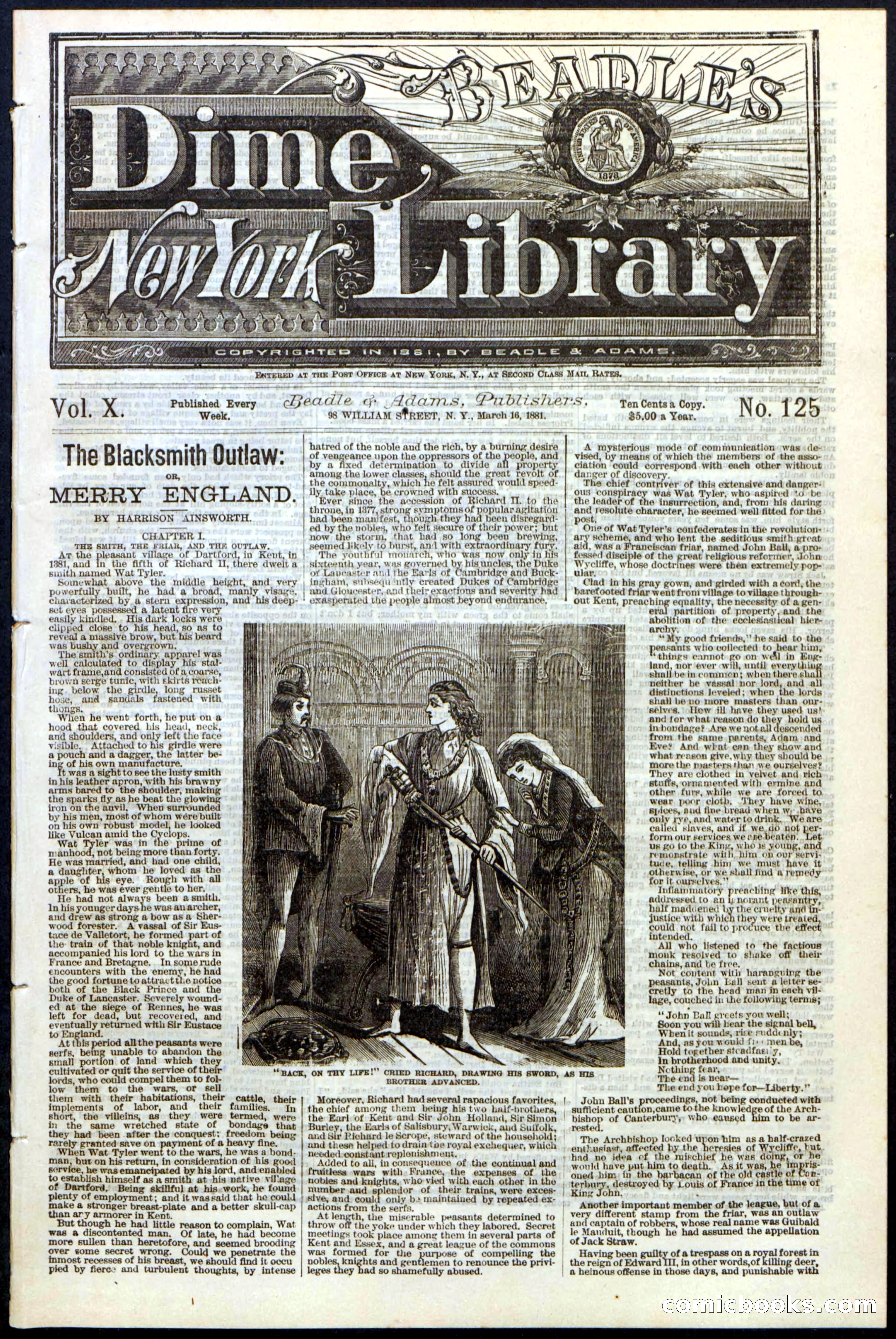
A restored page from Pulp Fiction, 1881. Page through the whole issue in the reader above.
📄 Transcribed text from this page (OCR, searchable)
Machine-transcribed from the original scan — historical spelling and the odd misread are preserved.
Ts =, COPYRIGHTERP IN ISSi1,BYvY BEADLE & ADAMS. a —— —-< Vol. X, 0 mae The Blacksmith Outlaw: MERRY ENGLAND. BY HARRISON AINSWORTH. CHAPTER I. THE SMITH, THE FRIAR, AND THE OUTLAW. At the 1381, and in the fifth of Richard I, there dwelt a siuith named Wat Tyler. Somewhat above the middle height, and very powerfully built, he had a broad, manly visage, chavacterized by_a stern expression, and his deep- set eyes possessed a latent fire very ‘Wt : easily kindled. . His dark locks were clipped close to his head, so as to H\ reveal a niassive brow, but his beard was bushy and overgrown, The smith’s ordinary apparel was well calculated to display his stal- wart frame,and consisted of a coarse, brown serge tunic, to skirts reach- rdle a Ai ing. below the long russet hose, and sandals fastened with thongs. When he went forth, he put on a hood that covered his head, neck, and shoulders, and only left the face visible, Attached to his girdle were a pouch and a dagger, the latter be- ing of his own manufacture. it was a sight to see the lusty smith in his leather apron, with his brawny arms b to the shoulder, making the sparks fly as he beat the glowing iron on the anvil, When surrounded by his men, most of whom wére built on his own robust model, he looked like Vulcan amid the fe ops. Wat Tyler was in the prime of manhood, not being more than forty. He was married, and had one child, a daughter, whom he loved as the apple of his eye. Rough with all others, he was ever gentle to her. He had not always been a smith. 1n his younger days he was au archer, and drew as strong a bow as a Sher- wood forester. A vassal of Sir Eus- tauce de Valletort, he formed part of the train of that noble knight, and accompanied his lord to the wars in France and Bretagne. In somerude encounters with the enemy, he had the good fortune to attractthe notice both of the Black Prince and the Duke of Lancaster. Severely wound- ed at the siege of Rennes, he was left for dead, but recovered, and ye: eventually returned with Sir Eustace 5 At this serfs, be small — allthe peasants were ng unable to abandon the rtion of land which the cultivated or quit the service of their lords, who d compel them to fol- low them to the wars, or sell them with their habitations, their cattle, their implements of labor, and their families. [y short, the villeins, as they were termed, were in the same wretched state of bondage that they had been after the conquest: freedom being rarely granted save on oo of a heavy fine. When Wat Tyler went to the wars, he was a bond- man, hut on his return, in consideration of his good service, he was emancipated by his lord, and enabled to establish himself as a smith at his native village of Dartford, Being skillful at his. work, he found plenty of employment; and it wassaid that he could make a stronger breast-plate and a better skull-cap than ary armorer in Kent. But though he had little reason to complain, Wat was a discontented man. Of late, he had become more sullen than heretofore, and seemed brooding over some secret wrong. uld we penetrate the inmost recesses of his breast, we should find it occu pied by fierce and turbulent thoughts, by intense *. -_— -- aN J, ie _—— — 98 WILLIAM STREET, N. Y., March 16, 1981. hatred of the noble and the rich, by a burning desire of vemgrance upon the oppressors of the people, and by a fixed determination to divide all property ' among the lower classes, should the great revolt of leasant village of Dartford, in Kent, in | the commonalty, which he felt assured would speed- ily take place, be crowned with success, Ever since the accession of Richard TI. to the throne, in 1377, strong symptoms of popular agitation had been manifest, though they had been disregard- ed by the nobles, who felt secure of their power; but now the storm, that had so long been brewing, seemed Jikely to burst, and with extraordinary fury. The youthful mouarch, who was now only in his sixteenth year, was governed by his uncles, the Duke oY Laveaster and the Earls of Cambridge and Buck- ingham, sibsequ‘ntly created Dukes of Cambridge | and Gloucester, aod their exactions and severity had ‘ exasperated the people almost beyond endurance, Ps a a A ’ ~ es) RN “BACK, ON THY LIFE!" CRIED RICHARD, DRAWING | Ww | MOA } TT aa aaa 2 | | | | | \ i Nn esa |) at) Hi Mo ; 4 nN | ’ ! | p malty " ii ro 1 i : M ; | | i { ae . a7 e J ey y 5) || | : 4 ti Kt iu! BROTHER ADVANCED. the chief among them being his two haif-brothers, the Earl of Kent and Sir John Holland, Sir Simon Burley, the Earls of Salisbury, Warwick, aud Suifolk, and Sir Richard le Scrope, steward of the household; and these helped to drain tae royal exchequer, which needed: constant replenishment, Added to ali, in consequence of the continual and less wars with France, the expenses of the nobles and knights, who vied with each other in the number and splendor of their traing, were exces- \' ae Y Nf 47% if CNA TTT"T TT T*'* its ENTERED AT THE Post Orrice at New York, N, Y., AT SECOND CLASS MAIL RATES, Published Every Hheadle Gg Adams, Publishers, —EE Lt il Mh HH iin mat At i se Bt { ui . tai | Mt ; ' WM, P > ~ . Shs = Somme & HIS SWORD, AS HIS Moreover, Richard had several rapacious favorites, | - would have put him to death. As it was, he sive, and could only be maintained by repeated ex- actions from the serfs. At length, the miserable peasants determined to throw off the yoke under which they labored. Secret meetings took place among them in several parts of Kent and Essex, and a great league of the commons was formed for the purpose of compelling the nobles, kni leges they ad so shamefully abused. hts and gentlemen to renounce the privi- | Wl ri bee 3 The Wi ‘ “ Ih tell wat i mais «K, — ~u Vy > alli aliial \ = ) Het \ i wan ’ = ii HANA AA Muli wldasta NANI i™ s 1 S~ E> ix va a ae ‘ : he 4 Thuiak NUMAN wy ® * iui ee eegpnete se + nn a A No. 125 A mysterious mode of communication was de vised, by means of which the members of the asso- ciation could correspond with each other without danger of discovery. The chief contriver of this extensive and danger- ous ot dm was Wat Tyler, who aspired to be the leader of the insurrection, and, from his daring Bey character, he seemed well fitted for the post, One of Wat Tyler's confederates in the revolution- ary scheme, and who lent the seditious smith great aid, was a Franciscan friar, named John Ball, a pro- fessed diseiple of the great religious reformer, John Wyeliffe, whose doctrines were then extremely pop- ular. Clad in his gray gown, and girded with a cortl, the barefooted friar went from village to village through- out Kent, preaching equality, the necessity of a gen- eral partition of preperty,and the abolition of the ecclesiastical hier- archy. “My good friends," he said to the peasants who colleeted to hear him, ‘things cannot go on wA&l in Eng- land, nor ever owill, until everythin sha if bein common; when oe shall neither be vassal nor lord, and all distinctions Jeveled; when the lords shall be no more masters than our- selves, low ill have they used us’ and tor what reason do they hold us inbondage? Are we noteall descended from the same perents, Adam and Eve’ And what cen they show and what reason give,why they should be more the masters than we ourselves? They are clothed in velvet and rich stuffs, ornamented with ermine and other fure, while we are forced to wear poor cloth, .'They have wine, spices, aud fine bread when w, .bave only rye, and water to drink, We are called’ slaves, and if we.do not per- form our services we ene beaten. Let us Zo to the King, who Js young, and remonstrate with him on our servi- tuce, telling him we must have it otherwise, or we shall find a remedy for it ourselves,” Inflammatory preaching lke this, addressed to an ky norant peasantry, half maddened ly the cruelty and in- justice with which they were treated could not fail to procuce the effect intended. All who listened to the factious monk resolved to shake off their chains, and be free. Not content with haranguing the peasants, John Lal) sent a letter se- cretly to the head man in each vil- lage, couched in the following terms; ‘‘ John Ball greets you well; Soon you will hear the signal bell, When it sounds, rise ruddenly; And, as you woukd fi: + men be, Hold together stcadfasi y, In brotherhood and unity, Nothing fear, The end is near— The end you hepe for—Liberty.” John Ball’s proceedings, not being conducted with sufficient caution,came to the knowledge of the Arch- bishop of Canterbury, who eaused him to be ar- rested. The Archbishop locked upon him as a half-crazed enthusiast, affected by the heresies of Wycliffe, but had no idea of the mirchief he was Corne Sr doe mH - oned him: in the barbacan of the oJd castle of Con- terete destroyed by Louis of France in the time of King John, ‘ Another important member of the league, but of a very different stamp from the friar, was an outlaw and captain of robbers, whose real name was Guibald le Manduit, though he had assumed the appellation of Jack Straw. Having been guilty ofa on a royal forest in the reign of Edward ITI, in other words,of killing deer, a heinous offense in those days, and punishable with Ten Cents a Copy. $5.00 a Year. van iy ee i Will a \ (\ AR | | j i‘ if MICLOOOKS (CO) (C (Cc (0)