
Pulp Fiction, 1881 · page 15 of 32
Beadle's New York Dime Library No. 125 — page 15: what you’re looking at
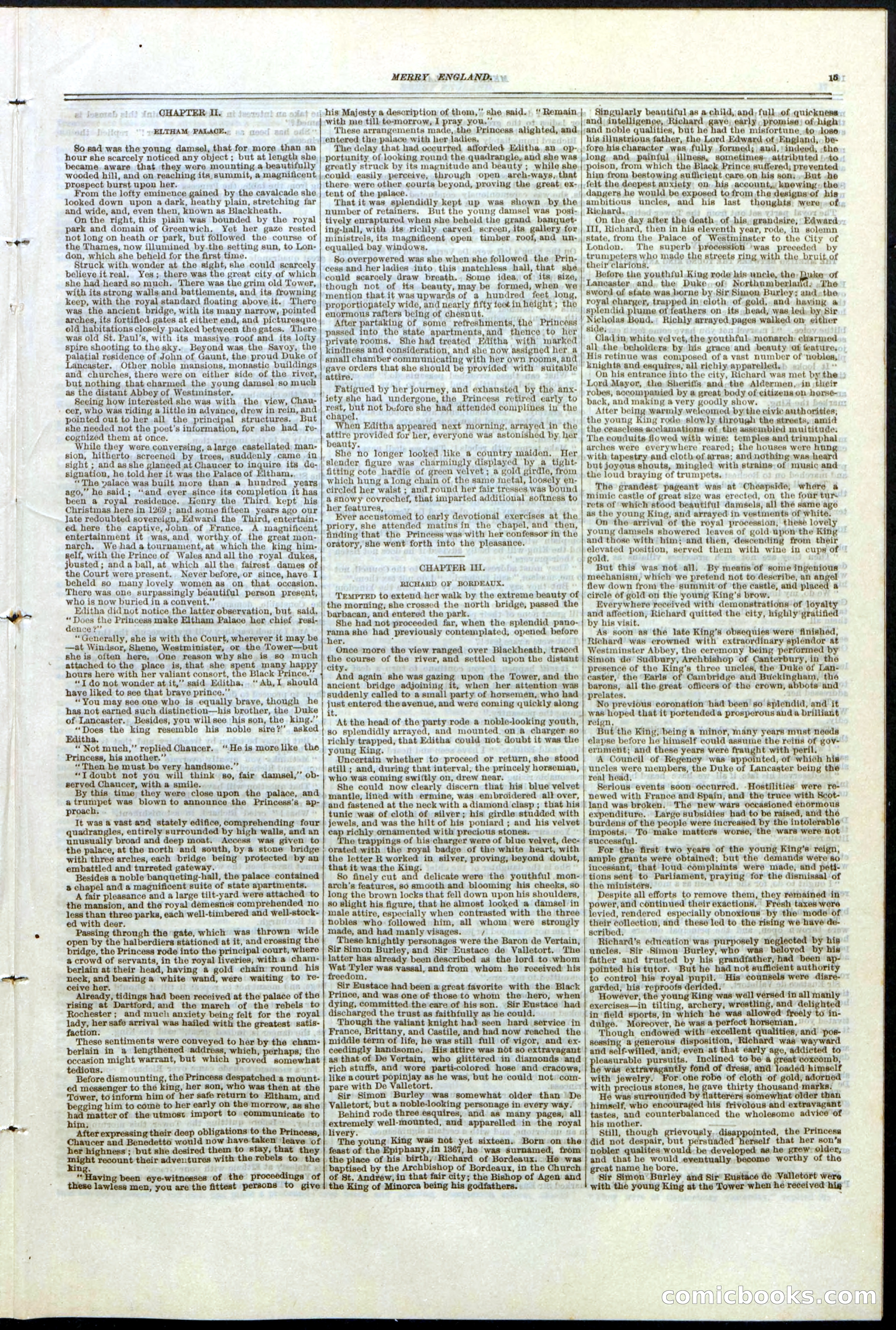
A restored page from Pulp Fiction, 1881. Page through the whole issue in the reader above.
📄 Transcribed text from this page (OCR, searchable)
Machine-transcribed from the original scan — historical spelling and the odd misread are preserved.
er CHAPTER Il. ELTHAM PALAOE. So sad was the young damsel, that for more than an hour she scarcely noticed any object ; but at length she became aware that they were mounting a beautifully wooded hill, and on reaching ita, summit, a magnificent prospect burst upon her. From the lofty eminence gained by the cayalcade she looked down upon a dark, heathy plain, stretching far and wide, and, even then, known as Blackheath. On the right, this plain was bounded by the royal park and domain of Greenwich, Yet her gaze rested not long on heath or park, but followed the course of the Thames, now illumined by.the setting sun, to Lon- don, which she beheld for the first time. Struck with wonder at the sight, she could scarcely believe it real. Yes; there was the great city of which she had heard so much. There was the grim old Tower, with its strong walls and battlements, and its frowning keep, with the royal standard floating above it. There was the ancient bridge, with its many narrow, pointed arches, its fortified gates at either end, and picturesque old habitations closely packed between the gates. There was old St. Paul’s, with its massive roof and its lolty spire shooting to the sky. Beyond was the Sayoy, the palatial residence of John of Gaunt, the proud Duke of Lancaster. Other noble mansions, monastic buildings and churches, there were on either side of the river, but nothing that charmed the young damsel so much as the distant Abbey of Westininster. Seeing how interested she was with the view, Chau- cer, who was riding a little in advance, drew in rein, and pointed out to her all the principal structures. But she needed not the poet's information, for she had. re- cognhized them at once. While they were conversing, alarge castellated man- sion, hitherto screened by trees, suddenly came in sight ; and as she glanced at Chaucer to inquire its de- signation, he told her it was the Palace of Eltham,, “The yvalace was built more than a hundred years ago,” he said; “and ever.since its completion it has been a royal residence.. Henry the Third kept his Christmas here in 1269; and some fifteen years ago our Jate redoubted sovereign, Edward the Third, entertain- ed here the captive, John. of France. A magnificent entertainment it was,and worthy of the great mon- narch. We hada tournament, at which the king him- acl, with the Prince of Wales andall the royal dukes, jousted; anda ball, at which all the fairest dames of the Court were present. Never before, or since, have I beheld so many lovely women as on that occasion. There was one surpassingly beautiful person present, who is now buried in a convent.” Editha did not notice the latter observation, but. said, aps the Princess make Eltham Palace her chief resi- ence ?"’ “Generally, she is with the Court, wherever it may be —at Windsor, Shene, Westminister, or the Tower—but she is often here, One reason why she is so much attached to the place is, that she spent many happy hours here with her valiant consort, the Black Prince.” “I do not wonder at it,”’ said Editha, ‘ Ab,1 should have liked to see that brave prince.” “You may see one who is equally brave, though he has not earned such distinction—his brother, the Duke of Lancaster., Besides, you willsee his son, the king.” “Does the king resemble his noble sire?’ asked Editha. “Not much,” replied Chaucer. ‘He is morelike the Princess, his mother.”’ “Then he must be very handsome.” “Tdoubt not you will think so, fair damsel,’’ ob- served Chaucer, with a smile. By this time they were close upon the palace, and a trumpet was blown to announce the Princess’s ap- proach, It was a vast and stately edifice, comprehending four quadran , entirely surrounded by high walls, and an unusually broad and deep moat. Access was given to the palace, at the north and south, by a stone bridge with three arches, each bridge being protected by an embattled and turreted gateway. Besides a noble oe renee Renn? eer ee rongtnn a chapel and a magnificent suite of 5 apartments. A fair pleasance and a large tilt-yard were attached to the mansion, and the royal deémesnes comprehended no less than three parka, each well-timbered and well-stock- ed with deer. through the gate, which was thrown wide open by the halberdiers stationed at it, and crossing the bridge, the Princess rode into the principal court, where @ crowd of servants, in the royal liveries, with a cham- berlain at their head, having a _— chain: round his ee es white wand, were waiting to re- ve her. rr tidings had been received at the palace of the rising at Dartford, and the march of the rebels to Rochester; and much: anxiety being felt for the royal pe her safe arrival was hailed with the greatest satis- These sentiments were conveyed to her by the cham- berlain in a len ; Sa gpa the occasion might warrant, but which proy somewhat tedious. Before dismounting, the Princess despatched a mount- ed messenger to the king, her son, who was then at the Tower, toinform him of her safe return to Eltham, and begging him to come to her early on the morrow, as she had matter of the utmost import to communicate to After expressing their deep obligations to the Princess, Chaucer and Benedetto would now have-taken ‘leave of her highness’; but she desired them to — they might recount their adventures with the rebels t g been eye-witnesses of the proceedings of these lawless men, you are the fittest persons to give MERRY ENGLAND. | his Majesty a description of them,” she said. ‘ Remain with me till tesnorrow, I pray you. : These arrangements made, the Princess alighted, and entered the palace with her ladies. The delay that had oceurred afforded Editha an op- portunity of looking round the quadrangle, and she was greatly struck by its magnitude and beauty; while she could easily perceive, through open. arech-ways, that there were other courts beyond, proving the great, ex- tent of the palace. That it was splendidly kept up was shown by the number of retainers. But the young damsel was posi- tively enraptured when she beheld the grand banquet- ing-hall, with its richly carved screen, ita gallery for ministrels, its magnificent open timber roof, and un- equalled bay windows. ; So overpowered was she when she followed the Prin- cess and her ladies into this matchless hall, that she could searcely draw breath.. Some idea, of its, size, though not of its beauty, may be formed, when we mention that.it was upwards of a hundred feet long, proportiopately wide, and nearly fifty feetin height; the enormous rafters being of chesnut. After partaking of some refreshments, the Princess passed into the state apartments,and thence to her private rooms. She had treated Editha with marked kindness and consideration, and she now assigned her a small chamber communicating with her own rooms, and gave orders that she should be provided with suitable attire. Fatigued by her journey, and exhansted by the anx- iety she had undergone, the Princess retired early to rest, but not before she had attended complines in the chapel. When Editha appeared next morning, arrayed in the eae provided for her, everyone was astonished by, her eanty. She no longer looked like a country maiden, Her slender figure was Pprdomny et displayed by a tight- fitting cote hardie of green velvet; a gold girdle, from which hung a long chain of, the same metal, loosely en- circled her waist ; and round her fair tresses, was bound a snowy covrechef, that imparted additional softness to her features, Ever accustomed to early devotional exercises at the priory, she attended matinsin the chapel, and then, finding that the Princess was with her confessor in the oratory, she went forth into the pleasance. CHAPTER IL. RICHARD OF BORDEAUX. TempreD to extend her walk by the extreme beauty of the morning; she crossed the north bridge, passed the barbacan, and entered the park. She had not proceeded far, when the splendid pano- — she had previously contemplated, opened before er. . Once more the view ranged over Blackheath, traced ae course of the river, and settled upon the distant city. And again she was gazing upon the Tower, and the ancient bridge adjoining it, when her attention was suddenly called to a sinall y of horsemen, who had just entered the avenue, and were coming quickly along it. ' At the head of the party rode a noble-looking youth, so splendidly arrayed, and mounted.on a charger so richly trapped, that Editha could not doubt it was the young King. Uncertain whether to proceed or return, she stood atill ; and, during that interval, the princely horseman, who was coming swi(tly on, drew near. She could now clearly discern that his blue velvet mantle, lined with ermine, was embroidered all over, and fastened at the neck with a diamond clasp; that his tunic was of cloth of silver; his girdle studded with jewels, and was the hilt of his poniard ; and his velvet cap richly ornamented with precious stones. The trappings of his charger were of blue velvet, dec- orated with the royal badge of the white heart, with the letter R worked in silver, proving; beyond doubt, that it was the King. So finely cut and delicate were the youthful mon- arch’s features, s0 smooth and blooming his cheeks, so long the brown locks that fell down upon his shoulders, BO ht his figure, that he almost looked a damsel in male attire, especially when contrasted with the three nobles who followed him, all whom were strongly made, and had manly visages. = / These knightly personages were the Baron de Vertain, Sir Simon Burley, and Sir Eustace de Valletort. The latter has already been described as the lord to.whom Wat Tyler was vassal, and from whom he received his freedo m. Sir Eustace had been a great favorite with the Black Prince, and was one of those to whom the hero, when dying, committed the care of his son. Sir Eustace had discharged the trust as faithfully as he could. Though the valiant kn had seen hard service in France, Brittany, and Castile, and had now reached the middle term of life, he was still full of vigor, and ex- ceedingly handsome. His attire was not so extravagant as that of De Vertain, who glittered in diamonds and rich stuffs, and wore parti-colored hose and cracows; like a court popmay as he was, but he could not: com- pare with De Valletort. Sir Simon Burley was somewhat older than De Valletort, but a noble-looking personage in every way. Behind rode three esquires, and as many pages, all extremely well-mounted, and apparelled in the royal livery. ws The young King was not yet sixteen, Born on the feast of the Epiphany, in , he was surnamed, from _ of Bordeaux. ._He was Pp of St. Andrew, in that fair city; the Bishop of Agen and the King of Minorca being his godfathers. foal sand noble qu of his , Richard by the Archbishop of Bordeaux, in the Church | 15 Singularly beautiful as a child, and, full .of quickness and. anteliigense, Richard gave, early promise) of high ities, but he had the misfortune. .to dose his illustrious father, the Lord Edward ot England, be- fore his character was fully formed; and,’ indeed, -the long and painful illness, sometimes. attributed | to = from which the Black Prince suffered; prevented iin from bestowing sufficient care on his son, , Bat .he felt the deepest anxiety on his account, knewing: the. dangers he would be exposed to from the designsof his ambitious uncles, and his last thonghts were .of Richard. " On the day after the death. of his, grandsire, Edward Ill, Richard, then in his eleventh year, rode, in solemn state, from the Palace of Westminster to the City of London. The superb procession ‘was preceded by trumpeters who made the streets ring with the bruit of their clarions. ar Before the youthful King rode his uncle, the, Dude of Lancaster and the Duke. of Northumberland, .The sword of state was borne by Sir Simon Burley; andthe royal charger, trapped in cloth of gold, and having a splendid phaume of feathers on its head, was led by Sir wehetss Bond. Richly arrayed. pages walked om either side, a Clad in, white velvet,the youthful. monarch: charmed all, the beholders: by lis grace and beauty of feature, His retinue was composed of a vast number of ‘nebles knights and eaquires, all richly apparelled, Sag On his entrance into the city, Richard was met by the Lord Mayor, the Sheriffs and. the Aldermen, in their robes, soaompameas’ by @ great body of citizens on horse- back, and making a very goodly show. “a Atter being warmly weleomed by the civic authorities, the young King rode. slowly through the streets, amid the ceascless acclamations of the assembled muititude. The conduits flowed with wine: temples and triumphal arches were everywhere reared; the houses were hun with tapestry and cloth of arras; and nothing was beard but joyous shouts, mingled with strains of music and the loud braying of trumpets. The grandest pageant was at Cheapside, where a mimic castle of great size was erected, on the four tur. rets of which stood beautiful dameels, all the same age as the young King, and arrayed in vestments of white. On the arrival of the royal procession, these lovely young damsels showered leaves of gold upon the King and those with him; and then, descending from their y= gga position, served them with wine in cups of gold. But this was not all. By means of some ingenious mechanism, which we pretend not to describe, an angel flew down from the summit of the castle, and placed a circle of gold on the young King’s brow. Everywhere received with demonstrations of loyalty - ai affection, Richard quitted the city, highly gratified y his visit. : As soon as the late King’s obsequies were finished, Richard was crowned with extraordinary spléndor at Westminster Abbey, the ceremony being performed by Simon de Sudbury, Archbishop of Canterbury, in the presencé of the King’s three uncles, the Duke of Lan- caster, the Earle of Cambridge and Buckingham, the barons, all the great officers of the crown, abbots and prelates. No previous coronation had been so splendid, and it a hoped that it portended a prosperous and a brilliant reign, But the King, being a minor, many years must needs elapse before he himself could assuie the reina of gov- ernment; and these years were fraught with peril. A Council of Regency was appointed, of which his uncles were members, the Duke of Lancaster being the real head. ' Serious events soon occurred. -Hostilities were re- newed with France and Spain, and the truce with Scot- land was broken. The new wars occasioned enormous expenditure. Large subsidies had to be raised, and the burdens of thé people were increased by the intolerable imposts. To make matters worse, the ware were not successful. : For the first two years of the young King’s reign, ample grants were obtained; but the demands were so incessant, that loud complaints were made, and peti- tions sent to Parliament, praying for the dismissal of the ministers. Despite all efforts to remove them, they remained power, and continued their exactions. Fresh taxes were levied, rendered especially obnoxious” by the mode of their collection, and these led to the rising we have de- scribed. de Richard’s education was purposely neglected by his uncles. Sir Simon Burley, who was Talrea by his father and trusted by his grandfather, had been ap- pointed his tutor. But he had not sufficient authority to control his royal Pom His counsels were disre- garded, his reproofs derided.’ . ~ tpt Ames However, the young King was well versed in all manl exercises—in tilting, archery, wres , and veliem in field sports,im which he was allowed’ freely to in- dulge. Moreover, he was a perfect horseman. ough endowed with excellent qualities, and pos- sessing & generous tion, Richard was wayward and self: led, and, even at that early age, addicted to leasurable pursuits. Inclined to be a coxcomb, 6 was extra tly fond of dress, and loaded himself with jewelry. For one robe of cloth of gold, adorned with precious stones, he gave thirty thousand marks. He was surrounded by flatterers somewhat older than himself, who encouraged his frivolous and extravagant tastes, and counterbalanced the wholesome advice of his mother. niet Still, though evously..disappointed, the Princess did not despair, but perstaded herself that her son’s nobler qualites would be developed as he grew: older, and that he would eventually become worthy of the t name he bore, a ; Sir Simon’ Burley and Sir Eustace de Valletort were with the young King at the Tower when he received hig GOmicdoo SalE@)