
Pulp Fiction, 1881 · page 14 of 32
Beadle's New York Dime Library No. 125 — page 14: what you’re looking at
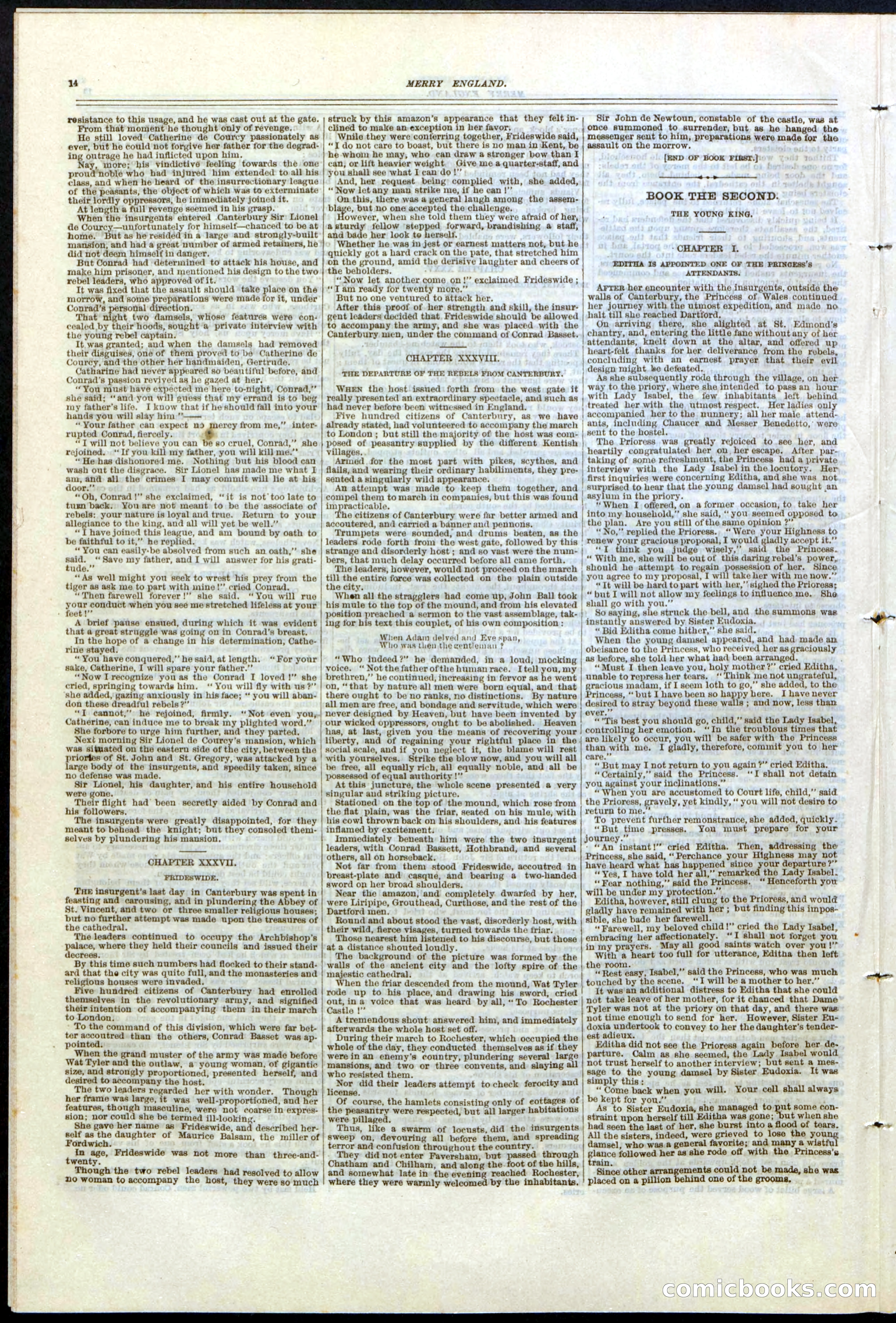
A restored page from Pulp Fiction, 1881. Page through the whole issue in the reader above.
📄 Transcribed text from this page (OCR, searchable)
Machine-transcribed from the original scan — historical spelling and the odd misread are preserved.
—— rz 14 MERRY ENGLAND. -- —— resistance to this usage, and he was cast out at the gate. From that monient he thought only of revenge. He still loved Catherine de Courcy passionately as ever, but he could not forgive her father for the degrad- ing outrage he had inflicted upon him. Nay more; his vindictive feeling towards the one proud noble who had injured him extended to all his class, and when he heard of the insurrectionary league of the peasants, the object of which was to exterminate their lordly oppressors, he immediately joined it. At length a full revenge seemed in his grasp. When the insurgents entered Canterbury Sir Lionel de Courcy—unfortunately for himself—chanced to be at homé. But as he resided in a large and strongly-built mansion, and had a great number of armed retainers, he | did not déeam himself in danger. But Conrad had determined to attack his house, and make him prisoner, and mentioned his design to the two rebel leaders, who approved of it. It was fixed that the assault should take place on thé morroW, and some preparations were made for it, under Conrad’s personal tion. That night two damsels, whose features were con- cealed by their hoods, sought a private interview with the young rebel captain. It was granted; and when the damsels had removed their disguises, oné of them proved to be Catherine de Courey, and the other her handmaiden, Gertrude. Catharine had never appeared so beautiful before, and Conrad's passion reviyed ag he gazed at her. “You must have expected me here to-night, Conrad,”’ she said; “and you will eness that my errand is to beg my father’s life. I know that if he should fall into your hands you will slay him '’—— “Your father can expect ee from me,” inter- rupted Conrad, fiercely. £ “T will not believe you can so cruel, Conrad,” she rejoined. “If you kill my father, you will kill me.”’ “He has dishonored me. Nothing but his blood can wash out the disgrace. Sir Lionel has made me what I a and all the crimes I may commit will lie at his oor.”” “Oh, Conrad!" she exclaimed, “it is not’ too late to tuzsn back: You are not meant to be the associate of rebels: your nature is loyal and true. Return to your allegiance to the king, and all will yet be well.’ “T have joined this league, and am bound by oath to be faithful to it,” he replied. “You can easily-be absolved from such an oath,’ she rose “Save my father, and I will answer for his grati- ude.” “As well might you seek to wrest his prey from the tiger as ask me to part with mine!” cried Conrad. “Then farewell forever!”’ she said. “You will rue your conduct when you see me stretched lifeless at your : feet!” A brief pause ensued, during which it was evident that a great struggle was going on in Conrad's breast. In the hope of a change in his determination, Cathe- rine stayed. “You have conquered,” he said, at length. sake, Catherine, I will spare your father.”’ “Now I recognize you as the Conrad I loved!” she cried, springing towards him. ‘“ You will fly with us?” “For your she , gazing anxiously in his face; ** you will aban- don these dreadful rebels ?”’ “TI cannot,” he rejoined, firmly. ‘ Not even you,. Catherine, can induce me to break my plighted word.” She forbore to urge him further, and they parted. Next morning Sir Lionel de Courcy’s mansion, which was situated on the eastern side of the city, between the riortes of St. John and St. Gregory, was attacked by a ge body of the insurgents, and speedily taken, since no defense was made. Sir Lionel, his daughter, and his entire household were — ; Their flight had been secretly aided by Conrad and his followers. The insurgents were greatly disappointed, for they meant to behead the knight; but they consoled them- selves by plundering his mansion. CHAPTER XXXVI. FRIDESWIDE. THE insurgent's last day in Canterbury was tin feasting and carousing, and in plundering the Abbey of St. Vincent, and two or three smaller religious houses; but no further attempt was made upon the treasures of the cathedral. The leaders continued to occupy the Archbishop's —— where they held their councils and issued their srees. By this time such numbers had flocked to their stand- ard that the city was quite full, and the monasteries and religious houses were invaded. Five hundred citizens of Canterbury had enrolled themselves in the revolutionary army, and signified their intention of accompanying them in their march to London. ' To the command of this division, which were far bet- ter accoutred than the others, Conrad Basset was ap- Povnen ti , en the grand muster of the army was made before Wat Tyler and the outlaw, a young woman, of ee size, and strongly proportioned, presented herself, and a to accompany the host. The two leaders regarded her with wonder. Though her frame was large, it was well-proportioned, and her features, wait masculine, were not coarse in expres- sion; nor could she be termed ill-looking. sativa Guarnee oy = Liner nomen and described her- urice Balsam ater , the miller of In age, Frideswide was not more than three-and- twenty. Though the two rebel leaders had resolved to allow 20 woman to accompany the host, they were so much struck by this amazon’s appearance that they felt in- clined to make an exception in her favor, Wnile they were conterring together, Frideswide said, “JT do not care to boast, but there is no man in Kent, be he whom he may, who can draw a stronger bow than I can, or lift heavier weight, Give me a quarter-staff, and you shall see what I can do!” And, her request being’ complied with, she added, “Now let any man strike me, if he can !”’ On this, there was a general laugh among the assem- blage, but no one accepted the challenge. owever, When she told them they were afraid of her, axsturdy fellow ‘stepped forward, brandishing a staff, and e her look to herself. Whether he was in jest or earnest matters not, but he quickly got a hard crack on the pate, that stretched him on the ground, amid the derisive laughter and cheers of the beholders. “Now let another come on!’’ exclaimed Frideswide ; ‘‘Tam ready for twenty more.” But no one ventured to attack her. After this Ss of her strength and skill, the insur- gent leaders ided that. Frideswide should be allowed to accompany the army, and she was placed with the Canterbury men, under the command of Conrad Basset. CHAPTER XXXYVIII. THE DEPARTURE OF THE REBELS FROM CANTERBURY. Wen the host issued forth from the west gate it really presented an extraordinary spectacle, and such as had never before been witnessed in England. Five hundred citizens of Canterbury, as we have already stated, had volunteered to accompany the march to London ; but still the majority of the host was com- posed of peasantry supplied by the different Kentish villages, . Arined for the most part with pikes, scythes, and flails, and wearing their ordinary habiliments, they pre- sented a singularly wild appearance. An attempt was made to keep them together, and compel them to march in companies, but this was found Dppeece ewe he citizens of Canterbury were far better armed and accoutered, and carried a banner and pennons. Trumpets were sounded, and drums beaten, as the leaders rode forth from the west gate, followed by this avenge and disorderly host ; and so vast were the num- bers, that much delay occurred before all came forth. The leaders, however, would not proceed on the march till the entire farce was collected on the plain outside the city. When all the stragglers had come up, John Ball took his mule to the top of the mound, and from his elevated position preached a sermon to the vast assemblage, tak- ing for his text this couplet, of his own composition : When Adam delved and Eve span, Who was then the centlemau ? “Who indeed?” he demanded, in a loud, mocking voice. “ Not the father ofthe human race. I tell you, my brethren,” he continued, increasing in fervor as he went on, “that by nature all men were born equal, and that there ought to be no ranks, no distinctions. By nature all men are free, and bondage and servitude, which were never designed by Heaven, but have been invented by our wicked oppressors, onght to be abolished. Heaven has, at last, given you the means of recovering your liberty, and of regaining your rightful place in the social scale, and if you neglect it, the blame will rest with yourselves. Strike the blow now, and you will all be free, all equally rich, all equally noble, and all be possessed of equal authority !" At this juncture, the whole scene presented a very singular and striking picture. Stationed on the top of the mound, which rose from the flat plain, was the friar, seated on his mule, with his cowl thrown back on his shoulders, and his features inflamed by excitement: Immediately beneath him were the two insurgent leaders, with Conrad Bassett, Hothbrand, and several others, all on horseback. Not far from them stood Frideswide, accoutred in breast-plate and casque, and bearing a two-landed sword on her broad shoulders. Near the amazon, and completely dwarfed by her, were Liripipe, Grouthead, Curthose, and the rest of the Dartford men. Round and about stood the vast, disorderly host, with their wild, fierce visages, turned towards the friar. Those nearest him listened to his discourse, but those at a distance shouted loudly. The background of the picture was formed by the walls of the ancient city and the lofty spire of the majestic cathedral. When the friar descended from the mound, Wat Tyler rode up to his place, and drawing his sword, cried a voice that was heard by all, “To Rochester ea ” A tremendous shout answered him, and immediately afterwards the whole host set off. During their march to Rochester, which occupied the whole of the day, they conducted themselves as if they were in an enemy's country, plundering several large mansions, and two or three convents, and slaying all who resisted them. Nor did their leaders attempt to check ferocity and license. Of course, the hamlets consisting only of eottages of the amasitry were respected, but all larger habitations were pillaged. Thus, like a swarm of locusts, did the insurgents sweep on, devouring all before them, and spreading terror and confusion throughout the country. They did not enter Faversham, but ey a Chatham and Chilham, and along the. foot of the hills, and somewhat late in the evenin - Rochester, where they were wannly Wlodenet. by the inhabitants. Sir John de Newtoun, constable of the castle, was at once summoned to surrender, but as he hanged the messenger sent to him, preparations were made for the assault on the morrow. {END OF BOOK FIRST.]) > BOOK THE SECOND: THE YOUNG KING, * CHAPTER I. EDITHA IS APPOINTED ONE OF THE PRINGESS'S ATTENDANTS. | Arrer her encounter with the insurgents, outside the walls of Canterbury, the Princess of Wales continued her journey with the utmost expedition, and made no halt till she reached Dartford. On arriving there, she alighted at St. Edmond's | chantry, and, entering the little fane without any of her ‘attendants, knelt down at the altar, and offered up heart-felt thanks for her deliverance from the rebels, | concluding with an earnest prayer that their evil | design might be defeated, As she subsequently rode through the village, on her | way to the priory, where she intended to pass an hour with Lady Isabel, the few inhabitants left behind treated her with the utmost respect. Her ladies onl | accompanied her to the nunnery; all her maie attend- ‘ants, including Chaucer and Messer Benedetto,’ were sent to the hostel. The Prioress was greatly rejoiced to see her, and | heartily congratulated her on, her escape. After par- taking of some refreshment, the Princess had a private interview with the Lady Isabel in the locutory. Her first inquiries were concerning Editha, and she was not ' surprised to hear that the young damsel had sought an asylum in the priory. | When I offered, on a former occasion, to take her into my household,” she said, “you seemed opposed to the plan. Are you still of the same opinion ?” “No,” frac the Prioress.. ‘Were your Highness to ‘renew your gracious proposal, I would ly accept it.”’ | “I think you judge wisely,” said the Princess. “ With me, she will be out of this daring rebel’s power, ‘should he attempt to regain possession of her. Since you agree to my proposal, I will take her with me now.” “It will be hard to part with her,” sighed the Prioressa; “but I will not allow my feelings to influence me. She shall go with you.” So saying, she struck the bell, and the summons wag instantly answered by Sister Eudoxia. “ Bid Editha come hither,” she said. When the young damsel appeared, and had made an obeisance to the Princess, who received her as aAERSRDELY as before, she told her what had been arranged. “Must I then leave you, holy mother?” cried Editha, unable to repress her tears. ‘‘ Think me not ungrateful, gracious madam, if I seem loth to go,”’ she added, to the Princess, “ but I have been so happy here. I have never desired to stray beyond these w ; and now, less than ever.” “'Tis best you should go, child,” said the Lady Isabel, | controlling her emotion. “In the troublous times that are likely to occur, you will be safer with the Princess than with me. I gladly, therefore, commit you to her care.” “ But may I not return to you again?” cried Editha. “Certainly,” said the Princess. ‘I shall not detain you against your inclinations.” “When you are accustomed to Court life, child,” said the Prioress, gravely, yet kindly, “‘ you will not desire to | return to me.” To prevent further remonstrance, she added, quickly. “But time presses. You must prepare for your journey.” - “An instant!” cried Editha. Then, addressing the Princess, she said, “ Perchance your Highness may not have heard what has happened since your departure ? “Yes, I have told her all,” remarked the Lady Isabel. “Fear nothing,” ayia fe Princess. “ Henceforth you will be under my pro on.” Editha, howevel. Atill clung to the Prioress, and would gladly have remained with her ; but finding this impos- sible, she bade her farewell. . “Farewell, my beloved child!” cried the Lady Isabel, embracing her affectionately. “I shall not forget you in my prayers. May all good saints watch over you !’” With a heart too full for utterance, Editha then left he room. ; ¥ Rest easy, Isabel,’”’ said the Princess, who was much touched by the scene. “I will be a mother to her.” It was an additional distress to Editha that she could not take leave of her mother, for it chanced that Dame Tyler was not at the priory on that day, and there waz not time enough to send for her. However, Sister Eu- doxia undertook to convey to her the daughter's tender- est adiewx. ' Editha did not see the Prioress again before her de- parture. Calm as she seemed, the Lady Isabel would not trust herself to another interview; but sent a mes- sage to the young damsel by Sister Eudoxia. It was simply this: “Come back when you will. Your cell shall always be kept for you.” baa ¥Qhs ; As to Sister Eudoxia, she managed to put some con- straint upon herself till Editha was gone; but when she had seen the last of her, she burst into a flood of tears. All the sisters, indeed, were grieved to lose the young damsel, who was. a general favorite; and many a wistfu eae followed her as she rode off with the Princess's rain Since other arrangements could not be made, she was placed on a pillion d one of the grooms, or EomileGbooks, co