
Pulp Fiction, 1881 · page 16 of 32
Beadle's New York Dime Library No. 125 — page 16: what you’re looking at
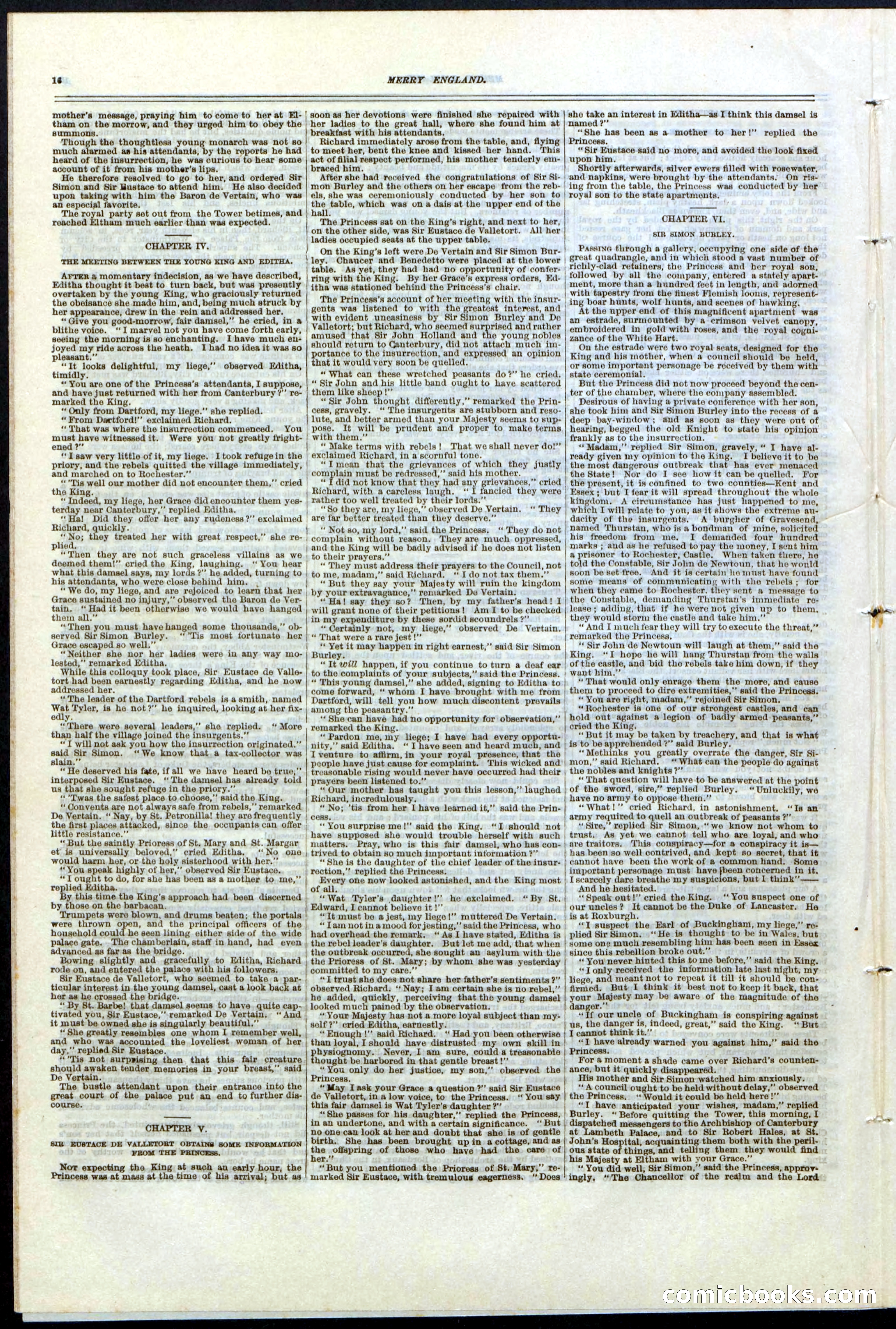
A restored page from Pulp Fiction, 1881. Page through the whole issue in the reader above.
📄 Transcribed text from this page (OCR, searchable)
Machine-transcribed from the original scan — historical spelling and the odd misread are preserved.
SS ee te +. aia 5 Ole mite Met © Ft a 445. HGS Se aa 1é MERRY ENGLAND. mother’s message, praying him to come to her at El- tham on the morrow, and they urged him to obey the summons. Though the thoughtless young monarch was not so much ed as his attendants, by the reports he had heard of the insurrection, he was curious to hear some account of it from his mother’s lips. He therefore resolved to go to her, and ordered Sir Simon and Sir Mustace to attend him. He also decided upon taking with him the Baron de Vertain, who was an especial favorite. The royal party set out from the Tower betimes, and reached Eltham much earlier than was expected. CHAPTER IV. THE MEETING BETWEEN THE YOUNG KING AND EDITHA. AFTER a momentary indecision, as we have described, Editha thought it beat to turn back, but was presently overtaken by the young King, who graciously returned the obeisance she made him, and, being much struck by her appearance, drew in the rein and addressed her. “Give you good-morrew, fair damsel,”’ he cried, in a blithe voice. ‘I marvel not you have come forth early, seeing the morning is so enchanting. Ihave much en- joyed my ride across the heath. I had no idea it was so pleasant.’’ “It looks delightful, my liege,’’ observed Editha, timidly. “You are one of the Princess’s attendants, I suppose, and have just returned with her from Canterbury ?’’ re- marked the King. “Only from Dartford, my liege.”’ she replied. “From Darctford!’’ exclaimed Richard. “That was where the insurrection commenced. You er witnessed it. Were you not greatly fright- ene ’” ‘* I saw very little of it, my liege. I took refugein the priory, and the rebels quitted the village immediately, and marched on to Rochester.” “*Tis well our mother did not encounter them,” cried the King. “‘ Indeed, my liege, her Grace did encounter them yes- terday near Canterbury,’’ replied Editha. ‘‘Ha! Did they offer her any rudeness ?’’ exclaimed Richard, quickly. i i they treated her with great respect,” she re- plied. “Then they are not such graceless villains as we deemed them!” cried the King, laughing. ‘ You hear what this damsel says, my lords ?”’ he added, turning to his attendants, who were close behind him. . “ We do, my liege, and are rejoiced to learn that her Grace sustained no injury,”’ observed the Baron de Ver- tain. “ Hadit been otherwise we would haye hanged them all.” “Then you must have hanged some thousands,”’ ob- served Sir Simon Burley. ‘Tis most fortunate her Grace escaped so well,” “Neither she nor her ladies were in any way mo- lested,”’ remarked Editha, While this colloquy took place, Sir Eustace de Valle- tort had been earnestly regarding Editha, and he now addressed her. “ The leader of the Dartford rebels is a smith, named Wee Tyler, is he not?’ he inquired, looking at her fix- edly. “There were several leaders,’’ she replied. than half the village joined the insurgents.” “T will not ask you how the insurrection originated.” ee Simon. ‘ We know that.a tax-collector was B Wye “He deserved his fate, if all we have heard be true,”’ interposed Sir Eustace. ‘ The damsel has already told us that she sought refuge in the priory.” “ "Twas the safest place to choose,” said the King. “ Convents are not always safe from rebels,’’ remarked De Vertain. ‘ Nay, by St. Petronilla! they are frequently the first places attacked, since the occupants can offer little resistance.” “But the saintly Prioress of St. Mary and St. Margar et is universally beloved,” cried Editha. ‘‘No one would harm her, or the holy sisterhood with her.” “Yous highly of her,” observed Sir Eustace. “T ought to do, for she has been as a mother to me,” replied tha. y this time the King’s approach had been discerned by those on the barbacan. Trumpets were blown, and drums beaten; the portals were thrown open, and the principal officers of the household could be seen lining either side of the wide palace gate. The chamberlain, staff in hand, had even advanced as far as the bridge. Bowing slightly and gracefully to Editha, Richard rode on, and entered the palace with his followers. Sir Eustace de Valletort, who seemed to take a par- ticular interest in the young damsel, cast a look b at her as he crossed the bridge. “ By St. Barbe! that damsel seems to haye quite cap- tivated you, Sir Eustace,’’ remarked De Vertain, “And it must be owned she is singularly beautiful.” “She greatly resembles one whom I remember well, and who was accounted the loveliest woman of her day,”’ replied Sir Eustace. “'Tis not 8 then that this fair creature should awaken tender memories in your breast,’’ said De Vertain. The bustle attendant upon their entrance into the great court of the palace put an end to further dis- course. ** More CHAPTER V. SIR EUSTACE DE VALLETORT OBTAINS SOME INFORMATION FROM THE PRINCESS, Nor expecting the King at such an early hour, the Princess was at mass at the time of his arrival; but as a — soon as her devotions were finished she repaired with her ladies to the great hall, where she found him at breakfast with his attendants. Richard immediately arose from the table, and, flying to meet her, bent the knee and kissed her hand. This act of filial respect performed, his mother tenderly em- braced him. After she had received the congratulations of Sir Si- mon Burley and the others on her escape from the reb- els, she was ceremoniously conducted by her son to nee? table, which was on a dais at the upper end of the hall. The Princess sat on the King’s right and next to her, on the other side, was Sir Eustace de Valletort. All her ladies occupied seats at the upper table. On the King’s left were De Vertain and Sir Simon Bur- ley. Chaucer and Benedetto were placed at the lower table. As yet, they had had no opportunity of confer- ring with the King. By her Grace’s express orders, Ed- itha was stationed behind the Princess’s chair. The Princess’s account of her meeting with the insur- gents was listened to with the greatest interest, and with evident uneasiness by Sir Simon Burley and De Valletort; but Richard, who seemed surprised and rather amused that Sir John Holland and the young nobles should return to Canterbury, did not attach much im- portance to the insurrection, and expressed an opinion that it would very soon be quelled. “What can these wretched peasants do?” he cried. “Sir John and his little band ought to have scattered them like sheep!” “Sir John Bak gay differently,”’ remarked the Prin- cess, gravely. “ The insurgents are stubborn and reso- lute, and better armed than your Majesty seems to sup- pose. It will be prudent and proper to make terms with them.” * Make terms with rebels! That we shall never do!” exclaimed Richard, in a scornful tone. “Tmean that the grievances of which they justly complain must be redressed,’’ said his mother. “I did not know that they had any grievances,” cried Richard, with a careless laugh. ‘I fancied they were rather too well treated by their lords.” “So they are, my liege,”’ observed De Vertain. are far better treated than they deserve.” “ Not so, my lord,”’ said the Princess. ‘“ They do not complain without reason. They are much oppressed, | and the King will be badly advised if he does not listen | to their prayers.” “ They must address their prayers to the Council, not to me, madam,” said Richard. ‘ I do not tax them.”’ “ But they say your Majesty will ruin the kingdom by your extravagance,”’ remarked De Vertain. “ Hal say they so? Then, by my father’s head! I will grant none of their petitions! Am I to be checked in my expenditure by these sordid scoundrels ?” “ Certainly not, my liege,"’ observed De Vertain. “ That were a rare jest !”’ ** Yet it may happen in right earnest,’’ said Sir Simon Burley. “It will happen, if you continue to turn a deaf ear to the complaints of your subjects,” said the Princess. “ This young damsel,” she added, signing to Editha to come forward, ‘whom I have brought with me from Dartford, will tell you how much discontent prevails among the peasantry.” ‘She can have had no opportunity for observation,” remarked the King. “ Pardon me, my liege; I have had every opportu- nity,’’ said Editha. “ I have seen and heard much, and I venture to affirm,in your royal presence, that the people have just cause for complaint. This wicked and treasonable rising would never have occurred had their prayers been listened to.”’ ; “Our mother has taught you this lesson,’”’ laughed Richard, incredulously. “No; ‘tis from her I have learned it,’’ said the Prin- cess, ‘You surprise me!" said the King. “I should not have supposed she would trouble herself with such matters. Pray, who is this fair damsel, who has con- trived to obtain so much important information ?” “She is the daughter of the chief leader of the insur- rection,’’ replied the Princess. aoe one now looked astonished, and the King most Oo . ° “Wat Tyler’s daughter!’ he exclaimed. “By St. Edward, I cannot believe it !’’ “It must be a jest, my liege!" muttered De Vertain. “Tam not ina mood for jesting,’’ said the Princess, who had overhead the remark. “ As I have stated, Editha is the rebel leader's daughter. But let me add, that when the outbreak occurred, she sought an asylum with the the Prioress of St. Mary; by whom she was yesterday committed to my care.”’ “I trust she does not share her father’s sentiments ?” observed Richard, ‘* Nay; Iam certain she is no rebel,” he added, quickly, perceiving that the young damsel looked much pained by the observation. “Your Majesty has not a more loyal subject than my- self?” cried Editha, earnestly. “Enough !’' said Richard. “ Had you been otherwise than loyal, I should have distrus my own skill in phasosnons Never, I am sure, could a treasonabie hought be harbored in that gentle breast !’’ “You only do her justice, my son,’’ observed the cess. “May [ask your Grace a question ?” said Sir Eustace de Valletort, in a low voice, to the Princess. ‘‘ You say this fair damsel is Wat Tyler's daughter ?”’ “She passes for his daughter,’ replied the Princess, in an undertone, and with a certain significance. “ But no one can look at her and doubt that she is of gentle birth. She has been brought up in a cottage, and as offapring of those who haye had the care of er,’ “But you mentioned the Prioress of St. Mary,’’ re- marked Sir Eustace, with tremulous eagerness. ‘Does “ They ee TTT EE wT she ho an interest in Editha—as I think this damsel is named ?”’ “She has been as a mother to her!” replied the Princess. “Sir Eustace said no more, and avoided the look fixed upon him. Shortly afterwards, silver ewers filled with rosewater, and napkins, were brought by the attendants, On ris- ing from the table, the Princess was conducted by her royal son to the state apartments. CHAPTER VI. SIR SIMON BURLEY. PASssING through a gallery, occupying one side of the great quadrangle, and in which stood a vast number of richly-clad retainers, the Princess and her royal son, followed by all the company, entered a stately apart- ment, more than a hundred feet in length, and adorned with tapestry from the finest Flemish looms, represent- ing boar hunts, wolf hunts, and scenes of hawking, At the upper end of this magnificent apartment was an estrade, surmounted by a crimson velvet canopy, embroidered in gold with roses, and the royal cogni- zance of the White Hart. On the estrade were two royal seats, designed for the King and his mother, when a council should be held, or some important personage be received by them with state ceremonial. But the Princess did not now proceed beyond the cen- ter of the chamber, where the company assembled. Desirous of having a private conference with her son, she took him and Sir Simon Burley into the recess of a deep bay-window; and as soon as they were out of hearing, begged the old Knight to state his opinion frankly as to the insurrection. **Madam,’’ replied Sir Simon, gravely,“ I have al- ready given my opinion to the King. I believe it to be the most dangerous outbreak that has ever menaced the State! Nor do I see how it can be quelled. For the present, it is confined to two counties—Kent and Essex; but I fear it will spread throughout the whole kingdom. A circumstance has just happened to me, which I will relate to you, as it shows the extreme au- dacity of the insurgents. named Thurstan, who is a bondman of mine, solicited his freedom from me. I demanded four hundred marks ; and as he refused to pay the money, I sent him a prisoner to Rochester, Castle. When taken there, he told the Constable, Sir Jolin de Newtoun, that he wonld soon be set free. And it ia certain hea must have found some means of communicating with the rebels; for when they came to Rochester. they sent a message to the Constable, demanding Thurstan's immediate re- lease; adding, that if he were not given up to them, they would storm the castle and take him,” “ And I much fear they will try to execute the threat,” remarked the Princess, ‘* Sir John de Newtoun will laugh at them,” said the King. “I hope he will hang Thurstan from the walls of the castle, and bid the rebels take him down, if they want him,” “That would only enrage them the more, and cause them to proceed to dire extremities,” said the Princess. “You are right, madam,” rejoined Sir Simon, “Rochester is one of our strongest castles, and can hold out against a legion of badly armed peasants,” cried the King. “But it may be taken by treachery, and that is what is to be apprehended ?”’ said Burley. “Methinks you greatly overrate the danger, Sir Si- mon,” said Richard. “What can the people do against the nobles and knights ?”’ “That question will have to be answered at the point of the sword, sire,” replied Burley. “Unluckily, we have no army to oppose them.” “What!” cried Richard, in astonishment. “Is an army required to quell an outbreak of peasants ?”’ “Sire,” replied Sir Simon, ‘we know not whom to trust, As yet we cannot tell who are loyal, and who are traitors. This conspiracy—for a conspiracy it is— has been so well contrived, and kept so secret, that it cannot have been the work of @ common hand, Some important personage must have concerned in it, I scarcely dare breathe my suspicions, but I think’”—— And he hesitated. “Speak out!” cried the King. ‘‘ You suspect one of our uncles? It cannot be the Duke of Lancaster. He is at Roxburgh. “I suspect the Earl of Buckingham, my liege,” re- plied Sir Simon, ‘He is thought to be in Wales, but some one much resembling him has been seen in Essex since this rebellion broke out.” “You never hinted this to me before,”’ said the King. “Jonly received the information late last night; my liege, and meant not to repeat it till it should be con- firmed. But I think it best not to keep it back, that your Majesty may be aware of the magnitude of the danger. “it our uncle of Buckingham is conspiring against us, the danger is, indeed, great,” said the King. “But I cannot think it." A burgher of Gravesend, ~ “TI have already warned you against him,’ said the © Princess. . For 4 moment a shade came over Richard's counten- ance, but it quickly disappeared. His mother and Sir Simon watched him anxiously. “‘A council ought to be held without delay,” observed the Princess, ‘* Would it could be held here !’’ “T have anticipated your wishes, madam,” replied Burley. “Before quitting the Tower, this morning, I Spyies messengers to'the Archbishop of Canterbury at beth Palace, and to Sir Robert Hales, at St. John’s Hospital, acquainting them both with the peril. — ous state of things, and ng them they would find his Majesty at Eltham with your Grace.” “ You did well; Sir Simon,”’ said the Princess, approv- ingly. “The Chancellor of the reaim and the Lord ie 7 re ct ee JOO S (é ©