
Pulp Fiction, 1881 · page 13 of 32
Beadle's New York Dime Library No. 125 — page 13: what you’re looking at
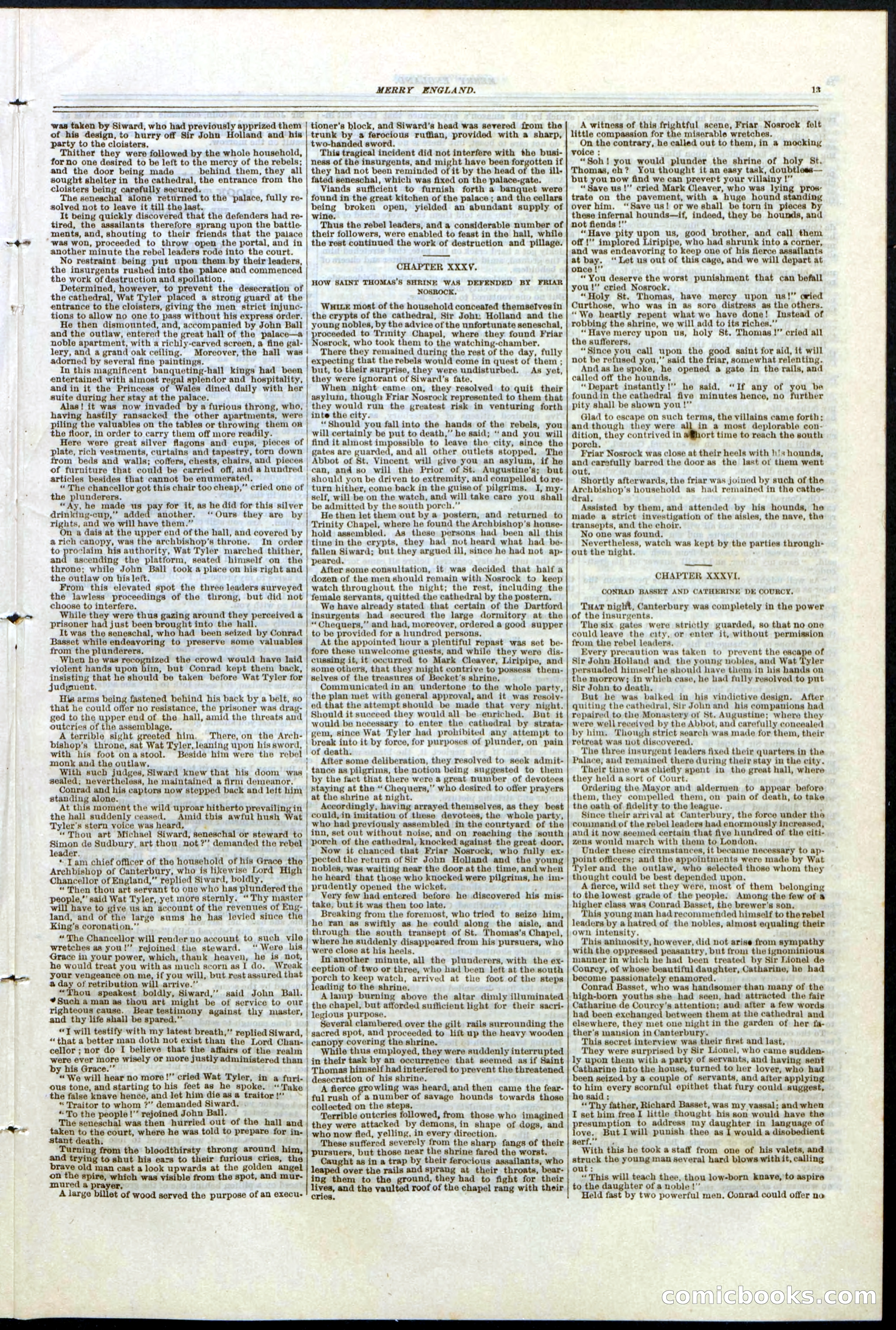
A restored page from Pulp Fiction, 1881. Page through the whole issue in the reader above.
📄 Transcribed text from this page (OCR, searchable)
Machine-transcribed from the original scan — historical spelling and the odd misread are preserved.
was taken by Siward, who had previously apprized them of his design, to hurry off Sir John Holland and his party to the cloisters. Thither they were followed by the whole household, forno one desired to be left to the mercy of the rebels; and the door being made behind them, they all sought shelter in the cathedral, the entrance from the cloisters being carefully secured. The seneschal alone returned to the ‘palace, fully re- solved not to leave it till the last. It being quickly discovered that the defenders had re- tired, the assailants therefore aprang upon the battle. ments, and, shouting to their friends that the palace ‘was won, proceeded to throw open the portal, and in another minute the rebel leaders rode into the court. No restraint being put upon them by their leaders, the insurgents rushed into the palace and commenced the work of destruction and spoilation. Determined, however, to prevent the desecration of the cathedral, Wat Tyler placed a strong guard at the entrance to the cloisters, giving the men strict injunc- tions to allow no one to pass without his express order. He then dismounted, and, accompanied by John Ball and the outlaw, entered the great hall of the palace—a noble apartment, with a richly-carved screen, a fine gal- lery, and a grand oak ceiling. Moreover, the hall was adorned by several fine paintings. In this magnificent banqueting-hall kings had been entertained with almost regal splendor and hospitality, andin it the Princess of Wales dined daily with her suite during her stay at the palace. Alas! it was now invaded by a furious throng, who, having hastily ransacked the other apartments, were piling the valuables on the tables or throwing them on the floor, in order to carry them off more rendily. Here were great silver flagons and cups, pieces of plate, rich vestments, curtains and tapestry, torn down from beds and walls; coffers, chests, chairs, and pieces of furniture that could be carried off, and a hundred articles besides that cannot be enumerated. “ The chancellor got this chair too cheap,” cried one of the plunderers. “Ay, he made us pay for it, as he did for this silver drinking-cup,” added another. ‘ Ours they are by rights, and we will have them.” On a dais at the upper end of the hall, and covered by a rich canopy, was the archbishop’s throne. In order to proclaim his authority, Wat Tyler marched thither, and ascending the platform, seated himself on the throne; while John Ball took a place on his right and the outlaw on his left. From this elevated spot the three leaders surveyed the lawless proceedings of the throng, but did not choose to interfere. While they were thus gazing around they perceived a prisoner had just been brought into the hall. It was the seneschal, who had been seized by Conrad Basset while endeavoring to preserve some valuables from the plunderers. When he was ed the crowd would have laid violent hands upon him, but Conrad kept them back, insisting that he should be taken before Wat Tyler for judgment. His arms being fastened behind his back by a belt, so that he could offer no resistance, the prisoner was drag- ged to the upper end of the hall, amid the threats and outcries of the assemblage. A terrible sight greeted him, There, on the Arch- bishop’s throne, sat Wat Tyler, leaning upon his sword, with his foot onastool. Beside him were the rebel monk and the outlaw. With such judges, Siward knew that his doom was sealed; nevertheless, he maintained a firm demeanor. Conrad and his captors now stepped back and left him standing alone. At this moment the wild uproar hitherto prevailing in the hall suddenly ceased. Amid this awful hush Wat Tyler's stern voice was heard, : “Thou art Michael Siward, seneschal or steward to Simon de Sudbury, art thou not?’ demanded the rebel leader. * Tam chief officer of the household of his Grace the Archbishop of Canterbury, who is likewise Lord High Chancellor of England,” replied Siward, boldly, “ Then thou art servant to one who has plundered the people,”’ said Wat Tyler, yet more sternly. “Thy master will have to give us an account of the revenues of Eng- land, and of the large sums he has levied since the King’s coronation.” “The Chancellor will render no account to such vile wretches as you!”’ rejoined the steward. “ Were his Grace in your power, which, thank heaven, he is not, he would treat you with as much scorn as 1 do. Wreak your vengeance on me, if you will, but rest assured that a day of retribution will arrive.” “Thou speakest boldly, Siward,’’ said John Ball. “Such aman as thou art might be of service to our righteous cause. Bear testimony against thy master, and thy life shall be spared.” “T will testify with my latest breath,” replied Siward, “that a better man doth not exist than the Lord Chan- cellor ; nor do I believe that the affairs of the realm were ever more wisely or more justly administered than by his Grace.”’ “We will hear no more!” cried Wat Tyler, in a furi- ous tone, and starting to his feet as he spoke. “'Take the false knave hence, and let him die asa traitor!” ~ “Traitor to whom ?” demanded Siward. . “To the people!’ rejoined John Ball. — The seneschal was then hurried out of the hall and taken to the court, where he was told to prepare for in- Turning from the bloodthirsty throng around him, and trying to shut his ears to their furious cries, the brave old man cast a look upwards at the golden angel on the spire, which was visible from the spot, and mur- mureda prayer: A large billet of wood served the purpose of an execu ' oy} MERRY ENGLAND. tioner's block, and Siward’s head was severed from the trunk by a ferocious ruffian, provided with a sharp, two-handed sword. This tragical incident did not interfere with the busi- ness of the insurgents, and might have been forgotten if they had not been reminded of it by the head of the ill- fated seneschal, which was fixed on the palace-gate. Viands sufficient to furnish forth a banquet were found in the great kitchen of the palace ; and the cellars being broken open, yielded an abundant supply of wine. Thus the rebel leaders, and a considerable number of their followers, were enabled to feast in the hall, while the rest continued the work of destruction and pillage. CHAPTER XXXV. HOW SAINT THOMAS’S SHRINE WAS DEFENDED BY FRIAR NOSROCK. Wuixe most of the household conceafed themselves in the crypts of the cathedral, Sir Johu Holland and the young nobles, by the advice of the unfortunate seneschal, Fomace ng to Trinity Chapel, where they found Friar osrock, who took them to the watching-chamber. There they remained during the rest of the day, fully expecting that the rebels would come in quest of them ; but, to their surprise, they were undisturbed. As yet, they were ignorant of Siward’s fate. When night came on, they resolved to quit their asylum, though Friar Nosrock represented to them that they would run the greatest risk in venturing forth inte the city. “Should you fallinto the hands of the rebels, you | will certainly be put to death,” he said; “and you will find it almost impossible to leave the city, since the gates are guarded, and all other outlets stopped. The | Abbot of St. Vincent will give you an asylum, if he /can, and so will the Prior of St. Augustine's; but ' should you be driven to extremity, and compelled to re- ' turn hither, come back in the guiseof pilgrims. I, my- | self, will be on the watch, and will take care you shall be admitted by the south porch.” He then let them out by a postern, and returned to Trinity ohspes where he found the Archbishop's house- hold assembled. As these persons had been all this time in the crypts, they had not heard what had be- fallen Siward; but they argued ill, since he had not ap- peared. After some consultation, it was decided that half a dozen of the men should remain with Nosrock to keep watch throughout. the night; the rest, including the female servants, quitted the cathedral by the postern. We have already stated that certain of the Dartford insurgents had secured the large dormitory at the * Chequers,”’ and had, moreover, ordered a good supper to be provided for a hundred persons. At the appointed hour a plentiful repast was set be- fore these unwelcome guests, and while they were dis- cussing it, it occurred to Mark Cleaver, Liripipe, and some others, that they mene contrive to possess them- selves of the treasures of Becket’s shrine, Communicated in an undertone to the whole party, the plan met with general approval, and it was resoly- | ed that the attempt should be made that very night. | Should it suceeed they would all be enriched. But it would be necessary to enter the cathedral by strata- gem, since Wat Tyler had prohibited any attempt to break into it by force, for purposes of plunder, on pain | of death. | After some deliberation, they resolved to seek admit- ' tance as pilgrims, the notion being suggested to them by the fact that there were a great number of devotees staying at the “ Chequers,’’ who desired to offer prayers at the shrine at night. Accordingly, having arrayed themselves, as they best could, in imitation of these devotees, the whole party, who had previously assembled in the courtyard of the inn, set ont without noise, and on reaching the south porch of the cathedral, knocked against the great door. Now it chanced that Friar Nosrock, who fully ex- pected the return of Sir John Holland and the young nobles, was waiting near the door at the time, and when he heard that those who knocked were pilgrims, he im- | prudently opened the wicket, : Mane 4 few had entered before he discovered his mis- take, but it was then too late, Breaking from the foremost, who tried to seize him, he ran as swiftly as he could along the aisle, and | through the south transept of St. Thomas's Chapel, where he suddenly disappeared from his pursuers, who were close at his heels. In another minute, all the plunderers, with the ex- ception of two or three, who had been left at the south orch to keep watch, arrived at the foot of the steps eading to the shrine. L Alamp burning above the altar dimly illuminated the chapel, but afforded sufficient light for their sacri- legious purpose, | Sev clambered over the gilt. rails surrounding the sacred spot, and proceeded to lift up the heavy wooden canopy covering the shrine. While thus employed, they were suddenly interrupted in their task by an occurrence that seemed as if Saint Thomas himself had interfered to prevent the threatened desecration of his shrine. A flerce wling was heard, and then came the fear- ful rush of 4 num of savage hounds towards those collected on the steps. Terrible outcries followed, from those who imagined they were attacked by demons,in shape of dogs, and who now fled, yelling, in every direction. — These suffered severely from the sharp fangs of their | serf pursuers, but those near the shrine fared the worst. t as in a trap by their ferocious assailants, who over the rails and sprang at their throats, bear- ing them to the ground, they had to fight for their lives, and the vaulted roof of the chapel rang with their es. 1% A witness of thia frightful scene, Friar Nosrock felt little compassion for the miserable wretches. ve the contrary, he called out to them, in a mocking voice : “Soh! you would plunder the shrine of holy St. Thomas, eh? You thought it an easy task, doubtlese— but you now find we can prevert your villainy !” “Save us !’’ cried Mark Cleaver, who was lying pros- trate on the pavement, with a huge hound standing over him. “Save us! or we shall be tornin pieces by these infernal hounds—if, indeed, they be hounds, and not fiends !"’ “Have pity upon us, good brother, and call them off !’' implored Liripipe, who had shrunk into a corner, and was endeavoring to keep one of his fierce assailants at bay. “Let us out of this cage, and we will depart at once |"’ “You deserve the worst punishment that can befall you!” cried Nosrock. “Holy St. Thomas, have mercy upon us!” cried Curthose, who was in as sore distreas as the others. “We heartly repent what we have done! Instead of robbing the shrine, we will add to its riches.”’ “Have mercy upon us, holy St. Thomas!” cried all the sufferers, “Since you call upon the good saint for aid, it will not be refused you,” said the friar, somewhat relenting. And. as he spoke, he opened a gate in the rails, and called off the hounds. ‘Depart inatantly!" he said, “If any of found in the cathedral five minutes hence, no pity shall be shown you!” Glad to escape on such terms, the villains came forth; and though they were in a most deplorable con- dition, they contrived in ort time to reach the south porch. Friar Nosrock was close at their heels with }\'s hounds, and carefully barred the door as the last of them went out, Shortly afterwards, the friar was joined by such of the =e meee a household as had remained in the cathe- al ou be rther ral. Assisted by them, and attended by his hounds, he made a strict investigation of the aisles, the nave, the transepts, and the choir. No one was found. Nevertheless, watch was kept by the parties through- out the night. CHAPTER XXXVI, CONRAD BASSET AND CATHERINE DE COURCY, Tuar night, Canterbury was completely in the power of the insurgents. The six gates were strictly guarded, so that no one could leave the city, or enter it, without permission from the rebel leaders. Every precaution was taken to prevent the escape of Sir John Holland and the young nobles, and Wat Tyler persuaded himself he should have them in his hands on the morrow; in which case, he had fully resolved to put Sir John to death, But he was balked in his vindictive design. After quiting the cathedral, Sir John and his companions had repaired to the Monastery of St. Augustine; where they were well received by the Abbot, and carefully concealed by him. Thouyh strict search was made for them, their retreat was not discovered. The three insurgent leaders fixed their quarters in the Palace, and remained there during their stay in the city. Their time was chiefly apent in the great hall, where they held a sort of Court. Ordering the Mayor and aldermen to appear before them, they compelled them, on pain of death, to take the oath of fidelity to the league. i Since their arrival at Canterbury, the force under the conmumand of the rebel leaders had enormously increased, and it now seemed certain that five hundred of the citi- zens would march with them to London. Under these circumstances, it became necessary to ap- ep officers; and the appointments were made by Wat ylerand the outlaw, who selected those whom they thought could be best depended upon. A fierce, wild set they were, most of them belonging to the lowest grade of the people. Among the few of a higher class was Conrad Basset, the brewer's son, This young man had recommended himself to the rebel leaders by a hatred of the nobles, almost equaling their own intensity. This anhnosity, however, did not arise from sympathy with the oppressed peasantry, but from the ignominious manner in which he had been treated by Sir Lionel de Courcy, of whose beautiful daughter, Catharine, he had become ionately enamored. Co Basset, who was handsomer than many of the high-born youths she had seen, had attracted the fair Catharine de Courcy's attention; and after a few words had been exchanged between them at the cathedral and elsewhere, they met one night in the garden of her fa- ther’s mansion in Canterbury. . This secret interview was their first and last, They were surprised by Sir Lionel, who came sudden- ly upon them with a party of servants, and having sent Catharine into the house, turned to her lover, who had been seized by a couple of servants, and after applying 7 him every scornful epithet that fury could suggest, 6 said “Thy father, Richard Basset, was my vassal; and when I set him free I little thought his son would have the george ty to address my ern, jon in language of ove. But Iwill punish thee as 1 would a diso t With this he took a staff from one of his valets, and struck the young man several hard blows with it, calling out: “ This will teach thee, thou low-born knave,)to aspire to the daughter of a noble t”’ Held fast by two powerful men, Conrad could offer no JOOKS (C©) (E(0)