
Pulp Fiction, 1881 · page 12 of 32
Beadle's New York Dime Library No. 125 — page 12: what you’re looking at
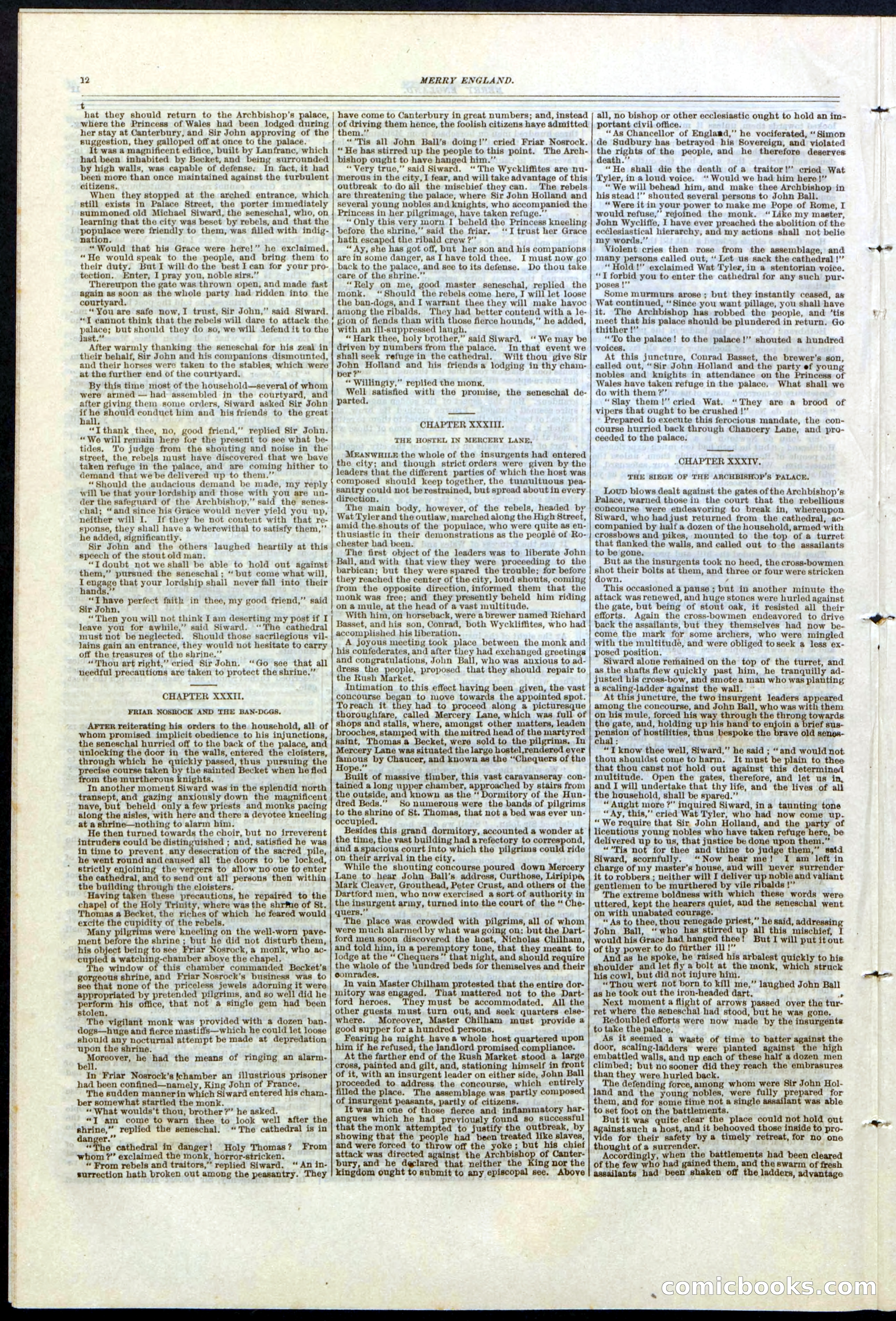
A restored page from Pulp Fiction, 1881. Page through the whole issue in the reader above.
📄 Transcribed text from this page (OCR, searchable)
Machine-transcribed from the original scan — historical spelling and the odd misread are preserved.
: ata Fi-— es =— >> — 72S : 4 - 12 t hat they should return to the Archbishop's ace, where the Princess of Wales had been lodged during her stay at Canterbury, and Sir John approving of the suggestion, they galloped off at once to the palace. It was a magnificent edifice, built by Lanfranc, which had been inhabited by Becket, and being surrounded by high walls, was capable of defense: In fact, it had been more than once maintained against the turbulent citizens. When they stopped at the arched entrance, which still exists in Palace Street, the porter immediately summoned old Michael Siward, the seneschal, who, on learning that the city was beset by rebels, and that the iat were friendly to them, was filled with indig- nation. “Would that his Grace were here!” he exclaimed. “He would speak to the people, and bring them to their duty. ButI will do the best Lean for your pro- tection. Enter, I pray you, noble sirs.” Thereupon the gate was thrown open, and made fast again as soon as the whole party had ridden into the courtyard. “You are safe now,I trust, Sir John,” said Siward. “TI cannot think that the rebels will dare to attack the palace; but should they do so, we will Jefend it to the just.” After warmly thanking the seneschal for his zeal in tlieir behalf, Sir John and his companions dismounted, and their horses were taken to the stables, which were at the further end of the courtyard. By this time most of the household—several of whom were armed — had assembled in the courtyard, and after giving them some orders, Siward asked Sir John if he should conduct him and his friends to the great hall, “TI thank thee, no, good friend,” replied Sir John. “We will reniain here for the present to see what be- tides. To judge from the shouting and noise in the street, the rebels must have discovered that we have taken refuge in the palace, and are coming hither to demand that we be delivered up to them.’’ “Should the audacious demand be made, my reply will be that your lordship and those with you are un- der the safeguard of the Archbishop,” said the senes- chal; “and since his Grace would neyer yield you up, neither will I. If they be not content with that re- sponse, they shall have a wherewithal to satisfy them,”’ he added, significantly. Sir John and the others laughed heartily at this speech of the stout old man. “T doubt not we shall be able to hold out against them,”’ pursned the seneschal ; “ but come what will, I ongege that your lordship shall never fall into their hands.”’ *“T have perfect faith in thee, my good friend,” said Sir John. “Then you will not think I am desertin leave you for awhile,” said Siward. “ must not be neglected. Should those sacrilegious vil- lains gain an entrance, they would not hesitate to carry off the treasures of the shrine.” “Thou art right,” cried Sir John. “Go see that all needful precautions are taken to protect the shrine,” iny post if I e cathedral CHAPTER XXXII. FRIAR NOSROCK AND THE BAN-DOGS. AFTER reiterating his orders to the household, all of whom promised implicit obedience to his injunctions, the seneschal hurried off to the back of the palace, and unlocking the door in the walls, entered the cloisters, through which he quickly passed, thus pursuing the age course taken y the sainted Becket when he fled the murtherous knights. In another moment Siward was in the splendid north transept, and gazing anxiously down the nificent nave, but beheld only a few priests and monks pacin along the aisles, with here and there a deyotee kneeling at a shrine—nothing to alarm him. He then turned towards the choir, but no irreverent intruders could be distinguished ; and, satisfied he was in time to prevent any desecration of the sacred pile, he went round and caused all the doors to be locked rt cee Mi Papa, the vergers to allow no one to enter the cathedral, and to send out all persons then within the Pie kee the cloisters. Te en these precautions, he repaired to the chapel of the Holy Trinity, where was the shrm™e of St. Thomas a Becket, the riches of which he feared would excite the cupidity of the rebels. Many pilgrims were kneeling on the well-worn pave- ment before the shrine ; but he did not disturb them, his oblect vane to see Friar Nosrock, a monk, who ac- cupied a watching-chamber above the chapel. e window of this chamber commanded Becket’s us shrine, and Friar Nosrock’s business was to see that none of the priceless jewels adorning it were appropriated by pretended pilgrims, and so well did he og his office, that not a single gem had been stolen, The vigilant monk was provided with a dozen ban- dogs—huge and fierce mastiffs—which he could let loose should any nocturnal attempt be made at depredation upon the shrine. — wey es he had the means of ringing an alarm- In Friar Nosrock’s [chamber an illustrious prisoner had been confined—namely, King John of France, The sudden mannerin which Siward entered his cham- ber somewhat startled the monk. “What woulds’t thou, brother?” he asked. “TI am come to warn thee to look well after the shrine,” replied the seneschal. “The cathedral is in danger.” “The cathedral in danger! Holy Thomas? From whom ?” exclaimed the monk, horror-stricken. “ From rebels and traitors,” replied Siward. ‘ An in- surrection hath broken out among the peasantry. They MERRY ENGLAND. have come to Canterbury in great numbers; and, instead re driving them hence, the foolish citizens haye admitted em.”” “*Tis all John Ball’s doing!’’ cried Friar Nosrock. “He has stirred up the people to this point. The Arch- bishop ought to have hanged him.” “Very true,”’ said Siward. “The Wyckliffites are nu- merous in the city, I fear, and will take advantage of this outbreak to do all the mischief they can. The rebels are threatening the palace, where Sir John Holland and several young nobles and knights, who accompanied the Princess in her pilgrimage, have taken refuge.” “Only this very morn I beheld the Princess kneeling before the shrine,” said the friar. ‘I trust her Grace hath escaped the ribald crew ?” “ Ay, she has got off, but her son and his companions are in some danger, as I have told thee. I must now go back to the palace, and see to its defense. Do thou take care of the shrine.” “Rely on me, good master seneschal, replied the monk. “Should the rebels come here, I will let loose the ban-dogs, and I warrant thee they will make havoc among the ribalds. They had better contend with a le- gion of fiends than with those fierce hounds,” he added, with an ill-suppressed langh, “ Hark thee, holy brother,” said Siward. ‘‘ We may be driven Ur numbers from the palace. In that event we shall seek refuge in the cathedral. Wilt thou give Sir John Holland and his friends a lodging in thy cham- ber ?” “ Willingly,” replied the monx, Well satisfied with the promise, the seneschal de- parted. CHAPTER XXXII. THE HOSTEL IN MERCERY LANE, MEANWHILE the whole of the insurgents had entered the city; and though strict orders were given by the leaders that the different parties of which the host was composed should keep together, the tuiaultuous pea- santry could not be restrained, but spread about in every direction. The main body, however, of the rebels, headed by Wat Tyler and the outlaw, marched along the High Street, amid the.shouts of the populace, who were quite as en- thusiasticin their demonstrations as the people of Ro- chester had been. The first object of the leaders was to liberate John Ball, and with that view they were proceeding to the barbican; but they were spared the trouble; for before they reached the center of the city, loud shouts, coming from the opposite direction, informed them that the monk was free; and they presently beheld him riding on a mule, at the head of a vast multitude. With him, on horseback, were a brewer named Richard Basset, and his son, Conrad, both Wyckliffites, who had accomplished his liberation. A joyous meeting took place between the monk and his confederates, and after they had exchanged greetings and congratulations, Jolin Ball, who was anxious to ad- dress the people, proposed that they should repair to the Rush Market. Intimation to this effect having been given, the vast concourse began to move towards the appointed spot. Toreach it they had to proceed agin} a pictu ue thoroughfare, called Mercery Lane, which was full of shops and stalls, where, amongst other matters, leaden brooches, staniped with the mitred head of the martyred saint, Thomas a Becket, were sold to the igrines, In Mercery Lane was situated the large hostel, ever famous by Chaucer, and known as the “Chequers of the ope.” Built of massive timber, this vast caravanseray con- tained a long upper chamber, approached by stairs from the outside, and known as the “‘ Dormitory of the Hun- dred Beds.” So numerous were the bands of pilgrims to the shrine of St. Thomas, that not a bed was ever un- occupied. Besides this grand dormitory, accounted a wonder at the time, the vast building had arefectory to correspond, and a epee one court into which the pilgrims could ride on their arrival in the city. While the shouting concourse poured down Mercery Lane to hear John I's address, Curthose, Liripipe, Mark Cleaver, Grouthead, Peter Crust, and others of the Dartford men, who now exercised a sort of authority in the insurgent army, turned into the court of the “ Che- quers,”’ The place was crowded with pilgrims, all of whom were much alarmed by what was going on: but the Dart- ford men soon discovered the host, Nicholas Chilham, and told him, ina parenyphory tone, that they meant to lodge at the “ Chequers” that night, and should require the whole of the hundred beds for themselves and their oomrades. In vain Master Chilham protested that the entire dor- mitory was engaged, That mattered not to the Dart- ford heroes. They must be accommodated. All the other guests must turn out, and seek quarters else- where. Moreover, Master Chilham must provide a good supper for a hundred persons. Fearing he ht havea whole host quartered upon him if he refused, the landlord promised compliance. At the farther end of the Rush Market s a large cross, painted and gilt, and, stationing himself in front of it, with an insurgent leader on either side, John Ball procended to address the concourse, which entirely ed the place. The assemblage was partly composed of insurgent ts, partly of citizens. It was in one of those fierce and inflammatory har- angues which he had previously found so successful that the monk attempted to justify the outbreak, by showing that the people had been treated like slaves, and were forced to throw off the yoke; but his chief attack was directed t the Archbishop of Canter- bury, and he d@¢l that neither the King nor the kingdom ought to submit to any episcopal see. Above all, no bishop or other ecclesiastic ought to hold an im- portant civil office. “As Chancellor of Englaad,’’ he vociferated, “Simon de Sudbury has betrayed his Sovereign, and violated yg of the people, and he therefore deserves eath.”’ “He shall die the death of a traitor!’’ cried Wat Tyler, in aloud voice. “* Would we had him here!” “We will behead him, and make thee Archbishop in his stead !’’ shouted several persons to John Ball. “Were it in your power to make me Pope of Rome, I would refuse,”’ rejoined the monk. “ Like my master, John Wycliffe, I have ever preached the abolition of the ecélesiastical hierarchy, and my actions shall not belie my words.” Violent cries then rose from the assemblage, and many persons called out, *‘ Let us sack the cathedral |’’ ‘Hold! exclaimed Wat Tyler, in a stentorian voice. “I forbid you to enter the cathedral for any such pur- poses !"’ Some murmurs arose; but they instantly ceased, as Wat continued, “Since you want pillage, you shall have it. The Archbishop has robbed the people, and ’tis meet that his palace should be plundered in return. Go thither ["’ “To the palace! to the palace!’”’ shouted a hundred voices. At this juncture, Conrad Basset, the brewer's son, called out, “Sir John Holland and the party ef young nobles and knights in attendance on the Princess of Wales have taken refuge in the palace, What shall we do with them ?’’ “Slay them!" cried Wat. “They are a brood of vipers that ought to be crushed |” Prepared to execute this ferocious mandate, the con- course hurried back through Chancery Lane, and pro- ceeded to the palace. CHAPTER XXXTYV. THE SIEGE OF THE ARCHBISHOP’S PALACE. Loup blows dealt against the gates of the Archbishop’s Palace, warned those in the court that the rebellious concourse were endeavoring to break in, whereupon Siward, who had just returned from the cathedral, ac- companied by half a dozen of the household, armed with crossbows and pikes, mounted to the top of a turret that flanked the walls, and called out to the assailants to be gone. But as the insurgents took no heed, the cross-bowmen ye their bolts at them, and three or four were stricken own. , This occasioned a pause; but in another minute the attack was renewed, and huge stones were hurled against the gate, but being of stout oak, it resisted all their efforts. Again the cross-bowmen endeavored to drive back the assailants, but they themselves had now be- come the mark for some archers, who were mingled with the multitude, and were obliged toseek a less ex- posed position. Siward alone rerhained on the top of the turret, and as the shafts flew quickly past him, he tranquilly ad- justed his cross-bow, and smote a man who was planting a scaling-ladder against the wall. ~ At this juncture, the two insurgent leaders appeared among the concourse, and John Ball, who was with them on his mule, forced his way through the throng towards the gate, and, holding up his hand to enjoin a brief sus- pens on of hostilities, thus bespoke the brave old senes- c . “IT know thee well, Siward,”’ he said ; “and would not thou shouldst come to harm. It must be plain to thee that thou canst not hold out against this determined multitude. Open the gates, therefore, and let us in, and I will undertake that thy life, and the lives of ali the household, shall be spared.” “ Aught more ?” inquired Siward, in a taunting tone “Ay, this,’’ cried Wat Tyler, who had now come up- “ We require that Sir John Holland, and the party of licentious young nobles who have taken refuge here, be delivered up to us, that justice be done upon them.” “'Tis not tor thee and thine to judge them,” said Siward, scornfully. “Now hear me! I am left in charge of ny master’s house, aud will never surrender it to robbers ; neither will I deliver up noble and valiant gentlemen to be murthered by vile ribalds !” The extreme boldness with which these words were uttered, kept the hearers quiet, and the seneschal went on with unabated courage. “ As to thee, thou renegade priest,” he said, addressin Jobn Ball, “who has stirred up all this mischief, i would his Grace had hanged thee But I will put it out of thy power to do further ill!” And as he spoke, he raised his arbalest quickly to his shoulder and let fly a bolt at the monk, which struck his cowl, but did not injure hin. “Thou wert not born to kill me,” laughed John Ball as he took out the iron-headed dart. o Next moment a flight of arrows passed over the tur- ret where the seneschal had stood, but he was gone. Redoubled efforts were now made by the insurgents to take the palace, it seemed a waste of time to batter against the door, scaling-ladders were planted against the high embattled walls, and up each of these half a dozen men climbed; but no sooner did they reach the embrasures than they were hurled back. — : The defending force, among whom were Sir John Hol- land and the young nobles, were fully prepared for them, and for some time not a single t was able to set foot on the battlements. But it was quite clear the place could not hold out Against such a host, and it behooved those inside to pro- de for their safety by a timely retreat, for no one thought of a surrender. . Accordingly, when the battlements had been cleared of the few who had gained them, and the swarm of fresh assailants had been shaken off the ladders, advantage Gomicbooks (E(0)