
Pulp Fiction, 1881 · page 11 of 32
Beadle's New York Dime Library No. 125 — page 11: what you’re looking at
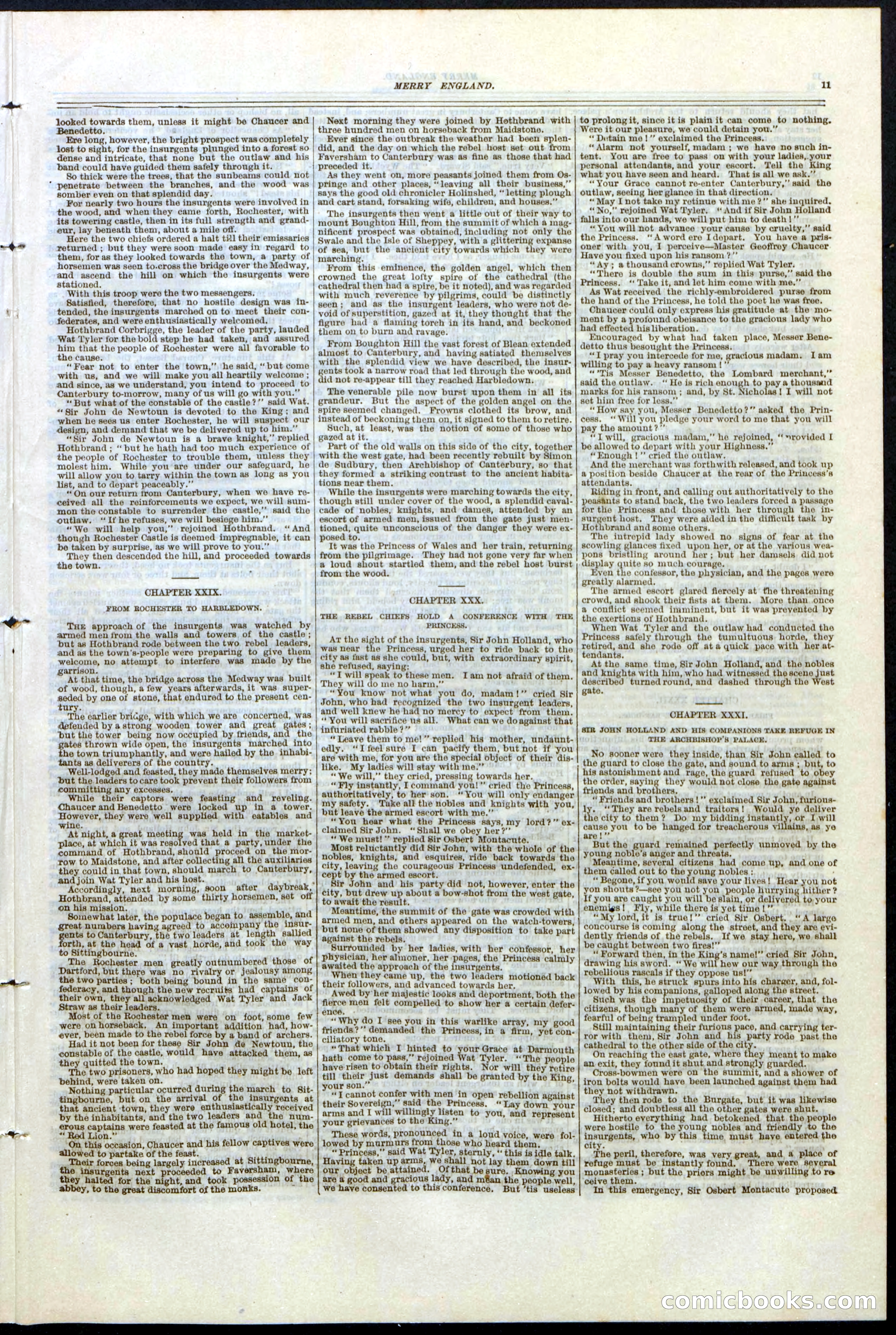
A restored page from Pulp Fiction, 1881. Page through the whole issue in the reader above.
📄 Transcribed text from this page (OCR, searchable)
Machine-transcribed from the original scan — historical spelling and the odd misread are preserved.
MERRY ENGLAND, il looked towards them, unless it might be Chaucer and Benedetto. Ere long, however, the bright prospect was completely lost to sight, for the insurgents plunged into a forest so dense and intricate, that none but the outlaw and his band could have guided them safely through it. So thick were the trees, that the sunbeams could not * penetrate between the branches, and the wood was somber even on that splendid day. For nearly two hours the insurgents were involved in the wood, and when they came forth, Rochester, with its towering castle, then in its full strength and grand- eur, lay beneath them, about a mile off. Here the two chiefs ordered a halt tii] their emissaries returned ; but they were soon made easy in regard to them, for as they looked towards the town, a party of horsemen was seen to.croas the bridge over the Medway, and ascend the hill on which the insurgents were stationed. With this troop were the two messengers. Satisfied, therefore, that no hostile design was in- tended, the insurgents marched on to meet their con- federates, and were enthusiastically welcomed. Hothbrand Corbrigge, the leader of the party, lauded Wat Tyler for the bold step he had taken, and assured him that the people of Rochester were all favorable to the cause. “Fear not to enter the town,” he said, “but come with us, and we will make you all heartily welcome ; and since, as we understand, you intend to proceed to Canterbury to-morrow, many of us will go with you.” “But what of the constable of the castle?’’ said Wat. “Sir John de Newtoun is devoted to the King; and when he sees us enter Rochester, he will suspect our design, and demand that we be delivered wp to him.” “Sir John de Newtoun is a brave knight,” replied Hothbrand ; “but he hath had too much experience of the people of Rochester to trouble them, unless they molest him. While you are under our safeguard, he will allow you to tarry within the town as long as you list, and to depart peaceably.” “On our return trom Canterbury, when we have re- ceived all the reinforcements we expect, we will sum- mon the constable to surrender the castle,’’ said the outlaw. “If he refuses, we will besiege him.” “We will help you,” rejoined Hothbrand. “And though Rochester Castle is deemed impregnable, it can be taken by surprise, as we will prove to you.” They then descended the hill, and proceeded towards the town. CHAPTER XXIX. FROM ROCHESTER TO HARBLEDOWN. THE approach of the insurgents was watched by armed men from the walls and towers of the castle ; but as Hothbrand rode between the two rebel leaders, and as the town's-people were preparing to give them welcome, no attempt to interfere was made by the garrison. At that time, the bridge across the Medway was built of wood, though, a few years afterwards, it was super- seded by one of stone, that endured to the present cen- ry. The earlier bridge, with which we are concerned, was defended by a strong wooden tower and great gates; but the tower being now occupied by friends, and the oe thrown wide open, the insurgents marched into e town triumphantly, and were hailed by the inhabi- tants as deliyerers of the country. Well-lodged and feasted, they made themselves merry; but the leaders tocare took prevent their followers from committing any excesses. While their captors were feasting and reveling. Chaucer and Benedetto were locked up in a tower. ar habia they were well supplied with eatables and wine. At night, a Groat mesting was held in the market- place, at which it was resolved that a party,under the command of Hothbrand, should proceed on the mor- row to Maidstone, and after collecting all the auxiliaries they could in that town, should march to Canterbury, and join Wat Tyler and his host. Accordingly, next morning, soon after daybreak, Hothbrand, attended by some thirty horsemen, set off on his mission. Somewhat later, the populace began to assemble, and great numbers having agreed to accoinpany the insur- ane to Canterbury, the two leaders at length sallied orth, at the head of a vast horde, and took the way to Sittingbourne. The Rochester men greatly outnumbered those of Dartford, but there was no rivalry or jealousy among the two parties; both being bound in the same con- federacy, and though the new recruits had captains of their own, prog all acknowledged Wat Tyler and Jack Straw as their leaders. Most of the Rochester men were on foot, some few were on horseback, An Daportent addition had, how- ever, been made to the rebel force by a band of archers. Had it not been for these Sir John de Newtoun, the constable of the castle, would have attacked them, as they quitted the town. The two prisoners, who had hoped they might be left behind, were taken on. Nothing particular ocurred during the march to Sit- tingbourne, but on the arrival of the insurgents at that ancient ‘town, they were enthusiastically received by the inhabitants, and the two leaders and the num- erous captains were feasted at the famous old hotel, the 4 Lion.” ; “Or on occasion, Chaucer ae his fellow captives were d to partake of the feast. Their forces being largely increased at Sittingbourne, insurgents next proceeded to Faversham, where they hala for the aight, and took possession of the , to the great discomfort of the monks. Next morning they were joined by Hothbrand with three hundred men on horseback from Maidstone. Ever since the outbreak the weathor had been splen- did, and the day on which the rebel host set out from Faversham to Canterbury was as fine as those that had preceded it. As they went on, more peasants joined them from Os- pringe and other places, “leaving all their business,”’ says the good old chronicler Holinshed, “ letting plough and cart stand, forsaking wife, children, and houses.” The insurgents then went a little out of their way to mount Boughton Hill, from the summit of which a mag- nificent prospect was obtained, including not only the Swale and the Isle of Sheppey, with a glittering expanse of sea, but the ancient city towards which they were marching. From this eminence, the golden angel, which then crowned the great lofty spire of the cathedral (the cathedral then had a spire, be it noted), and was regarded with much reverence by pilgrims, could be distinctly seen; and as the insurgent leaders, who were not de- void of superstition, gazed at it, they thought that the figure had a flaming torch in its hand, and beckoned them on to burn and ravage. From Boughton Hill the vast forest of Blean extended almost to Canterbury, and having satiated themselves with the splendid view we have described, the insur- gents took a narrow road that led through the wood, and did not re-appear till they reached Harbledown. The venerable pile now burst upon them in all its grandeur. But the aspect of the golden angel on the spire seemed changed. Frowns clothed its brow, and instead of beckoning them on, it signed to them to retire. Such, at least, was the notion of some of those who gazed at it. Part of the old walls on this side of the city, together with the west gate, had been recently rebuilt by Simon de Sudbury, then Archbishop of Canterbury, so that they formed a striking contrast to the ancient habita- tions near them. While the insurgents were marching towards the city, though still under cover of the wood, a splendid caval- cade of nobles, knights, and dames, attended by an escort of armed men, issued from the gate just men- tioned, quite unconscious of the danger they were ex- posed to. It was the Princess of Wales and her train, returning from the pilgrimage. They had not gone very far when a loud shout startled them, and the rebel host burst from the wood. CHAPTER XXX. THE REBEL CHIEFS HOLD A CONFERENCE WITH THE PRINCESS. At the sight of the insurgents, Sir John Holland, who was near the Princess, urged her to ride back to the city as fast as she could, but, with extraordinary spirit, she refused, saying: “TI will speak to these men. Iam not afraid of them. They will do me no harm,” , / “You know not what you do, madam!” cried Sir John, who had recognized the two insurgent leaders, and well knew he had no mercy to expect from them. “You will sacrifice us all. What can we doagainst that infuriated rabble ?” “Leave them to me!” replied his mother, undaunt- edly. “Ifeelsure I can pacify them, but not if you are with me, for you are the special object of their dis- like. My ladies will stay with me.” “We will,” they cried, pressing towards her. “Fly instantly, I command you!” cried the Princess, authoritatively, to her son. “You will only endanger my safety. ‘Take all the nobles and knights with you, but leave the armed escort with me.” Bi. “You hear what the Princess says, my lord?” ex- claimed Sir John. “Shall we obey her?’ **We must!” replied Sir Osbert Montacute. Most reluctantly did Sir John, with the whole of the nobles, knights, and esquires, ride back towards the city, leaving the courageous Princess undefended, ex- rhe by the armed escort. ir John and his party did not, however, enter the city, but drew up about a bow-shot from the west gate, to await the result. Meantime, the summit of the gate was crowded with armed men, and others appeared on the watch-towers, but none of them showed any disposition to take part against the rebels. Surrounded by her ladies, with her confessor, her physician, her almoner, her pages, the Princess calmly awaited the approach of the insurgents. When they came up, the two leaders motionéd back their followers, and advanced towards her. Awed by her majestic looks and deportment, both the fierce men felt compelled to show her a certain defer- encé. - “Why do I see you in this warlike array, my good friends?’’ demanded the Princess, in a firm, yet con- ciliatory tone. “That which I hinted to yourGrace at Darmouth hath come to pass,” rejoined Wat Tyler. “‘The people have risen to obtain their rights. Nor will they retire till their just demands shall be granted by the King, our son.” we I cannot confer with men in open rebellion against their pth ges said the Princess. “Lay down your arms and I will willingly listen to you, and represent your grievances to the King.” These words, pronounced in a loud yoice, were fol- lowed by murmurs from those who heard them, “Princess,” said Wat Tyler, sternly, “ this is idle talk. Having taken up arms, we shall not lay them down till our object be attained. Ofthat be sure. Knowing you are a good and ous lady, and m@an the people well, we have consented to thisconference., But ’tis useless to prolongit, since itis plain it can come to nothing. Were it our pleasure, we could detain you.” “ Dutain me!’ exclaimed the Princess. “Alarm not yourself, madam ; we have no snch in- tent. You are free to ee on with your ladies,.your personal attendants, and your escort. Tell the King what you have seen and heard. That is all we ask.” “Your Grace cannot re-enter Canterbury,’ said the outlaw, seeing her glance in that direction. “May I not take my retinue with me ?”’ she inquired. “No,” rejoined Wat Tyler. “And if Sir John Holland falls into our hands, we will put him to death !’’ “You will not advance your cause by cruelty,’ said the Princess. “A word ere Idepart. You have a pris- oner with you, 1 perceive—Master Geoffrey Chaucer Have you fixed upon his ransom ?’”’ “Ay; a thousand crowns,” replied Wat Tyler. “There is double the sum in this purse,” said the Princess. ‘' Take it, and let him come with me,”’ As Wat received the richly-embroidered purse from the hand of the Princess, he told the poet he was free. Chaucer could only express his gratitude at the mo- ment by a profound obeisance to the gracious lady who had effected his liberation. Encouraged by what had taken place, Messer Bene- detto thus besought the Princess. “T pray you intercede for me, gracious madam. Iam willing to pay a heavy ransom |" “'Tis Messer Benedetto, the Lombard merchant,’’ said the outlaw. “ He is rich enough to pay a thousand marks for his ransom ; and, by St. Nicholas! I will not set him free for less.” “ How say you, Messer Benedetto?” asked the Prin- cess. ‘ Will you pledge your word to me that you will pay the amount?”’ *T will, gracious madam,” he rejoined, “ »rovided [ be allowed to depart with your Highness.” “Enough !”’ cried the outlaw. And the merchant was forthwith released, and took up a position beside Chaucer at the rear of the Princess's attendants. Riding in front, and calling out authoritatively to the peasints to stand back, the two leaders forced a passage for the Princess and those with her through the in- surgent host. They were aided in the difficult task by Hothbrand and some others. The intrepid lady showed no signs of fear at the scowling glances fixed upon her, or at the various wea- pons bristling around her; but her damsels did not display quite so much courage. Eyen the confessor, the physician, and the pages were greatly alarmed. The armed escort glared fiercely at the threatening crowd, and shook their fists at them. More than..once a conflict seemed imminent, but it was preyented by the exertions of Hothbrand. When Wat Tyler and the outlaw had conducted the Princess safely through the tumultuous horde, they retired, and she rode off ata quick pace with her at- tendants. At the same time, Sir John Holland, and the nobles and knights with him, who had witnessed the scene just est turned round, and dashed through the West ga . OHAPTER XXXI. SIR JOHN HOLLAND AND HIS COMPANIONS TAKE REFUGE IN THE ARCHBISHOP’ PALACE. No sooner were they inside, than Sir John ealled to the guard to close the gate, and sound to arma ; but, to his astonishment and rage, the guard refused to obey the order, saying they would not close the gate against friends and brothers, “ Frionds and brothers!” exclaimed Sir John, furionus- ng “They are rebels and traitors! Would ye deliver the city to them? Do my bidding ina tenety or. Iwill pie you to be hanged for treacherous as yo are ” ‘ But the ayers remained perfectly unmoved by the young noble’s anger and threats, Meantime, several citizens had come up, and one of them Called out to the young nobles : * Begone, if you would save your lives! Hear you not yon shouts ?—see you not yon people hurrying hither ? If you are caught you will be slain, or delivered to your enemigs! Fly, while thereisyettime!” |. “My lord, it is true!’’ cried Sir Osbert.. “A large concourse is coming along the street, and they are evi- dently friends of the rebels. If we stay here, we shall be caught between two fires!” otheat “ Forward then, in the King’s name!” cried Sir John, drawing his sword. “ We hew our way through the rebellious rascals if they oppose us!” With this, he struck spurs into his charger, and, fol- lowed by his yp commer alloped along the street. Such was the impetuosity of their career, that the citizens, thongh many of them were armed, way, fearful of being trampled under foot, Still maintaining their furious pace, and carrying ter- ror with them, Sir John and his party rode past the cathedral to the other side of the ae. | On reaching the east gate, where they meant to make an exit, they found it shut and strongly guarded. Cross-bowmen were on the summit, and a shower of iron bolts would have been launched against them had they not withdrawn. They then rode to the Burgate, but it was likewise closed; and doubtless all the other gates were shut. Hitherto everything had betokened that + oe le were hostile to the Sate Rice) ae and sig be ° insurgents, who by this e must have en the ai 4 sree The peril, therefore, was y and a place of refuge must be instantly foiind eThere were several monasteries ; but the priors might be unwilling to re ‘ceive them. ~~ In this emergency, Sir Osbert ‘Montacute proposed GOmicdoo cS (E(@)