
Pulp Fiction, 1881 · page 10 of 32
Beadle's New York Dime Library No. 125 — page 10: what you’re looking at
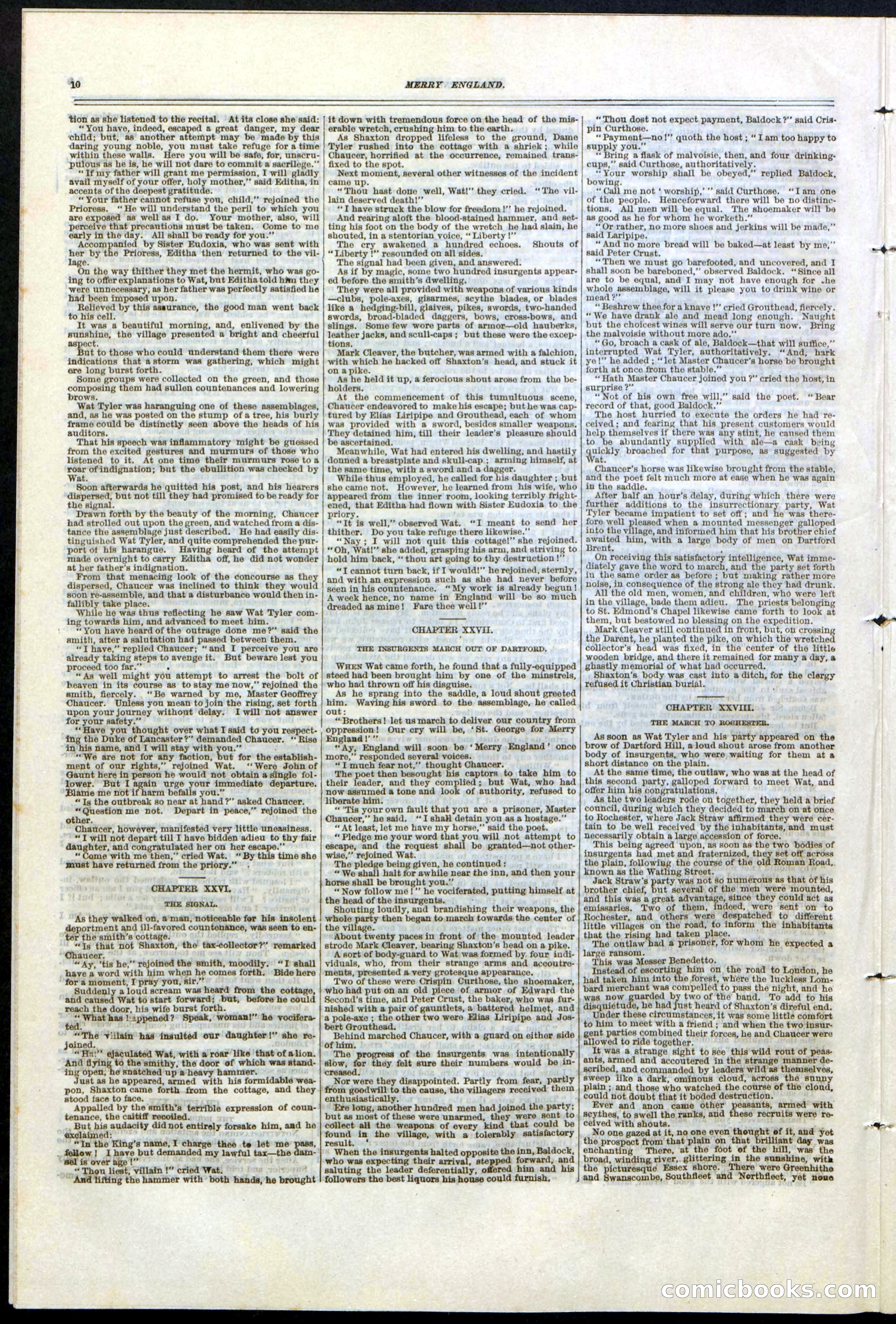
A restored page from Pulp Fiction, 1881. Page through the whole issue in the reader above.
📄 Transcribed text from this page (OCR, searchable)
Machine-transcribed from the original scan — historical spelling and the odd misread are preserved.
ing towards him, and advan 10 MERRY ENGLAND. tion as she listened to the recital. At its close she said: “You have, indeed, escaped a great danger, my dear ‘child; but, as another attempt may be made by this daring young noble, you must take refuge for a time within these walls. Here you will be safe, for, unscru- pulous as he is, he will not dare to commit a sacrilege.” “Tf my father will grant me permission, I will gladly avail myself of your offer, holy mother,” said Editha, in accents of the deepest gratitude. * Your father cannot refuse you, child,’’ rejoined the Prioress. ‘He will understand the peril to which you are exposed as wellas I do. Your mother, also, will perceive that precautions must be taken. Come to me early in the day. All shall be ready for you.” Accompanied by Sister Eudoxia, who was sent with her by the Prioress, Editha then returned to the vil- 1 age. On the way thither they met the hermit, who was go- ing to offer explanations to Wat, but Editha told him they were unnecessary, as her father was perfectly satisfied he had been imposed upon. Relieved by this assurance, the good man went back to his cell. It was a beautiful morning, and, enlivened by the sunshine, tho village presented a bright and cheerful aspect. Bat to those who could understand them there were indications that astorm was gathering, which might ere long burst forth. Some groups were collected on the green, and those Me a them had sullen countenances and lowering rows. Wat Tyler was haranguing one of these assemblages, and, as he was posted on the stump ofa tree, his burly frame could be distinctly seen above the heads of his auditors. That his speech was inflammatory might be guessed from the excited gestures and murmurs of those who listened to it. At one time their murmurs rose toa van of indignation; but the ebullition was checked by fat. Soon afterwards he quitted hia post, and his hearers dispersed, but not till they had promised to be ready for the signal. Drawn forth by the beauty of the morning, Chaucer had strolled out upon the green, and watched from a dis- tance the assemblage just described. He had easily dis- tinguished Wat Tyler, and quite comprehended the pur- port of his harangue. Having heard of the attempt made overnight to carry Editha off, he did not wonder at her father’s indignation. From that menacing look of the concourse as they dispersed, Chaucer was inclined to think they would soon re-assemble, and that a disturbance would then in- fallibly take place. While he was thus oe he saw Wat Tyler com- to meet him. “You have heard of the outrage done me?” said the smith, after a salutation had passed between them. “T have,” replied Chaucer; “and I perceive you are already taking steps to avenge it. But beware lest you proceed too far.” . “As well might you attempt to arrest the bolt of heaven in its course as to stay me now,” rejoined the smith, fiercely. _‘‘Be warned by me, Master Geoffrey Chaucer. Unless you mean to join the rising, set forth upon your journey without delay. I will not answer for your safety.” *“‘Have you thought over what I said to you respect- a Duke of Lancaster?” demanded Chaucer. ‘“ Rise in his name, and I will stay with you.” ‘We are not for any faction, but for the establish- ment of our rights,” rejoined Wat. ‘ John of Gaunt here in person he would not obtain a e fol- lower. But I again urge your immediate departure. Blame me not if herr befalls you.” “Ig the outbreak so near at hand?” asked Chaucer. “Question me not. Depart in peace,” rejoined the Chaticer, however, manifested very little uneasiness. pow: I will not depart soe) I and See adieu to thy fair ughter, and congratulated her on her ‘he a ¢ with me then,” cried Wat. “ y this time she must have returned from the priory.” a F CHAPTER XXVI. ' THE SIGNAL. As they walked on, aman, noticeable for his insolent Seporiment and ill-favored countenance, was seen to en- er the smith’s cottage. ~ “Ts that not Shaxton, the tax-collector?” remarked Chaucer, “Ay, tis he,’ rejoined the smith, moodily. “TI shall have a word with him when he comes forth. Bide here for a moment, I pray you, sir.” Suddenly aloud scream was heard from the cottage, and ca Wat to start forward; but, before he could reach the door, his wife burst forth. ' aint ¥illain’ hag insulted our daughter!” she re- Ass Ha; ejaculated Wat, with a roar like that of alion. | Ss Sytie the smithy, the door of which was stand- a, é snatched up a heavy hammer. ust as he appeared, armed with his formidable wea- pon, Shaxton came forth from the cottage, and they stood face to face. ..-, Appalled by the smith’s terrible expression of coun- tenance, the caitiff recoiled. . But his audacity did not entirely forsake him, amd he exclaimed: ‘ “In the King’s name, I charge thee te let me om ma! ve but demanded my lawful tax—the . Ph eng NO a Ee : lifting the hammer with both hands, he brought it down with tremendous force on the head of the mis- erable wretch, crushing him to the earth. As Shaxton dropped lifeless to the ground, Dame Tyler rushed into the cottage with a shriek; while Chaucer, horrified at the occurrence, remained trans- fixed to the spot. Next moment, several other witnesses of the incident came up. “Thou hast done well, Watl!’’ they cried. ‘‘The vil- lain deserved death!’’ **T have struck the blow for freedom !’’ he rejoined. And rearing aloft the blood-stained hammer, and set- ting his foot on the body of the wretch he had slain, he shouted, in a stentorian voice, “‘ Liberty !’’ The cry awakened a hundred echoes. “ Liberty !”’ resounded on all sides. The signal had been given, and answered. As if by magic, some two hundred insurgents appear- ed before the smith’s dwelling. They were all provided with weapons of various kinds —clubs, pole-axes, gisarmes, scythe blades, or blades like a hedging-bill, om pikes, swords, two-handed swords, broad-bladed daggers, bows, cross-bows, and slings. Some few wore parts of armor—old hauberks, leather jacks, and scull-caps; but these were the excep- tions. Mark Cleaver, the butcher, was armed with a falchion, with which he hacked off Shaxton’s head, and stuck it on a pike. As he held it up, a ferocious shout arose from the be- holders. At the commencement of this tumultuous scene, Chaucer endeavored to make his escape; but he was cap- tured by Elias Liripipe and Grouthead, each of whom was provided with a sword, besides smaller weapons. They detained him, till their leader's pleasure should be ascertained. Meanwhile, Wat had entered his dwelling, and hastily donned a breastplate and skull-cap.; arming himself, at the same time, with a sword and a dagget While thus employed, he called for his daughter ; but she came not. However, he learned from his wife, who appeared from the inner room, looking terribly fright- ese that Editha had flown with Sister Eudoxia to the priory. “It is well,” observed Wat. “I meant to send her thither. Do you take refuge there likewise.” “Nay; I will not quit this cottage!” she rejoined. “Oh, Wat!” she added, grasping his arm, and striving to hold him back, “‘ thou art going to thy destruction !" “T cannot turn back, if I would!” he rejoined, sternly, and with an expression such as she had never before seen in his countenance. “My work is already begun! A week hence, no name in England will be so much dreaded as mine! Fare thee well!’’ Shouts of CHAPTER XXVIII. THE INSURGENTS MARCH OUT OF DARTFORD. WHEN Wat came forth, he found that a fully-equipped steed had been brought him by one of the minstrels, who had thrown off his disguise. As he sprang into the saddle, a loud shout greeted him. Waving his sword to the assemblage, he called out: “Brothers! let us march to deliver our country from oppression! Our cry will be, ‘St. George for Merry England |’”’ “Ay, England will soon be ‘Merry England’ once more,”’ responded several voices. “TI much fear not,’’ thought Chaucer. The t then besought captors to take him to their leader, and they complied; but Wat, who had now assumed atone and look of authority, refused to liberate him. “*Tis your own fault that you are a prisoner, Master Chaucer,” he said. ‘I shall detain you as a hostage.” “ At least; let me have my horse,” said the poet. “ Pledge me your word that you will not attempt to escape, and the request shall be granted—not other- wise,” rejoined Wat. The pledge being given, he continued: “We shall halt for awhile near the inn, and then your horse shall be brought you.” “Now follow me!” he vociferated, putting himself at the head of the insurgents. : Shouting loudly, and brandishing their weapons, the whole y then began to march towards the center of the a About twenty paces in front of the mounted leader strode Mark Cleaver, bearing Shaxton’s head on a pike. A sort of -guard to Wat was formed by, four indi- viduals, who, from their strange arms and accoutre- ments, presented a very grotesque appearance. Two of these were Crispin Curthose, the shoemaker, who had put on an old piece of armor of Edward the Second’s time, and Peter Crust, the baker, who was fur- nished with a pair of gauntlets, a battered helmet, and, a pole-axe ; the other two were Elias Liripipe and Jos- bert Grouthead. Behind marched Chaucer, with a guard on either side of him. The of the insurgents was intentionally slow, éa thay felt sure their numbers would be in- creased. ; _Nor were they disappointed. Partly from fear, partly from goodwill to the cause, the villagers received them enthusiastically. Ere long, another hundred men had joined the party; but as most of these were unarmed, they were sent to collect ali the weapons of every kind that could be ra Ry in the village, with a tolerably satisfactory When the insurgents halted o ite the inn, Baldock, who was expecting their ‘teat one forward, and saluting the leader deferentially, o: him and his followers the best liquors his house could furnish, ee “Thou dost not expect. payment, Baldock ?”’ said Cris- pin Curthose. *Payment—no!"’ quoth the host ; “Iam too happy to supply you.” “ Bring a flask of malvoisic, then, and four drinking- cups,”’ said Curthose, authoritatively. “Your worship shall be obeyed,” replied Baldock, | bowing. “Call me not ‘ worship,’’’ said Curthose. ‘Iam one of the people. Henceforward there will be no distinc- tions. All men will be equal. The shoemaker will be as good as he for whom he worketh.” “Or rather, no more shoes and jerkins will be made,” said Laripipe. “And no more bread will be baked—at least by me,”’ said Peter Crust. “Then we must go barefooted, and uncovered, and I shall soon be bareboned,”’ observed Baldock. “Since all are to be equal, and I may not have enough for che whole assemblage, will it please you to drink wine or mead ?”’ “ Beshrew thee for a knave !”’ cried Grouthead, fiercely. “We have drank ale and mead long enough. Naught but the choicest wines will serve our turn now. Bring the malvoisie without more ado,”’ “Go, broach a cask of ale, Baldock—that will suffice,”’ interrupted Wat Tyler, authoritatively. “And, hark ye!” he added ; “let Master Chaucer’s horse be brought forth at once from the stable.” “Hath Master Chaucer joined you ?” cried the host, in surprise ?” “Not of his own free will,” said the poet. record of that, good Baldock.”’ The host hurried to execute the orders he had re- ceived; and fearing that his present customers would help themselves if there was any stint, he cansed them to be abundantly supplied with ale—a cask being qaicety broached for that purpose, as suggested by at. * Bear Chaucer’s horse was likewise brought from the stable, and the poet felt much more at ease when he was again in the saddle. After half an hour’s delay, during which there were further additions to the insurrectionary party, Wat Tyler became impatient to set off; and he was there- fore well pleased when a mounted messenger galloped into the village, and informed him that his brother chief Aah ag him, with a large body of men on Dartford ren . ,‘ On ahi ekg | | this satisfactory intelligence, Wat imme- diately gave the word to march, and the party set forth in the same order as before ; but making rather more noise, in consequence of the strong ale they had drunk. All the old men, women, and children, who were leit in the village, bade them adieu. The priests belonging to St. Edmond’s Chapel likewise came forth to look at them, but bestowed no blessing on the expedition. Mark Cleaver still continued in front, but, on crossing the Darent, he planted the pike, on which the wretched collector’s head was fixed, in the center of the little wooden bridge, and there it remained for many a day, a ghastly memorial of what had occurred. Shaxton’s body was cast into a ditch, for the clergy refused it Christian burial. ‘ —_____ CHAPTER XXVIII. THE MARCH TO ROGHESTER. As soon as Wat Tyler and his’ party appeared on the brow of Dartford Hill, aloud shout arose from another body of insurgents, who were waiting for them at a short distance on the plain. At the same time, the outlaw, who was at the head of this second party, galloped forward to meet Wat, and offer him his congratulations. As the two leaders rode on together, they held a brief council, during which they decided to march on at once to Rochester, where Jack Straw affirmed they were cer- tain to be well received by the inhabitants, and must necessarily obtain a large accession of force. © This being agreed upon, as soon as the two bodies of insurgents had met and fraternized, they set off across the plain, following the coursé of the old Roman Road known as the Watling Street. pot ee Dy Jack Straw's party was not 0 numerous as that of his brother chief, but several of the men were mounted, and this was a great advantage, since they could act as emissaries. Two of them, indeed, were sent on to Rochester, and others were despatched to different little villages on the road, to inform the inhabitants that the rising had taken place, . The outlaw had a prisoner, for whom he expected a large ransom. f This was Messer Benedetto. | Instead of escorting him on the road to London, he had taken him into the forest, where the luckless Lom- bard merchant was compelled to pass the night, and he was now by two of the band. To add to his nietude, he had just heard of Shaxton’s direful end. _. Under these circumstances, it was some little comfort to him to meet with a friend ; and when the two insur- gent parties combined their forces, he and Chaucer were allowed to ride together. : It was a strange sight to s¢e this wild rout of peas- ants, armed and accoutered in the strange manner de- seribed, and commanded by leaders wild as themselves, sweep like a dark, ominous cloud, across the snnn plain ; and those who watched the course of the aloud, could not doubt that it boded destruction. ~e Ever and anon came other ts, armed with scythes, to swell the ranks, and these recruits were re- or = ier pe es even thotenit of it, and yot o one at it, no one eve ougl the Sroetio? from’ that. plain on that frilliant day was enthanting There, a oni of bres. Stace Am road, winding river,. glittering in sunshine, with the iupsedtio Essex shore. ere were Greenhithe and Swanscombe, Southfleet and Northfleet, yet none JIOOKS (E(0) (6)