
Pulp Fiction, 1881 · page 8 of 24
Beadle's New York Dime Library No. 124 — page 8: what you’re looking at
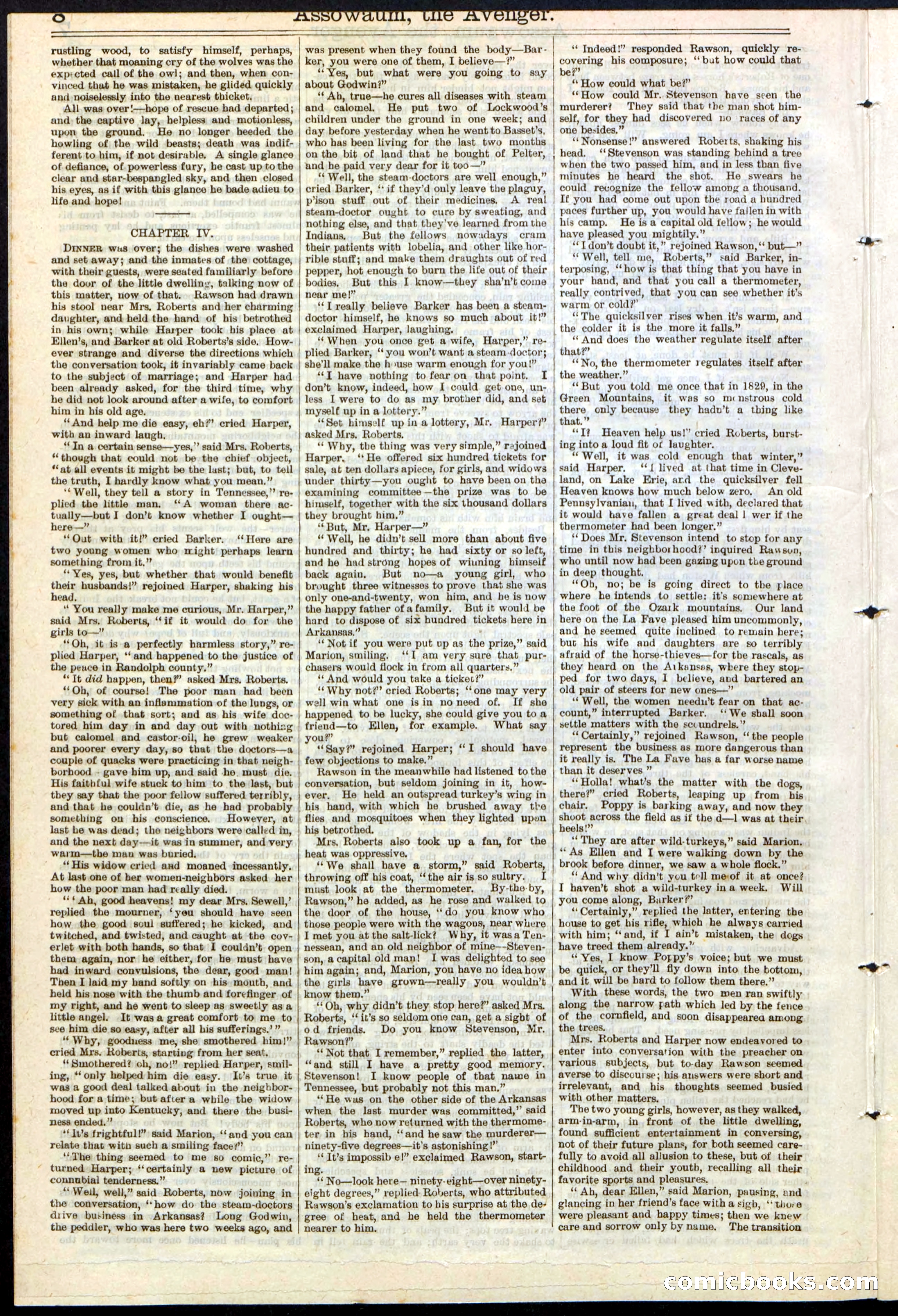
A restored page from Pulp Fiction, 1881. Page through the whole issue in the reader above.
📄 Transcribed text from this page (OCR, searchable)
Machine-transcribed from the original scan — historical spelling and the odd misread are preserved.
aa = rustling wood, to satisfy himself, perhaps, whether that moaning cry of the wolves was the exp:cted call of the owl; and then, when con- vinced that he was mistaken, he glided quickly and noiselessly into the nearest thicket. All was over!—hope of rescue bad departed; and the captive lay, belpless and motionless, upon the ground. He no longer heeded the howling of the wild beasts; death was indif- ferent to bim, if not desirable, A single glance of defiance, of powerless fury, be cast up to the clear and star-bespangled sky, and then closed his eyes, as if with this glance he bade adieu to life and hope! CHAPTER. IV. DINNER wus over; the dishes were washed and set away; and the inmates of the cottage, with their guests, were seated familiarly before the door of the little dwelling, talking now of this matter, now of that. Rawson had drawn his stool near Mrs, Roberts and her charming daughter, and held the hand of his betrothed in his own; while Harper took bis place at Ellen’s, and Barker at old Roberts’s side. How- ever strange and diverse the directions which the conversation took, it invariably came back to the subject of marriage; and Harper had been already asked, for the third time, why he did not look around after a wife, to comfort him in his old age. **And help me die easy, eh?’ cried Harper, with an inward laugh, “In a certain sense—yes,’’ said Mrs. Roberts, * though that could not be the chief object, “at all events it might be the lust; but, to tell the truth, I hardly know what you mean.” ‘* Well, they tell a story in Tennessee,’ re- plied the little man. “A woman there ac- tually—but I don’t know whether I ought— here—” ‘Out with it!” cried Barker. ‘Here are two young women who might perhaps learn something from it,” ‘* Yes, yes, but whether that would benefit oy husbands!” rejoined Harper, shaking his ead, “ You really make me curious, Mr. Harper,” said Mrs. Roberts, ‘‘if it would do for the girls to—” ‘Oh, it is a perfectly harmless story,” re- plied Harper, ‘and bappened to the justice of the peuce in Randolph county.” ‘Tt did happen, then?” asked Mrs, Roberts. ‘Oh, of course! The poor man had been very sick with an inflammation of the lungs, or something of that sort; and as his wife doc- tored him day in and day out with nothing but calomel and castor-oil, he grew weaker and poorer every day, so that the doctors—a couple of quacks were practicing in that neigh- borbood - gave him up, and said he. must die. His faithful wife stuck to him to the last, but they say that the poor fellow suffered terribly, and that he couldn’t die, as he had probably something on his conscience. However, at last he was dead; the neighbors were called in, and the next day——it was in summer, and very warm—tbe man was buried. ‘“*His widow cried and moaned incessantly, At last one of her women-neighbors asked her how the poor man had really died. *** Ah, good heavens! my dear Mrs, Sewell,’ replied the mourner, ‘yeu should have seen how the good soul suffered; he kicked, and twitched, and twisted, and caught at the cov- erlet with both hands, so that I couldn’t open them again, nor he either, for be must have had inward convulsions, the dear, good man! Then I laid my band softly on his mouth, and held his nose with the thumb and forefinger of my right, and he went to sleep as sweetly asa little angel. It was a great comfort to me to see him die so easy, after all his sufferings.’ ” ‘*Why, goodness me, she smothered him!” cried Mrs. Roberts, starting from her seat, ** Smothered? oh, no!” replied Harper, smil- ing, “‘ only helped him die easy. It’s true it was a good deal talked about in the neighbor- hood for a time; but after a while the widow moved up into Kentucky, and there the busi- ness ended.” ‘ Iw’s frightful!” said Marion, ‘‘and you can relate that with such a smiling face?’ ‘The thing seemed to me so comic,” re- turned Harper; ‘‘certainly a new picture of connubial tenderness.” “Weil, well,” said Roberts, now joiving in the conversation, ‘*how do the steam-doctors drive business in Arkansas? Long Godwin, the peddler, who was here two weeks ago, and JW aU, AVOCLYS - ee was present when they found the body—Bar- ker, you were one of them, I believe—?” “Yes, but what were you going to say about Godwin?” ‘* Ab, true—he cures all diseases with steam and calomel. He put two of Lockwood’s children under the ground in one week; and day before yesterday when he went to Basset’s, who bas been living for the last two months on the bit of land that he bought of Pelter, and he paid very dear for it too—” *‘ Well, the steam-doctors are well enough,” cried Barker, ‘if they’d only leave the plaguy, pison stuff out of their medicines, A real steam-doctor ought to cure by sweating, and nothing else, and that they've learned from the Indians, But the fellows nowadays cram their patients with lobelia, and other like hor- rible stuff; and make them draughts out of red pepper, hot enough to burn the life out of their bodies, But this I know—they sha’n’t come near me!” ‘‘T really believe Barker has been a steam- doctor himself, he knows so much about it!” exclaimed Harper, laughing. ‘When you once get a wife, Harper,” re- plied Barker, “‘ you won’t want a steam-doctor; she'll make the house warm enough for you!” ‘“‘T have nothing to fearon that point, I don’t know, indeed, how I could get one, un- less I were to do as my brother did, and set myself up in a lottery.” ‘Set himself up in a lottery, Mr. Harper?” asked Mrs, Roberts. ‘‘ Why, tbe thing was very simple,” rajoined Harper. ‘He offered six hundred tickets for sale, at ten dollars apiece, for girls, and widows under thirty—you ought to have been on the examining committee—the prize was to be himself, together with the six thousand dollars they brought him,” ‘* But, Mr, Harper—” “Well, he didn’t sell more than about five hundred and thirty; he had sixty or so left, and he had strong hopes of wiuning bimseif back again, But no—a young girl, who brought three witnesses to prove that she was only one-and-twenty, won him, and he is now the happy father ofafamily. But it would be hard to dispose of six hundred tickets here in Arkansas,” ' ‘‘ Not if you were put up as the prize,” said Marion, smiling. ‘‘I am very sure that pur- chasers would flock in from all quarters,” ‘‘ And would you take a ticket?” ‘Why not?’ cried Roberts; ‘‘one may very well win what one isin noneed of. If shoe happened to be lucky, she could give you toa friend—to Ellen, for example. What say you?” “Say?” rejoined Harper; ‘“‘I should have few objections to make,” Rawson in the meanwhile had listened to the conversation, but seldom joining in it, how- ever. He held an outspread turkey’s wing in his hand, with which he brushed away tte flies and mosquitoes when they lighted upon his betrothed. Mrs, Roberts also took up a fan, for the heat was oppressive. ‘‘We shall have a storm,” said Roberts, throwing off his coat, “the air isso sultry. I must look at the thermometer. By-the-by, Rawson,” he added, as he rose and walked to the door of the house, ‘‘do you know who those people were with the wagovs, near where I met you at the salt-lick? Why, it wasa Ten- nessean, and an old neighbor of mine—-Steven- son, a capital old man! I was delighted to see him again; and, Marion, you have no idea how the girls have grown—really you wouldn’t know them.” ‘‘Oh, why didn’t they stop here?” asked Mrs. Roberts, ‘it’s so seldom one can, get a sigbt of od friends. Do you know Stevenson, Mr. Rawson?” ** Not that I remember,” replied the latter, “and still I have a pretty good memory. Stevenson! I know people of that nawe in Tennessee, but probably not this man,” ‘‘He was on the other side of the Arkansas when the last murder was committed,” said Roberts, who now returned with the thermome- ter in bis hand, ‘‘and he saw the murderer— ninety-five degrees—it's astonishing!”’ ‘« It’s impossib e!” exclaimed Rawson, start- ing. ‘‘ No—look here— ninety-eight—over ninety- eight degrees,” replied: Roberts, who attributed Rawson’s exclamation to his surprise at the de- gree of beat, and he held the thermomete nearer to him. a a a i a re OO Ee ————————— Se eee eee ag... eee ** Indeed!” responded Rawson, quickly re- covering his composure; ‘‘ but how could that be?’ ‘* How could what be?” ‘‘How could Mr. Stevenson have seen the murderer? They said that the man shot bim- self, for they had discovered no races of any one besides,” ‘* Nonsense!” answered Roberts, shaking his head. ‘Stevenson was standing behind a tree when the two passed him, and in less than five minutes he heard the shot. He swears he could recognize the fellow among a thousand. If you had come out upon the road a hundred paces further up, you would have failen in with his camp. He is a capital old fellow; he would have pleased you mightily.” ‘1 don’t doubt it,” rejoined Rawson, ‘‘ but—” ** Well, tell me, Roberts,” said Barker, in- terposing, “how is that thing that you have in your hand, and that you call a thermometer, really contrived, that you can see whether it’s warm or cold?’ “The quicksilver rises when it’s warm, and the colder it is the more it falls,” ‘‘And does the weather regulate itself after that?” ‘‘No, the thermometer regulates itself after the weather,” ‘But you told me once that in 1829, in the Green Mountains, it was so mcnstrous cold there only because they hadv’t a thing like that.” “T? Heaven help us!” cried Roberts, burst- ing into a loud fit of laughter. “Well, it was cold enough that winter,” said Harper. ‘‘I lived at that time in Cleve- land, on Lake Erie, ard the quicksilver fell Heaven knows how much below zero, An old Pennsylvanian, that I lived with, declared that it would have fallen a great deal | wer if the thermometer had been longer.” ‘Does Mr. Stevenson intend to stop for any time in this neighborhood?’ inquired Rawsvno, who until now had been gazing upon the ground in deep thought. “Ob, no; be is going direct to the place where he intends to settle: it’s somewhere at the foot of the Ozark mountains, Our land here on the La Fave pleased him uncommonly, and he seemed quite inclined to remain here; but his wife and daughters are so terribly afraid of the horse-thieves—for tbe rascals, as they heard on the Aikanses, where they stop- ped for two days, I believe, and bartered an old pair of steers for new ones—” ‘‘ Well, the women needu’t fear on that ac- count,” interrupted Barker. ‘‘ We shall soon settle matters with the sccundrels.”’ “Certainly,” rejoined Rawson, ‘the people represent the business as more dangerous than it really is. The La Fave has a far worse name than it deserves ” ‘Holla! what’s the matter with the dogs, there?” cried Roberts, leaping up from bis chair. Poppy is barking away, and now they shvot across the field as if the d—1 was at their. heels!” ‘They are after wild-turkeys,” said Marion, ‘As Ellen and I were walking down by the brook before dinner, we saw a whole flock.” “And why didn’t you tell meof it at once? I haven’t shot a wild-turkey ina week, Will you come along, Burker?’ “Certainly,” replied the latter, entering the house to get his rifle, which he always carried with him; “and, if I ain’t mistaken, the dogs have treed them already.” “Yes, I know Poppy’s voice; but we must be quick, or they’ll fly down into the bottom, and it will be bard to follow them there.” With these words, the two men ran swiftly along the narrow path which led by the fence of the cornfield, and soon disappearea among the trees. Mrs. Roberts and Harper now endeavored to enter into conversation with the preacher on various subjects, but to-day Rawson seemed averse to discourse; his auswers were short and irrelevant, and his thoughts seemed busied with other matters. The two young girls, however, as they walked, arm-in-arm, in front of the little dwelling, found sufficient entertainment in conversing, not of their future plans, for both seemed care- fully to avoid all allusion to these, but of their childhood and their youth, recalling all their favorite sports and pleasures. “ Ah, dear Ellen,” said Marion, pausing, and glancing in her friend’s face witha sigb, ‘‘thore were pleasant and happy times; then we knew care and sorrow only by name. The transition -¢~ OMAK OO) (E SS (E(0)