
Pulp Fiction, 1881 · page 9 of 24
Beadle's New York Dime Library No. 124 — page 9: what you’re looking at
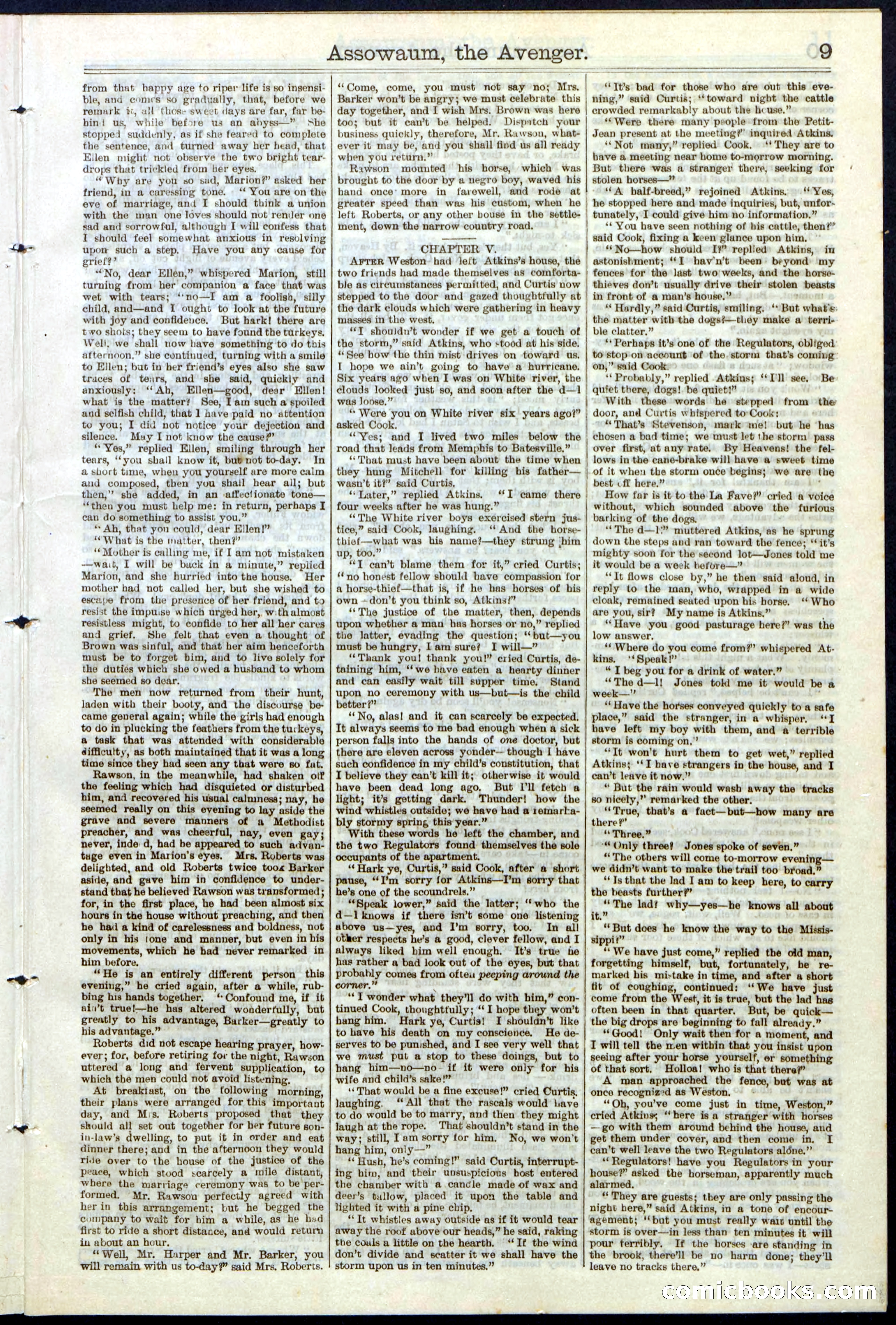
A restored page from Pulp Fiction, 1881. Page through the whole issue in the reader above.
📄 Transcribed text from this page (OCR, searchable)
Machine-transcribed from the original scan — historical spelling and the odd misread are preserved.
LL as ee —— ee from that happy age to riper life is so insensi- ble, and comes so gradually, that, before we remark it, all thos+ sweet days are far, far be- bin! us, while before us an abyss—” she stopped suddenly, as if she feared to complete the sentence, and turned away her head, that Ellen might not observe the two bright tear- drops that trickled from her eyes. “Why are you so sad, Marion?’ asked her friend, in a caressing tone. “‘ You are on the eve of marriage, and I should think a union with the man one loves should not render one sad and sorrowful, although I will confess that I should feel somewhat anxious in resolving upon such a step. Have you any cause for grief?’ “No, dear Ellen,” whispered Marion, still turning from her companion a face that was wet with tears; ‘‘no—I am a foolish, silly child, and—and I ought to look at the future with joy and confidence. But hark! there are two shots; they seem to have found the turkeys. Well, we shall now have something to do this afternoon,” she continued, turning with a smile to Ellen; but in ber friend’s eyes also she saw truces of teurs, and she said, quickly and anxiously: ‘‘Ah, Ellen—good, dear Hilen! what is the matter¢ See, Iam such a spoiled and selfish child, that 1 have paid no attention to you; I did not notice your dejection and silence. Muy I not know the cause?” “Yes,” replied Ellen, smiling through her tears, ‘you sball know it, butnot to-day. In a short time, when you yourself are more calm aud composed, then you shall hear all; but then,’’ she added, in an affectionate tone— “then you must lLelp me: in return, perhaps I can do something to assist you.” * Ah, that yon could, dear Ellen!” ‘What is the matter, then?’ ‘* Mother is calling me, if I am not mistaken -——wait, I will be buck in a minute,” replied Marion, and she hurried into the house. Her mother had not called her, but she wished to escape from the presence of ber friend, and to resist the impuise which urged her, with almost resistless might, to confide to her all her cares and grief. She felt that even a thought of Brown was sinful, and that ber aim henceforth must be to forget bim, and to live solely for the duties which she owed a husband to whom she seemed so dear. | The men now returned from their hunt, laden with their booty, and the discourse be- came geveral again; while the girls had enough to do in plucking the feathers from the turkeys, a task that was attended with considerable difficulty, as both maintained that it was a long time since they had seen any that were so fat. Rawson, in the meanwhile, had shaken olf the feeling which had disquieted or disturbed him, and recovered his usual calmness; nay, he seemed really on this evening to lay aside the grave and severe manners of g Methodist preacher, and was cheerful, nay, even gay; never, inde d, had be a advan- tuge even in Marion's eyes. Mrs. Roberts was delighted, and old Roberts twice too« Barker aside, and gave him in confidence to under- stand that he believed Rawson was transformed ; for, in tho first place, he had been almost six hours in the house without preaching, and then he had a kind of carelessness and boldness, not only in his tone and manner, but even in bis movements, which he bad never remarked in him before. “He is an entirely different person this evening,” he cried again, after a while, rub- bing his hands together. ‘Confound me, if it ain’t true!—he has altered wonderfully, but greatly to his advantage, Barker—greatly to his advantage.” Roberts did not escape hearing prayer, how- ever; for, before retiring for the night, Rawson uttered a long and fervent supplication, to which the men could not avoid listening, At breaktast, on the following morning, their plans were arranged for this important day, and Mis. Roberts proposed that they should all set out together for her future gon- in-law’s dwelling, to put it in order and eat dinner there; and in the afternoon they would ride over to the house of the justice of the peace, which stood scarcely a mile distant, where the marriage ceremony was to be per- formed. Mr. Rawson perfectly agreed with her in this arrangement; but he begged the company to wait for him a while, as he hed first to ride a short distance, and would return in about an hour, “Well, Mr. Harper and Mr. Barker, you will remain with us to-day?” said Mrs. Roberts. Assowaum, the Avenger. ‘Come, come, you must not say no; Mrs, Barker won't be angry; we must celebrate this day together, and I wish Mrs. Brown was here too; but it can’t be helped. Dispatch your business quickly, therefore, Mr. Rawson, what- ever it may be, and you shall find us all ready when you return.” Rawson mounted his horse, which Was brought to the door by a negro boy, waved his band once’ more in farewell, and rode at greater speed than was his custom, when he left Roberts, or any other bouse in the settle- ment, down the narrow country road, CHAPTER V. Arter Weston had left Atkins’s house, the two friends had made themselves as comforta- ble as circumstances permitted, and Curtis now stepped to the door and gazed thoughtfully at the dark clouds which were gathering in heavy masses in the west. “T shouldn’t wonder if we get a touch of the storm,” said Atkins, who stood at his side. ‘See how the thin mist drives on toward us, I hope we ain’t going to have a hurricane. Six years ago when [ was on White river, the clouds looked just so, and soon after the d—1 was loose.” | “ Were you on White river six years ago?” asked Cook. “Yes; and I lived two miles below the road that leads from Memphis to Batesville,” “That must have been about the time when they hung Mitchell for killing his father— wasn’t it?” said Curtis, ‘‘Later,” replied Atkins. ‘I came there four weeks after he was hung.” ‘“‘The White river boys exercised stern jus- tice,” said Cook, laughing. ‘' And the horse- thief—what was bis name?—they strung him up, too.” ‘*T can’t blame them for it,” cried Curtis; ‘*no honest fellow should have compassion for a horse-thief—that is, if he bas horses of bis own «don’t you think so, Atkins?” ‘*The justice of the matter, then, depends upon whether a man has horses or no,” replied the latter, evading the question; ‘ but—you must be hungry, Lam sure? I will—” “Thank you! thank you!” cried Curtis, de- taining him, ‘“‘we have eaten a hearty dinner and can easily wait till supper time, Stand upon no ceremony with us—but—is the child better?” ‘No, alas! and it can scarcely be expected. It always seems to me bad enough when a sick person falls into the hands of one doctor, but there are eleven across yonder-- though I have such confidence in my child’s constitution, that I believe they can’t kill it; otherwise it would have been dead long ago, But I'll fetch a light; it’s getting dark. Thunder! how the wind whistles outside; we have had a 1emart-a- bly stormy spring this year.” With these words he left the chamber, and the two Regulators found themselves the sole occupants of the apartment. ‘“‘Hark ye, Curtis,” said Cook, after a short pause, “I’m sorry for Atkins—I’m sorry that he’s one of the scoundrels,” “Speak lower,” said the latter; ‘“who the d—1 knows if there isn’t some one listening ubove us—yes, and I’m sorry, too. In all other respects he’s a good, clever fellow, and I always liked him well enough. It’s true he has rather a bad look out of the eyes, but that probably comes from ofteu peeping around the corner.” , ‘“*T wonder what they’ll do with him,” con- tinued Cook, thoughtfully; “‘ I hope they won’t bang him. Hark ye, Curtis! I shouldn't like to have his death on my conscience. He de- serves to be punished, and I see very well that we must put a stop to these doings, but to hang him—no—no- if it were only for his wife and child’s sake!” ‘‘That would be a fine excuse!” cried Curtis. laughing. “All that the rascals would have to do would be to marry, and then they might laugh at the rope. That shouldn’t stand in the way; still, Tam sorry for him, No, we won't hang him, only—” ‘Hush, he’s coming!” said Curtis, interrupt- ing bim, and their unsuspicious host entered the chamber with a candle made of wax and deer’s tullow, placed it upon the table and lighted it with a pine chip. “It whistles away outside as if it would tear away the roof above our heads,” he said, raking the couls a little on the hearth. “If the wind don’t divide and scatter it we shall have the storm upon us in ten minutes,” + ee ome eo ee ee te ee er ee eee 9 ‘It’s bad for those who are out this eve- ning,” said Curtis; ‘‘toward night the cattle crowded remarkably about the house,” ‘Were there many people from the Petit- Jean present at the meeting?’ inquired Atkins. ‘‘Not many,” replied Cook, ‘' They are to bave a meeting near home to-morrow morning. But there was a stranger there, seeking for stolen horses—” ‘*A balf-breed,” rejoined Atkins. ‘Yes, he stopped here and made inquiries, but, unfor- tunately, I could give him no information.” ‘* You have seen nothing of bis cattle, then?” said Cook, fixing a keen glance upon him. ** No—how should I?” replied) Atkins, in astonishment; “I hav'n’t been» beyond my fences for the last two weeks, and the horse- thieves don’t usually drive their stolen beasts in front of a man’s house,” “ Hardly,” said Curtis, smiling. ‘“* But what's. the matter with the dogs/—they make a terri- ble clatter.” ** Perhaps it’s one of the Regulators, obliged to stop on aceount of the. storm that's coming: on,” said Cook. ‘* Probably,” replied Atkins; ‘I'l see. Be: quiet there, dogs! be quiet!” With these words he stepped from the door, and Curtis whispered to Cools: “That’s Stevenson, mark me! but he ‘has chosen a bad time; we urust let the storm pass over first, at any rate. By Heavens! the fel- lows in the cane-brake will have a sweet time of it when the storm once begins; we are the best ff here.” nae How far is it to the La Fave?” cried a voice without, which sounded above the furious barking of the dogs. “The d—l” muttered Atkins, as he sprung down the steps and ran toward the fence; “it’s mighty soon for the se¢ond lot—Jones told me it would be a week bhefure—” “It flows close by,” he then said aloud, in reply to the man, who, wrapped in a wide cloak, remained seated upon his horse. ‘ Who are you, sir? My name is Atkins.” . ‘‘Have you good pasturage here?” was the low answer. ** Where do you come from?” whispered At- kins. ‘‘Speak!” “I beg you for a drink of water.” “The d—l! Jones tokd me it would be a week—”’ , ‘** Have the horses conveyed quickly to a safe place,” said the stranger, in a whisper, ‘I have left my boy with them, and a terrible storm is coming on,” “It won't hurt them to get wet,” replied Atkins; ‘‘I bave strangers in the house, and I can’t leave it now.” “ But the rain would wash away the tracks 80 nicely,” remarked the other. “True, that’s a fact—but—how many are there?” “Three.” “Only threef Jones spoke of seven,” “The others will come to-morrow evening— we didn’t want to make the trail too broad, ‘* Is that the Iad I am to keep here, to carry the beasts further?” The lad? why—yes—he knows all about t. “But does he know the way to the Missis- ** We have just come,” replied the old man, forgetting himself, but, fortunately, be re- marked his mistake in time, and after a short tit of coughing, continued: ‘‘We have just come from the West, it is true, but the lad has often been in that quarter, But, be quick— the big drops are beginning to fall already.” “Good! Only wait then for a moment, and I will tell the men within that you insist upon seeing after your horse yourself, er something of that sort. Holloa! who is that there?’ A man approached the fence, but was at once recognized as Weston, : “Oh, you’ve come just in time, Weston,” cried Atkins; “here is a stranger with horses —go with them around behind the house, and get them under cover, and then come in. I can’t well leave the two Regulators aldne.”’ ‘“Regulators! have you Regulators in your house?” asked the horseman, apparently much alarmed. “They are guests; they are only passing the night here,” said Atkins, in a tone of encour- agement; ‘bat you must really waic until the storm is over—in less than ten minutes it will pour terribly. If the horses are standing in the brook, there'll be no harm done; they’ll leave no tracks there,” COMMIE OOO) KS 5